

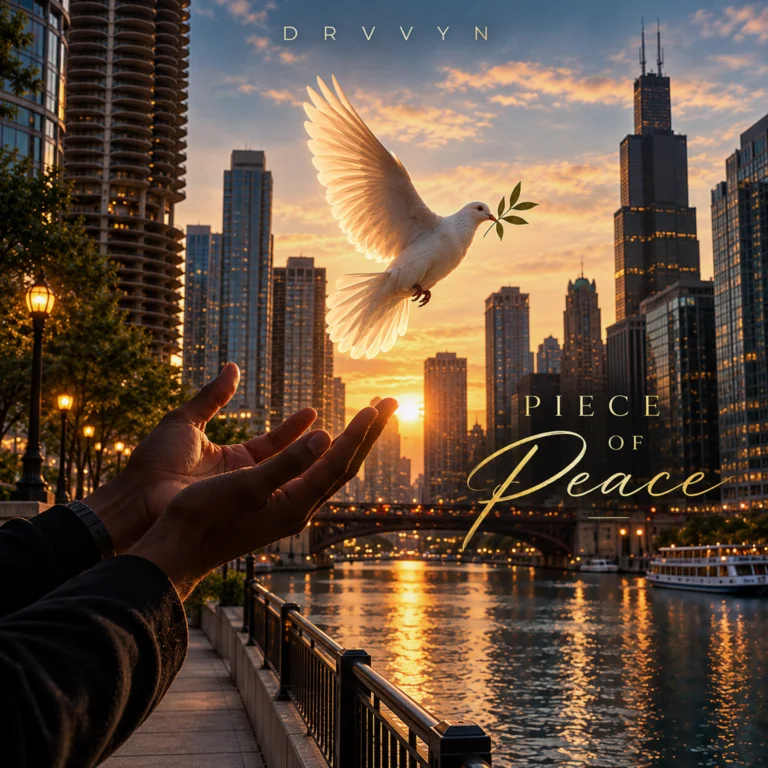
Official Video
Piece of Peace by DRVVYN is a reflective, cinematic R&B song about letting go of the need to control everything and learning how to find calm without waiting for the world around you to become quiet first.
The song is built around a simple but powerful idea:
Peace does not always come from changing your circumstances. Sometimes it comes from changing the way you carry them.
At the center of Piece of Peace is the moment when resistance finally begins to soften.
You stop fighting every outcome.
Stop chasing answers that may never come.
Stop believing that peace is something waiting for you once every problem is solved.
The world continues moving.
Storms still come.
Loss still happens.
Life still refuses to follow a perfect plan.
But something inside begins to settle.
That shift is what the song captures.
The title itself carries a double meaning.
A piece of peace can be something small—one moment of stillness, one breath, one night where the mind finally slows down.
But the narrator eventually realizes that peace is not only something to search for.
He can become part of it.
He can become the piece of peace he needs.
That turns the song from a meditation on calm into a statement of self-empowerment.
Meaning
At its core, Piece of Peace is about accepting that life cannot always be controlled.
The opening lyric:
“We need peace / Just a little piece”
immediately makes the idea feel human and attainable.
The narrator is not asking for a perfect life.
He is asking for enough peace to keep moving.
That matters because the song does not treat peace as something absolute.
It begins small.
A little space.
A little quiet.
A little relief.
The first verse introduces one of the song’s central truths:
“Storms will come / And storms will go.”
Difficulty is presented as part of life rather than something that can be completely eliminated.
The narrator has learned this through experience.
“I’ve learned to bend / I’ve learned to grow.”
The imagery suggests resilience without rigidity.
Bending does not mean breaking.
It means adapting.
Learning how to survive what cannot be stopped.
The next lines deepen that idea:
“The world still hums / The night still sighs / But I found my calm within my mind.”
The outside world has not changed.
The noise remains.
The darkness remains.
But the narrator’s relationship to it has changed.
That is the true turning point of the song.
Peace is no longer dependent on external silence.
It has become internal.
The chorus makes that realization explicit:
“I made peace with what I see / Within love, and loss, and me.”
This is not only acceptance of the world.
It is acceptance of the self.
Love.
Loss.
Mistakes.
Growth.
Identity.
The narrator is learning to hold all of it without needing every part to be resolved.
Then comes the central line:
“If I can’t change the world, I’ll be — / The piece of peace I need.”
This transforms the message from passive acceptance into empowerment.
The narrator is not giving up.
He is choosing where to place his energy.
If the world cannot be controlled, then he can still control the way he responds to it.
That is not surrender.
It is perspective.
HIDDEN DETAILS
The production of Piece of Peace is designed to feel weightless.
Nothing is meant to overpower the listener.
The textures stay soft.
The rhythm flows instead of driving aggressively.
The arrangement creates movement without urgency.
That production choice mirrors the song’s message.
The track does not force peace.
It creates space for it.
There is also a subtle sense of lift throughout the arrangement.
As the song progresses, elements begin to open rather than stack heavily.
The sound feels wider.
More breathable.
The emotional effect is not pressure building.
It is pressure releasing.
That distinction is important.
Many songs build toward intensity.
Piece of Peace builds toward openness.
Even the transitions avoid sharp tension.
They move smoothly from one section to the next, reinforcing the feeling that the narrator is learning not to resist every change.
The production itself begins to behave like the philosophy of the lyrics.
Nothing is gripping too tightly.
Nothing is demanding control.
Everything is allowed to move.
The track is not trying to overwhelm the listener.
It is trying to settle them.
Themes
Inner Peace
Inner peace is the central theme of the song.
The narrator gradually realizes that calm cannot always depend on external circumstances.
The world may remain noisy.
Life may remain uncertain.
But there can still be a quiet place inside.
The line:
“I found my calm within my mind”
captures that shift directly.
Peace becomes an internal practice rather than an external destination.
Acceptance of Life’s Challenges
The song does not deny difficulty.
It acknowledges it openly.
“Storms will come / And storms will go.”
Challenges are temporary, but they are inevitable.
The narrator stops treating every difficult season as proof that something has gone wrong.
Instead, he learns to move through it.
Acceptance becomes a form of strength.
Self-Empowerment
The most empowering idea in the song appears in:
“If I can’t change the world, I’ll be — / The piece of peace I need.”
The narrator stops waiting for the world to give him calm.
He chooses to create it.
That shift restores agency.
He may not control everything.
But he still has influence over how he lives within it.
Letting Go of Control
Control is one of the deeper themes beneath the lyrics.
People often chase peace by trying to fix every variable.
Every relationship.
Every problem.
Every uncertainty.
The song suggests that peace may begin when that need loosens.
Letting go does not mean becoming careless.
It means recognizing the limits of control.
Resilience
“I’ve learned to bend / I’ve learned to grow”
captures the song’s version of resilience.
Strength does not always look like standing rigidly against the storm.
Sometimes strength is flexibility.
Adapting.
Learning.
Growing.
Remaining intact without needing to remain unchanged.
Release
The second verse introduces emotional release:
“I’ve fought the fire / And chased the rain / Released my hurt / With all the pain.”
The narrator is no longer carrying every wound as though holding onto it will somehow change what happened.
Release becomes part of healing.
Pain is acknowledged.
Then allowed to move.
Love and Loss
The chorus places love and loss beside each other:
“Within love, and loss, and me.”
The song does not separate the good from the painful.
Both are part of life.
Both shape the narrator.
Peace comes from learning how to accept the whole story rather than only the parts that feel comfortable.
Self-Acceptance
The inclusion of “me” in the chorus matters.
The narrator is not only making peace with circumstances.
He is making peace with himself.
That can mean accepting flaws.
Mistakes.
Limitations.
Past decisions.
Growth.
Peace becomes partly about ending the internal war against who you are.
Emotional Freedom
The lyric:
“The noise fades out / The air feels free”
suggests emotional release.
The world may still be turning, but the narrator is no longer carrying it in the same way.
That lightness creates freedom.
Hope
Hope runs through the song without becoming unrealistic.
The message is not that darkness disappears.
Instead:
“Shine through it anyway.”
That is a more grounded kind of hope.
Not waiting for perfect conditions.
Choosing light while darkness still exists.
Ending the Inner Conflict
The bridge delivers one of the clearest emotional resolutions:
“No more war inside of me / Just love, just light, just peace.”
The greatest conflict in the song was never entirely external.
It was internal resistance.
Fear.
Pain.
The need to control.
The narrator’s final peace comes from ending that internal fight.
Perspective
The song repeatedly reframes difficulty.
Storms become temporary.
Darkness becomes something light can exist within.
Loss becomes part of a larger life.
Perspective becomes a tool for survival.
Growth
The narrator does not return to who he was before hardship.
He grows through it.
That distinction matters.
The song is not about undoing pain.
It is about becoming someone who carries it differently.
Mood
Piece of Peace carries a mood of peace, love, reflection, hope, and empowerment.
The song feels:
- Peaceful
- Reflective
- Hopeful
- Empowering
- Warm
- Soulful
- Cinematic
- Meditative
- Healing
- Gentle
- Spiritual
- Grounded
- Inspirational
- Open
- Restorative
- Calm
- Bittersweet
- Reassuring
The song feels like finally sitting down after carrying something heavy for too long.
Like realizing you do not need one more answer tonight.
Like watching a storm move farther into the distance.
Like taking a deep breath and noticing that you are no longer holding tension in your chest.
Like accepting that some things may remain unresolved and discovering that you can still be okay.
That is where the song finds its strength.
It is not about escaping reality.
It is about becoming more grounded inside it.
The world still turns.
The noise still exists.
Darkness still comes.
But the narrator no longer believes that peace must wait until all of those things disappear.
Instead, he becomes the calm within them.
That is what makes Piece of Peace feel empowering rather than passive.
The song does not say:
Nothing matters.
It says:
Not everything deserves control over me.
And that difference changes everything.
By the end, peace is no longer something distant.
It is something practiced.
Something chosen.
Something carried.
Something the narrator creates from within.
If the world cannot be made quiet, he can still become quieter inside it.
If the darkness remains, he can still choose light.
If everything cannot be changed, he can still change the way he holds it.
And sometimes that is the piece of peace that matters most.
Lyrics
We need peace
Just a little piece
Storms will come
And storms will go
I've learned to bend
I've learned to grow
The world still hums
The night still sighs
But I found my calm within my mind
I made peace with what I see
Within love, and loss, and me
If I can't change the world, I'll be —
The piece of peace I need
I've fought the fire
And chased the rain
Released my hurt
With all the pain
The noise fades out
The air feels free
The world still turns
And so do we
I made peace with what I see
Within love, and loss, and me
If I can't change the world, I'll be —
The piece of peace I need
If night come, let it stay
Shine through it anyway
Lift up higher, let it go
Feel the dark begin to glow
No more war inside of me
Just love, just light, just peace
If I can't change, the piece of peace i need
If I, the piece of peace I need
If I can't change the world, I'll be —
More from 12 Ways to Disappear
 12 WaysDRVVYNHaunted By YouDRVVYN
 Lost In Her RhythmDRVVYNTake Another PullDRVVYN
 Glass VeinsDRVVYNHollow HeavenDRVVYN
 Broken HalosDRVVYN
 Scars UnseenDRVVYN
 Light Left BehindDRVVYNFade Into MeDRVVYN
 Naked SoulDRVVYN