

Listening & Culture
Spotify vs YouTube Music Discovery
Spotify vs YouTube Music discovery feels different in real life. Here’s where each platform finds your next song, mood, and late-night repeat.
By DRVVYN · · 7 min read
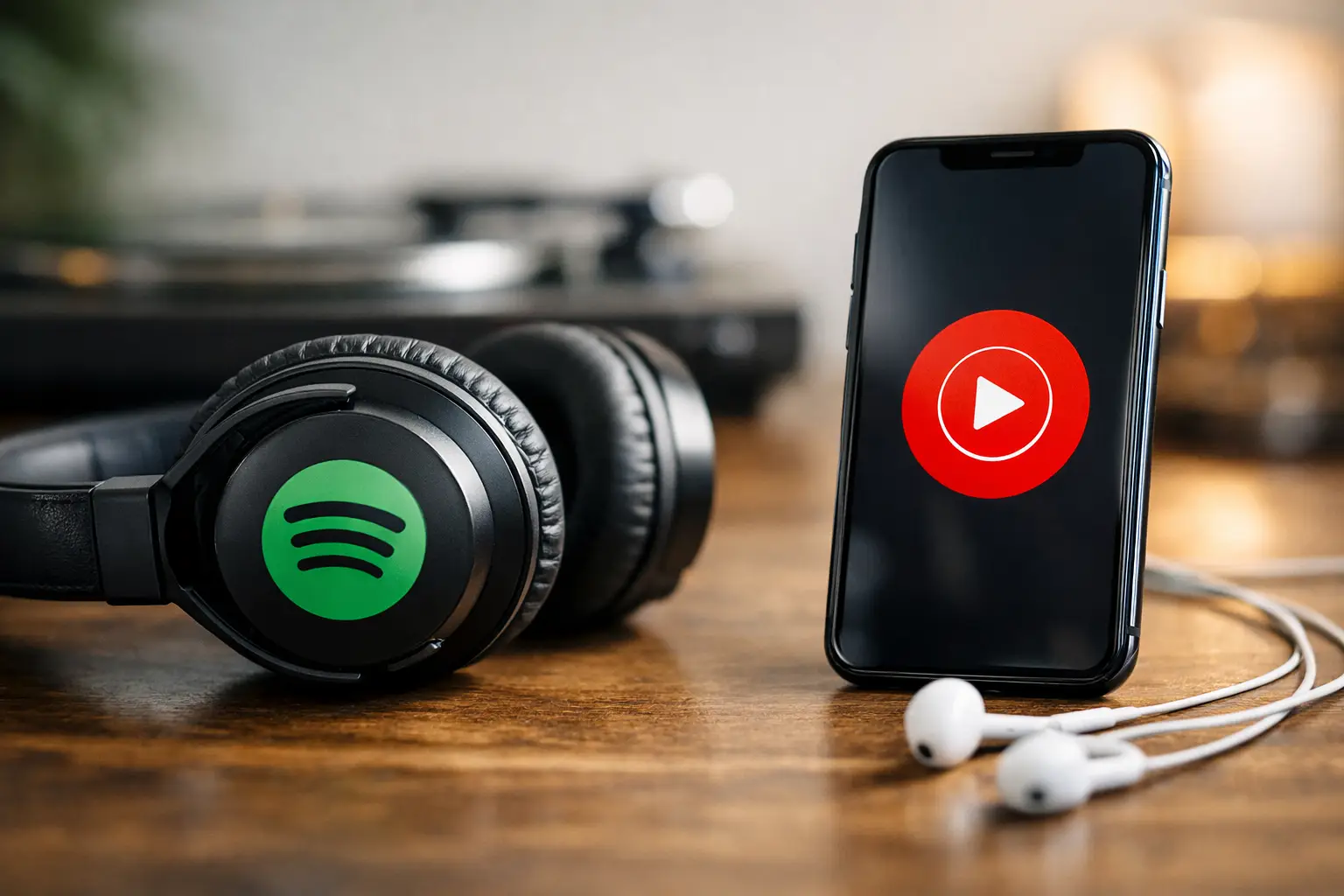
Some nights, Spotify knows exactly what to do with you. Other nights, YouTube Music pulls up a live version, a slowed edit, or a forgotten upload that hits harder than the official release ever did. That’s really the center of spotify vs youtube music discovery – not which app has better tech, but which one understands the way you actually find music when you’re looking for a feeling.
If you use music as atmosphere, not background, the difference matters. Discovery is not just about getting shown something new. It’s about getting shown the right thing at the right hour, in the right emotional temperature.
Spotify vs YouTube Music discovery: two different instincts
Spotify feels structured. It learns your patterns, notices what you replay, and builds a world around your habits. Its recommendations often arrive polished and organized, shaped into playlists, radio stations, and algorithmic mixes that feel intentional. For listeners who want discovery with a sense of flow, that can feel reassuring.
YouTube Music is looser. It carries the energy of the wider YouTube ecosystem, which means discovery can come from official releases, fan uploads, live clips, visualizers, remixes, and tracks that never really belonged to a traditional streaming lane. It can feel messier, but also more alive.
That split says a lot. Spotify is usually better at refining your taste. YouTube Music is often better at expanding it.
When Spotify gets it right
Spotify is strong when your listening habits already point toward a clear lane. If you spend weeks inside moody alt-R&B, ambient trap, or late-night electronic textures, it tends to tighten the thread. Discover Weekly, Release Radar, artist radio, and dayparted mixes often keep feeding that same emotional zone without forcing a sharp turn.
There’s a reason people trust it during routine listening. Spotify understands repetition. It notices the songs you return to when you’re driving alone, writing, decompressing, or trying to stay inside a certain state. Over time, that memory becomes useful. It can make the platform feel less like a library and more like a mirror.
But there’s a trade-off. Spotify can get too comfortable. Once it decides who you are, it sometimes keeps recommending cleaner versions of the same mood. The songs may be good. They may even fit. But discovery can start feeling narrow, like you’re circling a familiar room instead of finding a new one.
For listeners who want subtle variation inside a specific atmosphere, that’s fine. For listeners chasing surprise, it can feel a little overmanaged.
Where YouTube Music feels more human
YouTube Music has a different kind of memory. It is shaped not just by songs, but by behavior across video culture. That changes the feeling of discovery.
You can search one track and end up in a chain of unofficial uploads, acoustic takes, old performance clips, region-specific releases, and edits that people passed around before streaming platforms caught up. It can feel less curated in the formal sense, but more connected to how music actually moves through people.
That matters if your taste lives outside neat genre lines. Maybe you like polished releases, but also obscure freestyles, cinematic instrumentals, and songs with visual context that changes how they land. YouTube Music is often better at picking up those edges. It understands that discovery is not always about the official single. Sometimes it’s about the version that found you first.
Its weakness is consistency. YouTube Music can feel uncanny one day and random the next. Because it pulls from such a broad environment, it doesn’t always preserve mood as carefully as Spotify does. If you want a long stretch of emotionally coherent listening, that unpredictability can break the spell.
The algorithm versus the rabbit hole
This is probably the clearest way to think about it.
Spotify discovery is algorithm first. The platform studies your behavior and delivers recommendations in a controlled way. Even when it surprises you, the surprise is usually shaped. You feel guided.
YouTube Music discovery still uses recommendation systems, of course, but it also benefits from the rabbit hole effect. One click leads to another. One visual leads to a memory. One live session opens up a whole side of an artist you never would have found through standard DSP sorting. You feel pulled rather than guided.
Neither is inherently better. It depends on how you listen.
If your ideal session is cohesive, fluid, and low-friction, Spotify usually has the edge. If your ideal session is curious, layered, and slightly unplanned, YouTube Music can be more rewarding.
Spotify vs YouTube Music discovery for mood listeners
For mood-driven listeners, the real question is not catalog size or interface polish. It’s whether the platform can hold a state.
Spotify is excellent at maintaining one. Its playlists and recommendation clusters tend to preserve tone. If you start in nocturnal R&B, dusky electronica, or introspective indie pop, it will usually keep the lights low. That makes it strong for long listening sessions where you want the music to stay emotionally accurate.
YouTube Music is better when the mood is less static. Maybe you start reflective, then drift into cinematic, then into something rawer and more devotional. It can follow that kind of emotional curve because it is less rigid about format. A song can turn into a live version, then into a visual performance, then into a deep cut from years ago. For some listeners, that feels closer to real life.
This is where platforms start revealing their personality. Spotify protects the atmosphere. YouTube Music tests it.
Discovery for artists and emerging sound
There’s another layer here. The platform you use shapes what kind of artists you encounter.
Spotify tends to reward songs that fit well into listening environments. If a track slides naturally into playlists, radio, and recommendation loops, it has more room to surface. That can be great for artists making emotionally clear, playlist-friendly work. It also means some music arrives to you already filtered through a system that values fit.
YouTube Music gives more space to context. Visual identity, performance clips, fan activity, and search behavior can all pull an artist into view. That creates more room for artists whose world matters as much as the song itself. If the music carries a visual or emotional universe around it, YouTube can deepen discovery in a way audio-only platforms sometimes can’t.
For a brand like DRVVYN Sound, where mood, continuity, and visual atmosphere matter, that distinction is real. Some listeners first connect through a song. Others connect through a whole feeling around it. Different platforms catch different entry points.
So which one actually discovers better?
If by better you mean more precise, Spotify usually wins. It is cleaner, steadier, and better at turning your listening history into a dependable stream of songs that match your taste.
If by better you mean more expansive, YouTube Music often wins. It is more likely to surface alternate versions, unexpected corners, and music that exists beyond the clean architecture of streaming catalogs.
If by better you mean more emotionally accurate, it depends on the moment.
Spotify is better for staying inside a mood. YouTube Music is better for chasing one.
That difference sounds small until you feel it. Staying inside a mood is what you want when you need the music to hold you together. Chasing one is what you want when you’re trying to find the song that says what you couldn’t.
The best use of both
A lot of serious listeners end up using both platforms differently, even if they pay for only one. Spotify becomes the place for daily rhythm, trusted playlists, and refined recommendations. YouTube Music becomes the place for edges – rare finds, visual context, alternate takes, and songs that arrive through curiosity instead of routine.
That’s not indecision. It’s just honest listening.
Music discovery has never been a pure algorithm problem. It’s emotional. Sometimes you want the platform that knows you. Sometimes you want the platform that surprises you with a version of yourself you hadn’t reached yet.
The best choice is the one that gets you closer to that moment when the room changes, your thoughts quiet down, and a song feels less like content and more like recognition.
Pick the platform that meets you there, then leave a little space for the other one to catch you off guard.