

Listening & Culture
12 Best Atmospheric Music Artists for Late Nights
A late-night guide to the best atmospheric music artists, from ambient architects to shadowy voices that turn silence, memory, and motion into sound.
By DRVVYN · · 6 min read
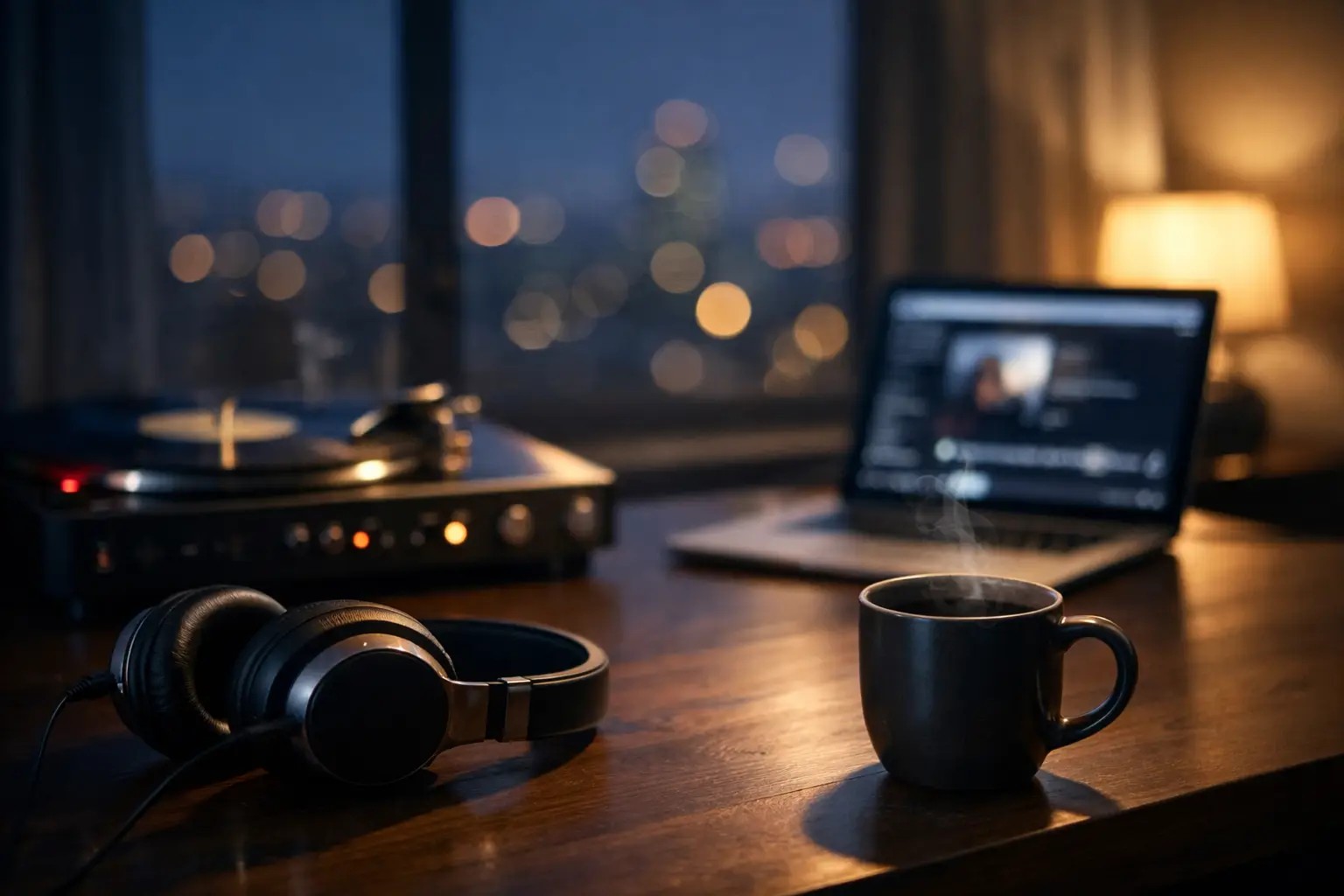
Some music fills a room. Other music changes the room entirely.
The best atmospheric music artists understand that difference. They make sound for the hour when the city has gone quiet, the drive has nowhere urgent to end, or a thought keeps circling long after it should have left. Texture matters. Space matters. So does the feeling that a song is holding something back.
Atmospheric music is not one genre. It can live in ambient, electronic, dream pop, post-rock, R&B, and the spaces between them. What connects it is less about tempo than presence: music that creates a place you can step into.
What makes an artist atmospheric?
Atmosphere is not the same as softness. A distorted synth can be atmospheric. So can a voice that sounds close enough to hear breathing between the words. The strongest artists use repetition, reverb, silence, field recordings, and restraint to make emotion feel physical.
That means this is not a ranking based on technical difficulty or popularity. It is a list of artists whose work has a world around it. Some are best heard alone with headphones. Others belong to rain on the windshield, airport windows, empty streets, and the strange clarity that arrives at 2 a.m.
12 best atmospheric music artists to spend time with
Brian Eno
Brian Eno remains a starting point because he gave ambient music a language for existing without demanding the center of the room. His work can feel architectural – soft light moving across a wall, a space gradually revealing its shape. Albums such as Ambient 1: Music for Airports are patient without being empty.
Start here if you want atmosphere in its purest form: open, unhurried, and quietly infinite.
Aphex Twin
Aphex Twin makes ambient music with a pulse under the floorboards. Even at his most delicate, there is often a sense of memory being bent out of shape. Tracks like “Rhubarb” and the material on Selected Ambient Works Volume II feel tender, distant, and slightly unreal.
His catalog can get abrasive and chaotic, which is part of the point. When he turns toward stillness, it feels earned rather than decorative.
Burial
Burial’s music sounds like a city after its last train. Rain, vinyl crackle, distant voices, broken garage rhythms, and half-lit melodies become emotional evidence. Untrue is essential, but the longer pieces that followed it carry an even deeper sense of drift.
This is atmosphere with ache in it. It does not romanticize isolation so much as give it a place to breathe.
Grouper
Grouper makes songs that seem to arrive through a wall. Liz Harris lets guitar, piano, tape haze, and a barely reachable voice blur into one private weather system. On Dragging a Dead Deer Up a Hill, melody is present, but it never feels fully exposed.
Her music asks for stillness. Give it your full attention and it becomes intimate in a way that can feel almost too close.
Tim Hecker
Tim Hecker works with distortion the way some filmmakers work with fog. His music can be beautiful, overwhelming, and disorienting in the same passage. Albums like Ravedeath, 1972 turn organ tones and digital decay into something enormous.
He is not the choice for a gentle unwind. He is for when you want the room to feel larger, darker, and charged with something unnamed.
Julianna Barwick
Julianna Barwick builds immense spaces from her own voice. Her layered vocal loops rise like a choir seen through mist, carrying spiritual weight without needing fixed language. The effect is uplifting, though never overly polished or sentimental.
Her work is a good reminder that atmospheric music can be radiant. Not every shadow needs to lead somewhere heavy.
Stars of the Lid
Stars of the Lid understood the power of moving slowly. Their long-form compositions stretch strings, drones, and soft brass into music that feels suspended outside ordinary time. And Their Refinement of the Decline is often treated as an ambient landmark for good reason.
There is very little urgency here. That is the gift. Put it on when your mind needs fewer sharp edges.
Loscil
Scott Morgan, recording as Loscil, finds warmth inside minimal electronic sound. His records are detailed but never crowded, often shaped by soft piano, submerged beats, and tones that seem to glow from a distance. Plume and Sea Island are especially rich entry points.
Loscil works well when you need focus, but not the kind that shuts feeling out. The music stays present without asking to be followed too closely.
William Basinski
William Basinski’s The Disintegration Loops is built around decay, and you can hear time passing through every repetition. The tape loops slowly deteriorate, turning a simple melodic fragment into a meditation on impermanence.
It is a demanding listen in the best way. Nothing dramatic needs to happen because the change is already inside the sound. For reflective nights, few records feel more honest.
Cocteau Twins
Cocteau Twins made dream pop that feels detached from gravity. Elizabeth Fraser’s voice is often impossible to pin down, floating above Robin Guthrie’s glowing guitars and layered production. Heaven or Las Vegas is luminous, romantic, and endlessly replayable.
Their music proves that lyrics do not always need to be clear to land emotionally. Sometimes a voice carries the feeling before the mind can translate it.
FKA twigs
FKA twigs brings atmosphere into a more physical, intimate space. Her work moves between fragile vocals, clipped percussion, orchestral tension, and silence that feels deliberate. MAGDALENE is especially powerful when you want music that is both cinematic and painfully close.
She is not an ambient artist in the traditional sense. Still, few contemporary artists shape emotional space with this much precision.
The Caretaker
The Caretaker, the project of Leyland Kirby, made memory itself sound unstable. In his best-known work, ballroom records blur, repeat, and gradually lose their form. It can be beautiful, but it can also be deeply unsettling.
This is not background listening. It is music for confronting the way the past changes once you cannot fully reach it anymore.
How to find the right atmosphere for your night
The right artist depends on what you need from the silence. For calm without emptiness, start with Loscil, Stars of the Lid, or Eno. For grief, distance, and dim streetlights, choose Burial, Grouper, or Basinski. If you want something more intense – beauty with pressure behind it – Tim Hecker and FKA twigs can take you there.
Do not shuffle too quickly. Atmospheric records reveal themselves through continuity. Let an album run. Let the slower tracks earn their place. The moment you stop treating music as a quick answer to boredom, it can become somewhere you return to.
That is the real value of this kind of sound. It does not always tell you what to feel. It gives your feeling a room, then leaves the light on.