

Artist Strategy
The Role of Silence in Music: Emotion, Structure, and Healing
The Role of Silence in Music: Emotion, Structure, and Healing
! Composer studying sheet music in home studio
What silence actually does in music
Silence in music is not empty space.
By DRVVYN · · 10 min read
The Role of Silence in Music: Emotion, Structure, and Healing
What silence actually does in music
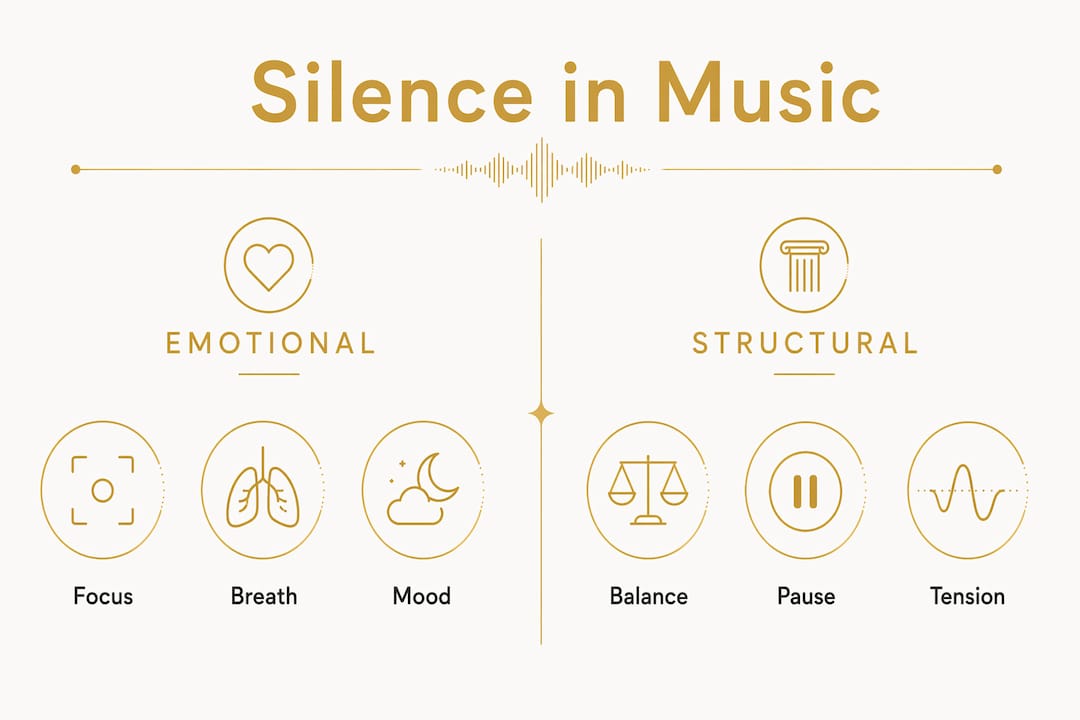
Silence in music is not empty space. It is an active, generative force that shapes how you feel, how you listen, and how meaning accumulates between the notes. Musicologists describe silence as a functional aesthetic construct that creates structural balance, emotional depth, and rhythmic tension by framing your perception of time and space. That framing is the whole point.
Think of it this way: a note only lands because something preceded it. Silence is that something.
- Silence creates architectural space, giving sound a place to breathe and expand
- It frames listener perception of time, making moments feel suspended or urgent
- It highlights the notes not played, a principle Miles Davis built his entire voice around
- It generates rhythmic tension and release, the push and pull that keeps you emotionally engaged
- It serves as a foundational tool across genres, from classical restraint to hip-hop drops
The role of silence in music is, at its core, the art of subtraction. What you leave out defines what remains.
Table of Contents
- How silence shapes your emotional experience
- Minimalism and the power of empty space
- Practical techniques for using silence in your music
- Silence in music therapy: what the research shows
- How Drvvynsound approaches silence as a creative tool
- How silence has evolved across cultures and history
- How silence functions differently across musical genres
- Famous works that made silence their subject
- How silence is written into music scores
- Key Takeaways
How silence shapes your emotional experience
Silence drives tension, anticipation, and release. It acts as a palate cleanser that helps you reset and perceive dynamic contrasts more intensely. When a track goes quiet before a chorus hits, your nervous system leans forward. That lean is not accidental.
Research published in Music Perception found that tonal context profoundly shapes how listeners experience musical pauses. Silences following tonal closure were identified more quickly and perceived as less tense than silences following unresolved passages. In plain terms: where silence falls matters as much as how long it lasts.
- Silence placed after unresolved harmony creates suspense and emotional weight
- Silence placed after resolution signals rest, completion, and emotional exhale
- Contextual placement modulates the entire narrative arc of a piece
Industry experts warn against the “maximalist trap,” the instinct to fill every second with sound. Constant loudness causes listener fatigue. Silence is the necessary reset that makes the loud moments actually land.

Minimalism and the power of empty space
Minimalist composers do not use silence because they run out of ideas. They use it because restraint is its own form of expression. Sparse textures, long resonance decays, and registral openness create what Chinese philosophical aesthetics call liúbái, or “留白,” the deliberate leaving of white space that makes the whole composition breathe.
Daoist philosophy frames silence as an active source of music, not an absence. The principle you-wu xiangsheng holds that form arises out of emptiness and returns to it. Applied to piano music, silence becomes generative, a field where sonic meaning takes shape rather than a gap between sounds.
Confucian aesthetics add a structural dimension. Silence, in this tradition, acts as a form of restraint and moderation, regulating musical expression the way ritual propriety regulates behavior. It keeps music from becoming saturated, preserving formal unity and clarity.
- Rests and resonance decay define pacing and structural form
- Sparse textures increase perceptual awareness, making each note feel deliberate
- Silence creates emotional interiority, the sense that music is speaking from somewhere deep
- Philosophical traditions across cultures treat silence as creative potential, not negation
Pro Tip:When arranging a minimalist passage, try removing one more element than feels comfortable. The discomfort you feel is often exactly what the listener needs to feel too.
Practical techniques for using silence in your music
Silence is a skill. Performing it requires the same intentionality as playing a melody. The musicians who master it, Miles Davis with his two-second gaps in “Round Midnight,” Glenn Gould with his micro-silences in the Bach Goldberg Variations, treat every pause as a purposive act, not a mechanical rest.
Here is how to put that into practice:
- Cut elements before a drop. Strip the arrangement down to a single element or full silence for one to two bars before a major moment. The contrast makes the drop feel physical.
- Mute bars strategically. In a four-bar loop, silencing bar three creates an asymmetry that pulls the listener’s attention forward.
- Use silence as a transition. A half-second of complete quiet between sections signals a shift in emotional register more clearly than any crossfade.
- Slow your tempo to expand silence. Glenn Gould’s later recordings used slower tempos specifically to widen the space between notes, giving silence room to carry meaning.
- In live performance, a held pause before a final chorus can transform audience engagement, turning passive listeners into active participants holding their breath.
Psychoacoustically, an abrupt silence before a key moment heightens emotional focus. Your brain, anticipating sound, sharpens its attention. That sharpened attention is where the emotional impact lives.
Silence in music therapy: what the research shows
Silence is not just a compositional tool. In therapeutic settings, it functions as an intervention. A 2025 systematic review published in The Arts in Psychotherapy confirmed that silence in music therapy supports rumination, relaxation, mood stabilization, and altered perception of time and self.
| Therapeutic function | How silence achieves it |
|---|---|
| Mood stabilization | Quiet passages reduce arousal and allow emotional regulation |
| Rumination support | Silence creates space for internal reflection without external noise |
| Relaxation | Absence of stimulation lowers physiological tension |
| Altered time perception | Silence stretches subjective experience of duration, deepening presence |
| Self-perception shift | Quiet listening encourages introspective awareness and identity clarity |
Silence in therapy is not passive. Therapists use it as an active auditory element, intentionally placed to guide a client’s internal experience. The quiet is doing something.
Research in neuroscience supports this: a 2005 study in Nature found that the sound of silence activates the auditory cortex, meaning your brain responds to absence the same way it responds to presence. Silence is heard, not just felt.
How Drvvynsound approaches silence as a creative tool
At Drvvynsound, silence is not what happens between the music. It is part of the music. DRVVYN’s work in R&B and cinematic sound design treats quiet moments as architectural decisions, places where the emotional weight of a lyric can settle before the next phrase lifts it again.
The themes that run through DRVVYN’s catalog, love, reflection, healing, and personal growth, are themes that need silence to breathe. A song about grief that never pauses feels dishonest. The pause is where the truth lives.
- Silence creates narrative pacing, letting a lyric land before the next one arrives
- It signals emotional transition, the shift from pain to acceptance, from tension to release
- It gives listeners permission to feel something without being told what to feel
- Quiet passages in arrangement build intimacy, pulling the listener closer rather than pushing them back
- Silence between tracks on an album shapes the listener’s journey, with 0.5 to 1.0 seconds of intertrack timing acting as a pacing tool that maintains flow without disrupting the emotional arc
For music creators inspired by this approach: trust the quiet. The pressure you feel to fill every moment is the maximalist trap. Resist it.
How silence has evolved across cultures and history
Silence has carried musical meaning for millennia. A 2,000-year-old Japanese dotaku bell, built without a clapper and buried in earth, was designed to be mute. Its silence was the ritual. That impulse, to make absence sacred, runs through musical traditions worldwide.

In Japanese music, the concept of ma describes the meaningful space between sounds, a pause that is not empty but charged with presence. Western classical music encoded silence through formal notation, rests that carry the same weight as notes. The 20th century pushed further: John Cage’s 4’33″ (1952) reframed ambient sound as music, arguing that silence is a cultural construct, not an acoustic fact.
Cage’s work sits at the intersection of two traditions. The Western binary, sound versus silence, and the Eastern view of silence as an active, living force. Both agree on one thing: silence is never neutral.
How silence functions differently across musical genres
Silence does not mean the same thing in every genre. Its function shifts depending on the musical context, and understanding that shift is part of what makes it such a flexible tool.
In jazz, silence is conversational. Miles Davis used gaps of over two seconds between phrases to create dialogue, letting the space speak as clearly as the trumpet. In classical music, rests are structural, marking phrase boundaries and controlling harmonic tension. In electronic and hip-hop production, silence before a drop is a psychoacoustic weapon, the abrupt cut that makes the bass feel like a physical impact. In R&B and soul, quiet passages create emotional intimacy, the breath before a confessional lyric. In ambient music, silence and near-silence blur together, with the distinction between sound and quiet becoming part of the listening experience itself.
Across all of these, silence serves the same underlying purpose: it makes the surrounding sound matter more.
Famous works that made silence their subject
Some compositions do not just use silence. They make it the point.
John Cage’s 4’33″ (1952) is the most radical example. The performer plays nothing for four minutes and thirty-three seconds. The ambient sounds of the room become the music. Cage argued that silence is a cultural construct, not an acoustic one, and 4’33″ proved it.
Miles Davis’s Kind of Blue (1959) uses silence differently: as breath, as space, as the thing that makes each note feel chosen. His approach to “Round Midnight” in particular, with deliberate gaps between phrases, shaped how an entire generation understood restraint in jazz.
Glenn Gould’s 1981 recording of Bach’s Goldberg Variations is a study in micro-silence. Gould slowed the tempo specifically to expand the space between notes, treating each pause as an interpretive decision rather than a notational requirement.
The Beatles’ Sgt. Pepper’s Lonely Hearts Club Band (1967) used a deliberate two-second pause between tracks to create a cohesive listening experience, an early example of silence as an album-sequencing tool.
How silence is written into music scores
In Western notation, silence is represented by rests: whole rests, half rests, quarter rests, eighth rests, and smaller subdivisions. Each symbol tells the performer exactly how long not to play. A whole rest lasts four beats in common time. A quarter rest lasts one beat. These are not suggestions. They carry the same rhythmic authority as any note.
Beyond standard rests, composers use fermatas to indicate a held silence of indeterminate length, leaving the duration to the performer’s judgment. Grand pauses, marked “G.P.” in scores, signal a complete silence for the entire ensemble, often at a moment of maximum dramatic weight.
In recorded and electronic music, silence is managed through automation, volume envelopes, and deliberate cuts rather than written symbols. The function is identical: silence as a musical tool that reduces frequency clashes, creates clarity, and gives the listener’s ear a moment to reset. Advanced listeners distinguish between what researchers call “opaque silence,” which isolates music from ambient sound, and “capacious silence,” which incorporates environmental noise as part of the listening experience itself.
Both are written into the music. One just uses a different notation system.
Key Takeaways
Silence is an active musical force that shapes emotion, structure, and meaning across every genre, tradition, and therapeutic application.
| Point | Details |
|---|---|
| Silence is generative, not absent | It creates structural balance, emotional depth, and rhythmic tension rather than simply marking a gap. |
| Tonal context determines emotional weight | Silences after unresolved harmony feel tense; silences after resolution signal rest and completion. |
| Intertrack timing shapes album flow | Pauses of 0.5 to 1.0 seconds between tracks act as a pacing tool that enhances the flow and the listener’s album journey experience. |
| Silence is a therapeutic intervention | Research confirms it supports mood stabilization, rumination, relaxation, and altered self-perception. |
| Restraint is a compositional skill | Cutting elements before a drop or muting a bar creates psychoacoustic contrast that sharpens emotional impact. |
At Drvvynsound, every quiet moment in DRVVYN’s music is a deliberate choice. If you want to hear what silence sounds like when it’s used with intention, explore the music and feel the space between the notes.