

Listening & Culture
Therapeutic Music Listening: What It Is and How It Heals
What is therapeutic music listening? Therapeutic Music Listening (TML) is a clinical, evidence-based practice in which credentialed music therapists.
By DRVVYN · · 11 min read

What is therapeutic music listening?
Therapeutic Music Listening (TML) is a clinical, evidence-based practice in which credentialed music therapists design personalized music protocols to help you reach specific health goals. It is not background music. It is not a playlist you put on to unwind after a long day. TML sits inside a structured therapeutic relationship, guided by a trained professional who shapes every listening experience around your emotional, cognitive, and physical needs.
The distinction matters more than most people realize. According to a novel clinical approach published in peer-reviewed literature, listening-based interventions represent approximately 47% of all music therapy practices globally, a figure reported by the World Federation of Music Therapy. That prevalence reflects how deeply receptive music work has taken root across hospitals, rehabilitation centers, and mental health settings throughout the United States.
What sets TML apart from simply pressing play:
- Clinical oversight: A board-certified music therapist designs and monitors every session.
- Personalized protocols: Playlists are built from your musical history, preferences, and therapeutic goals, not generic relaxation tracks.
- Structured goals: Each listening session targets a measurable outcome, whether that is reducing anxiety, supporting neurological recovery, or easing chronic pain.
- Ongoing adjustment: The therapist modifies the protocol based on your feedback and observed responses over time.
- No musical skill required: You do not need to play an instrument or read music to benefit fully.
TML integrates the subjective experience of music you love with the objective, parametric qualities of sound, tempo, rhythm, and harmonic complexity, to create an intervention that is both personal and clinically grounded.
How your brain responds to therapeutic music listening
Music does something to the brain that most other therapeutic tools cannot. When you listen, multiple regions activate at once: areas governing emotion, memory, movement, and language light up in a coordinated wave. That simultaneous activation is the neurological engine behind TML’s therapeutic effects.

The limbic system sits at the center of this process. Because of music’s connection to the limbic system, it can help you access the relaxation response and calm your nervous system, slowing your breathing and shifting your mind away from what it is stuck on. This is not metaphor. It is a measurable physiological shift, and it happens without you having to consciously decide to relax.
Beyond relaxation, music acts as what researchers describe as an information carrier. A skilled therapist reads your responses to specific musical parameters as diagnostic data, gaining insight into your emotional and cognitive state that verbal communication alone might not reveal. The music becomes a kind of mirror, reflecting what is happening inside you before you have the words for it.
Brain plasticity research adds another layer. Music listening can strengthen neural pathways associated with emotional regulation and cognitive processing, which is why TML shows particular promise in neurological rehabilitation after stroke or traumatic brain injury. The brain, it turns out, responds to music with a kind of structural openness that few other stimuli can match.
What makes TML different from casual listening or music medicine
You have probably used music therapeutically without realizing it. You put on a certain song when you are grieving, another when you need to push through something hard. That instinct is real and valid. But TML operates on an entirely different level of intentionality and clinical structure.
The clearest way to understand the difference is to place three approaches side by side:
| Feature | Casual listening | Music medicine | Therapeutic Music Listening |
|---|---|---|---|
| Who guides it | You | Medical staff | Board-certified music therapist |
| Assessment | None | Minimal | Full clinical and musical history |
| Goals | Personal preference | Relaxation or distraction | Specific, measurable therapeutic outcomes |
| Playlist design | Self-selected | Generic or self-selected | Individually crafted, parameter-based |
| Ongoing adjustment | None | Rare | Regular, based on clinical feedback |
| Therapeutic relationship | None | None | Central to the process |
Music medicine involves a patient wearing headphones and listening to preferred music during a medical procedure, primarily for distraction or comfort. It requires no therapist, no assessment, and no protocol. TML, by contrast, requires all three. The therapist builds a hypothesis about what musical parameters will serve your therapeutic needs, then modulates the playlist over time based on what your responses reveal.
Key attributes that define TML as a clinical practice:
- Individual assessment: Your musical background, emotional associations, and clinical history all inform the initial protocol.
- Parameter-based playlist design: Songs are selected not just for personal preference but for tempo, rhythmic complexity, harmonic structure, and expressive intensity.
- Three functional categories: Therapists organize music into relaxation or deactivation, activation, and distraction, each mapped to specific musical structures.
- Therapeutic relationship: Even in receptive listening, the clinician-client connection shapes how you process and respond to the music.
- Credentialed oversight: Only interventions led by credentialed professionals with clear protocols demonstrate consistent clinical outcomes.
The difference between TML and putting on a playlist is the difference between a conversation with a skilled counselor and talking to yourself in the mirror. Both have value. Only one is treatment.
Who benefits from therapeutic music listening, and for what conditions
TML reaches people across a wide range of clinical settings, and the breadth of its applications is one of the things that makes it so compelling. It is not a niche tool for one diagnosis. It is a flexible intervention that clinical applications show can address emotional regulation, neurological rehabilitation, pain management, and social functioning.
| Clinical area | Target population | Key outcomes |
|---|---|---|
| Emotional regulation | Anxiety, depression, trauma | Reduced cortisol, improved mood stability |
| Neurological rehabilitation | Stroke, traumatic brain injury | Improved motor coordination, cognitive recovery |
| Pain management | Chronic pain, post-surgical recovery | Reduced perceived pain intensity |
| Dementia care | Older adults with cognitive decline | Improved memory recall, reduced agitation |
| Mental health | Depression, schizophrenia, PTSD | Reduced symptoms, improved social engagement |
| Sleep disorders | Adults with insomnia | Improved sleep onset and quality |
| Autism spectrum | Children and adults with ASD | Enhanced communication, reduced anxiety |
Research supports TML’s reach across these populations. A systematic review published in peer-reviewed literature found that music therapy, including receptive listening methods, produces improvements in physical, psychological, and social outcomes for people diagnosed with autism spectrum disorder, dementia, depression, insomnia, and schizophrenia. The review characterized music therapy as a safe, low-threshold method that complements other disease-specific treatments.
For people living with dementia, TML can unlock something that feels almost impossible to reach through words alone. Familiar music from a person’s past can bypass the fog of cognitive decline and surface memories, emotions, and moments of clarity. For someone recovering from a stroke, carefully selected rhythmic music can support motor retraining by engaging the brain’s movement-related pathways through auditory stimulation.
Pro Tip:If you or someone you care for is navigating a neurological condition, ask your care team specifically about receptive music therapy as a complement to existing rehabilitation. Many hospital systems in the United States now offer music therapy as part of inpatient and outpatient programs.
Pain management is another area where TML’s effects are well-documented. Music listening can shift attention away from pain signals, reduce the emotional weight of chronic discomfort, and lower physiological stress markers. The distraction category in TML protocol design, music with divergent elements and high variation, is specifically engineered to redirect the brain’s focus.
How a therapeutic music listening session actually works
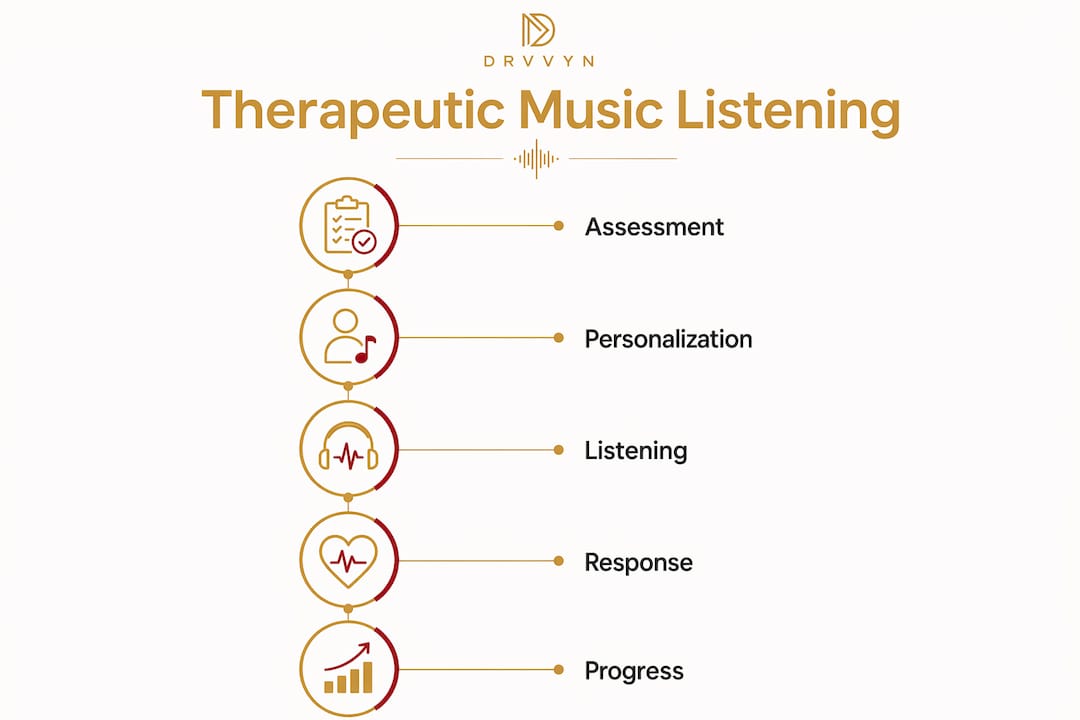
The process begins before a single note plays. A qualified music therapist conducts a thorough one-on-one evaluation, gathering your clinical history, musical preferences, emotional associations with specific genres or songs, and the therapeutic goals you are working toward. This is not a questionnaire you fill out and forget. It is the foundation of everything that follows.

From that assessment, the therapist builds your initial listening protocol. The playlist is not assembled by mood alone. Every track is chosen with attention to its structural and parametric qualities: tempo measured in beats per minute, rhythmic regularity, melodic complexity, harmonic tension, and expressive intensity. A personalized listening protocol is then adjusted over time as the therapist collects your feedback and observes how you respond.
The TML session process, step by step:
- Initial clinical assessment: The therapist gathers personal, musical, and medical history through structured interviews and questionnaires.
- Goal identification: Together, you and the therapist define specific, measurable therapeutic targets, such as reducing anxiety before medical procedures or improving sleep quality.
- Playlist construction: The therapist selects music that balances your personal preferences with the parametric requirements of your therapeutic goals.
- Listening session: You listen in a structured environment, sometimes with guided attention to emotional responses, sometimes in quiet focus, depending on the protocol.
- Feedback collection: After each session, the therapist gathers your responses, noting emotional shifts, physical sensations, and any associations the music triggered.
- Protocol adjustment: Based on your feedback and observed progress, the therapist modifies the playlist, tempo, genre, or session structure to keep the intervention aligned with your evolving needs.
| Session phase | Therapist’s role | Your role |
|---|---|---|
| Assessment | Gather history, identify goals | Share openly, describe musical relationships |
| Protocol design | Select and sequence music by parameters | Review and respond to initial playlist |
| Active listening | Monitor responses, guide attention if needed | Listen, notice emotional and physical reactions |
| Feedback | Collect and interpret responses | Describe what you felt, what shifted |
| Adjustment | Modify protocol based on data | Continue engaging honestly with the process |
One of the most freeing aspects of TML is what it does not require from you. You do not need musical training, performance ability, or any prior experience with therapy. As board-certified music therapist Lorrie Kubicek has noted, you just need to love music and have something you want to develop or nurture.
Where is therapeutic music listening headed?
The field is moving fast, and the most exciting development is the integration of AI-generated and algorithmically composed music into TML protocols. Researchers are exploring how algorithmic music can balance deeply personal listening preferences with precise parametric control, creating soundscapes that adapt in real time to a patient’s physiological and emotional state.
This is not about replacing the music therapist. The human relationship at the center of TML remains irreplaceable. What AI offers is a new layer of precision: music that can shift tempo, key, or texture in response to biometric feedback, creating a listening experience that is simultaneously personal and clinically calibrated.
Scholars also point to an ongoing push toward more rigorous, standardized protocols. One of TML’s current challenges is the heterogeneity of methods across clinical settings. Different hospitals, different therapists, and different research teams use music interventions in ways that are hard to compare directly. The next generation of TML research aims to establish clearer benchmarks, more consistent assessment tools, and replicable protocols that can be studied across larger populations.
The expansion of TML into preventive care is another promising direction. Rather than waiting for a clinical diagnosis, future applications may bring structured music listening into wellness programs, workplace mental health initiatives, and community health settings. The accessibility of TML, no musical skill required, no complex equipment needed, makes it a natural fit for broader public health contexts.
For those who find emotional resonance in music as part of their daily lives, exploring vinyl and physical music formats can deepen the intentionality of listening, a small but meaningful step toward the kind of focused engagement that TML cultivates.
Why the therapeutic relationship is the heart of TML
Music can move you on its own. But in TML, the presence of a skilled clinician transforms that movement into something purposeful. The therapeutic relationship is not incidental to the process. It is the process.
Even in receptive listening, where you are not playing an instrument or singing, the clinician-client connection shapes how you engage with the music and what you do with what surfaces. A board-certified music therapist reads your responses, holds space for what the music brings up, and guides the emotional processing that follows. That guidance is what separates a healing experience from a pleasant one.
Practitioners who specialize in TML consistently highlight several insights about what makes the therapeutic relationship work:
- Presence without pressure: The therapist creates a container where you can feel what the music brings up without needing to perform or explain yourself immediately.
- Music as a third voice: The music itself becomes a participant in the therapeutic dialogue, saying things that neither you nor the therapist might reach through words alone.
- Emotional permission: Having a credentialed professional present gives many people permission to feel things they have been holding at a distance, grief, anger, tenderness, relief.
- Continuity of care: Because the therapist tracks your responses across sessions, patterns emerge that inform deeper therapeutic work over time.
- Cultural and personal attunement: A skilled therapist selects music that honors your cultural background and personal history, making the listening experience feel genuinely yours.
Pro Tip:When starting TML, be as specific as possible about your emotional associations with music. Tell your therapist which songs have carried you through hard times, which ones you cannot listen to without crying, and which ones make you feel like yourself again. That information is clinical gold.
The distinction between therapeutic and recreational listening comes down to intention and relationship. You can listen to music alone and feel something real. But when a trained clinician is present, interpreting your responses and adjusting the experience in real time, the music becomes a tool with direction. It moves you somewhere specific, not just somewhere.
At Drvvynsound, the music we create is built around exactly these themes: love, reflection, healing, and personal growth. Explore the DRVVYN sound world to find music that resonates with where you are right now, whether you are working with a therapist or simply letting yourself feel.

Key Takeaways
Therapeutic Music Listening is a clinician-guided, evidence-based intervention that uses personalized, parameter-based music protocols to achieve specific emotional, cognitive, and physical health outcomes within a structured therapeutic relationship.
| Point | Details |
|---|---|
| TML prevalence | Listening-based interventions represent approximately 47% of all music therapy practices globally. |
| Limbic system access | Music bypasses conscious worry by activating the limbic system, slowing breathing and calming the nervous system. |
| Clinical breadth | TML addresses emotional regulation, neurological rehabilitation, pain management, dementia care, and sleep disorders. |
| No skill required | Patients need no musical training or background to benefit from therapeutic music listening. |
| Future direction | AI-generated algorithmic music is being integrated into TML to combine personalization with precise parametric control. |