

Artist Strategy
What Is Musical Dynamic Contrast? A Guide for Musicians
What Is Musical Dynamic Contrast? A Guide for Musicians
!
By DRVVYN · · 10 min read
What Is Musical Dynamic Contrast? A Guide for Musicians
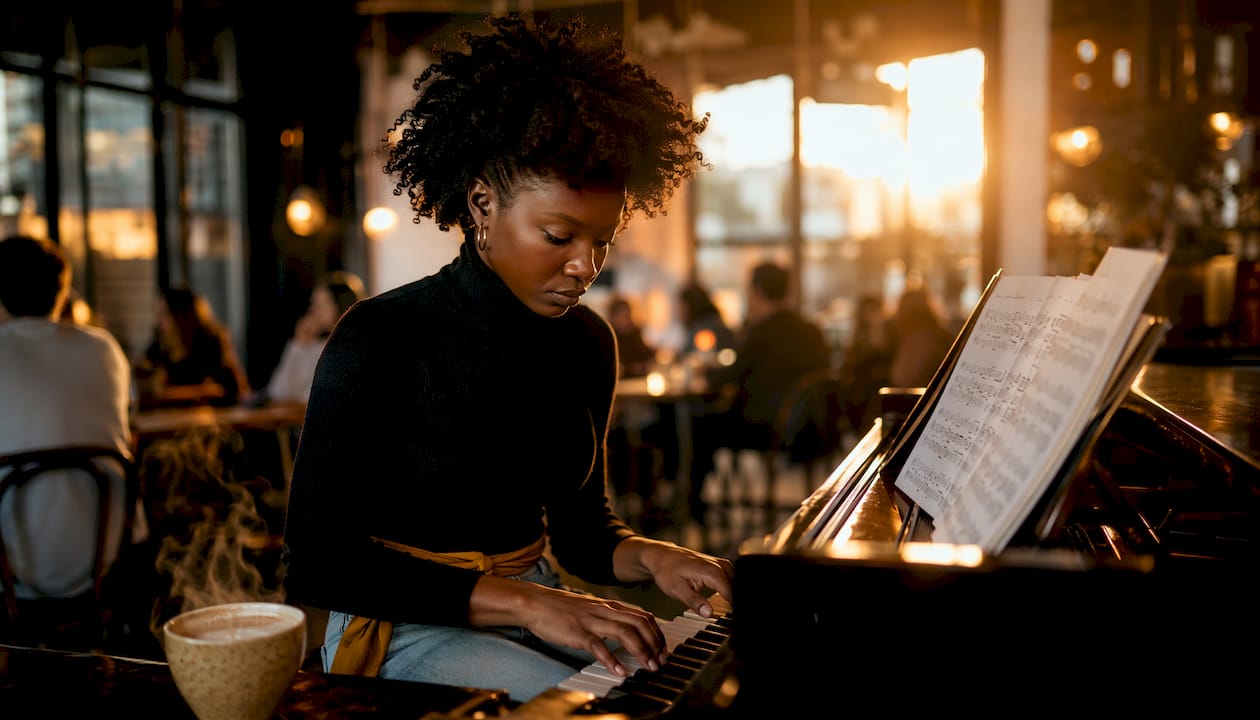
Musical dynamic contrast is the intentional variation between loud and soft in music — the push and pull of volume that gives a piece its emotional shape. Without it, even the most beautiful melody can feel suspended in a kind of numbness, going nowhere.
Two quick examples you can hear right now:
- A phrase played softly for four bars, then a sudden forte accent on beat one of bar five — the silence before it feels sharp, and the loud note lands like a release of pressure.
- A slow crescendo building through a pre-chorus into a full, open chorus — the tension accumulates, and the arrival feels earned.
That contrast is the difference between music that moves you and music that simply plays. It shapes emotion, signals structure, and keeps listeners present.
Table of Contents
- What do dynamic markings actually mean?
- How composers and performers create dynamic contrast
- Why dynamic contrast shapes the way music feels
- How to apply dynamic contrast in practice and composition
- How studio tools shape dynamic contrast in recorded music
- Key Takeaways
- Why dynamics are the most underestimated tool in the room
- Useful sources and listening examples for further study
What do dynamic markings actually mean?
Dynamic markings are written in Italian and give performers a relative guide to loudness. They are not fixed decibel values — a forte in a solo piano piece is a very different physical sound from forte in a full orchestra. Context and instrument always govern how markings are interpreted).
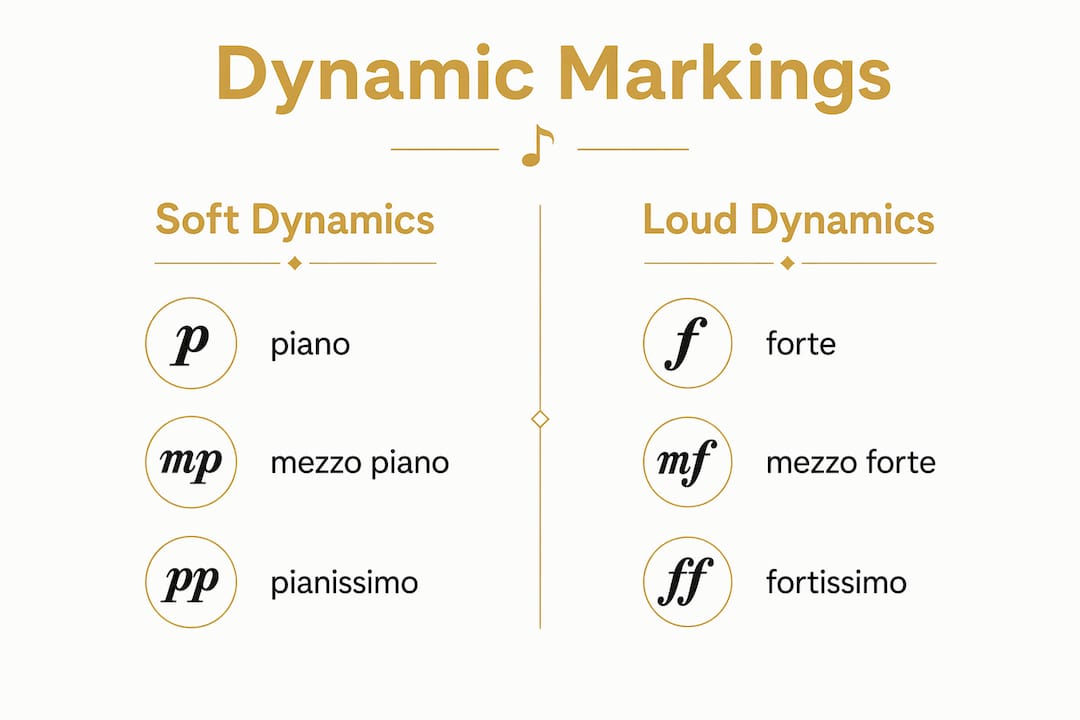
| Marking | Abbreviation | Plain-English meaning |
|---|---|---|
| Pianissimo | pp | Very soft |
| Piano | p | Soft |
| Mezzo piano | mp | Moderately soft |
| Mezzo forte | mf | Moderately loud |
| Forte | f | Loud |
| Fortissimo | ff | Very loud |
| Crescendo | cresc. or < | Gradually get louder |
| Diminuendo / Decrescendo | dim. or > | Gradually get softer |
Beyond the standard levels, a few accent symbols carry specific meaning:
- sforzando (sfz): A sudden, sharp accent on a single note — more of a punch than a sustained level.
- fortepiano (fp): Loud immediately followed by soft on the same note or beat; creates a quick, dramatic drop.
- subito piano (sub. p): Suddenly soft, with no gradual transition — the musical equivalent of a light switching off.
- hairpins (< >): The most common visual cue for gradual dynamic shifts; a hairpin opening outward means crescendo, closing inward means diminuendo.
One thing worth holding onto: markings indicate relative levels, not fixed ones. A piano in an orchestral tutti passage differs from piano in a solo setting. Phrase shaping often requires micro-dynamic adjustments within a single marked level — a long piano phrase still needs subtle rises and falls to breathe.
How composers and performers create dynamic contrast
The techniques fall into two broad families: gradual changes and sudden ones. Both are tools, and the choice between them shapes the psychological effect on the listener.
Gradual techniques:
- Crescendo: A steady increase in volume over several beats, bars, or even entire sections. Builds anticipation.
- Diminuendo / decrescendo: The reverse — a gradual softening that can signal resolution or withdrawal.
- Poco a poco: “Little by little” — a directive to make the change incrementally, preventing abrupt shifts where smoothness is needed.
Sudden techniques:
- Sforzando (sfz): A sharp accent that interrupts the prevailing dynamic level without warning.
- Subito piano: Cuts the volume immediately, often used for surprise or emotional release.
- Fortepiano (fp): A loud attack that drops instantly to soft — common in Classical-period writing.
Beyond individual markings, composers also use texture and orchestration as contrast tools. Pulling back to a solo instrument after a full ensemble passage creates a dramatic shift in perceived volume even without a single dynamic marking. The reverse — moving from a solo to a tutti (full ensemble) — is one of the most visceral contrasts in orchestral writing. Terraced dynamics, common in Baroque music, work this way: alternating between a small group and a larger one to produce loud/soft effects before modern gradual notation became standard.
Pro Tip:When you interpret a crescendo, think about where the peak lands, not just the direction of travel. A crescendo that peaks too early deflates the phrase; one that arrives exactly on the structural downbeat feels inevitable.
Why dynamic contrast shapes the way music feels
Dynamics are the emotional heartbeat of a composition. They prevent musical stagnation and communicate intent that notation alone cannot capture. A melody played at a single, unchanging volume can feel mechanical — technically correct but emotionally inert.
The functions of dynamic contrast map closely to how we process tension and release:
- Emotional shaping: A soft, restrained verse followed by a full chorus creates the sensation of something opening up — pressure leaving the chest.
- Structural signposting: Sudden dynamic shifts mark formal boundaries. A subito piano at the start of a bridge tells the listener something has changed, even before the harmony does.
- Maintaining interest: Variety in intensity keeps the ear engaged across a long piece. Without it, even a strong melody blurs into the background.
- Creating surprise: An unexpected sforzando in a quiet passage can feel like a sharp intake of breath — disorienting in the best possible way.
Stylistic context matters here. Baroque composers relied on terraced dynamics — abrupt shifts between levels — rather than the gradual swells that became central to Romantic writing. A Beethoven symphony and a Bach concerto grosso both use dynamic contrast, but the shape of that contrast is entirely different. Interpreting a Baroque piece with Romantic-style crescendos misreads the style; the markings are relative to the period, not just the instrument.
How to apply dynamic contrast in practice and composition
Building real control over dynamics takes deliberate, focused repetition. These exercises move from basic awareness to compositional application.
- Two-bar soft/loud shifts. Play any short phrase at piano for two bars, then repeat it at forte. No gradual transition — just the contrast. Notice how the same notes feel different at each level. This is the foundation of dynamic sensitivity.
- Controlled crescendo across a scale. Play a one-octave scale starting at pp and arriving at ff on the top note. Record yourself, then listen back. Most players rush the loudest notes or peak too early — the goal is a perfectly even gradient.
- Accent-then-remove exercise. Play a phrase with deliberate accents on every strong beat, then play it again with no accents at all. The difference reveals how much of your phrasing is habit versus intention.
- Three-level phrase shaping. Take a four-bar phrase and divide it into three dynamic zones: mp on the opening, mf through the middle, p on the final note. This mimics natural speech cadence and trains you to think in arcs, not flat lines.
For composers and arrangers, a short checklist:
- Identify the emotional peak of each section and mark it explicitly.
- Choose gradual contrast (crescendo/diminuendo) for anticipation, sudden contrast (sfz, sub. p) for surprise or release.
- Consider texture alongside level — removing instruments is as powerful as changing a marking.
- Write dynamics clearly in the score; performers cannot feel what you have not notated.
Pro Tip:In R&B and soul writing, the most powerful dynamic moments often come from restraint, not volume. Pulling a full arrangement back to voice and a single instrument right before the final chorus creates a tension that the return of the full band releases with real force.
How studio tools shape dynamic contrast in recorded music
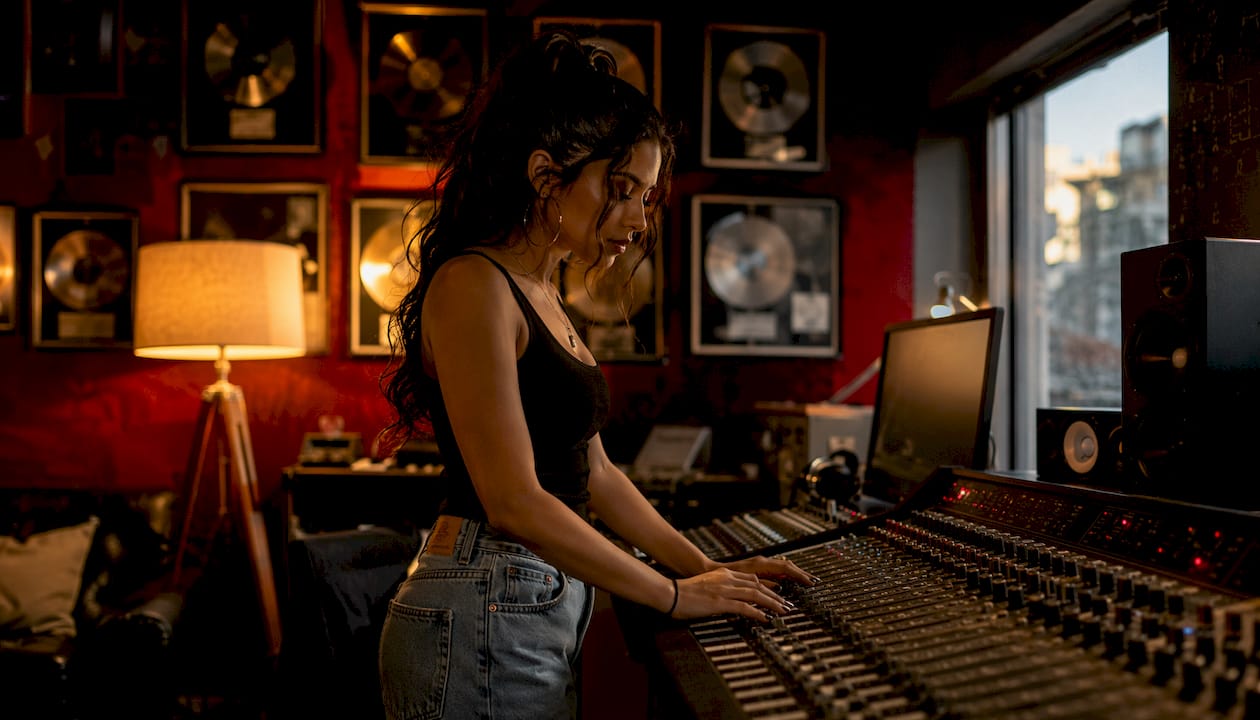
Live performance dynamics do not survive the recording chain unchanged. Dynamics processing — compression, limiting, automation, and expansion — reshapes perceived contrast at every stage of production.
| Tool | Primary function | Effect on contrast |
|---|---|---|
| Compressor | Reduces peaks, raises quiet passages | Can flatten contrast if overused |
| Limiter | Hard ceiling on peak levels | Prevents clipping; minimal contrast loss when used conservatively |
| Automation | Precise level control over time | Preserves or creates contrast intentionally |
| Expander / gate | Reduces or silences quiet signals | Can increase contrast by deepening quiet passages |
Practical mixing guidance:
- Use automation to preserve natural crescendos. If a vocalist naturally swells into a chorus, draw that movement into the fader automation rather than compressing it flat.
- Avoid over-compression on the master bus. Heavy limiting crushes the peaks that make loud moments feel loud. The quiet passages lose their contrast reference.
- Check your mix at multiple playback levels. A mix that sounds balanced at high volume often loses its dynamic shape at low volume — the softest elements disappear and the contrast collapses.
Pro Tip:Listen to your mix at a very low volume, the kind where you can still hold a conversation. If the emotional arc still reads — if the chorus still feels bigger than the verse — your dynamic contrast is working. If everything blurs into the same level of presence, go back to your automation.
Key Takeaways
Dynamic contrast is the intentional variation between loud and soft that gives music its emotional shape, structural clarity, and forward motion.
| Point | Details |
|---|---|
| Markings are relative | pp to ff indicate levels relative to context and instrument, never fixed decibel values. |
| Two contrast types | Gradual (crescendo, diminuendo) builds anticipation; sudden (sfz, sub. p) creates surprise or release. |
| Texture amplifies dynamics | Removing or adding instruments shifts perceived volume as powerfully as any marking. |
| Automation preserves contrast | In the studio, fader automation protects natural dynamic arcs that compression would otherwise flatten. |
| Practice with intention | Controlled crescendo scales and two-bar soft/loud shifts build the muscle memory dynamic control requires. |
Why dynamics are the most underestimated tool in the room
Most musicians learn dynamic markings early and then stop thinking about them. They become decoration on the page rather than decisions in the body. What gets lost is the understanding that dynamics are not about volume — they are about time. A crescendo is not just getting louder; it is building a feeling across bars, suspending the listener in anticipation until the peak arrives and something inside them shifts.
The same principle applies in the studio. Producers who reach for a compressor the moment a vocal gets expressive are, in effect, editing out the emotion. The swell in a singer’s voice before the hook, the breath before a whispered line — those are dynamic events, and they carry weight. Flattening them in the name of consistency trades emotional truth for technical tidiness.
What actually works is treating dynamics as a compositional layer, not an afterthought. In arrangement, that means planning the quiet moments as carefully as the loud ones. In mixing, it means asking whether the contrast you felt in the room is still present in the playback. And in performance, it means understanding that the softest note in a phrase is often the one that holds the most tension.
Explore how Drvvynsound approaches dynamics in production across original R&B releases and cinematic arrangements.
Useful sources and listening examples for further study
- OnMusic Dictionary — Dynamic Contrast: Clean, concise definition; good starting reference for the core concept.
- Wikipedia — Dynamics (music)): Covers historical context, terraced dynamics, and the relativity of markings across periods and instruments.
- Music Theory Academy — Dynamics: Practical notation guide covering hairpins, accent symbols, and how to read dynamic markings in scores.
- Native Instruments — Dynamics in Music: Covers both performance dynamics and production tools; particularly useful for the compression and automation sections.
- Flat — Music Dynamics Explained: Student-friendly reference for notation software and standard markings from pp to ff.
- A1 Lifestyle — New Music: A broader look at how dynamics function in contemporary releases and modern production practice.
Listening examples to try:
- Beethoven, Symphony No. 5, opening movement: The four-note motif cycles through sudden forte and piano contrasts within the first minute — one of the clearest examples of sudden dynamic contrast in the repertoire.
- Samuel Barber, Adagio for Strings: A long, sustained crescendo across the full ensemble that peaks and then collapses to near silence — textbook gradual contrast used for emotional effect.
- Any R&B bridge section that strips back to voice and piano before the final chorus: The reduction in texture functions as a dynamic drop even when the volume difference is modest. Listen for the moment the full arrangement returns — that is the contrast doing its work.