

Listening & Culture
Benefits of Digital Music for Isolation and Loneliness
Benefits of Digital Music for Isolation and Loneliness
! Person listening to music alone in dim room
Digital music reduces feelings of isolation by acting as a social surrogate, filling in for the belonging and validation that human contact usually provides.
By DRVVYN · · 10 min read

Benefits of Digital Music for Isolation and Loneliness

Digital music reduces feelings of isolation by acting as a social surrogate, filling in for the belonging and validation that human contact usually provides. A 2025 study from the University at Buffalo found that listening to your favorite music increases feelings of belonging and buffers the sting of social exclusion, and it worked better than random or unfamiliar music. Separately, a 3-week randomized controlled trial of digital music therapy found measurable drops in depression, stress, and insomnia compared to a group that received no intervention.
You don’t need a therapist’s office or a support group meeting to start feeling the effect. Here’s where to begin tonight:
- Put on the song that feels like it already knows you, and actually listen to it, not just have it playing.
- Try a synchronous listening session with one other person, even from two different couches.
- Use a guided or mood-based playlist when you don’t have the energy to pick a song yourself.
Pro Tip:Skip the algorithm’s autoplay for one session and choose the track yourself. Self-selected music engages identity and reward circuits in a way autoplay rarely does.
Key Takeaways
Digital music reduces isolation because self-selected songs act as a social surrogate, and structured multi-week listening produces measurable improvements in mood and stress.
| Point | Details |
|---|---|
| Favorite music beats random music | Self-selected tracks buffer loneliness and social threat more effectively than unfamiliar music. |
| Four mechanisms drive the effect | Tonality, rhythm, reward, and sociality each map to a specific digital listening habit. |
| Timelines differ | Mood lifts arrive in minutes; measurable stress and insomnia relief took three weeks in trial data. |
| Know when to step up | Persistent depression or functional impairment calls for a credentialed music therapist, not a playlist. |
| DRVVYN Sound offers a starting point | Curated late-night and mood-based playlists give readers a structured way to begin the practice tonight. |
This article is general information, not a substitute for advice from a qualified doctor. Consult a qualified healthcare professional about your own circumstances before acting on anything here.
Table of Contents
- What Are the Real Benefits of Digital Music for Isolation?
- Does the Research Actually Support Music as Isolation Relief?
- How Do You Use Music When You’re Feeling Isolated Right Now?
- How Do You Build a Playlist That Actually Helps?
- When Should You See a Music Therapist Instead of Self-Directed Listening?
- Can Music Make Loneliness Worse Instead of Better?
- Sources
What Are the Real Benefits of Digital Music for Isolation?
The comfort you feel from a familiar song isn’t accidental. Researchers studying music and the brain point to four core mechanisms, mapped out in a neuroscience and psychiatry review, that explain why music can stand in for social contact when you’re alone: tonality, rhythm, reward, and sociality.
Tonality is the emotional coloring of a song, the way a minor key can hold sadness without judgment while a major key can lift you before you notice it happening. Rhythm engages your body’s own sense of timing; a track with a strong pulse invites movement, even if it’s just your foot tapping. Reward is the dopamine hit of hearing a song you love, the same circuitry that lights up during real connection with a friend. Sociality is the sense of shared experience, whether that’s imagining the artist speaking directly to you or actually listening alongside someone else in real time.
Digital tools turn these into practical levers:
- Rhythm becomes actionable through danceable playlists that get your body moving without leaving your room.
- Sociality becomes actionable through shared queues, live-listening rooms, and synchronous streams with a friend.
- Reward becomes actionable through self-curated favorites instead of passive, algorithm-fed background noise.
A related finding backs this up: self-selected favorite music engages reward and identity circuits more strongly than music you didn’t choose, which is likely why it does more to ease loneliness.
Does the Research Actually Support Music as Isolation Relief?
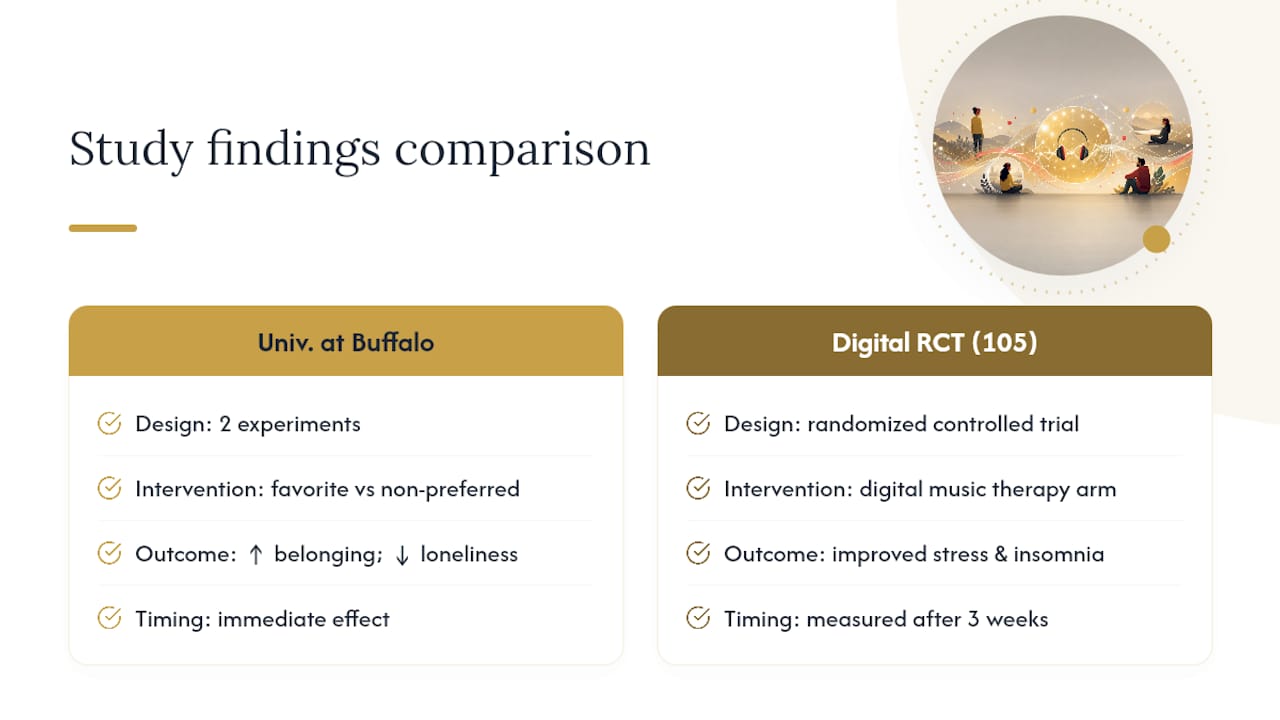
Two studies carry most of the weight here, and it helps to know exactly what each one measured. The University at Buffalo research ran two experiments testing whether favorite music could function as a social surrogate. It found that favorite tracks increased belonging and reduced loneliness, and also softened the emotional hit of a simulated social-exclusion task, more effectively than non-preferred music.
The randomized controlled trial took a different angle. Across a larger study population, a subgroup of 105 participants assigned to a digital music therapy arm showed significant improvements in stress and insomnia after three weeks, with the effect partly explained by improvements in depression symptoms.
Favorite music didn’t just make people feel better in the moment. It changed how resilient they were to a direct social threat, suggesting the benefit runs deeper than simple mood elevation.
That gap matters: a single song can lift your mood in minutes, but measurable changes in depression, stress, and insomnia took a structured three-week program to show up. Neither study claims digital music replaces human connection. Both point to something narrower and still valuable: music genuinely buffers the psychological weight of being alone.
How Do You Use Music When You’re Feeling Isolated Right Now?
You don’t need a plan with twelve steps. You need something you’ll actually do at 9 p.m. on a Tuesday when the apartment is too quiet. Try this sequence:
- Pick one favorite song, not a playlist, not a genre. One track that already means something to you.
- Listen with full attention for 10 minutes. No scrolling, no folding laundry. Let the song be the only thing happening.
- Extend into a social or synchronous option if you’re up for it: text a friend a track, start a shared queue, or join a live-listening room.
- Close with journaling or movement. Write one sentence about what the song brought up, or just let your body move if the rhythm asked for it.
For something more repeatable, build a loose weekly template: a nightly ten-minute session with a comfort track, one midweek synchronous listen with someone else, and a weekend block for discovering something new. The structure matters less than the consistency.
Group listening rooms, virtual open-mic nights, and live-streamed sessions all lean on sociality, the fourth mechanism, more directly than solo listening does. If privacy is a concern, most platforms let you listen or share without broadcasting your activity publicly, so you can get the connection benefit without the exposure.

Pro Tip:When loneliness feels more physical than emotional, restless, jittery, keyed up, reach for higher-danceability tracks. Streaming data from COVID lockdowns showed people gravitated toward more rhythmically engaging music during isolation, likely because rhythm can substitute for the physical cues of being around other people.
How Do You Build a Playlist That Actually Helps?
A playlist thrown together in thirty seconds rarely does much. A playlist built with intent can shift your mood or your energy on purpose. Start with self-selected tracks over algorithmic suggestions; music you already love does more work than music a recommendation engine guessed you’d like. Screen lyrics ahead of time if you’re in a fragile stretch, a song that once felt cathartic can turn into a trigger if it’s tied to a specific memory you’re not ready to sit with.
Music therapists often use the iso principle: match a song to your current mood first, then gradually shift toward the mood you want. Trying to force a sad night into forced positivity with an upbeat track usually backfires; matching first, then shifting, tends to work better.
- Comfort set: familiar, mid-tempo, low lyrical complexity, songs you’ve heard hundreds of times.
- Reminiscence set: tracks tied to a specific memory or era, useful for connection but riskier if grief is involved.
- Energize set: high-danceability, building tempo, saved for when you want to move your body out of a low mood.
Familiar music tends to soothe; novel music tends to stimulate curiosity and slight arousal. Neither is automatically better; Harvard Health’s summary of the research is blunt about this, noting there’s no single best dose or genre for everyone. You’ll need to test what actually works on your worst nights, not just your average ones.
| Template | Best for |
|---|---|
| Comfort set | Acute loneliness, anxious evenings |
| Reminiscence set | Processing grief or nostalgia carefully |
| Energize set | Low motivation, physical restlessness |
| Distraction set | Racing thoughts, difficulty settling down |
When Should You See a Music Therapist Instead of Self-Directed Listening?
Self-directed listening is genuinely useful for mild, situational loneliness, a rough week, a quiet Sunday, a stretch of working from home with little social contact. It becomes insufficient when loneliness turns into persistent depression, thoughts of self-harm, or an inability to function day to day. That’s a signal to bring in a licensed professional, not a playlist.
If you’re considering tele-music therapy, use this checklist before starting:
- Confirm board certification through a recognized credentialing body.
- Ask whether the program follows an evidence-based structure rather than informal sessions.
- Clarify session format: live video, structured curriculum, or a hybrid model.
Board-certified music therapists distinguish clearly between clinical, therapist-led work and everyday playlist curation. Both have value, but they aren’t interchangeable. A reasonable timeline: give self-directed listening two to three weeks. If nothing shifts, or things get worse, that’s your cue to step up to professional support, roughly the same window the 3-week RCT used to detect measurable clinical change.
Can Music Make Loneliness Worse Instead of Better?
Music isn’t automatically safe just because it’s comforting. A song tied to a painful memory can pull you into rumination instead of relief. Stimulating, high-tempo tracks played right before bed can disrupt sleep instead of aiding it. And leaning on music as your only coping tool can quietly become a way of avoiding social contact altogether, rather than a bridge back toward it.
Music should widen the door back to connection, not become the only room you’re willing to stand in.
A few safeguards keep the practice healthy:
- Preview lyrics before adding an unfamiliar song to a comfort playlist.
- Pair heavier listening sessions with a grounding technique, slow breathing or naming five things you can see.
- Set a time limit on emotionally intense listening sessions rather than looping the same sad song for hours.
- Keep crisis resource contact information saved somewhere accessible, not buried in a note you’ll never find.
On privacy: choose platforms that are transparent about how listening data gets used, and be cautious about pairing music apps with mental-health tracking features that store sensitive information you wouldn’t want shared.
Where DRVVYN Sound Fits Into This Conversation
DRVVYN Sound is an independent R&B and multimedia company built around emotionally driven songs, visualizers, and playlists centered on themes of healing, reflection, and connection.
Music built around real emotional weight tends to land differently than music built purely for streaming numbers.
- Original alternative R&B releases designed around themes of solitude and reconnection.
- Prior reporting on solitary listening as a legitimate emotional practice, not a lesser substitute for company.
- Curated playlists built specifically for late-night, low-connection moments.
A Quiet Night, a Familiar Song, and What It Actually Fixed
There’s a particular kind of quiet that settles in on a Tuesday night alone, and I’ve found that the right song does more in three minutes than an hour of scrolling ever does. It doesn’t erase the loneliness. It just makes the room feel less empty while you sit in it. Try the experiment below and see what shifts for you.
Try This Three-Day Listening Experiment
You don’t need a subscription overhaul or a new app to test whether this works for you, just three nights and a little intention. Night one, pick one favorite song and listen with full attention for ten minutes, no multitasking. Night two, try a synchronous listen with someone else, even from separate rooms. Night three, build a five-song comfort set using the iso principle: match your mood first, then let the songs shift it gradually.
If you want a starting point instead of building from scratch, DRVVYN Sound’s late-night listening guide is built around exactly this kind of solitary, reflective listening. Stream the Alternative R&B mood playlists tonight and see which set matches where you actually are.
Sources
- Study finds solo music listening boosts social well-being
- Randomized controlled trial on digital music therapy
- Biological principles for music and mental health | Translational Psychiatry
- Can music improve our health and quality of life? – Harvard Health