
Fan Growth
How Fan Communities Shape Music Discovery and Growth
How Fan Communities Shape Music Discovery and Growth
! Hands arranging vinyl record covers on table
Fan communities are the living engine behind music discovery, promotion, and cultural participation — not a passive audience waiting to be broadcast at.
By DRVVYN · · 19 min read

How Fan Communities Shape Music Discovery and Growth

Fan communities are the living engine behind music discovery, promotion, and cultural participation — not a passive audience waiting to be broadcast at. The 2023 Fan Engagement Report found that 86% of streamers value personalized recommendations, and streamers spend on average 1.5x more time and money on music than non-streamers. That gap exists largely because communities create the conditions for discovery to compound. One immediate action you can take this week: open a free Discord server, invite your 50 most engaged followers, and post one piece of behind-the-scenes content. Watch what they do with it.
Start here:
- Identify your top 50 engaged listeners across platforms and invite them to a private channel
- Post one piece of raw, unpolished content this week and measure the response
- Track one KPI — pre-saves, shares, or replies — for the next 30 days to establish your baseline
Key Takeaways
Fan communities are the most durable growth engine available to independent artists — more resilient than any single viral moment and more valuable than raw follower counts.
| Point | Details |
|---|---|
| Own at least one channel | Email and Bandcamp give you fan data and revenue that no platform can take away. |
| Superfans drive disproportionate revenue | Superfans spend across merch, tickets, and brand purchases, not just streams. |
| Streaming velocity matters | Early-day streams signal genuine demand to algorithms; coordinate your community around release windows. |
| 1,000 true fans is a real target | A modest committed core paying directly can financially sustain an independent artist. |
| Drvvynsound’s approach | Emotionally immersive music paired with owned-channel strategy creates lasting fan relationships. |
Table of Contents
- Why does the role of fan community in music matter so much right now?
- Who are your fans, and what roles do they actually play?
- How do fan communities actually drive discovery and promotion?
- Which platforms should you build your fan community on?
- How do fan communities convert to real revenue?
- What does a 30/90/180-day community-building plan look like?
- How do you measure whether your community is actually working?
- What risks and ethical issues come with fan communities?
- How does DRVVYN Sound approach community, and what can you replicate?
- The single most important thing you can do for your community
- Drvvynsound offers what independent artists actually need
- Sources
Why does the role of fan community in music matter so much right now?
Fan communities have always existed. What changed is the pressure they can apply, the speed at which they move, and the revenue they generate when an artist treats them as partners rather than consumers.
The academic framing is useful here. Participatory culture theory positions fans not as passive receivers but as active producers — translating, remixing, and circulating content in ways that shape meaning and reach. That theoretical lens maps almost perfectly onto what streaming data now confirms. When fans share a track, save it, or add it to a playlist, they send algorithmic signals that push it toward new listeners. Earned amplification costs nothing and carries social proof that paid advertising cannot replicate.
The business case goes deeper than discovery. A Vevo study reported by Music Business Worldwide found that superfans drive spending across merch, tickets, and brand-adjacent purchases, with fandom identity sitting at the center of that behavior. These are not casual listeners who might buy a T-shirt. They are people for whom the artist’s music is woven into how they understand themselves.
Long-term fan relationships also create resilience that a single viral moment cannot. A song can trend on TikTok and disappear in two weeks. A community of 2,000 people who feel genuinely connected to your work will pre-save your next release, show up to your next show, and tell someone else about you without being asked. That compounding effect is what separates artists with sustainable careers from those chasing the next algorithm spike.
The business case in brief:
- Discovery: fan sharing and playlist activity send algorithmic signals that surface music to new listeners
- Promotion: organic amplification through UGC and social sharing reduces paid marketing dependency
- Monetization: superfans convert across multiple revenue channels simultaneously
- Cultural participation: communities create collective meaning that deepens identity and loyalty over time
Who are your fans, and what roles do they actually play?
Not every listener carries the same weight, and treating them as if they do is one of the most common mistakes in fan strategy. A practical taxonomy helps you allocate energy and offers more precisely.
Casual listeners stream your music when it appears in a playlist or recommendation feed. They rarely seek you out directly. Their value is reach and algorithmic signal volume, but their conversion rate to paid products is low without a deliberate nudge.
Engaged followers know your name, follow you on at least one platform, and occasionally interact — a comment, a share, a reply to a story. They are the most fertile ground for conversion. They already feel something; they just haven’t been given a reason to go deeper.
Superfans are identity-linked. They buy merch, attend shows, create fan content, and recruit others. The Vevo research confirms what most artists already sense: these people spend across categories, not just on music. Kevin Kelly’s 1,000 true fans heuristic argues that a modest, committed core paying directly can financially sustain an independent creator — a figure that feels small until you do the math on what each true fan spends annually.
Organizers and moderators are the rarest tier and the most valuable per person. They run fan accounts, moderate Discord servers, organize listening parties, and create the infrastructure that lets a community function without constant artist input. Treat them as collaborators, not volunteers.
The conversion pathway between tiers is rarely a straight line. NPR’s reporting on fan relationships describes how fans shift between roles — customer, patron, advocate — over time, and how artists who treat that fluidity as natural rather than a failure reduce fatigue and sustain longer relationships. Someone who was a superfan during your last album cycle might be a casual listener during your next one. That’s not loss; it’s rhythm.
Pro Tip:Never run back-to-back high-ask campaigns (pre-save, buy merch, vote for us, stream this week) without a rest phase in between. Fans who feel constantly recruited burn out and disengage. Build in weeks of pure giving — free content, exclusive access, genuine appreciation — before the next ask.
How do fan communities actually drive discovery and promotion?
The mechanisms are concrete, and each one produces a measurable outcome.

Social sharing is the most visible. When a fan posts a clip on TikTok or shares a track to their Instagram story, they extend your reach into networks you cannot access directly. One well-placed share from an account with 10,000 followers can generate more genuine streams than a $200 ad spend.
User-generated content (UGC) goes further. Fans who create their own videos, covers, or reaction content around your music generate social proof and feed platform algorithms simultaneously. TikTok’s discovery engine, in particular, rewards content that generates responses — a fan’s cover of your song can pull new listeners toward the original.
Playlist pushes work differently on Spotify. When fans add a track to personal playlists, the platform’s collaborative filtering picks up the signal and begins surfacing the song to listeners with similar taste profiles. Coordinated playlist campaigns — where a community agrees to add a track on release day — can meaningfully accelerate this process.
Streaming velocity is the mechanic that surprises most artists. Spotify’s algorithm weights early-day and early-week streaming numbers heavily when deciding whether to push a track into editorial or algorithmic playlists. A fan community that streams a release in the first 24–48 hours creates a velocity spike that the algorithm reads as a signal of genuine demand. That window is narrow, and communities who understand it can use it deliberately.
The feedback loop across platforms is where the real leverage lives. Fan activity on TikTok or YouTube can influence Spotify discovery, and vice versa. A song that trends on TikTok generates search volume on Spotify. A Spotify playlist placement drives YouTube views. YouTube’s role in artist discovery is particularly strong for artists whose visual content deepens the emotional connection — a music video that a fan shares on YouTube can pull a listener into a full catalog exploration.
Which platforms should you build your fan community on?
The honest answer is: not all of them equally. Each platform serves a different function in the community ecosystem, and spreading thin across seven channels usually produces mediocre results on all of them.
| Platform | Best for | Revenue model | Fan data ownership | Measurement signals |
|---|---|---|---|---|
| Spotify | Discovery, algorithmic reach | Royalties per stream | None (artist has no direct fan data) | Streams, saves, playlist adds, Spotify for Artists |
| YouTube | Long-form discovery, visual storytelling | Ad revenue share, Super Chat | Limited (subscriber email via Google) | Views, watch time, comments, CTR |
| TikTok | Viral reach, UGC amplification | Creator Fund, brand deals | None | Views, shares, duets, sounds used |
| Patreon | Superfan monetization, membership | Subscription tiers (platform takes a fee) | Yes (email, tier data) | MRR, patron count, churn rate |
| Bandcamp | Direct sales, catalog ownership | Direct sales (platform fee per transaction) | Yes (buyer email, purchase history) | Sales volume, revenue per release |
| Discord | Community depth, real-time engagement | Free (server hosting) | Partial (member list, not email) | Message activity, member retention |
| Owned relationship, conversion | Free to low-cost (ESP fees) | Yes (full ownership) | Open rate, click rate, conversion |
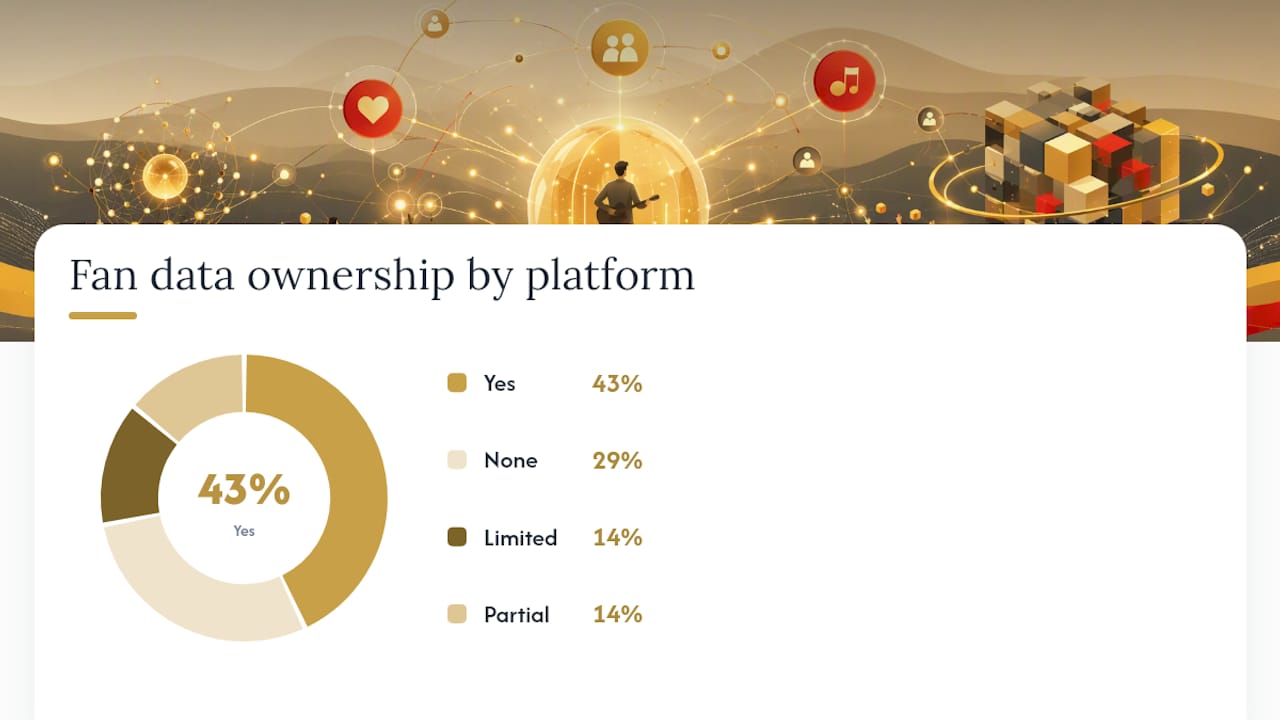
Spotify is where discovery happens at scale, but you own nothing there. Use it as a top-of-funnel channel and drive listeners toward owned platforms.
YouTube rewards depth. A cinematic music video or a behind-the-scenes mini-documentary can hold attention for minutes, not seconds, and that watch time compounds over months. The 2023 Fan Engagement Report confirms that streamers who engage with recommendations spend more — and YouTube’s recommendation engine is one of the most powerful in music.
TikTok is the fastest path to new ears, but the relationship is shallow until you move people somewhere else. Think of it as a door, not a room.
Patreon and Bandcamp are where the financial relationship deepens. Practitioner guidance from FanCircles is direct: shift investment from vanity metrics to owned channels and fan apps. Patreon gives you recurring revenue and a direct line to your most committed listeners. Bandcamp gives you the buyer’s email and a purchase history you actually own. The difference between renting a relationship on Instagram and owning one through Bandcamp is the difference between a tenant and a homeowner.
Discord sits between social and owned. You control the server, but you don’t own email addresses. It’s best for real-time community depth — listening parties, Q&As, fan challenges — rather than as a primary CRM.
Email is the most underused channel in independent music. Open rates for music newsletters consistently outperform social reach, and you own the list regardless of what any platform decides to change.
When resources are limited, prioritize two channels: one for discovery (TikTok or YouTube depending on your content style) and one for depth (email or Discord). Add a third only when the first two are producing consistent engagement.
Pro Tip:Build your community on rented platforms for reach, but always be moving people toward something you own. Every TikTok bio, every Spotify artist profile, every YouTube description should point toward an email signup or a Bandcamp page.
How do fan communities convert to real revenue?
Community behavior maps to revenue in ways that are more direct than most artists realize. The key is matching the right offer to the right fan tier.
Merch converts best when it carries meaning beyond the product. Limited drops tied to a release moment, a tour date, or a fan milestone create urgency and a sense of participation. Superfans buy merch partly for the object and partly for the story it lets them tell about themselves.
Subscriptions and patronage are the most predictable revenue stream for independent artists. A Patreon tier at $5–10/month with exclusive content — early access, demos, behind-the-scenes video, a monthly voice note — can generate stable monthly income from a few hundred committed fans. The 1,000 true fans framework is worth revisiting here: 500 fans at $10/month is $5,000 in monthly recurring revenue before a single stream or show.
Ticketing and experiences are where superfan spending accelerates. A small-room listening event, a virtual hangout, or a fan-only acoustic session can command a premium price precisely because access is limited.
Direct sales through Bandcamp let you capture the full value of a purchase minus a modest platform fee, and you keep the buyer’s email. That combination makes it the most efficient direct-to-fan revenue channel available. For a deeper look at how this model works, the future of direct-to-fan music is worth reading in full.
Licensing and sync are less community-dependent but benefit from community visibility. A song that has accumulated genuine streaming history and fan engagement is a more credible pitch to a music supervisor than one with no social proof.
A simple A/B test for your first subscription tier: Launch two versions of a Patreon tier in the same week — one at $5/month with three benefits, one at $10/month with four benefits. Run both for 30 days and compare conversion rates. The result tells you more about your fans’ willingness to pay than any amount of guessing.
Platform fees matter. Email and Discord cost almost nothing. Factor those numbers into your pricing before you set a tier.
What does a 30/90/180-day community-building plan look like?
Building a fan community is not a launch event. It’s a practice. The first six months are about creating infrastructure, testing what resonates, and recruiting the people who will help sustain it.
Days 1–30: lay the foundation
- Choose your two primary channels (one for discovery, one for depth) and set them up completely — bio, links, pinned content, community guidelines
- Send a personal message or post to your existing audience announcing the community and what they’ll get by joining
- Post three pieces of content in the first week: one behind-the-scenes, one piece of finished work, one question or prompt that invites a response
- Set up an email capture — a free download, an exclusive track, or early access to something — and link it everywhere
- Define your community guidelines: what’s welcome, what isn’t, and how violations are handled
Days 31–90: build momentum
- Launch a weekly content rhythm: behind-the-scenes on Mondays, fan challenge or prompt on Wednesdays, finished work or release news on Fridays
- Host your first live community event — a Discord listening party, a YouTube live Q&A, or an Instagram Live — and keep it under 45 minutes
- Identify your three to five most active members and invite them to a private moderator channel; give them early access and a clear role
- Run your first limited merch drop or subscription offer and track conversion against your email list size
- Tag all campaign content consistently so you can measure uplift against your baseline
Days 91–180: deepen and sustain
- Launch a co-creation project: a fan remix contest, a collaborative playlist, or a fan-submitted visual for an upcoming release
- Recruit one or two volunteer moderators from your most active members and give them written guidelines and an escalation path
- Review your KPIs at the 90-day mark and cut the content type with the lowest engagement; double down on the highest
- Begin migrating your most engaged Discord or social followers toward email with a specific offer
- Plan a quarterly “rest phase” — a week or two of pure giving with no asks — to prevent community fatigue
Weekly content types that sustain engagement:
- Behind-the-scenes production moments (raw, unpolished, honest)
- Fan challenges tied to a specific song or lyric
- Co-creation prompts (“what should the next video look like?”)
- Early access to demos or unreleased material
- Personal voice notes or text updates that feel direct and human
For in-person activation that complements your online community, hosting or joining a music jam is one of the most underrated ways to convert online followers into real-world advocates.
How do you measure whether your community is actually working?
Measurement without a framework produces noise. These are the KPIs that actually tell you something.
Core KPIs to track:
- Engagement rate: replies, shares, and saves divided by reach — a more honest signal than raw follower count
- Retention: what percentage of your Discord members or email subscribers are still active after 30, 60, and 90 days
- Conversion to paid: what percentage of your community has made at least one purchase (merch, ticket, Bandcamp, Patreon)
- Streams uplift: the percentage increase in streams during a campaign window compared to your baseline week
- Ticket conversion: what percentage of your email list or Discord members bought tickets to your last show
- LTV proxy: average revenue per fan over a 12-month period, estimated from your Bandcamp and Patreon data
A simple dashboard has three rows. The top row holds your weekly pulse metrics: engagement rate, new email subscribers, and streams. The middle row holds your monthly conversion metrics: Patreon MRR, Bandcamp sales, and ticket conversions. The bottom row holds your quarterly health metrics: retention rate, LTV proxy, and community growth rate.
Affordable tools for tracking: Spotify for Artists (free), Mailchimp or ConvertKit for email analytics, Patreon’s built-in dashboard, and a simple Google Sheet for cohort comparisons. You don’t need enterprise software to see what’s working.
Attribution in practice: tag every campaign with a consistent label (a UTM parameter in links, a specific hashtag, a release-week identifier). Define a short campaign window — typically 7–14 days around a release or event. Compare streams, pre-saves, and ticket clicks during that window against the two weeks before. That cohort comparison, described in artist-fan engagement research from the University of Alabama, is the simplest way to connect community actions to measurable outcomes.
Cadence: check engagement rate and new subscribers daily during a campaign, weekly otherwise. Review conversion metrics monthly. Run a full KPI audit quarterly and adjust your channel mix based on what the numbers show.
What risks and ethical issues come with fan communities?
Community energy is real, and it can turn in directions you didn’t intend. Knowing the risks before they arrive is the difference between a healthy community and a crisis.
Privacy and data misuse are the most legally consequential risks. If you collect fan emails or purchase data, you are responsible for how that data is stored and used. US-based operations should consult legal counsel about compliance with applicable data privacy laws before launching any fan data collection program.
Toxicity and harassment tend to emerge when communities grow faster than their governance structures. A server or comment section without clear rules and active moderation becomes a space where the loudest voices set the tone, and that tone is not always welcoming. Write your community guidelines before you need them, not after.
Parasocial boundary issues are subtler but equally serious. Fans who feel an intense personal connection to an artist can develop expectations that no real relationship could satisfy. Being warm and accessible is a strength; being available without limits is a path to burnout for both artist and fan. Set clear boundaries about what you share, how often you respond, and what kind of contact is appropriate.
Artist and moderator burnout are underreported. Moderating a community is emotional labor. Volunteer moderators who feel unsupported or unappreciated leave, and their departure can destabilize the community they built. Pay attention to your moderators’ wellbeing, rotate responsibilities, and acknowledge their contribution publicly.
Platform dependency is a structural risk. A community built entirely on a platform you don’t control can disappear overnight if that platform changes its algorithm, its terms, or its business model. The FanCircles practitioner guidance is clear: own the relationship wherever possible.
The civic spillover question is one that K-pop fandom has made impossible to ignore. Research published in Signs and Society documents how K-pop fan practices — light sticks, coordinated chants, online mobilization — were repurposed during the 2024–2025 impeachment protests in South Korea, functioning as what the researchers call an “affective infrastructure” for collective action. The organizational skills fans develop inside a fandom are transferable. If you ever consider mobilizing your community for a cause, create explicit opt-ins and be transparent about what you’re asking for.
Pro Tip:Post your community guidelines as a pinned message on day one, not after the first incident. Include three things: what kind of content is welcome, what will result in a warning, and what will result in a ban. Simple, visible rules reduce the moderator’s burden and set the tone before it needs to be corrected.
How does DRVVYN Sound approach community, and what can you replicate?
Drvvynsound operates as an independent alternative R&B company under the artist brand DRVVYN, and the community approach reflects the music itself: emotionally direct, visually immersive, and built around the themes of love, reflection, and personal growth that run through every release.
The channels Drvvynsound uses follow the owned-first logic described throughout this article. Streaming platforms (Spotify, YouTube) serve as discovery surfaces. Social content — particularly cinematic visualizers and short-form clips — creates the emotional entry point. Owned channels (email, direct fan communication) are where the relationship deepens. The alternative R&B production style that defines DRVVYN’s sound gives the community a specific aesthetic identity to gather around, which makes co-creation prompts and fan challenges feel natural rather than manufactured.
Replication checklist for independent artists:
- Choose a clear aesthetic identity that your community can recognize and reflect back to you
- Set up one owned channel (email or Discord) before your next release and drive all campaign traffic toward it
- Release at least one piece of behind-the-scenes content per release cycle that shows the emotional process, not just the finished product
- Identify your five most engaged fans and give them early access to something; watch what they do with it
- Track one conversion metric (Bandcamp sales, Patreon sign-ups, email list growth) for 90 days before adding complexity
The qualitative outcomes Drvvynsound has observed follow the patterns the research predicts: fans who feel emotionally connected to the music become advocates without being asked. They share, they comment, they bring others in. The emotional depth of the music is itself a community-building mechanism, because it gives listeners something to feel together.
Three lessons any practitioner can apply immediately:
- Aesthetic coherence is a community signal. When your visual and sonic identity is consistent, fans know what they’re part of and can represent it to others.
- Emotional honesty converts better than polish. Fans respond to the process, the doubt, the late-night session — not just the finished product.
- Small and committed beats large and indifferent. A Discord server with 200 people who genuinely care about your music will generate more streams, more sales, and more word-of-mouth than a social following of 20,000 passive scrollers.
The single most important thing you can do for your community
Build one thing you own before you optimize anything you rent.
Every platform discussed in this article — Spotify, TikTok, YouTube, even Discord — operates on someone else’s terms. The algorithm changes. The reach drops. The rules shift. An email list, a Bandcamp buyer database, or a Patreon membership roster belongs to you regardless of what any platform decides next quarter. The research is consistent on this point, and the artists who have built durable independent careers have almost always done it by owning the relationship at its core.
Start today: add an email capture to every platform profile you have, offer something specific in exchange for the signup, and send your first email this week. Not a newsletter. A personal note. Something that sounds like you wrote it at midnight because you meant it.
Drvvynsound offers what independent artists actually need
Most artists spend years building audiences on platforms they don’t control, then wonder why the relationship feels thin. Drvvynsound was built on a different premise: that emotionally immersive music, paired with cinematic visual content and a direct-to-fan strategy, creates the kind of connection that lasts past the algorithm.
The services Drvvynsound offers — original alternative R&B releases, visual media production, artist branding, music publishing, and direct-to-fan campaign support — are designed for artists who want depth, not just reach. Whether you’re looking to license music that carries genuine emotional weight, develop your artist brand around a coherent identity, or build a fan community strategy grounded in the principles this article describes, Drvvynsound has the creative infrastructure to support it.
Explore the direct-to-fan music model Drvvynsound uses, or start with the alternative R&B mood playlist guide to hear what emotionally driven music sounds like in practice. When you’re ready to talk about what a community-first approach could look like for your project, reach out at Drvvynsound.
Sources
These are the primary sources that informed this article, organized by type.
Academic and peer-reviewed:
Industry reports:
Practitioner and editorial: