

Music Marketing
100-Word Copyable Pitch: Spotify Playlist Pitching for Indie Artists
Follow Spotify-for-Artists rules and use a copyable 100-word pitch plus a 72-hour first-week checklist to make your editorial submissions count for indie…
By DRVVYN · · 9 min read

Open Spotify for Artists, go to your upcoming release, and click Pitch. Submit at least seven days before release, but give yourself ten to fourteen when you can, and fill in every field with real, specific detail about the song rather than vague enthusiasm. That single act determines whether your track is even eligible for Release Radar. It does not promise a spot on an editorial playlist, but skipping it, or rushing it, quietly closes doors you didn’t know were open.
TL;DR:
- Submitting your pitch at least 10 to 14 days before release maximizes the chance of eligibility for Release Radar and allows for metadata corrections.
- Only one song per release can be pitched, and the track chosen should be the most representative of your project with a clear story and specific genre tags.
- Ensure your artist profile is claimed, your metadata is accurate, and your distributor’s release date matches Spotify’s data before submitting.
- The pitch should be concise, honest, and tailored to a specific playlist lane, including concrete plans like videos or collaborations to strengthen your case.
- Paying for playlist placement or streams violates Spotify’s terms and provides no true indication of audience demand, risking account penalties.
How Do You Submit a Spotify Playlist Pitch?
The mechanics are simple, but the details inside each step are where most artists lose ground. Spotify for Artists is the only channel for this, and official Spotify guidance treats song and video pitches as two separate processes with their own eligibility rules.
Here’s the path from login to submission:
- Log into Spotify for Artists with an account that has Admin or Editor access. If you’re signed up through a manager or label rep with lower permissions, you won’t see the pitch tool at all.
- Go to Music, then Upcoming. Your unreleased track needs to already be delivered by your distributor and visible here before you can touch it.
- Select the track you want to pitch. Only one song per release gets a pitch, so choose the version you actually want editors hearing, not a placeholder.
- Click Pitch and open the submission form.
- Fill in every field genre, mood, instrumentation, a short story, and any promotional context. Blank fields tell an editor nothing worth acting on.
- Submit and confirm the pitch shows as submitted under your release.
If your track isn’t showing up in Upcoming, the usual culprit is distributor timing. Most distributors need several days to push metadata to Spotify’s backend, and a typo in the release date or artist name can also stall the listing. Recheck your distributor dashboard before assuming the tool is broken.
What Should Your Pitch Actually Say?
Editors read thousands of these a week, and the ones that land tend to be short, specific, and honest rather than dressed up. According to Berklee’s Take Note, editors respond to context, not hype: a clear story, a sense of where the song fits, and any press or video plans already in motion. A related Playlist Atlas guide frames the ideal pitch as an answer to five questions: who you are, which song this is, which playlist lane it belongs in, why it fits, and what happens next.
Aim for 80 to 150 words. That’s enough to say something real without burying the editor in adjectives.
- State your genre and mood tags narrowly and honestly. Calling a mid-tempo alt-R&B track “pop, indie, electronic, chill” tells an editor nothing usable.
- Mention concrete plans: a video release date, a co-writer with a track record, a sync placement in progress.
- Skip generic praise like “this song will be huge.” Editors have heard it from every pitch in the queue.
A weak line reads: “This is my best song yet and fans are going to love it.” A strong line reads: “This is a slow-burn alt-R&B track about long-distance grief, built for a late-night mood lane, with a performance video dropping the same week.”
Pro Tip:Write your pitch story to fit one specific playlist lane, not five. Editors would rather place a song precisely than guess where a vague description belongs.
Timing and Delivery Checklist Before You Hit Submit
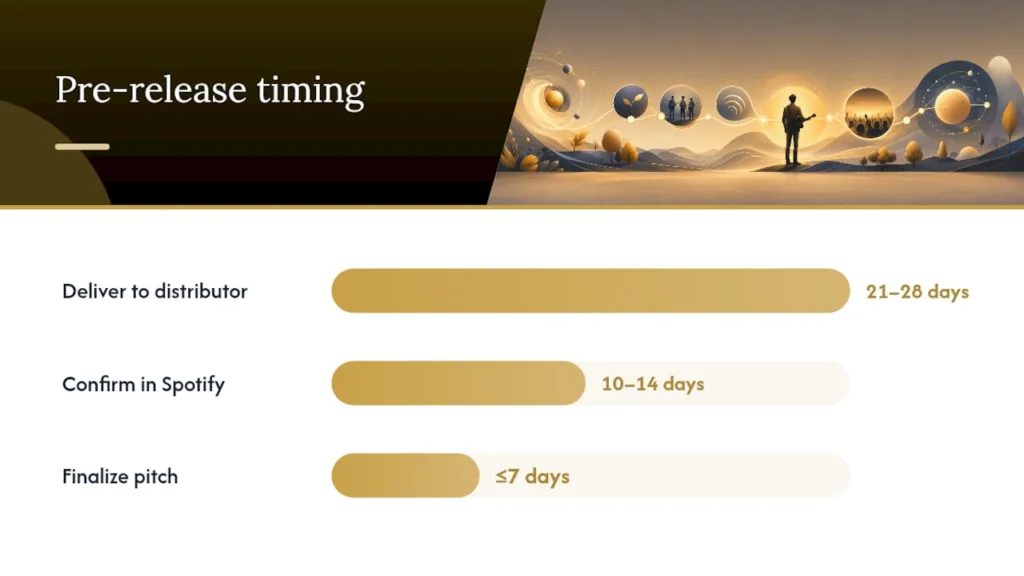
The seven-day window is a floor, not a target. Artist Advisory’s timeline guidance recommends delivering to your distributor 21 to 28 days before release, confirming the track is visible in Spotify for Artists 10 to 14 days out, and finalizing your pitch no later than seven days before release, ideally earlier.
Before you submit, run through this:
- Confirm cover art meets Spotify’s size and format specs.
- Verify your artist profile is claimed and shows correctly.
- Double check songwriter and producer credits are accurate.
- Confirm the release date matches what your distributor has on file.
- Reread every metadata field for typos, especially the featured artist and genre tags.
If the pitch tool still won’t show your track, check for a mismatch between your distributor’s release date and what Spotify has ingested. That gap is the most common reason a track technically exists but the pitch form won’t load it.
What Happens After You Submit the Pitch?
Editorial review is a manual process. A human reads your pitch, and there’s a real chance they pass your song to a different playlist than the one you had in mind, or skip it for that cycle entirely. Spotify’s own editors have said pitching does not guarantee placement, no matter how clean the submission is.
Even without an editorial pick, your pitch still feeds Release Radar eligibility, and a strong first week there can matter more than one playlist slot. If a curator chooses to feature your song on a flagship playlist, it may get pinned to the top under “This Is” or a similar banner for a limited stretch before it rotates down.
Watch these signals in the two weeks after release:
- Save rate relative to streams
- Completion rate (are people finishing the song or dropping off early)
- Playlist adds outside your own submissions
- Geographic clusters where the song is gaining traction
Behind the Playlists notes that editors field thousands of pitches, and historically a substantial minority of pitched tracks have landed at least one editorial placement. That means the majority of pitches don’t get picked, which is exactly why your algorithmic metrics deserve as much attention as the pitch itself.
How Is Video Pitching Different From Song Pitching?
Video pitching lives in a separate part of Spotify for Artists, and uploaded videos may still be rolling out under beta access depending on your account. Eligibility depends on the video being an official music video or performance clip, not a lyric reel or fan-made cut. Delivery method changes your seven-day window too. Spotify’s video pitching guidance treats label-delivered and artist-uploaded videos differently. In the pitch itself, describe the visual style, the story the video tells, and what promotion is already planned around it. Not every account will see the upload option, so check your dashboard directly rather than assuming access.
Common Mistakes That Quietly Kill a Pitch
Paying for placement or buying streams is against Spotify’s terms and can get a track or account flagged. It also tells editors nothing true about audience demand, which is the opposite of what a pitch is supposed to communicate.
- Leaving genre or mood fields blank, or stuffing them with every tag that might apply
- Writing a pitch with no story, just adjectives like “fire” or “next level”
- Submitting the pitch two or three days before release, leaving no room to fix an error
- Ignoring a mismatched release date between your distributor and Spotify for Artists
If you catch one of these after submitting, fix the metadata immediately, confirm your distributor has pushed the correction, and shift your energy toward organic first-week engagement instead of resubmitting. You generally can’t rep itch the same release once it’s live.
DRVVYN Sound’s Copyable Pitch Template and 72-Hour Checklist
Here’s a template built around the five questions editors actually respond to. Fill in the brackets and trim to around 100 words.
“I’m [artist name], an independent R&B artist. This is ‘[song title],’ a [tempo/mood] track about [one-sentence story]. It fits [specific playlist lane, e.g. late-night R&B or moody alt-soul]. [Collaborator name] produced/features on it, and I’m releasing a on [date].”
- Confirm cover art specs, verified profile, and credits before the pitch window opens.
- Screenshot your distributor confirmation as proof of delivery timing.
- Check Admin or Editor access on Spotify for Artists before pitching.
- In the first 72 hours after release, ask your core fans directly for saves, post one visual asset daily, and have any featured collaborator share to their own audience.
Pro Tip:Match your pitch story to the mood of the playlist lane you’re naming, not the mood of your whole catalog. A single well-aimed pitch beats a broad one every time.
Publisher Perspective: Pitching Inside a Bigger Release Plan
Pitching gets you in the room. It doesn’t win the room for you. Editorial placement is one of three discovery paths alongside algorithmic surfaces and independent curators, and treating it as the whole strategy is how artists end up disappointed by a single missed pick. DIY works fine when you have the time to manage metadata, timing, and follow-up yourself. When the release has real scale behind it, our playlist discovery guide and storytelling breakdown are worth pairing with your pitch.
— DRVVYN Sound
Where DRVVYN Sound Fits in Your Release Plan
A pitch form only holds so many words, and most artists run out of room right where the visuals and story could seal the case. Support is available for release planning, visualizer and video assets, and campaign execution built around the same lane you’re pitching for. If you’re releasing on a timeline that leaves no room for trial and error, or you want visuals ready before your pitch window opens, that’s when bringing in support makes sense over doing it solo. Start by looking through our visualizer ideas built for release campaigns and reach out to plan your next drop around a pitch that has real assets behind it.
Sources
Core guidance comes from Spotify’s official pitching support page and Spotify’s editor Q&A, alongside practical breakdowns from Berklee and Playlist Atlas linked throughout this guide.
- Pitching music and videos to Spotify playlist editors – Spotify
- Behind the Playlists: Your Questions Answered by Our Playlist Editors – Spotify
- How to get your music on Spotify playlists — Berklee Take Note
- Spotify for Artists: how to pitch your song to editorial playlists – Playlist Atlas
FAQ
How Far in Advance Should I Pitch My Song?
Spotify requires at least seven days before release for Release Radar eligibility, but a 10 to 14 day buffer gives you room to fix metadata errors before they matter.
Does Pitching Guarantee a Playlist Placement?
No.
Can I Pitch More Than One Song per Release?
No, Spotify allows one song pitch per release, so choose the track that best represents the project before submitting.
Is Video Pitching the Same Process as Song Pitching?
No, video pitching is a separate submission with its own eligibility rules, and artist-uploaded videos may still be limited by beta access.
What Happens if I Pay for Playlist Placement?
Paying for placement or streams violates Spotify’s terms and can get your account flagged, and it tells editors nothing true about real listener demand.