

Listening & Culture
Your Guide to Cinematic Listening Sessions
A guide to cinematic listening sessions: shape the room, choose the right sequence, and let sound turn an ordinary night into a place you can feel deeply.
By DRVVYN · · 6 min read
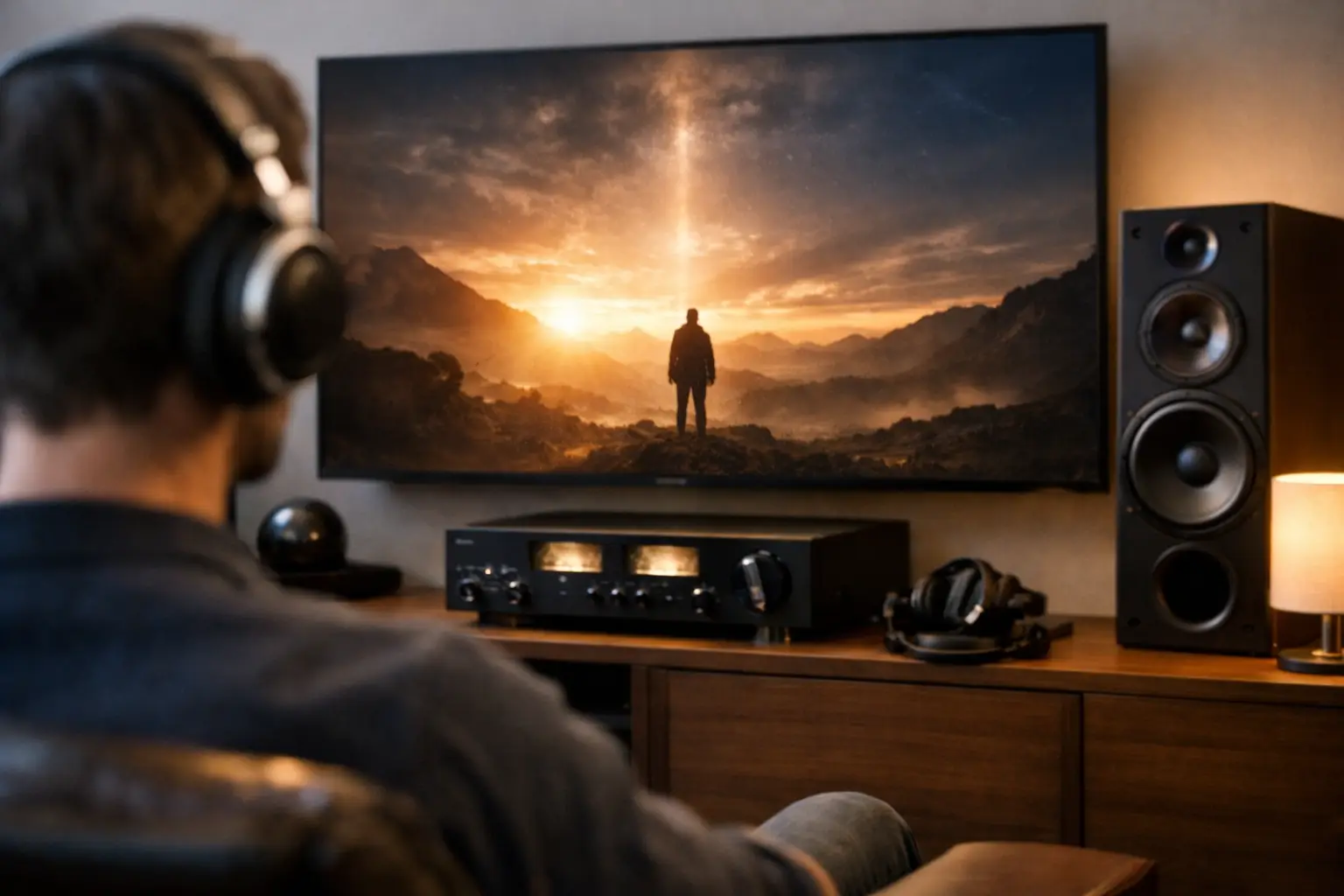
There is a difference between hearing a song and stepping inside it. A guide to cinematic listening sessions starts there: with the choice to let a record hold the room for a while. No skipping after ten seconds. No dozen open tabs. Just a sound, a setting, and enough quiet for the details to find you.
Cinematic listening is not about making your life look dramatic. It is about noticing the drama already there: headlights moving across the ceiling, a text you have not answered, rain against glass, the feeling that midnight makes everything more honest. The right music does not explain those moments. It gives them a frame.
Start with a real moment
A cinematic session works best when it has a reason to exist. Maybe the day left too much noise in your chest. Maybe you are driving with nowhere urgent to be. Maybe you need an hour where nobody expects an answer from you.
Name the feeling before you choose the music. Not perfectly. A few words are enough: restless but hopeful, warm and distant, after-hours focus, soft grief, low-lit romance. This keeps the session from becoming a random queue. You are not searching for the biggest song. You are building a place to land.
The setting matters, but it does not need to be expensive or staged. A bedroom with one lamp on can feel more cinematic than a carefully designed room that still has notifications flashing across it. Turn down the overhead lights. Leave one source of warmth. Let the outside world stay visible if it helps – city windows, a porch, the dark line of trees beyond the glass.
If you are listening during the day, work with what is there. Sun through blinds has its own rhythm. A slow morning can carry a different kind of intensity than a late night. Cinematic does not always mean dark. It means intentional.
Give the music an arc
The strongest sessions move like a scene, not a shuffle. Think in three parts: arrival, immersion, and release. The first few songs should clear the air. They set the color without demanding too much from you. Let the opening feel like a door closing behind you.
From there, deepen the mood. This is where a bassline can linger longer, vocals can get closer, and the production can widen into something that feels physical. Choose tracks that speak to one another through texture, emotional weight, or pace. A song does not need to sound identical to the one before it. It just needs to feel like the next shot.
The final stretch should not always end at the highest point. Sometimes the right ending is a comedown: an instrumental, a distant vocal, a track that leaves space around the feeling instead of tying it up. You are not making a playlist to impress anyone. You are letting the room breathe again.
A session can be five songs or fifty minutes. Longer is not automatically deeper. If the mood starts to blur, stop. Leave a little unsaid. The best records often stay with you because they do not chase closure.
Sequence by feeling, not genre
Genre can be useful, but it is not the real thread. An ambient passage can sit beside slow R&B. A cinematic score can open into nocturnal electronic music. A raw vocal can follow an instrumental if both songs carry the same ache.
Listen for the handoff between tracks. Does the final note leave room for the next song to enter? Does the energy rise too sharply? Does a lyric break the spell by saying more than the moment needs? These choices are subtle, but they are what turn a collection into a journey.
Avoid treating the playlist like a test of taste. Familiar songs belong if they still mean something. So do songs you barely know, especially when they leave enough mystery to grow into. The balance depends on the night. New music brings discovery. Known music brings history.
Protect the atmosphere
The smallest interruptions can flatten a session. A group chat, a loud autoplay transition, an ad, or the instinct to check whether someone saw your story can pull you out of the world you were building. Put your phone face down or across the room. If you need it for music, turn on a focus setting and let the screen go dark.
Use the best listening setup you actually enjoy. Headphones reveal private details – breaths, room tone, little echoes around a snare. Speakers let the sound change the air around you. Neither is the correct answer. Headphones are better when you need to disappear inward. Speakers are better when you want the music to become part of the space.
Volume deserves restraint. Turn it up until the music feels present, not punishing. Cinematic listening is not about force. A quiet track should be allowed to stay quiet. That contrast makes the heavier moments hit harder when they arrive.
And resist the urge to document every minute. A photo of the lamp, the dashboard, the record playing – that can be part of the ritual. But if you are constantly translating the moment for an audience, you leave the moment. Some nights are better when they belong only to you.
Let visuals support, not compete
A visual can make the session feel more dimensional: a muted film playing without sound, rain on a window, a late train ride, grainy footage of somewhere you have never been. But the music should remain the center. If the visual asks for too much attention, it becomes a different experience.
Choose images with motion but not much plot. Slow streetlights. Ocean water after sunset. An empty road. Old concert footage. Even a blank screen can work. The point is not to create a perfect aesthetic. It is to give your mind somewhere gentle to rest while the music does the deeper work.
For some listeners, especially when the day has been crowded, no visual is the better choice. Close your eyes. Sit on the floor. Let the songs make their own images. The mind is often more cinematic than anything on a screen.
Make room for what comes up
The music may bring back a person, a place, or a version of yourself you thought you had moved past. Do not rush to make it productive. You do not need to turn every feeling into a journal entry, a caption, or a breakthrough.
Still, it can help to keep a note nearby. Write down one line after the session: the track that stayed with you, the image it created, the thing you were avoiding, or simply the time the room started to feel different. Over weeks, those small notes become a map of what your inner life has been asking for.
This is part of why mood-based curation matters. A well-built sequence can meet you without demanding that you perform your feelings. DRVVYN Sound is built around that kind of return – music as a space, not just a stream of releases.
Build a ritual you will return to
Cinematic listening gets stronger when it becomes familiar. Pick a recurring window for it: Sunday night, the drive home after a long week, the first hour after everyone else is asleep. Repetition gives the ritual weight. Your body starts to recognize the signal that it is safe to slow down.
Do not pressure every session to be profound. Some will be beautiful. Some will just help you get through the evening without carrying the whole day into bed. Both are worth having.
Keep refining your sequence as you change. Remove songs that no longer feel true. Save the ones that quietly become landmarks. A cinematic listening session is not an escape from your life. It is a way of hearing it more clearly, one scene at a time.