

Listening & Culture
How to Build a Night Playlist That Holds the Mood
Learn how to build a night playlist with a slow emotional arc, intimate transitions, and songs that stay with you long after the room goes quiet again.
By DRVVYN · · 7 min read
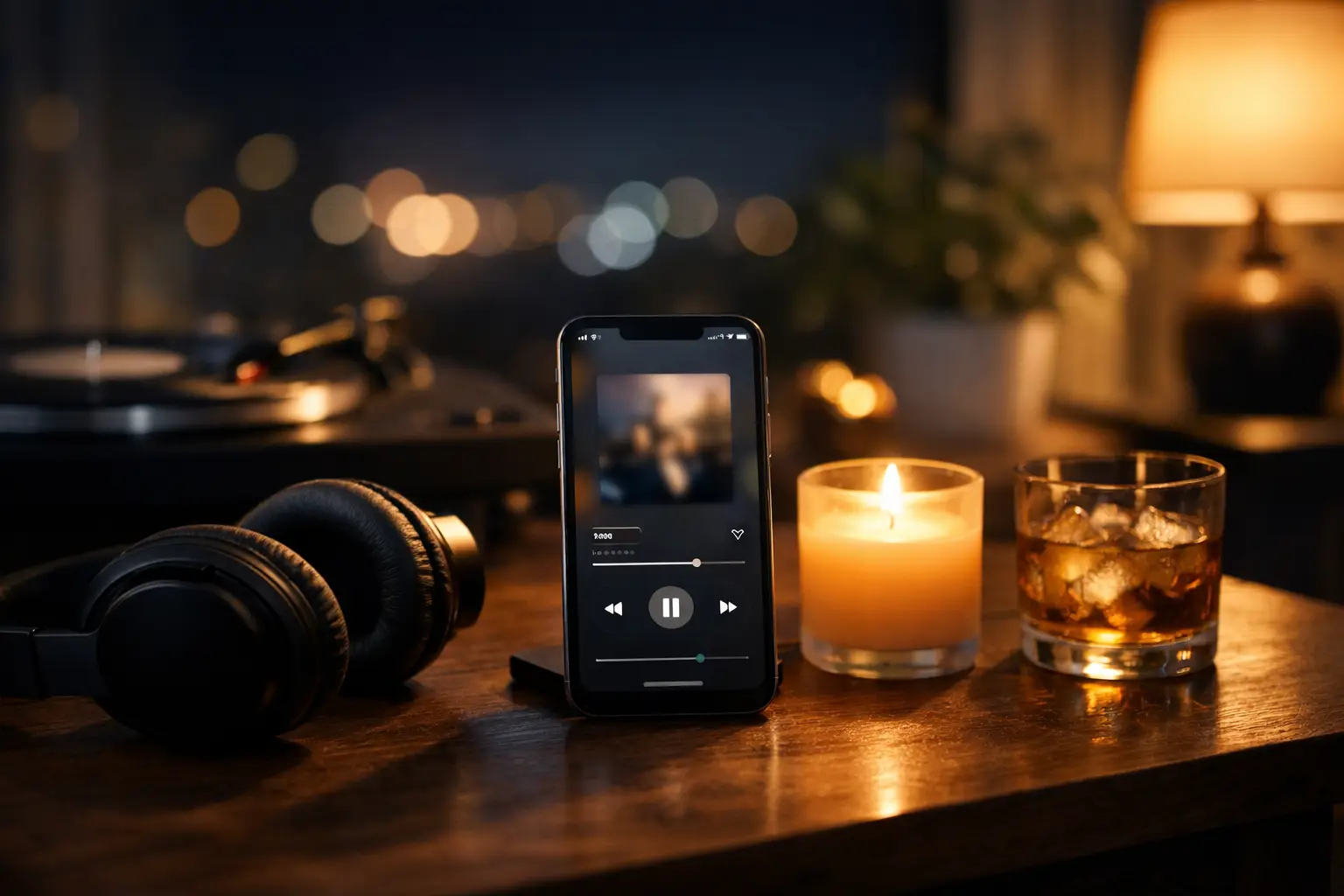
A good night playlist does not announce itself. It finds you after the messages slow down, after the drive home, when the room is dim and your thoughts finally have space to speak. Learning how to build a night playlist is less about collecting songs with “late night” in the title and more about creating a place someone can stay in for an hour or two.
The right sequence can make a familiar song feel newly honest. It can soften the edges of a long day, hold the silence between two people, or turn a walk through empty streets into something cinematic. That feeling is built on intention.
Start with the night you want to enter
“Night” is not one mood. It can be warm and close, lonely and restless, romantic, reflective, or a little dangerous. Before adding anything, name the scene in a sentence.
Maybe it is: 2:14 a.m., city lights through the window, no need to be anywhere tomorrow. Or: a slow drive after saying more than you meant to. That one line gives the playlist a center. It tells you whether the drums should hit hard, whether the vocals should feel distant, and whether the ending needs release or simply less noise.
Avoid trying to make one playlist carry every version of after-dark life. A set built for candlelight rarely works for a solo freeway drive. Both can be great. They just ask for different shadows.
Give the playlist a name that feels like a location or a private thought rather than a genre label. “After Hours” could mean anything. “The Apartment Is Finally Quiet” tells the listener where to stand.
Choose an opening that leaves the door open
The first track should not demand too much too soon. It is an entrance, not the whole room.
Look for an intro with air in it: muted percussion, a patient bassline, a vocal that arrives without reaching. The song can be beautiful, even recognizable, but it should make the listener lean in. A loud, immediate favorite may work for a party playlist. At night, it can break the spell before it begins.
This is where many playlists lose their shape. They start with the biggest song because it feels safe, then spend the rest of the sequence trying to recover the atmosphere. Start slightly below the emotional peak. Let the night earn its intensity.
A good test is simple: press play with your screen face down. If the opening makes you want to skip ahead, it is probably too still. If it feels like someone turned on every light at once, it is too much. Keep looking for the track that creates curiosity.
Build an arc, not a stack of songs
The best night playlists move like a conversation. There are pauses, shifts in distance, moments when the music says what you have not put into words. Think in three movements: arrival, depth, and aftermath.
Arrival: set the temperature
The first few songs establish the world. Keep the energy controlled and the production cohesive. This does not mean every track needs the same tempo or sound. It means they should share a temperature.
A hushed R&B record can sit beside ambient electronic music if both feel weightless and intimate. A smoky soul vocal can follow a minimal hip-hop cut if the drums enter with restraint. Genre matters less than emotional texture.
At this point, resist the urge to add all your favorites. The goal is trust. You are telling the listener, quietly, that this playlist knows where it is going.
Depth: let the feeling change shape
Once the space is established, bring in the songs that carry more gravity. This is where a beat can deepen, a voice can crack open, or a lyric can land closer to the bone.
The middle is allowed to be complicated. A night playlist does not need to stay sad, sensual, or peaceful from beginning to end. In fact, a little tension gives it a pulse. Pair a track that feels suspended with one that has a subtle forward motion. Follow a confessional lyric with something more spacious, so the listener has room to absorb it.
Pay attention to what changes between songs. If the previous track ends in a cloud of reverb, a stark piano entrance can feel intentional. If it ends abruptly, another abrupt beginning may feel like a collision unless that friction is the point. Transitions do not have to be invisible. They just need to feel chosen.
Aftermath: do not confuse quiet with empty
The final stretch should feel like the room after everyone leaves. The music can become softer, but it should still have a purpose.
Choose songs that release pressure without turning sentimental. Instrumentals, stripped-back vocals, and slow-burning closers often work well here. The last track matters more than people think. It leaves a trace. A good closer does not explain the night. It lets the listener carry something unresolved into the quiet.
If the playlist ends with a track that feels too final, it may make the whole experience feel smaller. If it fades into nothing, it can invite a replay. It depends on the night you are building. Some nights need an answer. Most only need somewhere to rest.
Match energy before genre
A playlist can move from alternative R&B to downtempo electronic to soft indie without feeling scattered. What matters is whether the emotional energy makes sense from one track to the next.
Listen for the details that connect songs: low, warm bass; roomy drums; a certain kind of vocal closeness; keys that seem to glow rather than shine. These small threads create continuity. They are often stronger than genre labels.
Tempo still matters, but it is not the whole story. Two songs at nearly the same BPM can feel completely different if one is anxious and the other is tender. Likewise, a slower song can feel like an escalation when its lyric is more exposed. Build with your ears, not just the numbers on a screen.
If a track is perfect on its own but changes the air too sharply, save it for another sequence. Leaving out a great song is not failure. It is taste.
Let lyrics have their moment
At night, words tend to land harder. A line about regret, desire, distance, or faith can shift the entire playlist. That can be powerful, but too many lyric-heavy songs in a row can make the experience feel crowded.
Give the listener space between emotional confessions. Place a more textural track after a song with a devastating chorus. Let a groove carry the mood for a few minutes before the next lyric asks for attention.
Also consider point of view. A playlist full of songs that speak directly to “you” can feel intimate. A run of songs from an inward, first-person perspective can feel like reading someone’s journal. Neither is better. The choice changes the relationship between the music and the listener.
Edit until every track belongs
The first version is usually too long. That is normal. You are discovering the shape while you build it.
Listen from beginning to end in one sitting, ideally at the time of night the playlist is meant to live. Do not shuffle. Notice where your attention wanders, where a song feels early, and where you reach for the skip button. That instinct is useful information.
Cut the tracks that only match the genre. Keep the ones that protect the mood. A strong 16-song playlist can feel more immersive than 45 songs gathered under the same dark cover image.
It also helps to leave it alone for a day, then return without looking at the track list. If the sequence still feels like a single world, you are close. If you can hear the moments where you added songs out of habit, edit again.
For a platform like DRVVYN Sound, that cohesion is the point. A playlist should feel less like a recommendation feed and more like a small, deliberate universe.
Keep it alive without breaking it
A night playlist can evolve, but constant updates can erase its memory. If the sequence is built around a particular season, feeling, or late-night chapter, treat it like a finished piece for a while.
When you do add music, replace rather than endlessly expand. Ask what the new track changes. Does it deepen the existing world? Does it create a better transition? Or do you simply like it right now?
There is room for both kinds of playlists: the one that stays untouched like a photograph, and the one that changes as your nights do. Just be honest about which one you are making.
Tonight, start with one song that makes the room feel different. Then add the song that knows what to do after it. Let the rest reveal itself slowly.