

Music Business
Patreon vs Ko-fi for Musicians: Keep More After Patreon’s 10% Fee
Compare Patreon and Ko-fi fees, payout timing, and features for musicians. Real take-home math after Patreon's 10% fee, plus a DRVVYN Sound playbook for…
By DRVVYN · · 11 min read

Ko-fi wins for creators living on tips, commissions, and one-off shop sales. Patreon wins for creators building structured monthly memberships with tiers and gated content. The math shifted after Patreon’s 2025 fee change, so the right answer now depends heavily on your income mix, not just your gut feeling about which platform feels friendlier. This article walks through the actual fee math, feature tradeoffs, and a decision path so you can pick with confidence instead of guessing.
TL;DR:
- Ko-fi’s free tier easily supports one-off tips and small sales, but its 5% fee on memberships becomes less advantageous at higher recurring revenue.
- Patreon’s 10% fee and advanced membership tools make it ideal for creators with structured tiers and gated content, especially if they prioritize community features.
- Payment processing costs, particularly the fixed $0.30 fee per transaction, significantly impact small pledges, so setting a minimum pledge amount is crucial for maintaining margins.
- Combining Ko-fi for casual support and sales with Patreon for memberships offers a flexible approach suited for creators at different income levels.
- Audience ownership is limited on both platforms, so building and maintaining an email list is vital for long-term independence and growth.
Patreon vs Ko-fi: The Six Platforms Creators Actually Compare
Most creators researching this decision aren’t only weighing Patreon against Ko-fi. They’re also eyeing Buy Me a Coffee, Bandcamp Subscriptions, Substack, and beehiiv, because the “best” platform depends entirely on what you’re selling and how your fans prefer to pay. Here’s the quick read on each.
Patreon is the membership-first platform. If your business model is recurring monthly tiers, exclusive content drops, and a community that expects a patron-manager experience, Patreon still has the deepest toolkit. It charges a standard 10% platform fee for creators who joined after August 4, 2025, though creators with older accounts may retain legacy pricing.
Ko-fi is the lightweight option. Its free tier charges 0% on one-off tips and 5% on memberships, shop items, and commissions, with a flat monthly Gold subscription available for creators who want to eliminate percentage fees entirely.
Buy Me a Coffee sits between the two. You can be live and collecting tips in minutes, which makes it a reasonable pick for creators who want simplicity over deep customization.
Bandcamp Subscriptions exists in its own lane. It’s built for musicians who want fan subscriptions tied directly to a storefront that sells actual music files, vinyl, and merch. If your creative output is albums rather than blog posts or videos, this is worth a look purely for its music-retail muscle.
Substack and beehiiv both skip the tip-jar model entirely and build around paid newsletters. Substack leans on its email-first audience ownership pitch, and beehiiv pushes hard on subscriber-list ownership and growth tooling for creators scaling a paid list. Neither replaces a membership platform for video or audio creators, but both matter if your primary product is written content.
Here’s how the six stack up on the dimensions that actually change your take-home pay and workflow:
A few quick pros and cons worth flagging before you commit:
- Patreon gives you the most mature patron manager and content-gating system, but the 10% fee plus processing can eat a real chunk of small pledges.
- Ko-fi costs nothing on tips, but its 5% cut on memberships means heavy recurring-revenue creators should model the Gold plan before assuming the free tier wins.
- Buy Me a Coffee is dead simple, but its feature depth for memberships doesn’t match Patreon’s tiering options.
- Bandcamp Subscriptions is unmatched for music-retail integration, but it isn’t built for non-music creators (video, writing, art tutorials).
- Substack and beehiiv both hand you stronger subscriber-list ownership than either Patreon or Ko-fi, but neither offers tip jars or shop tooling suited to visual or audio creators.
How Much Do Patreon and Ko-fi Actually Take From Your Pay?
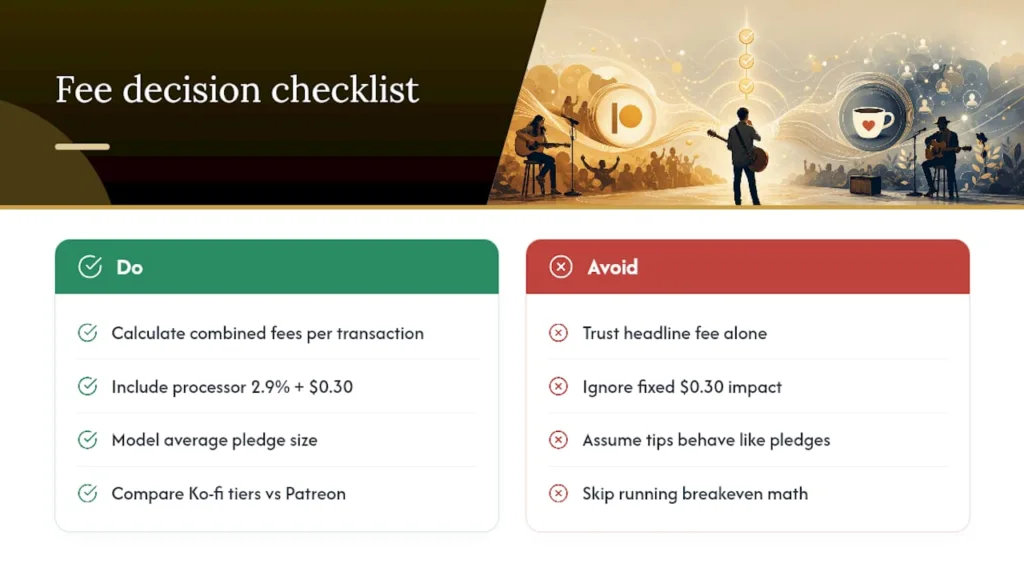
The headline fee percentage tells you almost nothing on its own. What matters is the combined bite of the platform fee and the payment processor, which typically runs around 2.9% plus $0.30 per transaction on top of whatever Patreon or Ko-fi charges. That fixed $0.30 is where the real damage happens, because it hits every transaction equally, whether someone tips you $2 or $200.
Here’s what that looks like in practice for a creator earning $100, $500, and $2,000 a month, assuming a realistic mix of small tips and larger monthly pledges.
The pattern holds across every income level: Ko-fi’s 0% pitch on tips matters most when your revenue comes from one-off support rather than recurring memberships. Once your income shifts toward monthly pledges, Ko-fi’s 5% fee on memberships closes the gap with Patreon’s 10%, and Ko-fi Gold’s flat monthly fee can pull ahead entirely once revenue clears a modest threshold, since the breakeven point depends on how much you’re moving through the platform each month.
Pro Tip: *Run the math on your average pledge size before you commit. A creator collecting mostly $2 to $5 tips loses a much larger percentage to the fixed $0.30 fee than a creator collecting $10+ pledges, because that flat cost stays constant while your pledge size shrinks.
Which Platform Has Better Features for Your Content?
Fees only tell half the story. The other half is whether the platform actually supports how you want to run your creator business day to day.
Membership depth is where Patreon still leads. Its patron manager lets you build multiple tiers, gate specific posts behind specific tiers, track churn, and message subscribers directly. Patreon remains the strongest off-the-shelf toolkit for tiered memberships precisely because that infrastructure has been built out for over a decade. Ko-fi offers memberships too, but the tiering tools feel noticeably lighter, better suited to two or three simple tiers than a complex ladder of perks.
One-off sales and shops flip the advantage. Ko-fi’s shop and commission tools are more polished for creators selling digital downloads, art commissions, or physical merch alongside their support tiers. Buy Me a Coffee offers a similar but simpler shop feature, useful if you just need a clean storefront without much configuration.
Community and discovery features vary widely. Patreon has native discovery tools that can surface your page to new fans browsing the platform, something Ko-fi doesn’t really offer at the same scale. Both platforms integrate with Discord for gated community access, but Patreon’s integration feels more purpose-built for creators running an active fan community alongside their content.
Ownership limitations are the quiet dealbreaker for many creators. Neither Patreon nor Ko-fi hands you a fully exportable subscriber list the way Substack or beehiiv does. If audience portability matters to your long-term strategy, that’s a real tradeoff worth weighing before you build your entire fan relationship inside either platform.
- Patreon: strongest tiering, patron manager, and discovery
- Ko-fi: stronger shop and commission tools, weaker discovery
- Buy Me a Coffee: simplest setup, thinnest feature depth
- Bandcamp Subscriptions: best for music-specific storefronts
- Substack and beehiiv: best for owned, exportable audience data
Pro Tip:Plenty of creators skip the either/or question entirely. A common setup uses Ko-fi as a tip jar and shop for casual supporters, while Patreon runs the core paid membership tier. Combining the two lets you capture spontaneous one-off support without forcing every fan into a recurring commitment.
When Does Your Money Actually Hit Your Bank Account?
Payout timing and dispute handling matter just as much as the fee percentage once real money starts moving. A few things to know before you set up either platform:
- Most creator platforms pay out on a monthly or rolling schedule, typically tied to your connected bank account or payment processor, rather than instantly per transaction.
- Refunds and chargebacks are usually deducted from your next payout, meaning the platform doesn’t eat that cost. You do.
- The fixed $0.30 processing fee disproportionately hurts $1 to $5 pledges, since it can represent 6% to 30% of the transaction on its own, before any platform percentage is even applied.
- Setting a minimum tip or pledge amount (commonly $3 or higher) is one of the simplest ways to protect your margins against that fixed cost.
- Keep a simple monthly log of gross revenue versus net deposits. The gap between what fans paid and what landed in your account is your real cost of doing business, and it’s easy to lose track of without a running tally.
Which Platform Should You Actually Pick?
Run through this short checklist before you commit to either platform:
- Estimate your average pledge or tip size. Under $5 favors Ko-fi’s free tier. Above $10, the gap narrows fast.
- Decide your product mix. Heavy on digital downloads or commissions, lean Ko-fi. Heavy on gated recurring content, lean Patreon.
- Weigh your need for discovery. If you’re relying on the platform itself to bring new fans, Patreon’s native discovery gives you an edge Ko-fi doesn’t match.
- Test for one month before scaling. Track your conversion rate, average pledge, and early churn. Those three numbers tell you more than any fee comparison ever will.
- Re-evaluate quarterly. Fee structures and features change (Patreon’s own policy shift in 2025 is proof of that), so don’t treat your first choice as permanent.
| Creator Type | Recommended Starting Point |
|---|---|
| Hobbyist testing the waters | Ko-fi (free tier, no commitment) |
| Early pro building first tiers | Patreon (tiering tools worth the fee) |
| Scaling creator with steady fans | Run both: Ko-fi for tips, Patreon for memberships |
| Product/commission seller | Ko-fi (shop and commission tools) |
**
How DRVVYN Sound Runs Fan Support Across Multiple Platforms
Running a music and multimedia brand means the fan-support math looks a little different than it does for a single-format creator. Original songs, visualizers, and licensed content each pull fans toward different kinds of support, and no single platform covers all of it cleanly.
The lesson that matters most: don’t force every fan into one payment model. A listener who wants to drop a one-time tip after a visualizer premiere has a different relationship with your work than a fan who commits to a monthly tier for early access to unreleased tracks. Treat those as two separate funnels, not one.
In practice, that means keeping tip-based support light and frictionless while reserving membership tiers for genuinely exclusive content, like early mixes or behind-the-scenes footage from a music video shoot. Pricing tiers around what a fan actually gets (not just a flat “support us” ask) keeps churn lower and pledge sizes more predictable month to month.

Pro Tip:Set your membership cadence before you launch, not after. Fans churn fastest when they don’t know when to expect the next drop.
Where to Verify These Fee Numbers Yourself
Don’t take fee claims at face value; check them against the source.
- Patreon’s official fee policy for the current 10% standard rate
- Patreon’s creator fees overview for processing mechanics
- CalcFalcon’s Ko-fi vs Patreon breakdown for Gold plan math
- beehiiv’s platform comparison for ownership tradeoffs
Why Audience Ownership Should Shape Your Long-Term Plan
Here’s the uncomfortable truth: every platform in this comparison controls your relationship with your fans, not you. Building an email list alongside whichever platform you choose gives you a way out if fees rise again or a platform changes its rules. Once your fan base and revenue reach real scale, that’s the moment to seriously weigh owning more of your infrastructure instead of renting it. Start smaller: prioritize your email list now, before you need it.
Licensing Your Music Is a Different Kind of Revenue Stream Entirely
Tips and memberships solve the fan-support side of your income, but they don’t touch what happens when a brand or media company wants to license your track for a commercial project. That’s a separate revenue engine, and it’s one most creators leave on the table simply because they don’t know where to start. DRVVYN Sound handles licensing directly, connecting original music to brands, media companies, and content creators who need a track for a specific placement. If your catalog is ready for that kind of opportunity, the licensing page is the place to start that conversation.
FAQ
Is There a Better Option Than Patreon?
It depends on your revenue mix. Ko-fi is the better option for creators earning mostly from one-off tips and shop sales, since its free tier charges 0% on tips versus Patreon’s 10% standard fee. For structured recurring memberships with deep tiering tools, Patreon is still hard to beat.
Why Are Artists Leaving Patreon?
The most common reason is Patreon’s standard 10% platform fee for creators who joined after August 4, 2025, which cuts more deeply into small or inconsistent pledge income. Some creators also cite a desire for more control over their subscriber data, which pushes them toward newsletter-first platforms like Substack or beehiiv.
What Are the Downsides of Using Patreon?
The biggest downside is the fee structure combined with limited audience ownership, since your patron list mostly lives inside Patreon’s ecosystem rather than in an exportable format. Smaller creators with modest, irregular tips also feel the fixed processing fee more acutely, since it eats a larger share of low-dollar pledges.
Does Anyone Use Patreon Anymore?
Yes. Patreon remains the strongest platform for creators running tiered memberships with active communities, thanks to its patron manager and content-gating tools. Many creators now pair it with Ko-fi for tips and one-off sales rather than abandoning it outright, which comparative reviews consistently recommend as a hybrid approach.
Can I Use Both Ko-fi and Patreon at the Same Time?
Yes, and it’s a common setup among mid-stage creators. Many use Ko-fi for spontaneous tips and digital product sales while running Patreon for structured monthly membership tiers, capturing both revenue types without forcing every fan into the same purchase model.