

Creative Process
Role of Interlude in Music Projects: A Producer’s Guide
Discover the role of interlude in music projects and how it enhances emotional flow. Transform your music production with powerful insights!
By DRVVYN · · 9 min read

An interlude in music is a short compositional segment, typically 30–90 seconds, that connects or contrasts sections of a larger project to shape emotional flow and narrative structure. Understanding the role of interlude in music projects separates producers who build albums from those who build experiences. Artists like Kendrick Lamar and Maverick City Music have used interludes not as filler, but as deliberate emotional architecture. When you place one with intention, the silence before the next track feels earned. The tension releases. The listener stays.
What primary functions do interludes serve in music projects?
An interlude’s core function is to serve as a narrative bridge that links songs or album sections while giving the listener emotional room to breathe. Think of it as a pause that does work. It resets the listener’s attention, signals a shift in mood, and prepares them for what comes next without breaking the album’s internal logic.
The function of interlude goes beyond simple transitions. Here are the three primary roles interludes play in any serious music project:
- Narrative bridging. Interludes connect thematically related songs that might otherwise feel abrupt next to each other. On Kendrick Lamar’s To Pimp a Butterfly, short spoken and musical interludes stitch the album’s political and personal threads into one continuous statement.
- Emotional pacing. Long projects, especially those over 10–12 tracks, create listener fatigue. An interlude resets that engagement. It lets the pressure leave the listener’s chest before the next wave hits.
- Creative experimentation. Interludes exist outside the commercial constraints of a full song. You can try an ambient texture, a spoken word passage, or a raw vocal moment that would feel out of place as a single but fits perfectly as connective tissue.
Interludes appear in 100% of concept albums as connective tissue in projects over 10–12 tracks. That number tells you something important: the artists who build the most cohesive bodies of work treat interludes as structural requirements, not optional extras.
Pro Tip:Before you finalize any interlude, ask yourself one question: does this prepare the listener for the next track, or does it just fill space? If you cannot answer that clearly, the interlude is not ready.

The importance of interlude also shows up in how listeners experience pacing. A well-placed interlude functions like a breath in a theatrical performance. It gives the audience a moment to absorb what just happened before the next scene begins.
How have interludes historically evolved in music?
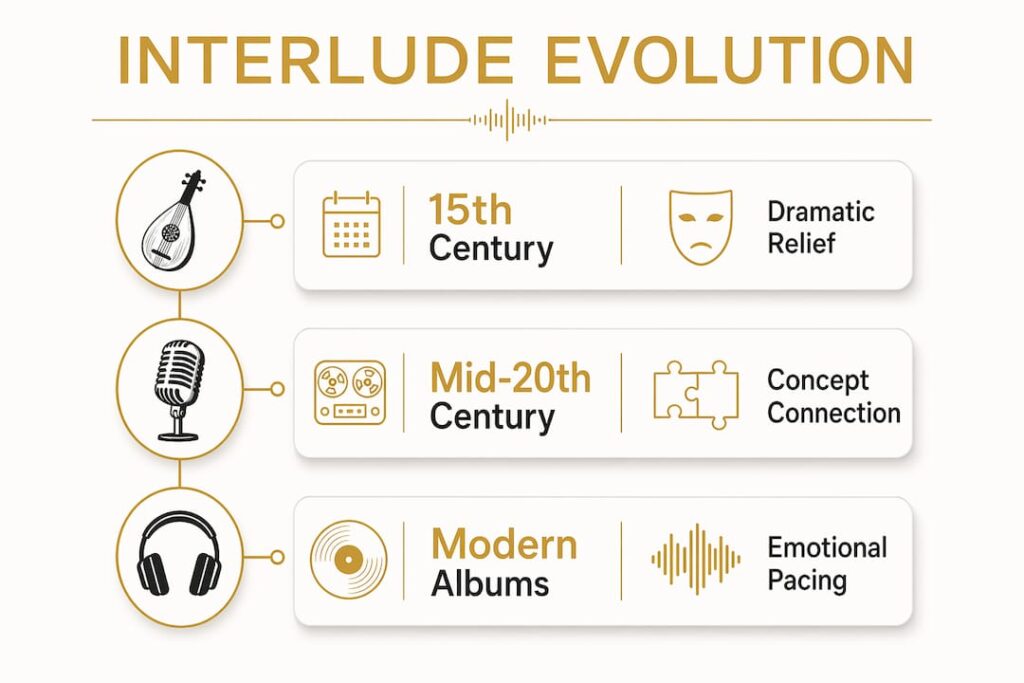
Interludes did not originate in the recording studio. Their roots trace to 15th-century dramatic performances where short comic scenes appeared between the acts of longer morality plays. By the 18th century, operatic intermezzi served a similar function, offering contrast and comedic relief between serious dramatic sections.
The table below shows how the interlude’s role has shifted across time while keeping its core purpose intact.
| Era | Form | Primary Function |
|---|---|---|
| 15th century | Dramatic interlude | Comic relief between morality play acts |
| 18th century | Operatic intermezzo | Contrast and tonal variety in opera |
| 20th century | Jazz and classical bridge | Harmonic transition between movements |
| Modern era | Album interlude | Narrative pacing and emotional cohesion |
What this history reveals is that the interlude has always served contrast and connection. The form changes. The purpose does not. When you place a 45-second ambient piece between two emotionally heavy R&B tracks, you are doing exactly what a 15th-century playwright did between acts. You are giving the audience permission to feel the shift.
Modern music project structure has absorbed this tradition fully. The interlude in album creation today carries the same weight it did in the theater. It signals to the listener that something is changing, and it does so with care rather than collision.
What are effective techniques for integrating interludes?
Production decisions around interludes shape whether they feel intentional or accidental. The most effective interludes share sonic motifs with neighboring tracks to create psychological continuity. When a listener hears a melody fragment from the previous song woven into the interlude, their brain registers cohesion rather than interruption.
Here is a practical production sequence for building interludes that hold their weight:
- Pull stems from adjacent tracks. Export individual elements, a piano chord, a vocal breath, a bass note, from the songs on either side of the interlude. Weave those elements into the interlude’s texture. This creates a sonic thread the listener feels even if they cannot name it.
- Choose your interlude form deliberately. Instrumental interludes work well for emotional transitions. Spoken word interludes carry narrative weight. Ambient soundscapes create atmosphere and space. Each form serves a different storytelling need.
- Decide: separate track or appended outro.Appending an interlude as an outro to the preceding song is an emerging strategy that reduces skip rates and keeps streaming metrics cleaner. A standalone interlude track gives the moment more visibility but invites skipping.
- Keep it short and purposeful. The 30–90 second range is not arbitrary. Shorter than 30 seconds and the interlude feels like an accident. Longer than 90 seconds and it starts competing with full tracks for attention.
- Test the skip instinct. Play your project for someone unfamiliar with it. Watch when they reach for the skip button. If they skip your interlude, the problem is usually one of two things: it is too word-heavy, or it does not connect sonically to what surrounds it.
Word-heavy interludes face higher skip rates in the streaming era, while instrumental and ambient interludes maintain listener engagement more reliably. That data point should inform every production choice you make around interlude composition techniques.
Pro Tip:If you are building a concept album, map your interludes on paper before you produce them. Write one sentence describing what emotional state each interlude should leave the listener in. That sentence becomes your production brief.
Maverick City Music uses interludes as moments of spoken prayer and reflection between worship songs. The effect is not accidental. Those moments of stillness make the songs that follow feel more urgent and alive.
How do interludes shape the listener’s emotional journey?
An interlude functions as a palette cleanser, resetting the listener’s emotional state so the next track lands with full force. Without that reset, even the strongest songs in a sequence can blur together. The listener stops feeling individual moments and starts experiencing the album as undifferentiated sound.
“Interludes offer crucial breaths in musical narrative, helping listeners process emotional tension and maintain immersion.” — Music theorists on narrative pacing
That framing matters for how you approach interlude composition. You are not filling a gap. You are creating a moment of suspension where the listener’s emotional attention can reorganize itself. Think of it as the space between two sentences in a poem. The silence carries meaning.
Interludes improve the listener’s emotional journey by offering narrative pacing and moments of reflection, much like breaths in theatrical rhythm. In practice, this means a well-placed interlude can make the track that follows feel more emotionally resonant than it would without the setup.
Concept albums depend on this mechanism entirely. Projects like Beyoncé’s Lemonade or Frank Ocean’s Blonde use interlude effects in music to build continuous emotional arcs across the full runtime. The listener does not just hear a collection of songs. They move through a structured emotional experience. That is the difference between a playlist and an album.
For genre-spanning projects, interludes also solve a specific structural problem. Bridging disparate genres or moods within a project with interludes maintains cohesion that full songs alone cannot achieve. A 60-second ambient piece can hold the space between a hard-hitting trap record and a soft acoustic ballad without either track losing its identity.
Key takeaways
Interludes are not optional extras in a music project. They are the structural and emotional architecture that transforms a track list into a complete listening experience.
| Point | Details |
|---|---|
| Interludes are narrative bridges | They connect songs thematically and emotionally, found in 100% of concept albums over 10–12 tracks. |
| Sonic motif sharing builds cohesion | Pull stems from adjacent tracks and weave them into the interlude to create psychological continuity. |
| Form determines function | Choose instrumental, spoken word, or ambient based on the specific emotional transition you need. |
| Streaming behavior matters | Ambient and instrumental interludes retain listeners better than word-heavy passages in the streaming era. |
| Placement is a production decision | Appending an interlude as an outro reduces skip rates compared to releasing it as a standalone track. |
Why most producers misread the interlude’s real power
Most producers treat interludes as the last thing they finish. They fill the gap between two strong tracks with something that feels like a leftover. That instinct is backwards. The interlude is where your album’s emotional intelligence lives.
I have spent time studying how the most cohesive projects use silence and transition as intentional tools. What separates a good album from one that genuinely moves people is almost always the space between the songs. The interlude is that space made audible. When you treat it as an artistic statement rather than a connector, the whole project shifts.
The trend I see gaining ground in 2026 is producers appending interludes directly to songs rather than releasing them as separate tracks. The streaming data supports it. Listeners do not skip what they do not see as a separate choice. That is a tactical insight worth building into your workflow now, before it becomes standard practice.
The deeper opportunity most producers miss is using interludes to say something the full songs cannot. A 45-second ambient piece can carry grief, relief, or anticipation in a way that a three-minute song sometimes cannot. Give your interludes a brief. Know what emotional state you want the listener in when the next track begins. Then build backward from that feeling.
— DRVVYN
Build your sound with Drvvynsound
If this article shifted how you think about structure and emotional pacing in your projects, Drvvynsound has the tools to take that thinking further. DRVVYN Sound LLC builds music with the same intentionality this article describes, where every transition, texture, and moment of silence serves the story.

Explore the DRVVYN Sound catalog to hear how interludes and transitions work inside fully realized R&B and cinematic projects. Whether you are producing your first concept album or refining your interlude composition techniques, the work at Drvvynsound shows you what intentional structure sounds like in practice. Let the music guide the next step.
FAQ
What is the role of interlude in music projects?
An interlude is a short musical segment, typically 30–90 seconds, that connects or contrasts sections of a music project. Its role is to shape emotional pacing, bridge narrative themes, and maintain listener engagement across a full album.
How long should an interlude be?
Interludes work best in the 30–90 second range. Shorter than 30 seconds feels accidental; longer than 90 seconds competes with full tracks for the listener’s attention.
Should an interlude be a separate track or part of another song?
Appending an interlude as an outro to the preceding song reduces skip rates and improves streaming metrics. A standalone track gives the moment more visibility but increases the chance listeners will skip it.
What types of interludes work best in the streaming era?
Instrumental and ambient interludes retain listeners more reliably than word-heavy or narrative-only passages. Streaming behavior shows that listeners skip dense spoken interludes at higher rates than textured soundscape interludes.
How do interludes improve album storytelling?
Interludes act as narrative breaths that give listeners space to process emotional tension before the next track begins. This pacing deepens immersion and makes the songs that follow feel more emotionally resonant.