

Listening & Culture
Why Listeners Seek Healing Music: R&B and the Mind
Discover why listeners seek healing music like R&B. Learn how it aids emotional regulation, pain relief, and cognitive restoration.
By DRVVYN · · 10 min read

Healing music is defined as a therapeutic auditory experience that engages multiple brain systems to support emotional regulation, pain relief, and cognitive restoration. Why listeners seek healing music goes deeper than preference. The brain physically responds to rhythm, melody, and lyrical meaning by shifting hormones, reorganizing neural pathways, and unlocking emotional memories that ordinary conversation cannot reach. Music therapy, the clinical practice built on these effects, is recognized by the American Psychological Association as an evidence-based intervention distinct from casual listening. For people navigating grief, heartbreak, or chronic stress, that distinction matters.
Why listeners seek healing music: the core answer
Healing music works because it engages the brain and body at the same time. When you hear a song that resonates, your auditory cortex processes the sound while your motor system locks onto the rhythm, your limbic system fires emotional responses, and your prefrontal cortex begins making meaning. These systems do not usually talk to each other this efficiently. Music forces the conversation.
Healing music strengthens neural bridges among auditory, motor, cognitive, and emotional brain regions simultaneously. That cross-system activation is what separates music from most other forms of emotional support. A conversation can reach your thoughts. Music reaches your body, your memory, and your mood at once.

The hormonal effects are just as real. Music modulates the endocrine-immune axis by increasing immunoglobulin A and reducing cortisol in stressed individuals. Lower cortisol means the pressure in your chest starts to lift. Higher immunoglobulin A means your immune system gets a quiet boost while you are simply listening.
What neurological processes make healing music effective?
The brain is a rhythm-seeking organ. Its electrical activity pulses in waves, and music gives those waves something to synchronize with. This process, called neural entrainment, is why a slow, steady beat can physically calm a racing mind. The brain does not just hear the rhythm. It follows it.
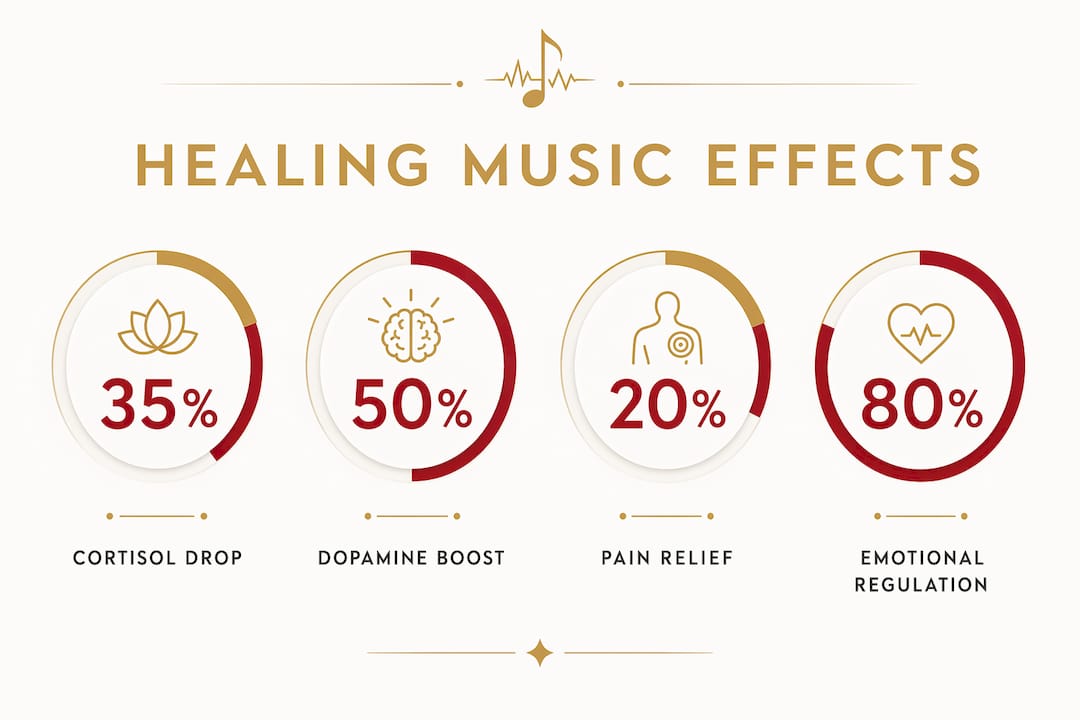
Music’s neurobiological impact physically reorganizes neural pathways and modulates neurotransmitters like dopamine and cortisol. Dopamine is the same chemical released during moments of joy and connection. When a song hits you in the chest, that sensation is neurochemical, not metaphorical.
The clinical evidence for this is substantial. A meta-analysis of 41 studies on music-based interventions showed that music aids rehabilitation for brain damage by improving motor, language, and cognitive functions. That means music is not just comforting. It is rebuilding.
Here is what happens inside your brain during a healing listening session:
- Neural entrainment: Your brainwaves synchronize with the tempo, slowing or energizing your mental state.
- Limbic activation: The emotional center of your brain lights up, allowing suppressed feelings to surface safely.
- Dopamine release: Pleasure and reward circuits fire, reducing the felt intensity of pain and sadness.
- Cortisol reduction: Stress hormones drop, releasing physical tension held in the body.
- Memory retrieval: Familiar songs activate autobiographical circuits, connecting you to who you were before the pain.
Pro Tip:If you want music to shift your mood, start with a song that matches how you feel right now, not how you want to feel. Your brain responds better to emotional honesty than to forced calm.
How do personal preferences shape why people listen to healing music?
The genre matters less than you think. What matters is the relationship you have with the music. Familiar music, even energetic R&B or soul, is more effective at reducing pain and anxiety than disliked “prescribed” relaxation music. A song you love at full volume does more healing work than a generic ambient track you tolerate.
How people use music shapes their emotional experiences more than the music itself. Listeners who engage deeply with meaningful songs often experience complex, mixed emotions. That blend of joy and sadness, or anger and tenderness, is not a sign that the music is not working. It is the processing happening in real time.
Four factors determine how powerfully music heals for you personally:
- Familiarity: Songs tied to specific memories activate autobiographical circuits more strongly than unfamiliar tracks, producing deeper emotional release.
- Identity resonance: Music that reflects your cultural background, values, or lived experience feels true in a way that generic wellness playlists rarely do.
- Personality: People who score high in openness to experience tend to feel music more intensely and process emotion through it more readily.
- Emotional context: The mood you bring to a listening session shapes what the music unlocks. Grief-state listening pulls different meaning from the same song than joy-state listening does.
Healing music’s impact depends not on genre alone but on how music aligns with individual emotional states and personal history. This is why a playlist built for someone else rarely works as well as one you built for yourself.
Why is R&B especially valued for emotional healing?
R&B carries something that most genres do not: it tells the truth about complicated feelings without flinching. The genre’s lyrical tradition addresses love, loss, resilience, and longing with a directness that reaches people who have stopped knowing how to name what they feel. When the words do the naming for you, the tension in your body starts to release.
R&B’s specific strengths as a healing genre include:
- Rhythmic alignment: R&B tempos typically fall in a range that supports neural entrainment toward calm, focused states without pushing the listener into forced relaxation.
- Vocal intimacy: The genre’s emphasis on expressive, close-mic vocal delivery creates a sense of being heard, which is itself a therapeutic experience.
- Lyrical specificity: R&B songs name emotions precisely. “Heartbreak” becomes a specific moment, a specific ache. That precision helps listeners locate and process their own feelings.
- Cultural familiarity: For many listeners, R&B is woven into personal history, family memories, and identity. That familiarity amplifies the autobiographical memory circuits that drive the deepest healing effects.
- Emotional range: R&B moves between vulnerability and strength within a single song, modeling the emotional arc that healing actually requires.
Drvvynsound builds its music around exactly these qualities. The DRVVYN catalog centers on themes of love, reflection, and personal growth, delivered through R&B production that is designed to meet listeners where they are emotionally.
What are the best practices for healing music engagement?
Music therapy involves intentional, evidence-based interventions designed for specific psychological and physiological targets. That is different from putting on a playlist while you scroll. The gap between those two experiences is the gap between passive exposure and real therapeutic benefit.
Active, intentional engagement with music amplifies therapeutic outcomes compared to passive background listening. Intentional listening means you have a purpose before you press play. You are not filling silence. You are doing something specific with the sound.
| Approach | What it looks like | Therapeutic effect |
|---|---|---|
| Passive background listening | Music plays while you work or scroll | Mild mood lift, minimal emotional processing |
| Active focused listening | Headphones, eyes closed, full attention | Deep emotional release, memory integration |
| Iso-Principle listening | Start with mood-matching songs, shift gradually to calmer tracks | Smooth emotional transition, reduced resistance |
| Goal-oriented listening | Set a specific intention before pressing play | Stronger outcomes for grief, anxiety, or stress relief |
| Journaling with music | Write during or after a listening session | Integrates emotional insights into conscious awareness |
The Iso-Principle deserves special attention. Clients respond best when music matches their current emotional intensity before transitioning to calmer states. If you are angry, start with something that holds that anger. Skipping straight to a meditation playlist creates a mismatch your nervous system will resist.
Intentional music listening fosters autobiographical memory integration, aiding emotional regulation and personal growth. Pairing music with journaling or meditation gives those surfaced memories somewhere to land.
Pro Tip:Build two playlists: one that matches your hardest emotional state, and one that represents where you want to arrive. Move between them deliberately, not randomly.
Key Takeaways
Healing music works because it engages the brain’s rhythm, emotion, memory, and reward systems at once, making it one of the most direct tools available for emotional regulation and personal growth.
| Point | Details |
|---|---|
| Neural entrainment drives healing | Music synchronizes brainwaves, reducing cortisol and activating dopamine for measurable stress relief. |
| Familiarity outperforms genre | Personally meaningful music heals more effectively than prescribed relaxation tracks, regardless of tempo or style. |
| R&B supports emotional processing | R&B’s lyrical honesty, vocal intimacy, and rhythmic range make it especially suited for grief, heartbreak, and resilience work. |
| The Iso-Principle prevents resistance | Match music to your current mood first, then shift gradually toward the emotional state you want to reach. |
| Intentional listening multiplies results | Active, goal-oriented listening produces deeper therapeutic outcomes than passive background exposure. |
What I have learned about healing music after years of making it
People often ask me whether classical music is the “right” choice for healing. My honest answer: it depends entirely on whether classical music means something to you. The research is clear that familiar, personally resonant music outperforms genre-prescribed options every time. If a slow R&B track carries more emotional weight for you than a Mozart sonata, that R&B track is the more therapeutic choice. Full stop.
What I have found in making music under the DRVVYN name is that listeners do not come to healing music looking for calm. They come looking for permission. Permission to feel what they have been holding. Permission to name the thing that has no name yet. The music does not fix anything. It creates the conditions where you can finally feel it, and feeling it is the first step toward moving through it.
The mistake most people make is treating healing music as background noise for a hard day. That is not wrong, but it is the lowest-yield version of what music can do. When you sit with a song intentionally, when you let the lyric land and the rhythm settle into your body, something shifts. The pressure leaves your chest. The silence after the song feels different from the silence before it.
My advice: stop waiting for the perfect playlist. Start with the song that already knows how you feel.
— DRVVYN
Drvvynsound and the music that meets you where you are
Drvvynsound creates original R&B music built around the emotional experiences that healing music addresses most directly: love, loss, reflection, and the slow work of personal growth. Every release under the DRVVYN name is crafted to function as both art and emotional support, with production choices designed to align with the neurological principles that make music therapeutic.

If you are building a healing practice around music, the DRVVYN catalog gives you a starting point that is emotionally honest and sonically intentional. You can explore the full catalog and find tracks that match where you are right now, not where someone else thinks you should be. The music is there when the silence gets too sharp.
FAQ
Why do listeners seek healing music?
Listeners seek healing music because it engages the brain’s emotional, rhythmic, and memory systems simultaneously, producing hormonal and neurological shifts that reduce stress and support emotional processing.
What are the main benefits of healing music?
The main benefits include cortisol reduction, dopamine release, pain relief, and emotional regulation. A systematic review found music therapy significantly reduces pain severity compared to controls, with a standardized mean difference of 2.18.
Does genre matter when choosing healing music?
Genre matters less than personal familiarity and emotional resonance. Familiar music activates autobiographical memory circuits more powerfully than unfamiliar tracks, regardless of whether the genre is R&B, classical, or soul.
What is the Iso-Principle in music therapy?
The Iso-Principle is a technique where music first matches the listener’s current emotional intensity before gradually shifting toward a calmer or more desired state, preventing the nervous system resistance that comes from emotional mismatch.
How is music therapy different from just listening to music?
Music therapy involves intentional, evidence-based interventions targeting specific psychological or physiological outcomes. Casual listening can lift mood, but active, goal-oriented listening produces measurably deeper therapeutic results.