

Listening & Culture
Why Music That Feels Cinematic Stays With Us
Why music that feels cinematic lingers long after the moment – and how atmosphere, emotion, and pacing turn a song into a lived experience.
By DRVVYN · · 7 min read
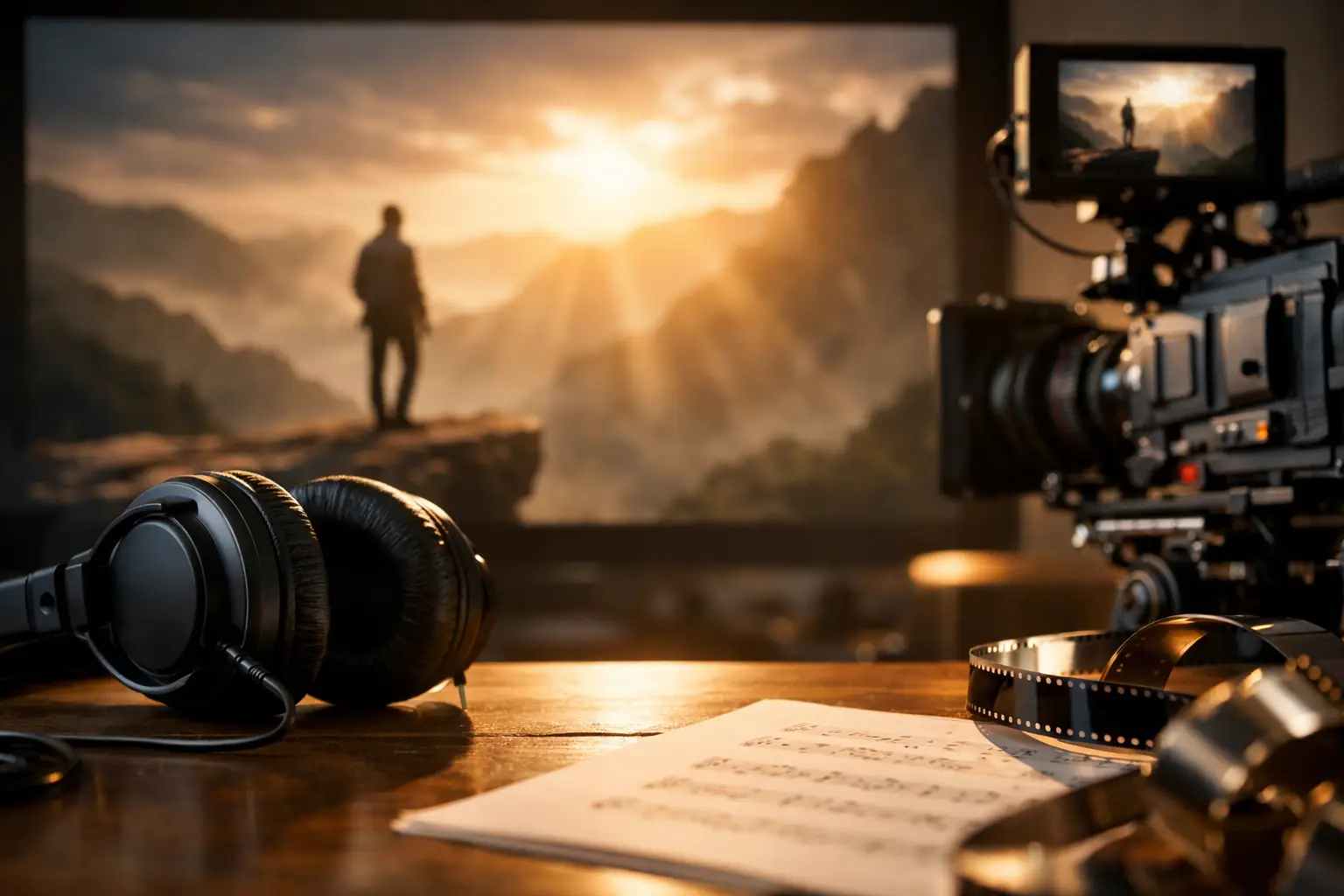
Some songs pass through you. Others set a scene and stay there.
That is the difference with music that feels cinematic. It does more than sound good in the background. It gives shape to a feeling you could not quite name, then lets you sit inside it for a while. A good cinematic track does not beg for attention. It pulls the room into focus, slows time a little, and makes even an ordinary moment feel charged with meaning.
For some people, that feeling arrives on a night drive with the city blurred in the windows. For others, it shows up in headphones at 1:12 a.m., when everything is quiet enough to hear what your mind has been trying to say. The setting changes. The need does not. We come back to certain songs because they make life feel more visible.
What makes music that feels cinematic?
It is not just strings. It is not just big drums, ambient textures, or a dramatic build. Those can help, but cinematic feeling is less about genre and more about emotional framing. The song has to suggest that something is unfolding.
That might come through space in the production, where every sound feels placed with intention. It might come through pacing, where the track does not rush to prove itself. It might come through contrast – a soft vocal against a heavy low end, or a quiet opening that eventually widens into something almost physical. You hear movement. You feel scale. Even when the song stays minimal, it still hints at a larger world around it.
The best examples do something subtle. They leave room for the listener to finish the picture. If a song tells you exactly what to feel, it can lose some of that cinematic pull. But if it gives you atmosphere, tension, and emotional direction, your own memories start filling in the rest. That is where the connection deepens.
Cinematic music feels like a memory in real time
Part of the pull is that cinematic sound rarely feels flat. It carries a sense of before and after. You are not just hearing a moment. You are hearing what led into it and what might follow.
That is why certain tracks hit harder when you are already in an emotional state. They do not interrupt the feeling. They extend it. A song with this kind of weight can make loneliness feel less empty, romance feel more suspended, and hope feel less naive. It does not fix the mood. It makes it legible.
This is also why overly polished music can sometimes miss the mark. If everything is too neat, too bright, too resolved, there is nothing for the listener to step into. Cinematic music often keeps a little mystery in the frame. A little grain. A little ache. Something unresolved enough to feel true.
Why we keep searching for music that feels cinematic
Most people are not searching for technical perfection. They are searching for recognition.
When someone types in music that feels cinematic, they are usually looking for a certain kind of emotional accuracy. They want sound that meets them where they are – not generic motivation, not empty chill, not background noise dressed up as mood. They want music with gravity. Music that understands silence. Music that knows how to hold intensity without flattening it.
That search says something about how we listen now. People build private worlds out of playlists. They score their own evenings. They return to the same track not because it is catchy, but because it makes a specific version of themselves feel understood. In that sense, cinematic music is personal before it is dramatic.
It also asks more from the listener. You do not throw it on and forget it is there. Even when it plays softly, it changes the emotional temperature of the room. That can be exactly what someone wants. It can also be too much for certain moments. Not every day needs to feel like a closing scene. Sometimes you want lightness, speed, or pure distraction. The power of cinematic music is real, but so is its weight.
The role of pacing, tension, and release
A lot of songs chase the peak too early. Cinematic ones usually do not.
They understand that tension is part of the experience. A sustained note, a repeating piano figure, a vocal that stays restrained a few bars longer than expected – these choices matter. They create anticipation without forcing drama. When the song finally opens up, it feels earned.
That release does not have to be huge. Sometimes the most cinematic shift is small: a harmony appearing behind the lead, a low synth rising under the chorus, a drum pattern dropping out just long enough to expose the emotional center. Big does not always mean effective. Sometimes scale is emotional, not sonic.
This is where a lot of mood-driven artists separate themselves. They understand that immersion depends on control. If every moment is intense, nothing is. If every section is dense, the song loses air. Cinematic music respects pacing because it respects feeling.
Visual thinking without the visuals
People often describe cinematic sound in visual terms for a reason. You can see it.
Not literally, maybe. But the song suggests color, motion, distance, weather, texture. You hear haze. You hear empty streets. You hear light coming through the wrong window at the right time. The strongest tracks do not need an actual film attached to them because they already carry that visual instinct in the arrangement.
That does not mean the song has to be massive or orchestral. Some of the most affecting cinematic music feels intimate, almost whispered. A close vocal can be cinematic. So can a sparse beat and one synth line that feels like it is floating over everything. Scale comes from intention, not just volume.
For listeners, this matters because it turns passive listening into something more immersive. The song becomes a setting. A place. You do not just hear it. You enter it.
When cinematic becomes too calculated
There is a weaker version of this sound, and you can usually feel it right away.
It happens when a song reaches for grandeur without emotional substance underneath. The strings swell. The drums hit. The reverb stretches everything into the distance. But nothing in it actually moves you. It feels designed to seem important instead of being honest enough to become important.
That is the trade-off. The more a song leans on cinematic cues, the more it risks feeling performative if the core emotion is thin. Atmosphere can elevate a real feeling. It cannot replace one.
The songs that last usually avoid overexplaining themselves. They trust mood. They trust restraint. They trust the listener enough not to crowd every space with meaning. That trust is part of what makes the experience feel personal.
Music that feels cinematic works because it gives you somewhere to go
That may be the simplest way to say it.
Some songs are content. Some are company. And some become a place you return to when language is not enough. That is what cinematic music can do at its best. It gives you movement when you feel stuck, stillness when everything feels loud, and a frame wide enough to hold whatever the night is carrying.
That is also why curated listening matters. A single song can open the door, but a sequence of tracks can keep you there. When the mood holds across songs, something deeper happens. The listening experience stops feeling random and starts feeling intentional. That is where artists and platforms built around emotional continuity stand apart. They are not just offering tracks. They are shaping a world you can step into.
DRVVYN Sound lives in that space – where music is less about interruption and more about atmosphere you can return to.
You do not need every song to feel cinematic. But when one does, you know it almost instantly. The room changes. Your thoughts sharpen. The moment looks different than it did a minute ago. And sometimes that is all you were looking for – not noise, not escape, just a piece of music that makes your inner world feel seen.