

Listening & Culture
Discover Music for Emotional Release: Fast Playlist Method
Discover music for emotional release with an easy playlist method. Create a cathartic experience and feel the stress melt away!
By DRVVYN · · 10 min read


You can discover music for emotional release right now by building a short, intention-driven playlist with a deliberate emotional arc: start with a few high-intensity tracks that match your current feeling, add one transitional track that softens the energy, then close with a grounding piece that lets the pressure leave your chest. That structure works because music modulates your nervous system, not just your mood. Peer-reviewed research confirms it lowers heart rate, blood pressure, and cortisol while stimulating dopamine release. Three quick-start actions you can take in the next five minutes:
- Play a 3-track catharsis set. Choose songs that mirror what you actually feel right now, not what you wish you felt.
- Add one grounding track. Something slower, spacious, with room to breathe. This is where the release happens.
- Save five candidate songs to a discovery folder. You’ll refine the list over time. Starting is the point.
If you want a ready-made starting point, DRVVYN Essentials is a curated playlist built around exactly this arc: emotional validation, transition, and grounding.
Pro Tip:Don’t start with a “happy” playlist when you’re grieving. Match the music to where you are, not where you want to be. The mirror effect is what makes the release possible.

Table of Contents
- What playlists actually help, organized by how you feel right now
- How music actually changes what’s happening inside you
- How do you find new songs that actually fit how you feel?
- How to use music safely so it helps instead of overwhelms
- How Drvvynsound designs playlists for emotional release
- Key Takeaways
- What I actually believe about music and emotional release
- DRVVYN Essentials: a ready-made playlist for your next session
- Useful sources and discovery tools
What playlists actually help, organized by how you feel right now
The most useful playlists for emotional healing aren’t long. Three to five tracks with a clear emotional purpose outperform a 50-song shuffle every time. CaringBridge guidance on active playlist-making confirms that personalized, intentional sets help validate feelings and process grief more effectively than passive listening. Here are five sets built around specific emotional needs, each with a reproducible pattern you can copy.
| Emotional Need | Suggested Tracks | Pattern |
|---|---|---|
| Anger / Frustration | Kendrick Lamar — “Alright” / Paramore — “Misery Business” / Billie Eilish — “Bellyache” | High intensity → slight release → ironic distance |
| Crying / Grief | Phoebe Bridgers — “Funeral” / Bon Iver — “Skinny Love” / Sufjan Stevens — “Death With Dignity” | Raw grief → quiet ache → acceptance |
| Breakup / Heartbreak | Olivia Rodrigo — “drivers license” / SZA — “Good Days” / Frank Ocean — “Self Control” | Sharp pain → longing → suspension |
| Anxiety / Calm | Nils Frahm — “Says” / Bonobo — “Kong” / Brian Eno — “An Ending (Ascent)” | Gentle tension → slow release → open space |
| Catharsis / Full Release | Radiohead — “Exit Music (For a Film)” / Massive Attack — “Teardrop” / Sigur Rós — “Ára bátur” | Build → peak → dissolution |
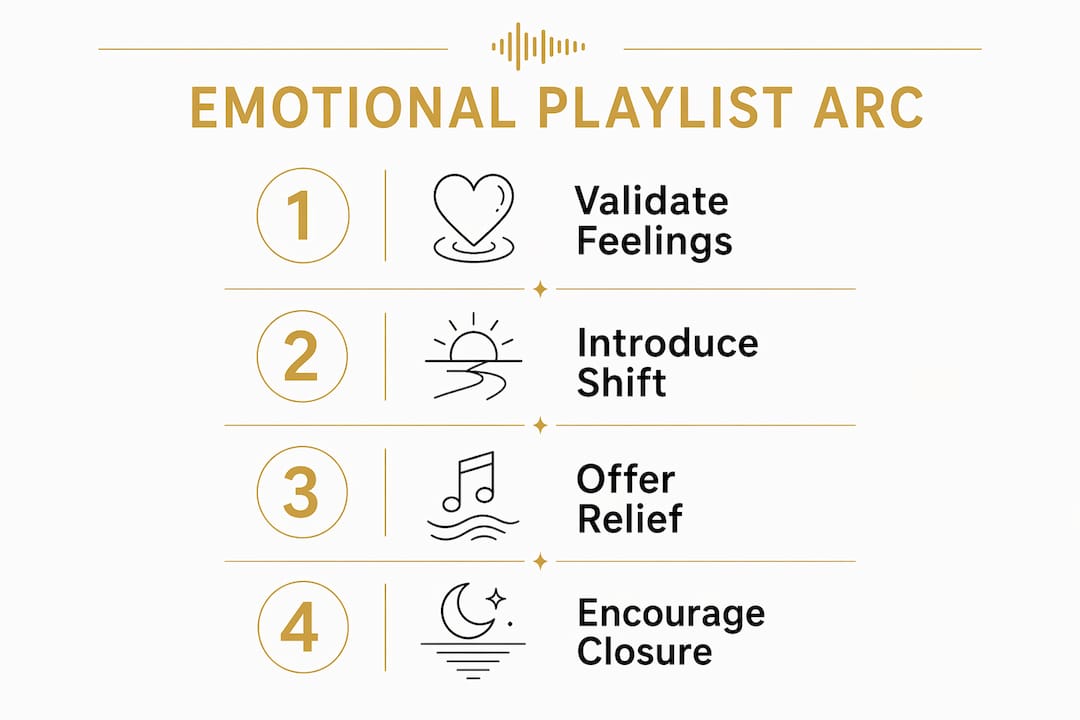
The pattern that runs through every set is the same: open with a track that validates the intensity, include a middle track that begins to shift the energy, and close with something that gives your nervous system room to settle. Healing music isn’t always calm. Sometimes a confrontational, high-energy song is exactly what’s needed to match and discharge a strong emotion before regulation becomes possible.
How music actually changes what’s happening inside you
Music modulates the nervous system in ways that are measurable and well-documented. Research published on PubMed shows that intentional music listening lowers heart rate, blood pressure, and cortisol while stimulating dopamine, the neurotransmitter tied to reward, motivation, and emotional processing. This isn’t metaphor. The body responds to sound the way it responds to other physiological inputs.
That mirroring effect is why matching the music to your current emotional state works better than playing something cheerful when you’re in pain. The music meets you where you are, and the nervous system follows it toward resolution rather than suppression. Clinical perspectives frame music as a complementary treatment that supports social connection and emotional expression, not a replacement for professional care when acute risk is present.
The physiological pathway runs roughly like this: a high-intensity track activates the sympathetic nervous system, giving the emotion somewhere to go. A transitional track begins to shift the arousal level. A grounding track activates the parasympathetic response, slowing the breath and heart rate. The arc isn’t decorative. It’s functional.
How do you find new songs that actually fit how you feel?
Discovery is where most people get stuck. You know you need music for healing emotions, but the algorithm keeps serving you the same twenty tracks. Here’s a step-by-step method that works.
- Describe the feeling in plain language. Write two to three sentences about what you’re experiencing right now: the physical sensation, the time of day, the specific texture of the emotion. “Hollow and restless, like something is suspended just behind my sternum” is more useful than “sad.”
- Use that description as a seed. Paste it into a mood-aware discovery tool (see the comparison table below) or into a streaming platform’s search bar. Specificity surfaces better results.
- Let the algorithm extend from one anchor track. Find one song that fits, then use artist radio or “similar tracks” to branch outward. This is faster than browsing genre lists.
- Curate, don’t collect. Save only tracks that genuinely fit the emotional moment. A folder of 30 vague candidates is less useful than eight precise ones.
- Test in a session. Play the candidates in sequence and notice where the energy shifts. Remove anything that breaks the arc.
Mood-aware discovery tools have become genuinely useful for finding songs to help process feelings. MeloTune uses a 400-mood ontology and an on-device mood map to surface tracks across genres that match nuanced emotional coordinates, going well beyond keyword playlists. Emotune takes free-text mood input, parses emotional nuance with a language model, and returns matching tracks, which is useful when your feeling resists a single-word label. Lomira takes a different approach entirely: it generates music from typed or spoken emotional descriptions, keeping processing local and private, which suits listeners who want something created specifically for their state rather than selected from existing catalogs.
| Discovery Method | Best For | Effort Level |
|---|---|---|
| Manual curation (streaming search) | Precise emotional fit; full control | High |
| Mood playlists / mood tags | Quick starting point; broad emotional categories | Low |
| AI mood apps (MeloTune, Emotune) | Nuanced feelings; expanding beyond familiar tracks | Low–Medium |
| Peer-shared / community playlists | Social validation; discover relatable tracks quickly | Low |
For readers exploring broader support alongside music, resources on energy healing for emotional trauma can complement what music does for the nervous system.
How to use music safely so it helps instead of overwhelms
The difference between a session that releases something and one that leaves you worse is structure. An intentional, timeboxed session with a clear start and finish keeps you in control of the process.
A session template with a clear start and finish:
- Warm-up (3–5 minutes). One track at moderate intensity. Let your body arrive. Don’t skip this.
- Catharsis (8–12 minutes). Two to three high-intensity tracks that match the emotion you’re working with. This is the confrontation phase. Let it be uncomfortable.
- Transition (5–8 minutes). One to two tracks that begin to soften the energy. The feeling doesn’t disappear; it starts to move.
- Grounding (5–10 minutes). One or two slower, spacious tracks. Breathe. Let the silence between notes do its work.
- Stillness (2–3 minutes). Sit quietly after the last track ends. Don’t immediately reach for your phone.
Safety red flags to watch for: dissociation during or after listening, a mood that worsens significantly and stays that way for more than a day, or any thoughts of self-harm. If any of these appear, pause the session, ground yourself physically (feet on the floor, slow breath), and reach out to a mental health professional. Music is a complementary support, not a clinical intervention. For readers exploring nonclinical approaches alongside music, spiritual healing resources can offer additional grounding support.
Pro Tip:Keep a small journal next to your listening space. After the grounding phase, write three sentences: what you felt at the start, what shifted, and what you notice now. Over time, this log becomes a map of your emotional patterns and which tracks reliably move you.
How Drvvynsound designs playlists for emotional release
Every playlist Drvvynsound builds starts from one design principle: the emotional arc has to be honest before it can be healing. That means opening with tracks that validate the weight of what you’re carrying, not tracks that try to lift you out of it prematurely. The sonic spacing between tracks, the dynamic range, the atmospheric arrangement, these aren’t production choices made for aesthetics. They’re the breathing room that allows a feeling to move through you rather than stay suspended.
DRVVYN Essentials is the practical expression of that principle. It’s a curated playlist of original alternative R&B tracks built around the catharsis-to-grounding arc described throughout this guide. To use it in a session: start at track one and let it run through the catharsis phase, then use the final two tracks as your transition and grounding sequence. You can also use it as a seed, pulling individual tracks into your own discovery folder and building outward from there.
- Tracks open with emotional validation: high-intensity, lyrically direct, sonically dense.
- Middle tracks shift the energy: slower tempo, wider dynamic range, more atmospheric.
- Closing tracks prioritize space over statement: minimal arrangement, room for breath.
- Sonic spacing between tracks is intentional, not incidental.
Key Takeaways
Music modulates the nervous system through measurable physiological changes, and a short playlist with a deliberate emotional arc (catharsis, transition, grounding) is the most reliable structure for intentional emotional release.
| Point | Details |
|---|---|
| Start with emotional matching | Open your playlist with tracks that mirror your current feeling, not your desired one. |
| Use the three-phase arc | Catharsis, transition, and grounding give your nervous system a path to follow. |
| Music lowers stress markers | Peer-reviewed research shows music reduces heart rate, blood pressure, and cortisol while stimulating dopamine. |
| Discover with mood-aware tools | MeloTune’s 400-mood ontology and free-text tools like Emotune surface tracks that keyword search misses. |
| Drvvynsound as a starting point | DRVVYN Essentials is a ready-made playlist built on the catharsis-to-grounding arc, available to use or expand from. |
What I actually believe about music and emotional release
Most guides on music for mental wellness treat the playlist as decoration. Something to put on in the background while you do the real work. That framing misses the point entirely.
Music is the work. When the silence is too sharp and words won’t come, a song that matches the exact texture of what you’re feeling does something no conversation can: it switches something back on. It says, without explanation, this is real and it matters. That’s not a metaphor for therapy. It’s a distinct mechanism, and it deserves to be used with intention.
The guides, the science, the session templates in this article all point to the same thing: the arc matters more than the individual tracks. Start where you are. Move through it. End somewhere quieter. Bookmark the discovery prompts in this guide, or preview DRVVYN Essentials as a ready-made version of that arc. Either way, start tonight.
Pro Tip:Once a week, add one new track to your discovery folder based on a feeling you haven’t named yet. Over a month, you’ll have a playlist that maps your emotional range more accurately than any algorithm.
DRVVYN Essentials: a ready-made playlist for your next session
When you need a playlist for emotional healing and don’t want to build one from scratch, DRVVYN Essentials gives you a fully structured arc in one place. It’s original alternative R&B built specifically for the catharsis-to-grounding sequence: tracks that validate, tracks that shift, and tracks that let you land somewhere quieter. No curation required on your end.

Use it as your catharsis seed and expand outward, or run the full playlist as a complete 20–40 minute session. Every track is produced with the sonic spacing and dynamic range that makes emotional release possible, not just pleasant background sound. Stream DRVVYN Essentials and use it tonight as your starting point.
Useful sources and discovery tools
The research and tools referenced throughout this guide are worth bookmarking. Here’s where to go first and why.
Core research:
- PubMed: Beneficial effects of music in healing — peer-reviewed evidence on music’s physiological effects (heart rate, cortisol, dopamine). Start here for the science.
- CaringBridge: Music and Healing — practical guidance on active playlist-making, community playlists, and music as an emotional mirror. Useful for the therapeutic framing.
Discovery tools:
| Tool | What It Does | Privacy Note |
|---|---|---|
| MeloTune | Matches music to nuanced emotion coordinates using a 400-mood ontology; on-device personalization | On-device model training |
| Emotune | Free-text mood input parsed by a language model; returns matching tracks | Open-source prototype |
| Lomira | Generates music from typed or spoken emotional descriptions | Local processing claimed |
How to use these sources: Read the PubMed abstract first to understand the physiological basis, then use CaringBridge for the practical playlist-building framework. For discovery, try MeloTune if you want to stay within existing music catalogs; try Lomira if you want something generated specifically for your emotional state.
This article is general information, not professional mental health advice. If you’re experiencing acute distress, please consult a qualified mental health professional.