

Music Marketing
Why Artists Release Music at Midnight: Playlists, Charts, and Buzz
Why Artists Release Music at Midnight: Playlists, Charts, and Buzz
! Hands adjusting audio mixer in warm lit studio
Artists drop music at midnight on Fridays because it gives a release the longest possible Billboard tracking window, lines up with Spotify's editorial playlist refreshes, and focuses the entire industry's attention into a single weekly moment.
By DRVVYN · · 11 min read

Why Artists Release Music at Midnight: Playlists, Charts, and Buzz

Artists drop music at midnight on Fridays because it gives a release the longest possible Billboard tracking window, lines up with Spotify’s editorial playlist refreshes, and focuses the entire industry’s attention into a single weekly moment. Three forces pull in the same direction at once: the IFPI’s Global Release Day standard (in place since July 2015), Billboard’s Friday-through-Thursday tracking week, and Spotify’s New Music Friday curation cycle. Miss that window and you’re not just late — you’re leaving chart days, playlist slots, and algorithmic momentum on the table.
- Global Release Day (IFPI): Friday became the coordinated global drop day in 2015, replacing Tuesday in the U.S. and Monday in the UK.
- Billboard tracking week: Runs Friday through Thursday, so a Friday release captures every single day of that cycle.
- Platform playlists: Spotify’s New Music Friday and Apple Music’s editorial lists refresh at the start of the weekend, rewarding songs that arrive on time.
- First-24-hour signals: Saves, completions, and repeat listens in the opening hours tell algorithms whether to push a song wider.
Table of Contents
- How the industry moved release day from Tuesday to Friday
- How chart tracking weeks shape the pressure behind a Friday drop
- Why streaming playlists reward songs that arrive on Friday at midnight
- Midnight local vs. a single global time: how releases actually roll out
- The practical mechanics: distributors, lead times, and pre-saves
- Insider tips from Drvvynsound: a release-day timeline for independents
- Exceptions, myths, and when midnight doesn’t actually matter
- Key Takeaways
- Timing is a creative decision, not just a business one
- Useful sources and further reading
How the industry moved release day from Tuesday to Friday
For decades, Tuesday was America’s release day. That date was retail logic, not listener logic. Physical albums shipped to stores over the weekend, sat in stockrooms Monday, and hit shelves Tuesday morning. The UK used Monday for similar reasons. The result was a fractured global calendar where a fan in Tokyo could hear an album days before someone in Chicago.
Streaming dissolved the physical-shipping rationale, but it exposed a new problem: piracy. When a record dropped in Australia on a Friday before it was available in the U.S., leaked files spread across the internet before American fans could buy a legal copy. The IFPI coordinated a global fix, announcing Global Release Day and rolling it out in July 2015 across dozens of markets simultaneously.
The shift wasn’t purely anti-piracy. It also handed labels and artists a single weekly marketing moment. Instead of spreading PR, social ads, and playlist pitching across multiple days in multiple markets, every team could aim at one Friday. That concentration of effort is part of why the midnight drop feels so charged — it’s the result of weeks of coordinated pressure releasing at once.
| Era | U.S. Release Day | UK Release Day | Primary Driver |
|---|---|---|---|
| Pre-2015 | Tuesday | Monday | Physical retail shipping |
| Post-2015 | Friday | Friday | IFPI Global Release Day / streaming |
How chart tracking weeks shape the pressure behind a Friday drop
The Billboard Hot 100 and Billboard 200 both run on a Friday-through-Thursday tracking week. A song released on a Friday collects seven full days of streams, sales, and airplay before the chart snapshot closes. Release on a Wednesday and you’re working with two days. That gap can mean the difference between debuting at number one and missing the top ten entirely.
Billboard’s alignment with the Friday cadence wasn’t accidental — the chart system restructured its reporting windows to match Global Release Day precisely so the industry would have a clean, consistent measurement cycle. Streaming counts, digital download sales, and radio airplay all feed into that same window.
| Metric | Tracking Window | Why Friday Matters |
|---|---|---|
| Billboard Hot 100 streams | Friday–Thursday | Full 7-day count from day one |
| Billboard 200 album sales | Friday–Thursday | Opening weekend included in week one |
| Radio airplay | Friday–Thursday | Spins from release day count immediately |
| Spotify Release Radar | Refreshes Friday | New songs surface to followers same day |
Why streaming playlists reward songs that arrive on Friday at midnight
Spotify’s New Music Friday playlist is one of the most-followed editorial playlists on the platform. It refreshes every Friday, and songs that aren’t available before the editorial team finalizes the list simply don’t make it. The same logic applies to Release Radar, the algorithmic playlist that surfaces new music from artists a listener already follows — it updates weekly, and a Friday release lands in that queue at the most visible moment.
Apple Music runs a parallel editorial refresh cycle, with curators updating featured playlists and “New Music” shelves at the start of the weekend. Friday releases align with both platforms’ discovery engines, which means a song dropped Thursday night at midnight local time is already seated and ready when editors and algorithms flip their lists.
- Songs submitted to Spotify for editorial consideration must be pitched at least seven days before release — the earlier the better.
- Release Radar pulls from songs released within the past 28 days, but the freshest releases surface highest.
- Apple Music’s “New Music” shelf typically highlights releases from the current Friday, making timing a gating factor for visibility.
- Missing the Friday window doesn’t disqualify a song from playlists forever, but it delays the first discovery spike by a full week.
Midnight local vs. a single global time: how releases actually roll out
Most major releases use a “midnight local” rollout, which means the song goes live at 12:00 AM in each time zone as that zone crosses into Friday. New Zealand hears it first. Then Australia, Japan, and Southeast Asia. Europe follows, and finally the Americas. By the time a fan in Los Angeles wakes up Friday morning, the song has already been streaming for roughly 18 hours in other parts of the world.

That rolling wave is intentional. It generates a continuous stream of social content without requiring the artist to be awake for all of it. A reaction video from a fan in Seoul lands on Twitter while the artist sleeps, and an American fan wakes up to a feed already buzzing.
The alternative is a fixed UTC or EST release, where the song drops at one precise moment globally. This concentrates the social spike but can mean fans in some markets wait until mid-morning or afternoon on Friday. For artists whose core audience is geographically concentrated, a fixed-time drop targeting that audience’s midnight can outperform the rolling model.
Pro Tip:If your streaming data shows 70% or more of your listeners in a single country, consider a fixed midnight release in that market’s time zone rather than a rolling local-midnight drop. You’ll concentrate the first-hour engagement spike where it matters most for your chart goals.
The practical mechanics: distributors, lead times, and pre-saves
Getting a song to flip at midnight requires more backend work than most fans realize. Distributors like DistroKid and CD Baby must receive fully approved files — audio, metadata, ISRC codes, artwork, and rights clearances — well before the release date. The platform ingest pipeline has to seat every asset and schedule the visibility flip. A late submission or a metadata error can push a release back by days.
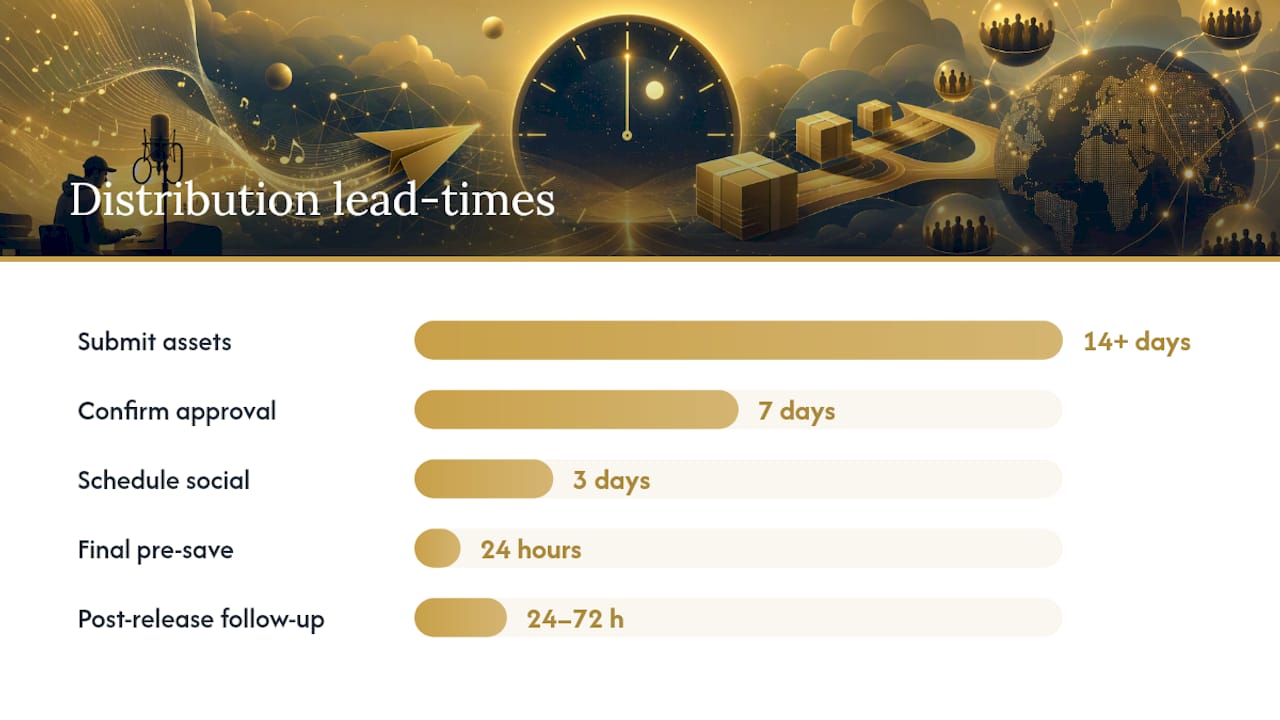
Understanding distribution timelines is one of the most practical things an independent artist can do before planning a midnight launch.
| Window | Action |
|---|---|
| 14+ days out | Submit audio, metadata, ISRC, artwork to distributor; pitch Spotify editorial |
| 7 days out | Confirm distributor approval; launch pre-save campaign |
| 3 days out | Schedule social posts; brief press contacts; set up smart links |
| 24 hours out | Final pre-save push; notify fan email list; prep release-day content |
| Release hour | Post across platforms; engage first comments; share streaming links |
| 24–72 hours after | Share streaming milestones; post reaction content; pitch secondary playlists |
- Deliver lossless audio (WAV or FLAC) — most distributors reject compressed MP3 masters.
- Confirm your ISRC is registered before submission; a missing ISRC delays chart reporting.
- Artwork must be at least 3000×3000 pixels, square, and free of platform logos.
- Set the release date at least 7 days out; 14 days gives you time to pitch Spotify editorial.
- Activate pre-saves as soon as the distributor confirms the release is live in their system.
Insider tips from Drvvynsound: a release-day timeline for independents
At Drvvynsound, the release process starts long before the song goes live. The emotional weight of a release — the anticipation, the vulnerability of putting something real into the world — deserves a structure that protects it. Here’s the timeline that keeps that energy focused rather than scattered.
T-minus 14 days: Submit everything to your distributor. Pitch Spotify editorial through Spotify for Artists. Start teaser content — a 15-second clip, a lyric fragment, anything that opens the conversation without giving everything away.
T-minus 7 days: Confirm distributor approval. Launch your pre-save link. Pre-saves don’t just build anticipation — they signal to platforms that listeners are already invested before the song exists in their libraries.
T-minus 72 hours: Schedule your social posts for release day. Brief any press contacts. Set up a smart link that routes listeners to their preferred platform.
T-minus 24 hours: Send your email list a personal note. Not a press release — a real message about what the song means. That intimacy converts casual followers into first-hour listeners.
Release hour: Post simultaneously across Instagram, TikTok, and X. Engage every comment in the first two hours. The algorithm reads your own engagement as a signal of activity.
24–72 hours after: Share streaming numbers honestly. Post fan reactions. Pitch secondary playlists. The conversation shouldn’t end at midnight — it should build through the weekend.
Pro Tip:Pin a pre-save link to your Instagram bio and TikTok profile at least 10 days before release. Fans who discover your teaser content on day eight still have time to pre-save, and every pre-save converts to an automatic library add the moment the song drops.
For artists who want a managed release workflow rather than navigating this alone, Drvvynsound offers artist development and digital marketing support built around exactly this kind of structured rollout.

Exceptions, myths, and when midnight doesn’t actually matter
Not every successful release follows the Friday midnight script. Beyoncé’s self-titled visual album dropped on iTunes on a Thursday night in December 2013 with zero advance notice. Drake has released projects mid-week. These surprise drops work precisely because they break the pattern — the shock of an unexpected release generates its own wave of attention that no amount of pre-save campaigning can manufacture.
A few myths worth clearing up:
“Midnight always charts better.” Timing helps, but a song with weak engagement in the first 24 hours won’t chart well on any day. The tracking window matters less than the actual listener response.
“You must release on Friday to get on Release Radar.” Release Radar pulls from the past 28 days. A Wednesday release can still surface in Release Radar the following Friday — it just won’t be the freshest entry.
“Missing the Spotify editorial pitch window means no playlists.” Algorithmic playlists like Discover Weekly and Radio don’t require advance pitching. Strong organic performance can earn algorithmic placement weeks after release.
Mid-week releases make strategic sense when a song is tied to a TV sync placement, a tour announcement, or a cultural moment that falls on a specific date. Chasing a Friday slot for its own sake when your actual news hook lands on a Wednesday is a missed opportunity.
Key Takeaways
Artists release music at midnight on Fridays because that single moment aligns chart tracking windows, editorial playlist refreshes, and coordinated industry attention into the most powerful launch position available.
| Point | Details |
|---|---|
| Global Release Day standard | IFPI moved the industry to Friday in 2015, replacing Tuesday in the U.S. and Monday in the UK. |
| Full Billboard tracking week | A Friday release captures all seven days of the Friday-through-Thursday chart window. |
| Playlist timing is a gating factor | Spotify’s New Music Friday and Apple Music’s editorial lists refresh on Fridays; late arrivals miss the cycle. |
| First 24–48 hours are algorithmically decisive | Save rate, completion rate, and repeat listens in the opening hours determine algorithmic reach. |
| Friday isn’t always the right call | Surprise drops, sync placements, and low-competition mid-week slots can outperform Friday for some artists. |
Timing is a creative decision, not just a business one
There’s something worth sitting with here. The midnight drop has become so standardized that it can feel like a mechanical checkbox — submit files, set the date, watch the clock. But the reason why artists release music at midnight runs deeper than chart math. Midnight is the threshold between one day and the next. It’s the hour when the world goes quiet and something new can enter without competing with the noise of the afternoon. That’s not just marketing psychology. It’s the same instinct that makes artists write their most honest lines at 2 AM.
The industry built a system around Friday midnight because it works. But the artists who use that system most effectively are the ones who understand what they’re actually doing: releasing something they made in private into a world that’s half-asleep, trusting that the right listeners will find it by morning. The structure protects the release. The music has to do the rest.
Drvvynsound approaches every release that way — with the mechanics handled and the emotional intention intact. You can explore that approach to release craft and see how timing decisions connect to the larger story an artist is trying to tell.
Useful sources and further reading
These are the primary sources behind this article, each worth reading directly if you want to go deeper.
- IFPI Global Music Report
- Global Release Day – Wikipedia
- Global Release Day launch set for July – Billboard (archived)
- Why Friday Became New Music Day (And Why Spotify Loves It) – That Eric Alper
- New Music Friday – NPR
- When to Release Music: Timing Strategy Guide | AndR. Learning Center
- Why new music drops on Friday – Tracknack
- The Reason Behind Music Being Released on Fridays at Midnight – Coveteur