

Music Business
90 Day Sync Licensing Plan for Independent Artists
90 day sync plan for indie artists: prepare masters, stems, metadata, clear rights, and use DRVVYN Sound pitches to land placements.
By DRVVYN · · 11 min read

Sync licensing is the permission a film, show, ad, or game needs to pair your music with visual content, and it almost always requires two separate approvals: one for the composition, one for the master recording. Owning both yourself means you can grant that permission alone. That’s the entire game changer for indie artists. When you control both rights, you clear deals faster and often keep more of the money.
TL;DR:
- Owning both the composition and master rights allows indie artists to expedite sync licensing deals and retain a larger share of income.
- Licensing requires both a synchronization license for the song’s melody and structure and a master use license for the recording, usually two separate approvals.
- Fees vary widely and are negotiated privately based on prominence, usage length, territory, exclusivity, and production budget, with indie placements typically between $500 and $30,000.
- Artists should prioritize PRO registration, clear metadata, and clean files before pitching, as these factors significantly impact their chances of placement.
- Owning rights and preparing ready-to-license catalogs reduce friction in the process and provide long-term benefits over quick buyout deals that forfeit future performance royalties.
What Is Sync Licensing? Composition Vs Master Explained
Sync licensing runs on two tracks that most beginners collapse into one. A synchronization license covers the composition, meaning the melody, lyrics, and underlying song structure, and it grants permission to pair that composition with moving images. A separate master use license covers the actual recording, the specific performance captured on tape or in a session file. A movie using an existing Beyoncé recording needs both: a sync license from her publisher and a master license from her label.
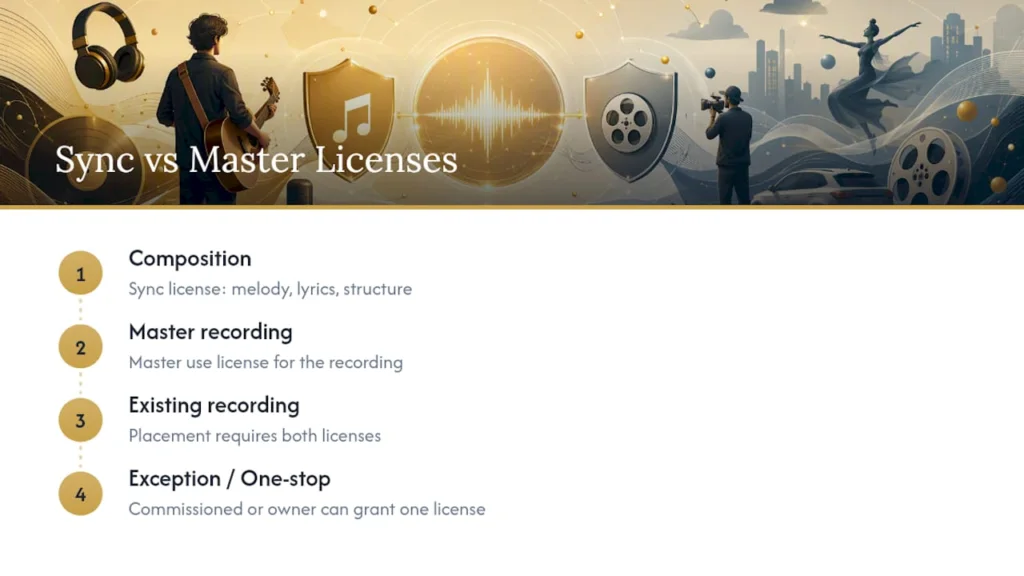
There’s one exception worth knowing early. If a production commissions original music, written and recorded specifically for that project, only one license typically applies because the composer and the performer are the same party granting the same permission at once. That’s rare for placements of existing catalog music, though, which is most of what indie artists pitch.
This dual structure is where independent artists who own their own masters and publishing gain a real edge. A one-stop rights holder can say yes to both licenses in a single email, with a single signature, at a single negotiated price. Supervisors on tight deadlines notice that. A production juggling a major label’s business affairs team on one side and a separate publishing company on the other can lose weeks to paperwork, and weeks are something most productions don’t have.
Who Decides: Supervisors, Publishers, Labels, and PROs
Music supervisors do the creative selecting, but they rarely have final say. Supervisors are the primary gatekeepers who scout, shortlist, and pitch tracks to a director or brand team, and those decision makers can veto a supervisor’s favorite pick for budget or creative reasons. Knowing this changes how you pitch: a supervisor passing on your song isn’t always a rejection of the music itself.
Publishers handle the composition side of the business, licensing songs, collecting royalties, and chasing usage across territories. Standard deals give publishers 30 to 50 percent of publishing income in exchange for that administration, which is why many independent artists choose to self-publish and keep the larger share, at the cost of doing the paperwork themselves.
Performance royalties flow through your performing rights organization, whether that’s ASCAP, BMI, or SESAC; understanding gym music licensing and PROs offers helpful background on how music licensing works in commercial settings. Registering your works and confirming your writer and publisher splits are correct is the single administrative task that determines whether a TV airing actually pays you months later. If you haven’t compared the major U.S. PROs yet, understanding how ASCAP and BMI differ is worth doing before your first placement, not after. Mechanical royalties, which cover reproduction rather than performance, run through the Mechanical Licensing Collective for U.S. streaming activity, a separate stream worth tracking but secondary to sync income for most artists starting out.
How Sync Deals Get Priced: Fees, Buyouts, and Terms
There’s no rate card for sync. Every fee is negotiated privately between the rights holder and the production, which means the price for the same three minutes of music can swing wildly depending on who’s asking and what they need it for.
A handful of variables drive that swing:
- Prominence: background music under dialogue pays less than a needle drop during a pivotal scene.
- Usage length: a 15-second clip costs less than a full-length sync.
- Territory: worldwide rights cost more than a single-country release.
- Exclusivity: locking the song out of other uses for a period raises the price.
- Production budget: a studio feature and a film-school short simply operate in different financial universes.
Pro Tip:Don’t fixate only on the headline fee. A slightly lower fee with a shorter exclusivity window and a narrower territory often leaves you freer to license the same song again elsewhere, which can outearn the bigger one-time check.
The other decision that shapes long-term value is buyout versus backend. A buyout pays one flat fee and often waives future royalties entirely, which can look attractive to a cash-strapped production but forfeits the recurring performance income a network TV airing would otherwise generate through your PRO. A licensed use with backend royalties intact usually pays less upfront but keeps paying every time the show reruns.
Realistic upfront ranges give you a sanity check before you negotiate. Indie TV and streaming placements commonly land between $500 and $30,000 depending on prominence and scope, while major ad campaigns and film trailers can pay well beyond that range. Student films and passion projects often offer little or no fee, sometimes trading exposure for a credit instead. Agents and sync libraries typically take a commission between 20 and 50 percent of whatever fee they negotiate on your behalf.
Getting Your Music Sync-Ready: Files, Metadata, and Rights Paperwork
Supervisors move fast and skip anything that looks unfinished. Here’s the checklist that keeps your catalog from getting passed over:
- Deliver a clean WAV master at full resolution, mixed without excessive limiting, since post-production teams need headroom to sit your track under dialogue or sound effects.
- Prepare stems, separating vocals from instrumental at minimum, so editors can drop the vocal for a scene that needs music but not lyrics.
- Embed metadata directly into the file, including title, writer names, publisher, and contact information, because a supervisor’s search tool reads that data even after the file gets separated from your original email.
- Register your ISRC and, where applicable, your ISWC, the codes that let PROs and distributors track the recording and composition separately across every platform it lands on.
- Keep a signed split sheet for every track, documenting who wrote what percentage, so payment disputes never stall a check that’s already been earned.
- Avoid uncleared samples entirely. A single uncleared loop can unravel an otherwise perfect placement and expose you to liability after the fact.
Pro Tip:Name your files like a supervisor would search for them: “ArtistName_SongTitle_Version_BPM_Key.wav” beats “Track3_final_v2.wav” every time.
Where to Pitch: Libraries, Direct Outreach, and Agents
Sync libraries offer volume. Submit once, and your track sits in a searchable catalog that supervisors browse for hours at a time, though most libraries take a cut and some demand exclusivity that locks your song out of other opportunities for months or years.
Direct pitching takes more effort but keeps you in control:
- Research supervisors working on projects that match your genre and mood before you ever hit send.
- Send a tight pitch packet: one or two tracks max, a one-sheet with credits and licensing terms, and a direct way to reach you.
- Expect silence more often than a reply. Supervisors field hundreds of submissions weekly, and no response within a few weeks usually just means no, not maybeCurrently.
Agents and boutique publishers sit between these two approaches, pitching on your behalf in exchange for a commission, and they’re worth pursuing once you have a catalog deep enough to justify someone else fielding calls for you. Whichever channel you choose, understanding how supervisors search for cinematic tracks that fit a specific brief will sharpen how you position your own catalog.
Contract Red Flags Every Independent Artist Should Know
A handful of clauses do most of the damage in a bad sync deal, and they’re the ones worth reading twice before you sign anything.
- Exclusivity scope: a narrow, short exclusivity window protects your ability to license the same song elsewhere; broad, indefinite exclusivity can quietly kill future income.
- Territory and term: “worldwide, in perpetuity” sounds impressive until you realize it means you can never place that song again anywhere, ever.
- Assignment clauses: watch for language letting the production transfer your license to a third party without your consent.
- Indemnity and warranty language: you’re often asked to warrant you own full rights and hold the production harmless if that turns out to be false, so don’t sign that warranty until every composition and master right is actually cleared.
Pro Tip:If a contract offers a buyout below roughly $2,000 with worldwide, perpetual, exclusive terms attached, that’s a signal to negotiate the exclusivity down rather than accept the fee as written.
Once a deal involves six figures, multi-territory exclusivity, or language you don’t fully understand, that’s the threshold for bringing in a music attorney or publisher rather than signing solo.
How DRVVYN Sound Builds and Pitches a Sync-Ready Cue
Tracks are sent as short cue packs with two or three options, full WAV masters, instrumental and vocal stems, one-sheet listings of writer credits and publishing splits, and contact information embedded in every file. Nothing goes out without clearance already documented, to avoid delays caused by ownership questions after interest.
The timeline from first pitch to signed placement usually runs weeks rather than days, and often longer when a project’s edit is still in flux. That waiting window is normal, not a sign the pitch failed. Tracks like Piece of Peace and the intimate cut of Lost in Her Rhythm show the kind of finished, metadata-tagged masters this process produces.
Your First 90 Days: A Sync Licensing Action Plan
Turning this guide into income takes structure, not more research. Here’s the order that gets a track in front of decision makers fastest:
- Weeks 1 to 2: register every unregistered work with your PRO and confirm all writer and publisher splits are documented correctly.
- Weeks 3 to 4: build a three-track cue pack, complete with WAV masters, stems, and embedded metadata on every file.
- Weeks 5 to 8: pick one lane, either a single sync library submission or a personalized outreach list of ten supervisors, and pitch consistently.
- Weeks 9 to 12: log every submission and response in one place, follow up once after two to three weeks of silence, and adjust your pitch based on what actually gets replies.
Given that indie placements commonly fall between $500 and $30,000, even a single successful pitch in this window can cover months of production costs.
Why Owning Your Rights Beats Chasing the Perfect Pitch
Most advice on sync licensing obsesses over the pitch itself: the perfect email subject line, the ideal supervisor to target, the magic genre tag. That’s not wrong, exactly, but it’s aimed at the wrong problem. The artists who actually get placements consistently are the ones who removed friction before they ever hit send, meaning they owned their masters, registered their publishing, and had clean files ready the moment an opportunity appeared.
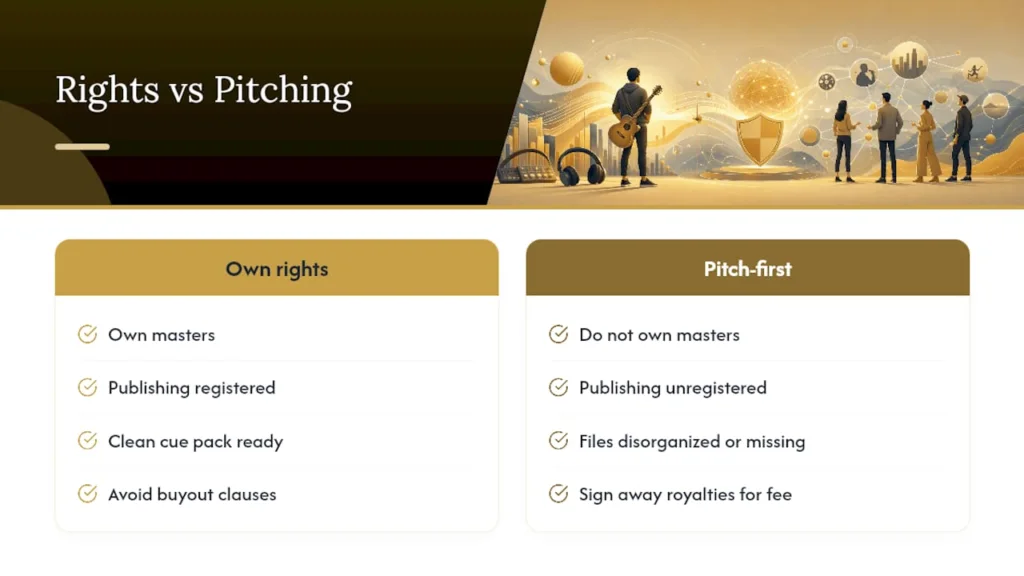
The conventional wisdom undersells how much buyout clauses cost artists over time. A flat fee feels good in the moment, but forfeiting years of potential performance royalties for a quick check is a trade few artists make with full information, because nobody explains the backend math until after the contract’s signed.
If you take one thing from this guide, prioritize the boring paperwork first: PRO registration, correct splits, and a clean cue pack. The pitching skills matter, but they’re wasted on a catalog that isn’t actually ready to say yes when someone finally asks.
— DRVVYN Sound
Sources
- What Is Synchronization Licensing? | Music Admin
- Synchronization rights
- What Is Sync Licensing: A Complete Beginner’s Guide | LordReverb
- What Is Sync Licensing? Complete 2026 Guide | DropCue
- Music Licensing 101: How to Sync Your Music | Berklee
FAQ
How does sync licensing work?
A production identifies music it wants to pair with visual content, then negotiates a synchronization license from the composition’s rights holder and, separately, a master use license from whoever owns the recording. Both must be cleared before the placement can legally air.
How much should I charge for a sync license?
There’s no fixed rate since every fee is negotiated privately, but indie TV and streaming placements commonly range from $500 to $30,000 depending on prominence, usage length, territory, and exclusivity terms.
Do I need a publisher to get sync placements?
No. Independent artists who self-publish keep a larger share of income since publishers typically take 30 to 50 percent of publishing revenue for the administrative work.
What’s the difference between a buyout and a licensing deal with royalties?
A buyout pays one flat fee upfront and often forfeits future performance royalties entirely, while a standard license typically pays less initially but keeps generating backend income through your PRO every time the placement airs again.
What files do I need ready before pitching to a supervisor?
Send a full-resolution WAV master, instrumental and vocal stems, embedded metadata with writer and contact details, and a signed split sheet documenting ownership percentages for every co-writer involved.