

Music Business
U.S. Songwriters: File Copyrights in eCO to Preserve Statutory Damages
Step by step U.S. how to for songwriters: set up an eCO account, prepare acceptable deposit files, use GRAM for album bundles, and file early to keep…
By DRVVYN · · 14 min read

You do not need to register a song to own its copyright, but you do need to register before you can sue for infringement or claim statutory damages, and the timing of that filing shapes what you can recover. If you plan to release, license, or monetize your music, the smart move is to start an eCO account now, gather your deposit copy, and file while the work is still fresh. Waiting costs you more than a filing fee.
TL;DR:
- Registering a song before release or monetization ensures access to statutory damages and the ability to enforce rights effectively.
- Accurate listing of authorship, claimant details, and high-quality deposit copies are critical to avoid processing delays and rejection.
- Registering both the musical composition and sound recording separately maximizes legal protection when different parties hold rights.
- Timely registration, ideally before infringement occurs, preserves the ability to claim damages based on statutory damages and attorneys’ fees.
- Group registration options can significantly reduce costs when registering multiple songs on the same project, provided authorship and ownership are uniform.
Understanding Copyright Registration for Songs
Protection for your song begins the instant you fix it in a tangible form, whether that’s a phone voice memo, a lyric sheet, or a finished master. That’s automatic, no paperwork required, under basic copyright principles. But automatic protection and enforceable protection are two different things.
Copyright registration for songs is the formal process of filing your work with the U.S. Copyright Office so it becomes part of the public record and, more importantly, so you gain the legal standing to act if someone steals it. Musicians sometimes hear “copyright” and “registration” used interchangeably, but they’re not the same event. You own the copyright the moment you write the song. You gain the right to sue in federal court, and access to the strongest financial remedies, only after you register.
That distinction drives everything else in this guide: what to prepare, how to file through the Office’s eCO system, what a musical composition deposit looks like versus a sound recording deposit, and how the timing of your filing can mean the difference between recovering real damages and recovering nothing at all.
Quick Checklist: What You Need to Register a Song Right Now
Before you open an eCO session, gather the essentials. Registration moves faster when you’re not hunting for information mid-application.
- Decide what you’re registering. A musical composition (the notation and lyrics), a sound recording (the fixed audio performance), or both, since they’re legally distinct works.
- Collect names and dates. You’ll need the precise legal names of every author and claimant, the date the song was created, and the date it was first published, if applicable.
- Have contact information ready, but choose it deliberately. Whatever you list becomes part of the public record through the Copyright Public Records system, so consider using a business address or publisher contact rather than a home address.
- Prepare your deposit copy. This means an electronic file such as a PDF of the score and lyrics, or an MP3/WAV of the recording, formatted according to Copyright Office standards.
- Have a payment method ready. Credit card, debit card, or a Copyright Office deposit account.
- Consider whether you’re registering multiple songs. If so, look into group registration before you start, since it changes how you organize your application.
Get these six items lined up first. The application itself moves quickly once the groundwork is done.
How Do You Register a Song Through eCO?
The U.S. Copyright Office’s eCO registration system is the fastest and cheapest path to registering a song, and it’s the route the Office itself recommends over paper filing. A complete claim requires three things: the application, the filing fee, and the deposit copy. Miss any one of them and the Office won’t even begin reviewing your claim.
Here’s how the process actually runs, start to finish.
- Create and verify your eCO account. Set up your login at the Copyright Office’s online portal, confirm your email, and familiarize yourself with the dashboard before you start a real application. You can save drafts, so there’s no penalty for exploring first.
- Select the correct claim type. Choose “musical composition” if you’re registering the underlying song, “sound recording” if you’re registering a specific fixed performance, or file both if you control both elements and want separate protection for each.
- Enter authorship and claimant details accurately. This step trips people up more than any other. If two people wrote the song together, that’s joint authorship. If you’re registering on behalf of a band under a work-for-hire agreement, the “author” listed may be the hiring party, not the individual musician. If rights were transferred, say from songwriter to publisher, that transfer needs to be reflected correctly.
- Upload your deposit copy. PDF for a lead sheet or lyric sheet, MP3 or WAV for the audio. The system will reject files that don’t meet its specifications, so check the format before you upload.
- Pay the filing fee and submit. Online filing fees are generally lower than paper filing fees, and the fee schedule is published in Circular 4.
- Save your confirmation and track your status. You’ll receive a case number immediately. Processing itself can take months, and you can check status through your eCO dashboard rather than calling the Office.
- Print a shipping slip if a physical deposit is required. Some claims, particularly those involving physical phonorecords, require you to mail a hard copy. The eCO system generates a shipping slip you attach to the package.
Pro Tip:Save your application as a draft before entering payment information, and reread every name field twice. A misspelled claimant name is one of the most common reasons registrations get flagged for correction later, and fixing it after the fact takes real time.
The effective date of your registration is not the day you click “submit.” It’s the day the Office receives all three required elements, acceptable application, fee, and deposit, in a form it can process. That date matters more than most songwriters realize, and it’s worth understanding before you file.
Musical Composition vs. Sound Recording: What Are You Actually Registering?
A musical composition is the song itself: the melody, harmony, and lyrics, the thing a songwriter creates whether or not it’s ever recorded. A sound recording is the fixed audio performance, the specific take that got mixed and mastered. These are legally separate works, and Circular 50 is the Copyright Office’s primary guidance on how to register each one correctly.
The distinction matters most when the songwriter and the performer aren’t the same person. A session singer might record a song written by someone else entirely, and each party may want to register their own contribution separately to protect their specific rights. If you wrote the song and also performed and produced the final recording, you may control both elements, and many working musicians register both to maximize their enforcement options and keep clean records for royalty tracking, according to the Copyright Office’s own guidance for musicians.
Combined registration, covering both the composition and the recording in a single claim, is permitted in specific circumstances. Circular 56 and 56A address these exceptions in detail, particularly around multiple works and collections. If your situation involves co-writers, sampled material, or a recording that mixes contributions from different rights holders, it’s worth reading those circulars closely or consulting an entertainment attorney before you file.
Timing, Effective Date, and Why Enforcement Depends on Registration
Filing late doesn’t just delay your paperwork. It can cost you your strongest legal remedies entirely.
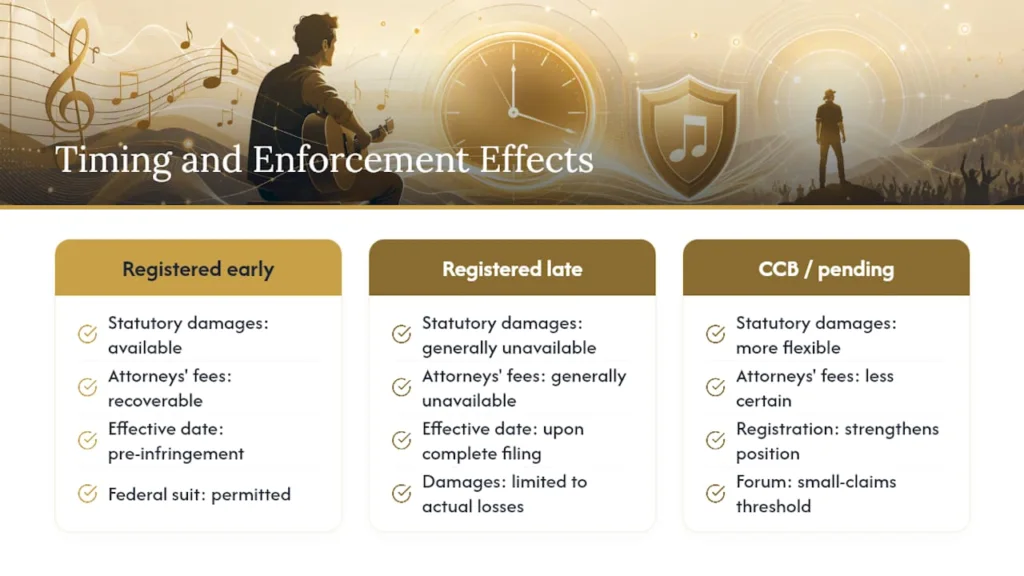
U.S. copyright law requires registration before you can bring a lawsuit for infringement of a U.S. work in federal court. That’s the baseline rule, and it applies no matter how clearly someone has ripped off your song. But the deeper issue is timing relative to when the infringement happened.
Registration is not just a formality before filing suit. It sets the effective date the Copyright Office recognizes for enforcement purposes, and the Office will not assign that date until it has received a complete application, fee, and deposit.
If you register before the infringement occurs, or within the statutory window shortly after your song is published, you preserve access to statutory damages and attorneys’ fees. Miss that window, and you’re generally limited to proving actual financial losses, a much harder and more expensive case to build. This is why creators who expect to commercialize their work benefit from registering early rather than waiting until a problem arises, since statutory damages and fee-shifting are what make litigation realistic for an independent artist facing a well-funded infringer.
There’s also a newer, lower-cost forum: the Copyright Claims Board, a small-claims style tribunal for disputes under a certain dollar threshold. Registration requirements there are somewhat more flexible than in federal court, but having a registered or at least pending claim still strengthens your position significantly.
Fees, Group Registration, and Ways to Save Money
The current fee schedule lives in Circular 4, and it’s worth checking before every filing since fees do get adjusted periodically. Online filing through eCO is consistently the cheapest option, and the Office accepts credit cards, debit cards, and prepaid deposit accounts for frequent filers.
If you’re registering more than one song, group options can cut your per-song cost substantially:
- Group registration for unpublished works allows you to bundle up to ten unpublished songs into a single application and fee, provided they share the same claimant.
- GRAM (Group Registration for Works on an Album) lets you register up to 20 musical works released on the same album in one filing, as long as the songs share consistent authorship and claimant information.
- Separate filings become necessary when songs on the same project have different writers, different ownership splits, or different claimants, since group options require uniform authorship rules to qualify.
If your album was written entirely by you and you hold all the rights, GRAM can save meaningful time and money. If you co-wrote three tracks with different collaborators, expect to file some of those separately.
What Counts as an Acceptable Deposit Copy?
Your deposit is the actual copy of the work you submit alongside your application, and it becomes a nonreturnable part of the Copyright Office’s permanent files. The Office needs it to verify what you’re claiming and to maintain a record of the work as it existed at filing.
- For a musical composition: a PDF of the lead sheet, full score, or lyric sheet is typically acceptable.
- For a sound recording: an MP3 or WAV file uploaded directly through eCO covers most claims.
- Physical deposits are sometimes required, particularly for certain published works, and in those cases you’ll print a shipping slip from eCO and mail a hard copy phonorecord.
- Best edition rules apply when a work exists in multiple formats. The Office generally wants the highest-quality, most complete version you have.
Pro Tip:Label your files clearly before uploading, using the song title and your name rather than a generic filename like “final_mix_v3.wav.” It sounds minor, but it makes your submission easier to track if you ever need to reference it during a dispute years later.
Registration also triggers a separate obligation: mandatory deposit to the Library of Congress for certain published works, distinct from the registration deposit itself. Circular 50 walks through when this applies.
Your Registration Becomes Public, and So Does the 35-Year Rule
Once you file, the details you submit, your name, your claimant information, creation and publication dates, become part of a permanent, searchable public record through the Copyright Public Records System. Anyone can look it up. That’s not a flaw in the system; it’s the point. Public registration is what gives your claim legal weight. But it does mean you should think carefully about what contact information you list, especially if you’re a solo artist without a publisher or business entity acting as a buffer.
There’s a second long-term detail every songwriter should understand: the termination right under Section 203 of the Copyright Act, commonly called the 35-year rule. If you transfer your rights to a publisher or label, federal law allows you to reclaim those rights roughly 35 years after the transfer, provided you follow specific notice requirements and timing windows. It sounds distant when you’re 25 and just signed your first deal, but songwriters who understand this right early are far better positioned to act on it decades later. If your catalog involves complex transfers, co-writers, or inherited rights, this is a conversation worth having with an entertainment attorney rather than guessing at the deadlines yourself.
The Mistakes That Delay or Sink a Registration
Most registration problems trace back to a handful of avoidable errors.
- Wrong claimant listed. If the person filing isn’t actually the current rights holder, due to a transfer, work-for-hire arrangement, or bandmate dispute, the claim can be challenged or rejected outright.
- Incomplete or mismatched deposits. Uploading the wrong file format, or a deposit that doesn’t match the described work, is one of the most common causes of processing delays.
- Wrong category selected. Filing a sound recording as a musical composition, or vice versa, muddies the legal record and may require correction later.
- Ignoring correction options. If you catch an error after submission, the Office allows supplementary registrations to correct or amplify the public record; don’t assume a mistake is permanent, but do expect the fix to take additional processing time.
- Falling for unofficial “registration” services. Some third-party sites charge songwriters for registration services that provide no actual legal protection beyond what a simple dated file already offers. International guidance from WIPO is consistent on this point: use your country’s official government system, not a private intermediary claiming to offer equivalent protection.
How DRVVYN Sound Approaches Registration for Original Work
Every original release DRVVYN Sound puts into the world, whether it’s a finished R&B track, an instrumental bed for a visualizer, or lyrics still in draft form, goes through the same basic sorting question before anything gets filed: is this a composition, a recording, or both, and who exactly holds the rights to each piece.
That sounds simple until a project involves a co-writer, a session musician, or a producer contributing original material. Getting authorship and claimant details right before submission saves far more time than fixing them after the fact, which is part of why metadata preparation, correct legal names, accurate dates, clear ownership splits, happens early in DRVVYN Sound’s production workflow rather than as an afterthought before release.
Registration is also just one piece of a bigger publishing and licensing picture. Understanding how performing rights organizations fit alongside registration matters just as much, and the breakdown of ASCAP versus BMI covers how royalty collection connects to the ownership records you establish when you register a song in the first place.
What Songwriters Get Wrong About Registration
Most guides treat registration like a bureaucratic afterthought, something to handle “eventually” once a song starts making money. That advice is backwards. The songs most worth protecting are exactly the ones you haven’t monetized yet, because early registration is what preserves your access to statutory damages if something goes wrong later.
The bigger blind spot, though, is public record exposure. Songwriters spend so much energy on the deposit and the fee that they give almost no thought to what contact information becomes permanently searchable the moment they file. That’s a real decision, not a checkbox.
If there’s one thing to prioritize above the rest, it’s this: treat registration as part of your release workflow, not a separate legal chore. Decide what you’re registering, prepare clean metadata, and file before the song goes out into the world, not after a problem forces your hand. For songwriters planning releases around a broader production and marketing timeline, tools like a custom anniversary song service can help build registration into that schedule rather than treating it as an afterthought.
— DRVVYN Sound
This article is general information, not a substitute for advice from a qualified lawyer. Consult a qualified legal professional about your own circumstances before acting on anything here.
Sources
Bookmark these before you start your first filing. The eCO portal is where the actual application happens. Circular 2 covers the general registration process, required elements, and fee structure. Circular 50 is the dedicated guide for musical compositions, including deposit formats and group registration eligibility. The GRAM help page walks through album-level group filing rules in detail. For anything unusual, joint ownership, terminations, disputed claimants, the Compendium of U.S. Copyright Office Practices is the deepest procedural reference available, though it reads more like a legal manual than a quick guide.
- Circular 50: Copyright Registration for Musical Compositions
- GRAM / group registration help (U.S. Copyright Office)
- 17 U.S. Code § 203 — Termination of transfers and licenses granted by the author
FAQ
How much does it cost to register a song with the U.S. Copyright Office?
Fees vary by claim type and filing method, with online eCO filing generally cheaper than paper filing; the current schedule is published in Circular 4. Group options like GRAM can lower your per-song cost significantly when you’re registering an album of related works.
What is the 35-year rule for music?
It refers to the termination right under Section 203 of the Copyright Act, which allows songwriters to reclaim rights they transferred to a publisher or label roughly 35 years after that transfer, subject to specific notice and timing requirements.
How do I register a song with the U.S. Copyright Office?
Create an eCO account, select whether you’re filing for a musical composition, a sound recording, or both, enter accurate authorship and claimant information, upload an acceptable deposit copy, and pay the filing fee before submitting.
How much of a song can I use without infringing copyright?
There’s no fixed word count, note count, or percentage that automatically qualifies as fair use; courts evaluate the purpose of the use, the amount taken relative to the whole work, and the effect on the original song’s market value case by case.