

Music Business
How Your Next 12 Months Decide: UnitedMasters vs TuneCore
Compare UnitedMasters and TuneCore by release frequency, royalty splits, playlist pitching, and publishing admin. Use DRVVYN Sound’s 12‑month decision…
By DRVVYN · · 12 min read

If you release often and want predictable royalties with publishing support, TuneCore is the stronger fit. If you’re starting out and want a free entry point plus brand and sync exposure, UnitedMasters makes more sense. And if pure volume at a flat annual cost is your priority, DistroKid rounds out the comparison. The right answer depends less on hype and more on how you release and what you need reported back to you.
TL;DR:
- Flat-fee distributors like DistroKid are more cost-effective for artists releasing multiple singles or albums annually, often paying no percentage of royalties.
- TuneCore retains full royalties after distributing fees and offers detailed reporting and publishing administration crucial for licensing and sync opportunities.
- UnitedMasters’ free plan provides social media distribution and brand partnership exposure, making it ideal for emerging artists testing the waters without upfront costs.
- Distributors differ significantly in payout frequency and thresholds, so artists with steady cash flow should prioritize services with faster, more consistent payout schedules.
- Consider your release schedule, licensing needs, and promotional priorities before choosing, as no one distributor is best for all artist goals.
UnitedMasters vs TuneCore vs DistroKid: The Quick Comparison
Every artist weighing distribution asks the same underlying question: who keeps more of my money, and who gets my music in front of the right ears? Here’s the shape of it before we dig into specifics.
- TuneCore charges per release or a yearly plan, lets you keep your royalties, and layers in publishing administration for artists who need sync and songwriter income tracked properly. Best for artists who release on a schedule and want granular, exportable reporting.
- UnitedMasters leads with a free DEBUT plan that distributes to social platforms. Then, it moves into SELECT and PARTNER tiers that unlock broader streaming reach plus brand and sync opportunities. Best for emerging artists who want a no-cost way to test the waters before committing budget, especially if visibility through partnerships matters more than pure royalty math early on.
- DistroKid runs on a flat annual fee for unlimited uploads and pays out 100% of streaming royalties. Best for prolific releasers who drop singles constantly and want cost predictability over any single-release pricing model.
Reach across the major stores (Spotify, Apple Music, Amazon Music) is broad for all three, but reporting depth is where they separate. TuneCore’s publishing admin option and detailed per-platform statements stand out for anyone pitching songs for licensing. UnitedMasters leans into brand partnerships over spreadsheet depth. DistroKid keeps things simple by design, trading some reporting nuance for speed and volume.
What Does Each Plan Actually Cost You Per Year?
Pricing structure is where the three services diverge most, and it’s worth doing the math against your actual release habits before picking one.
TuneCore historically runs on a per-release or annual plan model, where you pay upfront to distribute and keep your streaming royalties afterward. UnitedMasters flips that: its free DEBUT tier costs nothing but only reaches social platforms, while its SELECT and PARTNER plans unlock full streaming distribution along with brand and sync access, typically for a share of revenue or a paid tier. DistroKid uses a flat yearly membership fee that covers unlimited uploads for that year, with no revenue share on streaming income.
Here’s how that plays out across common release schedules:
- One single per year: A one-off release favors whichever service has the lowest per-release cost. If you’re not releasing again soon, a free-tier or per-release model avoids paying for a year of uploads you won’t use.
- Three singles per year: This is where flat-fee math starts to win. Three separate per-release charges can add up to more than a single annual membership fee, depending on the current rate each service publishes.
- One full album per year: A multi-track album usually costs more to distribute piece by piece than under one flat annual plan, since each track can carry its own per-release charge on some models.
The general pattern industry roundups confirm: flat-fee distributors typically pay 100% of streaming royalties, while revenue-share or free plans keep a percentage of earnings in exchange for the lower or zero upfront cost. If you release constantly, that percentage compounds fast. If you release rarely, it barely registers.
Pro Tip:Before you commit to any plan, add up your realistic release count for the next 12 months first. Most artists overestimate how often they’ll actually drop new music, and that number should drive the pricing decision, not the other way around.
Who Keeps More of the Royalties, and How Fast Do You Get Paid?
TuneCore lets you retain your royalties outright once you’ve paid the distribution fee, whether that’s per release or through an annual plan. DistroKid does the same under its flat membership, paying out 100% of streaming income with no ongoing commission. UnitedMasters is different: its free DEBUT plan takes a percentage of revenue in exchange for zero upfront cost, while its paid SELECT and PARTNER tiers shift toward higher royalty retention alongside broader distribution.
- Commission structure: TuneCore and DistroKid don’t take an ongoing cut of streaming royalties once you’re paying their fee. UnitedMasters’ free tier does, and that’s the trade-off for not paying anything upfront.
- Payout cadence: Payout frequency and thresholds vary by service and can change over time, so check each platform’s current terms before you release, especially if consistent cash flow matters to your budget.
- Payment methods: Most services support standard bank transfer or PayPal-style payouts, though availability depends on your country and account setup.
- Revenue stream treatment: Streaming royalties, social platform payouts, and sync or brand advances aren’t always treated identically. UnitedMasters, for instance, references artist advance options through partners like BeatBread for qualifying artists, which is a different mechanism entirely from a monthly royalty statement.
If cash flow predictability keeps you up at night, that’s a bigger factor than the headline royalty split. A distributor that pays 100% but settles quarterly can feel worse day to day than one with a small cut but faster, more frequent payouts.
How Do Playlist Pitching and Brand Deals Compare?
Promotional tools are where UnitedMasters tries hardest to differentiate itself, and it shows. The platform’s marketing leans heavily on brand partnerships, MasterLinks, and ArtistPages as promotional infrastructure, positioning itself less as a pure distributor and more as a discovery and monetization partner.
- Playlist pitching mechanics: Regardless of which distributor delivers your release, Spotify’s own rules govern editorial playlist consideration. You need to pitch unreleased songs and eligible videos at least 7 days before release to give editors time to listen, and who can submit that pitch depends on account access roles tied to your distributor.
- Brand and sync access: UnitedMasters’ SELECT and PARTNER plans open doors to brand and sync opportunities that aren’t part of its free tier. TuneCore’s publishing administration option supports sync placement indirectly by keeping your metadata and ownership documentation clean for licensing conversations.
- Mobile-first tools: UnitedMasters built much of its workflow around a mobile app experience, useful if you’re managing releases from your phone rather than a desktop dashboard.
Access to promotional partnerships can be worth paying for if discovery matters more to you right now than squeezing out every royalty dollar. That’s a real trade-off, not a marketing line: a wider audience today can be worth more than a slightly bigger check later.
For a deeper look at how pitching timing actually works, our review of Spotify’s playlist features breaks down the editorial process in more detail, and our playlist discovery tips cover tactics that work alongside whichever distributor you choose.
Which Service Gives You the Most Detailed Reporting?
If you need documentation for licensing conversations, this section matters more than pricing. TuneCore positions itself around distribution plus publishing administration and broader store reach, which means more granular, exportable statements for artists who need to prove earnings by platform and territory.
- Store reach: All three services deliver to major platforms like Spotify, Apple Music, and Amazon Music, with reach differences typically appearing in secondary or regional stores rather than the big names.
- Reporting granularity: TuneCore’s publishing admin option supports per-platform, per-country breakdowns useful for sync licensing paperwork. UnitedMasters’ reporting is more consumer-friendly through its app but historically less detailed for formal documentation.
- Content ID and publishing: TuneCore offers standalone publishing administration as an add-on. Content ID and YouTube monetization availability vary by plan across all three, so confirm current terms before assuming coverage.
If your income depends partly on licensing pitches, this is the section to weigh heaviest, since a distributor’s app can be beautiful and still leave you without the paperwork a sync supervisor wants to see.
How Good Is Support, and Can You Run It All From Your Phone?
Day-to-day usability separates these services almost as much as pricing does. UnitedMasters built its reputation on mobile-first workflows, letting you upload, monitor, and pitch to brand opportunities largely from an app.
- Support channels: All three offer help center documentation and ticket-based support; responsiveness varies and is worth testing with a real question before you commit a full catalog.
- Mobile capability: UnitedMasters handles most core tasks, including release uploads and brand-opportunity browsing, from mobile. TuneCore and DistroKid support mobile access but lean more on desktop dashboards for detailed reporting and publishing admin tasks.
- Integrations: Artists commonly pair any of these distributors with separate tools for playlist tracking, fan email lists, or social scheduling, since none of the three function as a full marketing suite on their own.
If you’re the type of artist who manages everything from your phone between shifts at a day job, that mobile gap between UnitedMasters and the other two is worth testing before you sign anything.
What Should You Ask Before You Sign Up?
Match your priorities to the right service using this quick checklist before committing your catalog to any one platform.
- How often will you actually release music this year? High-frequency releasers usually save money on flat-fee models; occasional releasers may do better with free or per-release pricing.
- Do you need publishing administration? If sync licensing is part of your income plan, confirm whether publishing admin is included or available as an add-on, and what it costs.
- What’s the commission structure on every revenue stream? Ask specifically about social platform payouts and YouTube monetization. A “keep 100%” claim sometimes applies only to core streaming, not every revenue source.
- What’s the payout threshold and schedule? Some platforms hold payouts until you hit a minimum balance, which matters if you’re relying on that income regularly.
- What’s the takedown policy? Confirm how long a takedown request takes to process across all connected stores before you plan a re-release or a distributor switch.
Red flags worth pausing on: vague answers about commission on non-streaming revenue, unclear takedown timelines, or support that can’t confirm current pricing in writing.
How Do You Switch Distributors Without Losing Your Catalog?
Moving your music between distributors is manageable if you follow a sequence rather than rushing it.
- Review your current contract terms for any exclusivity windows or notice requirements before initiating anything.
- Compile masters and full metadata for every release, including ISRC and UPC codes, songwriter splits, and release dates.
- Schedule takedowns and re-releases carefully to avoid simultaneous distribution, which can trigger duplicate-content flags on some stores.
- Verify each release reappears correctly on major platforms within the new distributor’s stated turnaround window before considering the migration complete.
The most common mistake is letting old and new releases go live at the same time, which fragments your streaming history and confuses playlist algorithms that weight consistency.
DRVVYN Sound Perspective: Matching the Distributor to the Goal
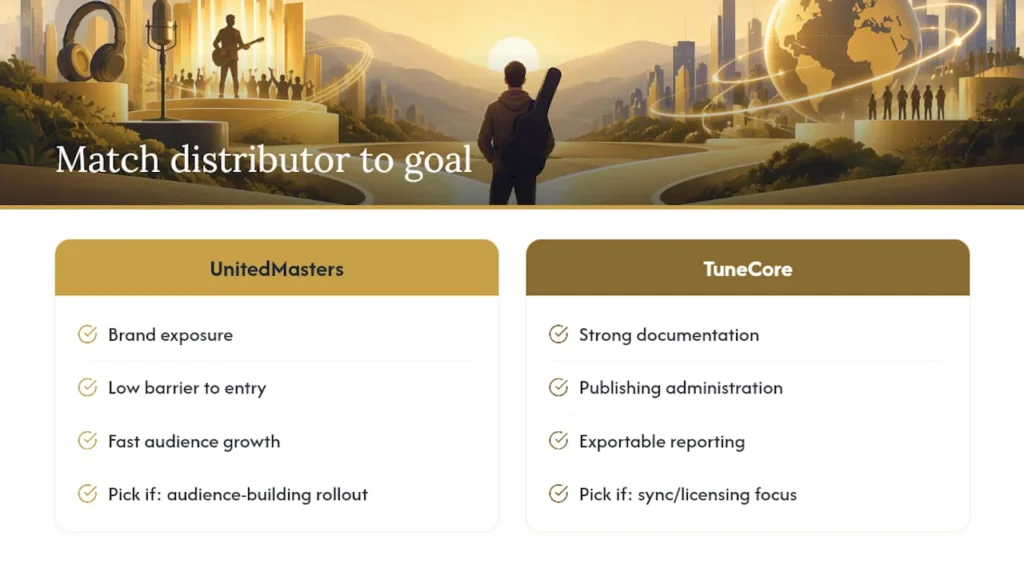
Our own catalog decisions come down to one question: what does this release need to do? A song built for sync placement needs clean publishing administration and exportable reporting more than it needs a flashy app, which is why TuneCore’s documentation strength matters for licensing-focused work. A song built to build audience fast, especially early in an artist’s rollout, benefits more from UnitedMasters’ brand exposure and low barrier to entry.
We don’t think one service is universally right. We think most artists pick based on marketing polish instead of asking what their next twelve months of releases actually require, and that’s the more expensive mistake.
— DRVVYN Sound
Beyond Distribution: What DRVVYN Sound Offers Artists
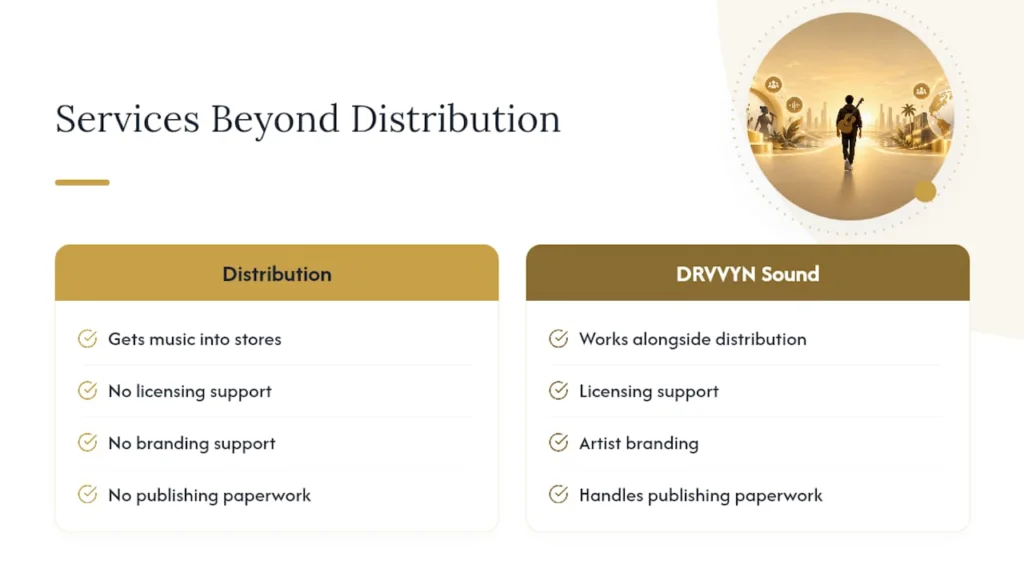
Distribution gets your music into stores. It doesn’t handle licensing conversations, brand outreach, or the publishing paperwork that turns a sync opportunity into an actual paycheck. That’s a different job, and it’s one most self-serve platforms leave entirely on your plate.
DRVVYN Sound works with artists on the side distribution doesn’t cover: licensing support, artist branding, and creative development built around emotionally driven, sync-ready music. If you’ve got a catalog and no clear path to licensing income, that gap is worth closing before your next release, not after it.
Explore licensing and artist services with DRVVYN Sound to see how managed support fits alongside whatever distributor you choose.
Sources
- Pitching music and videos to playlist editors – Spotify for Artists (support)
- AN UPDATE ON OUR ARTIST PLANS — UnitedMasters
- UnitedMasters vs TuneCore – Why TuneCore Better – TuneCore
- Best Music Distribution Services in 2026, Ranked by Royalty Payout | MelodicMind
FAQ
Which Famous Artists Use UnitedMasters?
UnitedMasters has built its reputation partly on partnerships with major brands, sports leagues, and media companies rather than a single roster of headline names. Its promotional tools and brand/sync access, detailed in its own plan documentation, are built to help emerging artists reach that kind of exposure, not just established ones.
Which Music Distribution Service Is Best?
There’s no single best distributor. TuneCore fits artists who need publishing administration and detailed reporting for licensing, UnitedMasters fits artists prioritizing low-cost entry and brand exposure, and DistroKid fits high-volume releasers who want flat annual pricing and 100% royalty retention.
Who Pays Better, DistroKid or UnitedMasters?
DistroKid pays 100% of streaming royalties under its flat annual fee with no commission. UnitedMasters’ free DEBUT plan takes a percentage of revenue in exchange for zero upfront cost, though its paid tiers shift toward higher retention alongside broader distribution.
Is UnitedMasters a Good Distributor?
UnitedMasters works well for artists who want a free entry point and value brand or sync exposure over maximum royalty retention early on. It’s a stronger fit for discovery-focused artists than for those purely optimizing net royalty income.
UnitedMasters vs TuneCore: Which Should I Choose First?
Choose TuneCore if you release on a schedule and need publishing administration or detailed per-platform reporting for licensing work. Choose UnitedMasters if you’re starting out, want to test distribution at no upfront cost, and value brand partnership access over granular royalty documentation.