

Music Business
Register Songs First: Publishing vs Label for Independent Musicians
Indie songwriters: register songs and fix metadata first. This action-first guide shows when to self administer, sign an admin deal, or work with a label.
By DRVVYN · · 11 min read

Publishing controls the song itself, the composition: the melody and lyrics you wrote. A label typically controls the master, the actual recorded performance. If you only do one thing today, register your songs with a performing rights organization and double-check your metadata, because that single step recovers money most independent artists are already owed. Beyond that, most songwriters need a publisher far sooner than they need a label.
TL;DR:
- Registering your songs with a performing rights organization and verifying your metadata can recover most unpaid royalties for independent artists.
- Royalties are split between composition rights collected by PROs and master rights managed by publishers or labels, often leading to unclaimed income.
- Choosing the right publishing deal depends on your needs for administration, co-publishing, or outright sale, with careful attention to contract definitions and rights transfer.
- Most independent artists should focus on self-administration through The MLC and PROs before considering publisher or label deals, especially for metadata and registration accuracy.
- International streaming and performance royalties require additional registrations and local agreements, making cross-border rights management more complex.
What each right actually protects: composition vs master
Two separate copyrights live inside every track you release, and they rarely travel together. The composition is the song as written, the words and the music, and it belongs to the songwriter (or whoever the songwriter assigns it to) the moment it’s created. The master is the specific recording of that song, the performance captured in the studio or bedroom, and ownership there usually sits with whoever paid for or controls that recording session.
This split is why one recording can quietly generate two income streams that never touch each other. A songwriter can earn from the composition even when they don’t own the master, and a label can profit from a master without owning a note of the underlying song. The U.S. Copyright Office treats these as distinct filings for a reason: Circular 50 covers musical composition registration, Circular 56 covers sound recordings, and the paperwork for each is different because the rights underneath them are different.
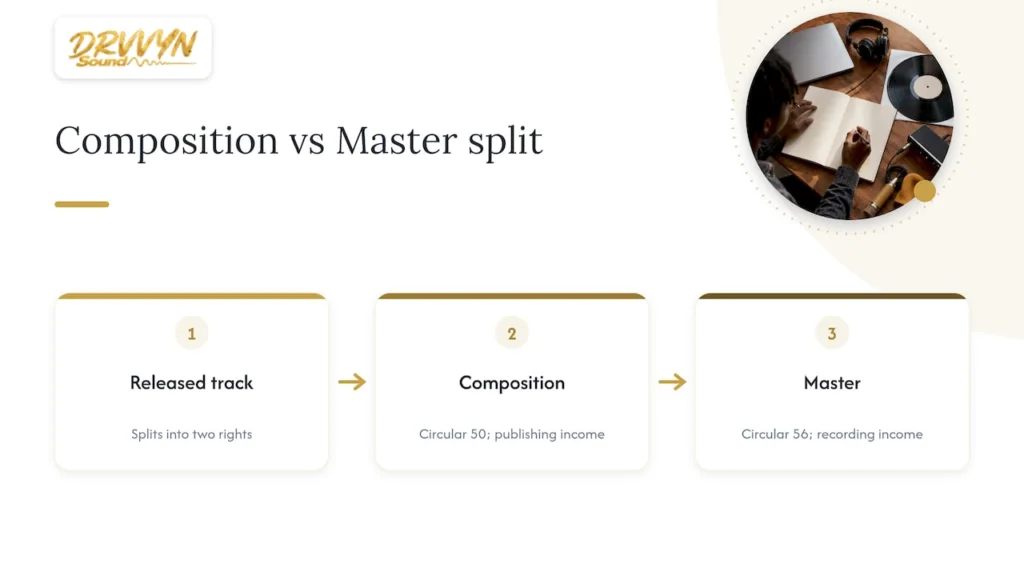
Keeping those negotiations separate, rather than letting one deal absorb both, gives you room to find the right partner for each asset instead of handing both away to whoever shows up first.
How royalties flow and who actually collects them
Money moves through different pipes depending on which right is generating it, and a lot of unclaimed income simply sits in the wrong pipe. Here’s the breakdown most independent artists are missing:
- Performance royalties come from radio play, live performance, and streaming plays of the composition, and they’re collected by performing rights organizations like ASCAP, BMI, SESAC, or GMR.
- Mechanical royalties for interactive streaming in the United States flow through The MLC, which self-administered songwriters can join directly at no cost.
- Master and digital performance royalties for non-interactive and satellite play are handled by SoundExchange, paid out to the owner of the sound recording rather than the songwriter.
As of Q2 2026, The MLC reports more than 85,000 enrolled members, and it still holds historical unmatched mechanical royalties dating back to 2007 for some services. That backlog exists largely because artists never registered or because metadata didn’t match between the recording and the songwriter’s claim, a gap worth checking even if you released music years ago.
Publishing deals: admin, co-publishing, and buyouts
Not every publishing deal costs you the same thing, and the differences matter more than the labels on the contract suggest.
- Administration deals let you keep full ownership while a publisher handles registration, licensing, and collection, typically for a 10 to 20 percent fee, the right fit when you mainly need global collection without giving anything up.
- Co-publishing deals commonly split publisher’s share and writer’s share around 50/50, and they can justify themselves when the publisher’s pitching network genuinely opens sync or placement doors you can’t reach alone.
- Full buyouts hand over your composition rights for a lump sum, trading long-term income for cash now, which only makes sense when that cash solves a real problem today.
Watch for red flags before signing anything: loss of creative approval over how your songs get used, and broad assignment language that quietly transfers more than the specific songs you intended to license.
Pro Tip:Read the definitions section of any publishing contract twice. That’s usually where “administration” quietly becomes “assignment.”
Record label deals: what they actually cost you financially
Labels monetize the master, not the song, and the money mechanics around that distinction shape nearly every clause in a label contract.
- Traditional deals advance you cash against future earnings, then recoup that advance from your royalties before you see another dollar, with artist royalty rates historically landing around 15 to 20 percent after recoupment.
- Licensing deals grant the label rights for a fixed term rather than forever, often with reversion clauses that hand the master back to you once the term ends, a structure that’s become more common as digital distribution lowers the stakes of giving up permanent ownership.
- 360 deals extend the label’s cut beyond recordings into touring, merchandise, and endorsements, which means the financial exposure runs far wider than a standard record deal.
Whatever the structure, push hard on three levers: the reversion schedule, audit rights over the label’s accounting, and a cap on what can be recouped before you start earning.
Do you need a publisher, a label, both, or neither?
Match the partner to the actual problem you have, not the one the industry assumes you have.
- Are you the songwriter on your own tracks? If yes, publishing income is already yours to claim, and registration matters more than any deal.
- Are your streams substantial enough that uncollected mechanicals add up? If yes, confirm your metadata before considering any paid arrangement.
- Do you need sync placements in film, television, or advertising? If yes, a publisher’s pitching relationships may be worth the fee.
- Do you need capital or marketing reach you can’t generate yourself? If yes, a label conversation becomes relevant, but only after your rights are in order.
Most independent songwriters land in one of two spots: self-administer with The MLC and a PRO, or sign a modest admin deal once a catalog is big enough to justify 10 to 20 percent. Co-publishing and label deals come later, once there’s a concrete reach problem that self-administration genuinely can’t solve.
Pro Tip:Fixing your registrations costs nothing and almost always pays off before any contract does.
A 6-step checklist to protect your rights and claim royalties
- Register your writer shares with a PRO (ASCAP, BMI, SESAC, or GMR) and confirm your splits match your collaborators’ filings.
- Join The MLC directly, or confirm your admin publisher has registered your catalog, and make sure your metadata is complete.
- Assign ISRCs to every recording and UPCs to every release, and register eligible masters with SoundExchange.
- Pull your recent statements and run them against The MLC’s Songwriter Hub matching tools to catch unmatched recordings.
- Hold off on selling publishing outright unless an admin deal’s advance and pitching plan genuinely beats self-administration.
- Before signing any label offer, review the reversion and recoupment terms line by line, and get a lawyer who handles music contracts to look at it first.
How publishing and labels got to where they are today
The split between song and recording wasn’t always this formal. For most of the twentieth century, publishers existed to sell sheet music and pitch songs to performers, while labels existed to manufacture and distribute physical records, two businesses that rarely overlapped because the technology kept them apart.
That changed as recorded music itself became the product people paid for. Labels grew into the dominant financial force in music because they fronted the costs of recording, pressing, and distributing, and they recouped those costs by owning the master outright, often for the life of the copyright. Songwriters who weren’t also performers depended entirely on publishers to place their songs and collect royalties from radio play and sheet music sales, a slower, more fragmented system than anything artists deal with now.
The balance of power shifted again once digital distribution removed the physical bottleneck. Independent musicians no longer need a pressing plant or a distribution deal to get music into listeners’ hands, which weakened the label’s original value proposition and strengthened the case for keeping ownership in-house. Publishing, meanwhile, became more valuable rather than less, since sync licensing in film, television, and advertising opened new revenue streams that didn’t exist when publishers were mostly pitching sheet music.
What streaming changed for publishing and labels
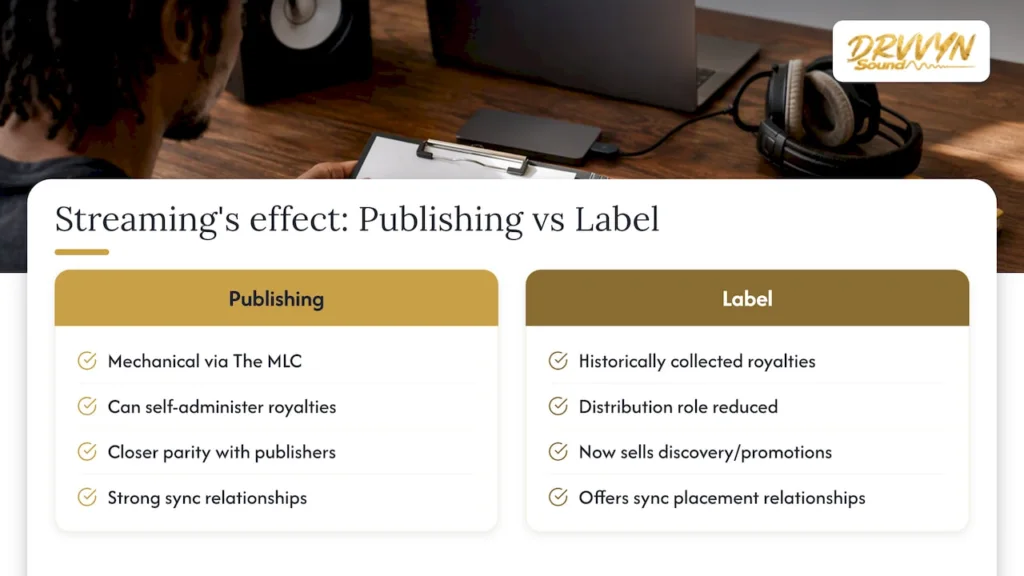
Streaming didn’t just change how people listen, it rewired which royalties matter most and who has leverage to collect them. Mechanical royalties, once tied to physical sales and downloads, now accumulate from every interactive stream, which is why The MLC exists specifically to administer that flow for the digital era rather than the CD era it replaced.
That shift also leveled some of the old imbalance between signed and independent artists. A songwriter who registers correctly and self-administers through The MLC can collect close to what a traditionally published artist collects, minus the sync-pitching advantage a publisher’s relationships might add. Labels, meanwhile, lost some of their built-in necessity: distribution no longer requires a label’s infrastructure, so the pitch for signing one has shifted from “we can get your music out” to “we can get your music noticed,” a much harder claim to prove.
Streaming also changed the economics of licensing deals. Because digital reversion clauses are easier to write and enforce than they were in the physical-media era, more labels now offer fixed-term licenses instead of lifetime assignments, a direct response to artists who increasingly know they don’t have to give up a master forever to get label support. The shift favors artists who understand which rights they’re actually negotiating, and penalizes those who sign quickly without checking.
How rights and roles shift once you cross borders
Publishing and label roles don’t travel identically across territories, and that matters the moment your music earns plays outside your home market. Performance royalties are typically collected by the PRO or collection society in the territory where the performance happens, then routed back to your home PRO through reciprocal agreements, a system that works reasonably well but can introduce delays measured in months rather than weeks.
Mechanical royalties follow an even more fragmented path internationally, since The MLC’s mandate covers interactive streaming specifically in the United States, and other territories rely on their own mechanical rights societies with their own registration requirements. An artist with meaningful international streams may need separate registrations or a sub-publishing relationship to collect fully, which is one of the stronger arguments for a co-publishing or administration deal once a catalog has real global reach.
Master rights and label structures vary even more by region, since what counts as a standard royalty range, a recoupment practice, or a reversion norm in one market doesn’t automatically apply elsewhere. None of this changes the core distinction between composition and master, but it does mean an independent artist with international audiences has more registration work ahead than one whose listeners are concentrated in a single market, and it’s worth confirming any cross-border claim with a rights professional rather than assuming the home-market rules apply everywhere.
DRVVYN Sound’s perspective on balancing ownership and scale
Ownership protects you long after a deal’s excitement fades. We’d rather see a songwriter fix their metadata and keep their masters than chase a label offer that trades control for reach they could have built themselves. Get a professional involved when the contract, not the music, is the hard part.
— DRVVYN Sound
How DRVVYN Sound can help with licensing and sync pitching
If your registrations are clean but sync placements still feel out of reach, that’s where a licensing partner earns its fee. DRVVYN Sound’s licensing services cover sync pitching, licensing administration, and guidance on getting your catalog in front of the right ears, support built for artists who want to keep ownership of their work while still reaching screens and playlists they can’t access alone. If you’re deciding whether a needle drop license applies to your situation, or just want a clearer read on where your royalties stand, reach out through our licensing page and we’ll walk through it together.
FAQ
What are the three types of publishing deals?
The three common structures are administration deals, where you keep full ownership and pay a fee for collection and licensing, co-publishing deals, which typically split ownership and income with the publisher, and full buyouts, where you sell your composition rights outright for a lump sum. Each trades a different amount of control for a different amount of upfront support.
Does an artist always own their own master recordings?
No, ownership of a master recording depends entirely on the deal signed, not on who performed the song. Independent artists who fund and record their own music typically own their masters outright, while artists signed to traditional label deals often don’t, unless their contract includes a specific reversion clause.
What is the 80/20 rule in songwriting?
There’s no single, universally recognized rule tied to royalty splits or songwriting credit in official publishing guidance, and claims about splits vary depending on who’s citing them. Treat any specific split you hear as a rule of thumb at best, and confirm actual splits through your PRO or publishing agreement rather than a shorthand rule.
Can you release and earn from music without a record label?
Yes, independent distribution and self-administered publishing let artists release music, collect composition royalties through a PRO and The MLC, and collect master-side royalties through SoundExchange without ever signing to a label. A label becomes relevant only when an artist specifically needs capital or marketing reach beyond what self-administration provides.
Sources
- What is the Mechanical Licensing Collective (MLC) – TuneCore Support
- Circular 50: Copyright Registration of Musical Compositions – U.S. Copyright Office
- A look at co-publishing, sub-publishing, and administration agreements – The Jacobson Firm
- The MLC Lawyer Toolkit – The MLC