

Music Business
What Is a Needle Drop License and What Rights Do You Need?
What Is a Needle Drop License and What Rights Do You Need?
!
By DRVVYN · · 14 min read
What Is a Needle Drop License and What Rights Do You Need?
A needle drop license lets you use a pre-existing sound recording once in a specific production, but it never comes as a single document. You’re always securing two separate rights at once: a synchronization (sync) license for the underlying composition, cleared through the publisher, and a master license for the actual recording, cleared through the label or master owner. Miss one, and you’re exposed no matter how carefully you handled the other.
Fees and terms swing wildly depending on prominence, term length, and territory, so no two needle drops cost the same.
- Two rights, two rights holders: sync (publisher) and master (label or owner)
- Some production libraries bundle both into one clearance
- One license covers one use, in one production, for a set term
Fast fact: industry rate reporting shows indie placements commonly run $250 to $2,500 per cue, while national ads and trailers often land far higher once broader rights get negotiated in.
Key Takeaways
A needle drop license is legally complete only when it secures both sync and master rights in writing, with performance royalties handled separately through PRO reporting.
| Point | Details |
|---|---|
| Two licenses, always | Secure sync rights from the publisher and master rights from the label or owner separately. |
| Budget with real ranges | Indie placements commonly run $250 to $2,500 per cue; national ads run far higher. |
| PRO obligations continue | Performance royalties through ASCAP, BMI, or SESAC typically survive a sync/master deal. |
| Get it in writing | Verbal permission offers no protection; platforms require documented proof of clearance. |
| Work with a rights holder directly | DRVVYN Sound licenses its original catalog and takes custom composition requests for projects needing a specific tone. |
Needle Drop Clearance Checklist Before You Reach Out
Before you email anyone, put your project on paper. A vague inquiry gets a vague answer, and vague answers waste weeks you don’t have during post-production.
- Nail down the cue. Exact timestamps, duration, and how prominently the track sits in the mix (background versus foreground).
- Define distribution. Platforms (streaming, broadcast, theatrical), territory (domestic, worldwide), and how long you need the rights.
- Decide on exclusivity. Do you need this track locked to your project, or is a shared, non-exclusive use acceptable?
- Identify who to contact. The publisher handles sync; the label or independent master owner handles the recording. A production music library can hand you both in one deal.
- Ask for three things: a fee quote, a sample contract, and written confirmation of who actually controls the master.
Pro Tip:Send your clearance brief as a one-page PDF, not a string of emails. Rights teams field dozens of requests weekly, and a clean brief gets answered faster than a scattered one.
How Do You Clear a Needle Drop Step by Step?
Clearing a needle drop follows a sequence, and skipping steps is exactly how productions end up with takedown notices weeks before a premiere.
- Confirm ownership first. Check publisher databases, run a PRO catalog search, and read label credits carefully. Songwriting splits get complicated when multiple publishers hold pieces of one composition.
- Reach out for sync terms, then confirm the master. Start with the publisher since composition rights are usually easier to trace. Once sync terms are workable, verify the label or independent owner can grant the matching master rights, since sampling reuses parts of a recording while a needle drop licenses the whole pre-existing recording and the two aren’t interchangeable.
- Negotiate the real terms, not just the fee:
- Term length and territory
- Media type (theatrical, streaming, broadcast, social)
- Exclusivity requirements
- Artist credit placement
- Payment schedule and any kill fee if the project falls through
- Weigh a production library instead, when your timeline is tight. Bundled rights and pre-cleared cues can save weeks compared to chasing two separate rights holders.
- Get everything in writing. A verbal “sure, go ahead” is not a license. Your written agreement should spell out use, term, territory, and both rights explicitly, and you should keep signed copies on file for every platform that might ask for proof later, including YouTube’s Content ID system or your distributor.
Store that paperwork somewhere retrievable. A rejected upload months after release, with no license on hand, is a fixable problem that becomes unfixable fast.
What Does a Needle Drop License Actually Cost?
Fees range widely, from free for some royalty-free cues to very high amounts for prominent commercial uses, with the exact fee depending on several key variables anticipated before negotiation.
Rough ranges reported across the industry:
- Royalty-free or library cues: free to low hundreds of dollars
- Indie film and web series: roughly $250 to $2,500 per cue
- TV background placements and small commercials: hundreds to low thousands
- National ads and trailers: tens of thousands into six figures, especially for recognizable recordings
Statistic to remember: that $250 to $2,500 indie range assumes limited exclusivity and modest territory. Push for worldwide, perpetual, or exclusive rights and the number climbs fast, sometimes doubling or tripling depending on the rights holder’s rate structure.
What actually drives the price:
- How prominent the cue is (opening credits versus faint background)
- Term, territory, and exclusivity scope
- Media type, since a Super Bowl spot and a YouTube short don’t pay the same
- The artist or label’s profile and negotiating leverage
- How the fee splits between sync and master owners
One more distinction worth knowing: a placement fee is a one-time payment for the sync. It’s separate from ongoing public performance royalties, which keep accruing after your project airs. And a buyout, paying once for unlimited future use, costs dramatically more than a time-limited license because you’re removing the rights holder’s ability to charge again.
Do You Still Owe Performance Royalties After Licensing?
Yes. Clearing sync and master rights does not make performance royalties disappear, and that surprises more producers than it should.
Performing rights organizations, meaning ASCAP, BMI, and SESAC in the United States, collect royalties whenever a composition is publicly performed, which includes broadcast airing and many streaming contexts. Securing your sync and master licenses typically doesn’t eliminate this obligation unless your contract explicitly states otherwise as part of a full buyout.
Who actually pays varies by distribution channel:
- Broadcasters and platforms often carry their own blanket PRO licenses covering everything they air
- Independent distributors and self-releasing creators may need to confirm this coverage themselves
Before signing anything, get clarity in writing on:
- Whether your license is a straight sync/master deal or a full buyout
- Who reports performance data to the PRO, you or your distribution partner
- Whether the platform you’re releasing on already carries blanket PRO coverage
Production Library Cues vs. Commercial Tracks: Which Fits Your Project?
The choice between a library cue and a recognizable commercial track usually comes down to how much time, budget, and creative risk you can absorb.
Production libraries win on speed and predictability. Rights are typically bundled, pricing is published upfront, and clearance can happen same day. The tradeoff is that these cues often carry non-exclusive terms, meaning other productions might use the same track.
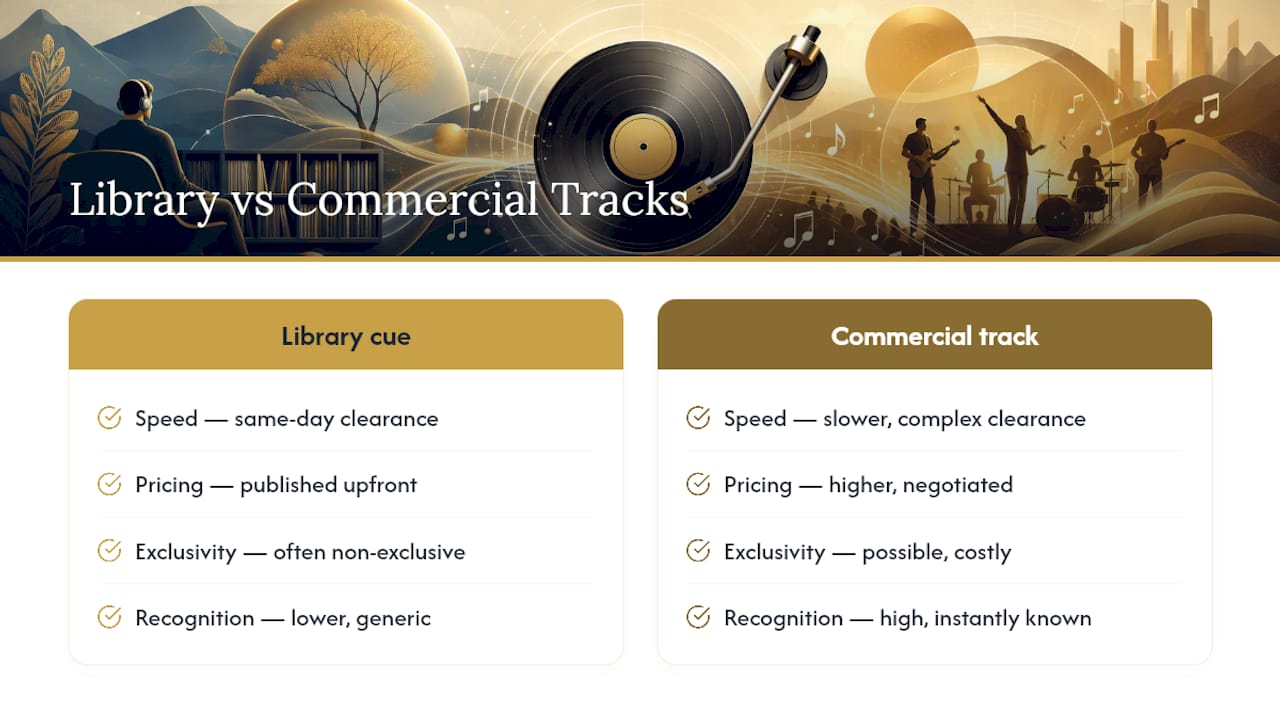
Commercial and popular recordings deliver instant recognition and can define a scene’s tone in ways no library cue matches, but they come with higher costs and more complicated rights splits across writers, publishers, and labels. Used well, a needle drop can anchor a scene’s mood or period instantly; used carelessly, it reads as an obvious shortcut rather than a deliberate choice. Thinking through how a track shapes emotional pacing, the kind of decision covered in sequencing songs for emotional impact, helps you decide if a famous cue earns its cost.
Pro Tip:If a scene needs a specific emotional signature that no existing catalog track quite nails, commissioning original music can cost less than licensing a hit song for broad, exclusive rights.
For long-term projects needing worldwide or perpetual rights, a bespoke composition often beats licensing a commercial track on cost alone.
Mistakes That Delay Releases or Trigger Claims
Most needle drop problems trace back to the same handful of avoidable errors, repeated project after project.
- Treating a text message or verbal “yes” as a license. Nothing protects you without a signed written agreement.
- Assuming you bought the track outright. Most needle drop licenses are time-limited to one production and one use, not a permanent buyout, so re-airing or repurposing footage may need a fresh license.
- Confusing sync clearance with full clearance. Securing the composition right without confirming the master right leaves half your exposure unaddressed.
- Ignoring PRO obligations, assuming they’re baked into the deal when they usually aren’t unless the contract says so.
- Skipping proof of clearance for platforms. Distributors and services like YouTube’s Content ID can flag or pull content without a filed license on record, even when you did pay for one.
Worth noting: production libraries commonly count repeated uses within one production as separate needle drops, so a track looping across three scenes might trigger three separate fees if you didn’t negotiate that upfront.
How DRVVYN Sound Handles Licensing Requests
DRVVYN Sound holds rights to its own catalog of original R&B recordings and cinematic visual content, which means licensing inquiries go straight to the actual rights holder, not a chain of intermediaries.
Requests get evaluated using the same framework outlined above:
- Cue selection, timestamp, and prominence in your edit
- Platform, territory, and intended term
- Exclusivity needs and proposed use case
Reach out with your project scope, and DRVVYN Sound can quote sync and master terms directly, or discuss a custom composition when an existing track doesn’t fit your budget or creative vision.
How Has Streaming Changed Needle Drop Licensing?
Streaming platforms turned needle drop licensing from a broadcast-era formality into a constant negotiation, because “where will this air” no longer has a simple answer.
A single video might land on YouTube, get clipped for Instagram Reels, embed on a brand’s website, and stream through a connected TV app, all from one master file. Each context can carry different rights implications, and a license written only for “broadcast television” leaves gaps the moment your content moves to a platform nobody anticipated when the contract was signed.
This is why modern licenses increasingly specify platforms by name or category rather than relying on vague, catch-all media language. A clearance covering “digital and social media” protects you far better than one written for a distribution model that assumes linear TV.
New media also compressed timelines. A viral moment demands a license turnaround measured in days, not the weeks traditional sync deals once took. That pressure is part of why production music libraries have grown as an option: pre-cleared bundled rights fit a publishing schedule built around social platforms far better than a slow-moving negotiation with a major label.
Streaming royalty structures add another layer. Performance royalties on streaming platforms get calculated differently than broadcast royalties, and PROs have adjusted their reporting systems accordingly. None of this erases your sync and master obligations. It just means the platforms multiplying around your project each carry their own fine print.
Does a Needle Drop License Cover International Use?
Territory is one of the most commonly underspecified terms in needle drop agreements, and it’s also one of the most expensive to fix after the fact.
A license scoped to “domestic use” or a specific country doesn’t automatically extend to a global release, even if your platform happens to be accessible worldwide. Streaming makes this especially easy to overlook: uploading to a platform with global reach doesn’t mean your underlying music rights matched that reach when you signed the deal.
If your project might travel, film festivals, international distribution deals, or a platform with cross-border audiences, negotiate worldwide or multi-territory rights upfront rather than discovering a gap after release. Retroactively expanding territory almost always costs more than negotiating it as part of the original deal, since the rights holder now knows your project already has traction.
Rights holders in different countries can also complicate things. A composition might have separate publishers administering rights in different regions, meaning your “one publisher” contact for domestic clearance might not control international rights at all. Confirm this explicitly before assuming a single signature covers you everywhere your content might end up.
How Do You Negotiate Better Needle Drop Terms?
Negotiating a needle drop license isn’t about squeezing the lowest number out of a rights holder. It’s about matching the scope of what you’re paying for to what you actually need, so you’re not overpaying for rights you’ll never use or underbuying rights you’ll need later.
Start by being specific about scope rather than asking for “the cheapest option.” A rights holder can quote a lower fee once they know you need six months of regional streaming rights instead of worldwide perpetual use. Vague requests tend to get quoted at the higher end, since the rights holder is pricing in the risk of your unknown intentions.
Ask about tiered pricing. Many rights holders will offer a lower initial fee with an option to expand territory or term later if your project performs well, which protects your budget on unproven projects.
Negotiate kill fees upfront if the production might not go forward, and clarify credit requirements early since some artists require specific attribution language as a non-negotiable condition. Finally, always ask what happens if the cue gets used more than once in the same production. As noted above, that scenario often counts as multiple separate uses unless you negotiate a flat rate covering repeated placements from the start.
What Happens If You Use Music Without a License?
Using a recording without clearing both sync and master rights exposes you to real legal and financial risk, not just a theoretical possibility.
Rights holders can issue takedown notices, which platforms like YouTube enforce automatically through content-matching systems, often pulling your video before you even know there’s a dispute. Beyond takedowns, unauthorized use can trigger copyright infringement claims, statutory damages, and in commercial contexts, demands for retroactive licensing fees that are usually far higher than what you would have paid upfront.
Distributors and streaming platforms increasingly require proof of clearance before accepting a submission, which means an unlicensed track doesn’t just risk a lawsuit, it can block your release entirely. Film festivals and broadcast networks routinely request license documentation as part of their intake process, and a missing or informal “permission” from an artist rarely satisfies that requirement.
The safest path is treating every needle drop as requiring written confirmation before you lock picture, not after. Verbal agreements, social media comments, or a friendly text from an artist saying “go ahead” offer no legal protection if that artist’s label or publisher later disputes the use. Written licenses, properly signed by both the publisher and the master owner, are the only real safeguard against a claim landing after your project is already public.
Editorial Take: What the Clearance Process Actually Rewards
Most guidance on needle drop licensing treats it like a legal formality to survive, a box to check before the real creative work continues. That framing gets it backward. The clearance process rewards specificity, not speed, and the producers who suffer most are the ones who treat “getting a license” as one task instead of two distinct negotiations with two different gatekeepers.
The conventional advice to “just contact the label” ignores how often publishers and master owners disagree on terms, timelines, or even willingness to license at all. A composition can be cleared while the specific recording stays locked, and vice versa.
What we’d prioritize differently: negotiate territory and repeat use before fee. A cheap quote that doesn’t cover your actual distribution plan isn’t a deal, it’s a delayed problem. Get the scope right first, then let the number follow.
— DRVVYN Sound
Get Cleared Music and Custom Compositions Through DRVVYN Sound
Licensing platforms and library subscriptions solve part of the problem, but they hand you a catalog, not a relationship with the artist behind the recording. DRVVYN Sound offers something different: direct access to an original R&B catalog and cinematic visual content where the person quoting your license terms is the same person who wrote and owns the master.
That means fewer intermediaries, faster answers on prominence-based pricing, and the option to commission an original composition when nothing in an existing catalog matches your scene’s tone. Browse DRVVYN Sound’s video work to see how music and visuals get paired in practice, or explore project management support for licensing needs if you need help structuring a multi-track deal. Reach out with your cue timestamps, platform list, and territory, and get a direct quote instead of a subscription tier.
Sources
- Support — Warner Chappell Production Music
- How Much Does Sync Licensing Pay? A Realistic Fee Breakdown by Placement | DropCue
- What You Should Know About Needle-Drop Licenses — LiveAbout
- What a Needle Drop Means in Movies — MovieWeb
FAQ
What Is the Most Expensive Song to License?
There’s no single definitive record, but iconic recordings tied to major artists or cultural moments can command six-figure fees for national ads or major film placements, driven largely by exclusivity and worldwide territory demands.
How Much Does a Sync License Cost?
Costs range from free for royalty-free library cues to $250 to $2,500 for indie placements, climbing into tens of thousands or more for national commercials and trailers depending on scope.
What Is the 35-Year Rule for Music?
This refers to copyright termination rights in the United States, which let creators reclaim rights to works after a statutory period under specific conditions; it’s a separate legal mechanism from needle drop licensing and doesn’t affect standard sync or master clearance terms.
Do You Need Both ASCAP and BMI Licenses?
You don’t personally need both as a producer securing a needle drop; PRO licensing for public performance is typically handled by broadcasters, platforms, or venues, though your contract should confirm who’s responsible for that reporting.
Can You Get a Needle Drop License Directly From an Artist?
Yes, when the artist owns their own masters and publishing, as is the case with independent catalogs like DRVVYN Sound’s, which simplifies clearance by removing layers of label and publisher negotiation.