

Creative Process
What Role Does Authenticity Play in Music, and Why It Matters
What Role Does Authenticity Play in Music, and Why It Matters
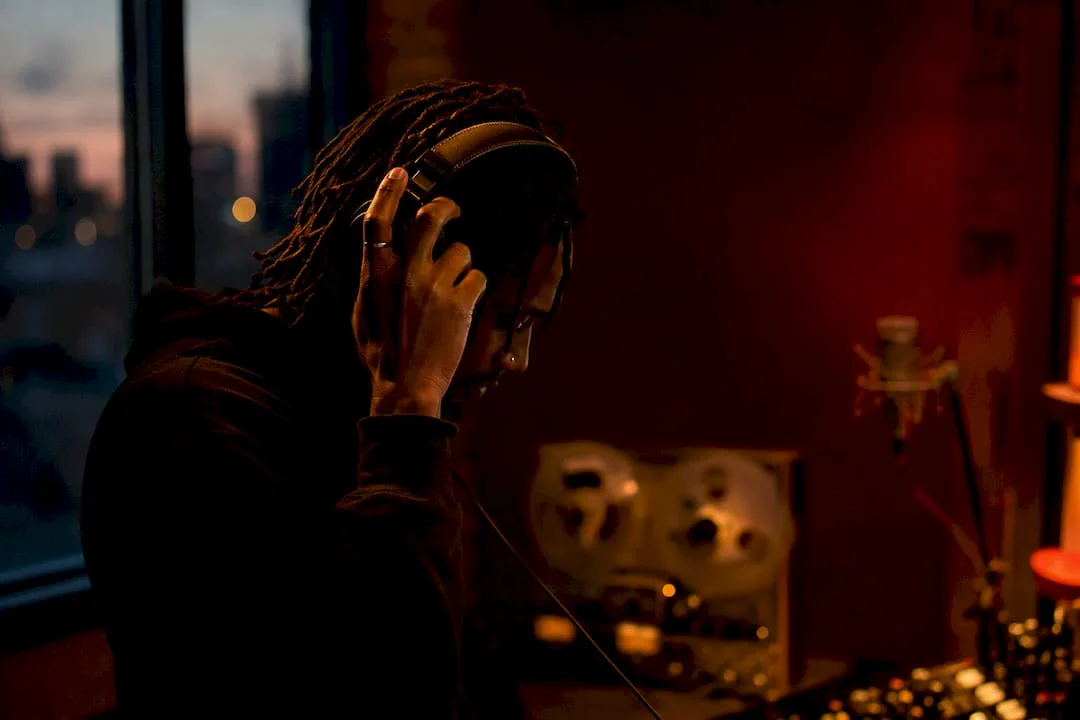
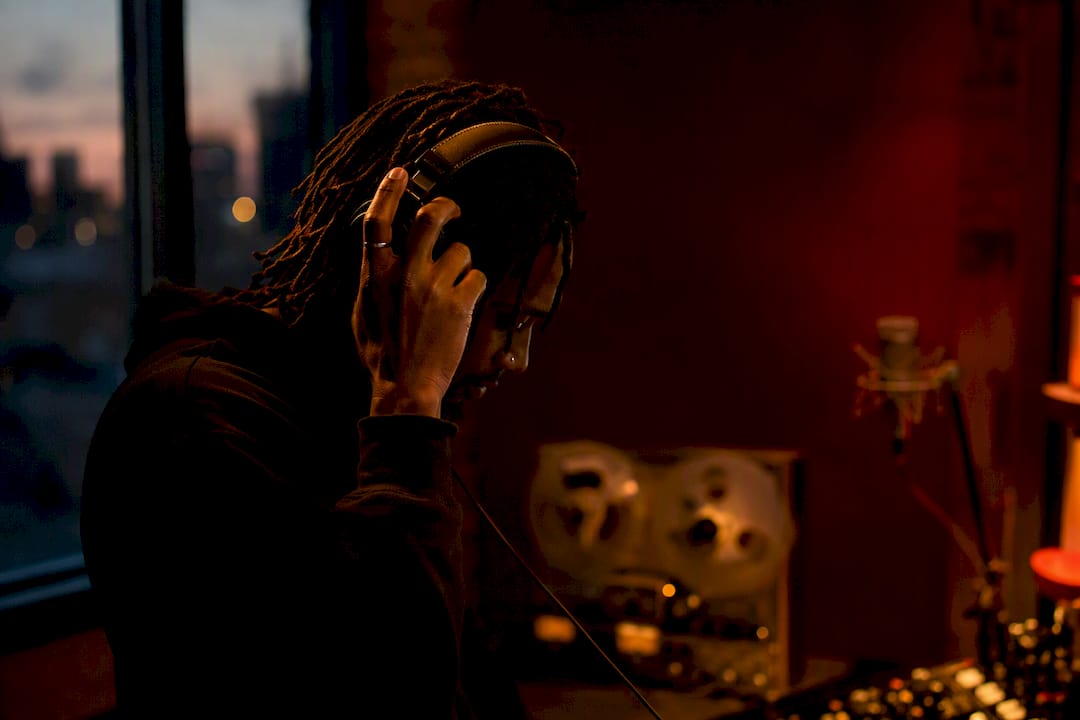
! Musician adjusting headphones in studio
Authenticity is the social mechanism that lets music validate a listener's experience and sustain trust between artist and audience.
By DRVVYN · · 12 min read
What Role Does Authenticity Play in Music, and Why It Matters
Authenticity is the social mechanism that lets music validate a listener’s experience and sustain trust between artist and audience. It is not a stamp of factual truth. It is something we ascribe, together, when a song feels like it means what it says. That single function ripples outward into three effects worth knowing before we go further:
- Emotional connection: authentic-feeling music invites listeners to lower their guard and feel seen.
- Credibility and trust: audiences extend loyalty to artists they believe are not performing a costume.
- Identity and belonging: authenticity signals let listeners locate themselves inside a genre, scene, or story.
The rest of this piece works through where that role comes from, how scholars categorize it, why the digital era complicates it, and what musicians can actually do about it.
Key Takeaways
Authenticity works because listeners, not artists, decide what counts as real, and that judgment drives empathy, trust, and loyalty more reliably than polish does.
| Point | Details |
|---|---|
| Authenticity is ascribed | Listeners and communities assign authenticity; it is not a fixed property of a recording. |
| Ask “who” is authenticated | First-, second-, and third-person typologies clarify whether a claim is about the self, the audience, or a tradition. |
| Specificity beats polish | Concrete lyrical detail and audible imperfection often read as more honest than a flawless take. |
| Digital tools cut both ways | Direct-to-fan intimacy builds trust, while algorithm-driven formula and unexplained AI polish can erode it. |
| Test with small audiences | Qualitative reactions from a trusted group catch authenticity mismatches before a full release. |
The Role of Authenticity in Music: A Working Definition
Authenticity in music is not a property baked into a recording. It is a judgment listeners and communities assign to a performer, a song, or a scene, based on whether the presentation matches some standard of honesty, origin, or belonging they care about. That framing sounds academic because it is. Scholarship on the subject treats authenticity as an act of attribution rather than an inherent trait, meaning the same song can register as deeply authentic to one listener and staged to another.
That distinction matters because everyday language flattens it. In casual conversation, “authentic” often just means honest, original, or unpolished. Scholars push back on that shortcut. Research on authenticity as authentication frames the real analytic question as who is being authenticated: the performer’s self, the audience’s taste, or a tradition’s rules. A blues guitarist might be judged authentic because he lived the hardship in his lyrics. A pop vocalist might be judged authentic because her delivery matches an emotional truth her fans recognize in themselves. Different standards, same word.
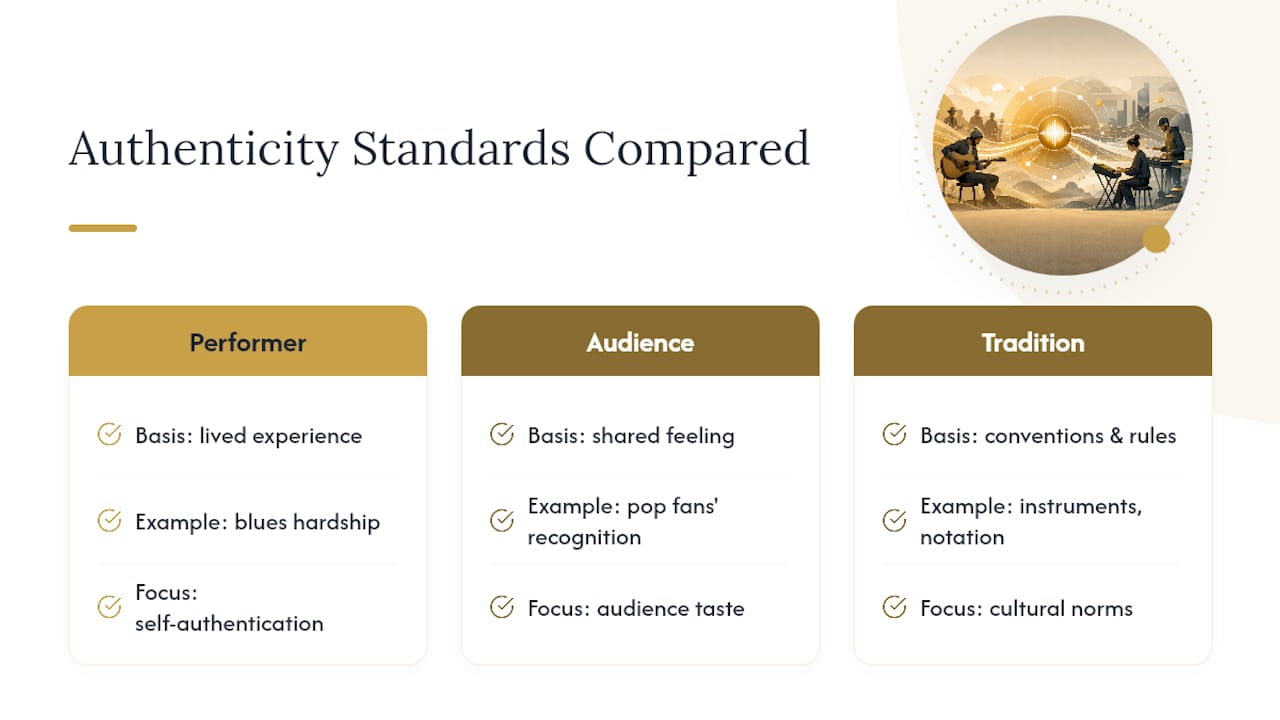
Historical evidence backs this up. Notation practices, performance conventions, and what counts as a “real” instrument have shifted across centuries, and scholarship tracing authenticity’s history shows the criteria move with the culture, not the other way around. There is no fixed, universal test. A broad review of authenticity research describes it as a complex, historically variable construct, which is precisely why the debate over what “counts” keeps recurring in every generation and every genre.
Who Gets Authenticated? A Typology Every Listener Should Know
Asking “is this authentic?” is the wrong first question.
- First-person authenticity asks whether the work expresses something true about the artist’s own self. A songwriter narrating a real breakup fits here.
- Second-person authenticity asks whether the performance rings true to the audience, regardless of the artist’s biography. A cover song can feel more honest than the original if it connects.
- Third-person authenticity asks whether a performance faithfully executes a tradition’s rules, like a bluegrass player honoring a regional style.
- Social and meta-authenticity describe how communities collectively enforce standards, and how artists sometimes perform the idea of authenticity itself, aware they are being watched for it.
Why bother with this vocabulary? Because most arguments about whether an artist “sold out” or is “keeping it real” are actually disagreements about which of these four lenses the critic is using. A rapper can be authentic in the first-person sense (the story is true) while failing a third-person test (the delivery breaks genre convention), and both critics can be right. The typology of authentication gives critics and musicians a shared frame instead of a shouting match.
How Does Authenticity Affect Music’s Impact on Listeners?
Authenticity does measurable work. It is not just a feel-good adjective critics reach for when they like something.
- Emotional validation. When a lyric or performance reads as genuine, listeners feel their own experiences mirrored back, which deepens empathy rather than mere appreciation.
- Fan loyalty and reputational capital. Audiences extend longer-term trust to artists they believe are not simply chasing trends, which shows up in streaming retention and willingness to buy directly from an artist.
- Market signaling. Brands, licensors, and sync partners often weigh perceived authenticity when deciding who to pair with a campaign, because a mismatched partnership can undercut both parties’ credibility.
A randomized experiment involving 492 participants found that cultural authenticity positively shaped aesthetic evaluation and liking, giving the emotional argument some empirical weight beyond anecdote. Other scholarship connects the mechanism directly to empathy: what matters, according to work on authenticity, empathy, and creative imagination, is not whether an origin story checks out but whether the music opens a channel for imaginative, empathetic engagement. Identity plays into this too. Research on authenticity and identity construction suggests listeners use authenticity judgments to locate themselves inside genres and scenes, which is part of why a scene’s gatekeepers guard the label so fiercely. The songs that keep pulling people back tend to lean on this exact mechanism, something worth exploring further in how music built for emotional connection tends to hold up over repeat listens.
How Is Authenticity Signaled? Lyrics, Performance, and Production
Authenticity is read off specific, concrete cues, not vibes alone. Understanding those cues is useful whether you are a critic trying to explain a reaction or a musician trying to earn one.
- Lyrical specificity and vulnerability. Concrete, unglamorous detail (a street name, a specific argument, a precise regret) reads as more honest than vague sentiment.
- Performance cues. Audible imperfections, a cracked note left in, visible physical commitment on stage, all signal that the performer is not hiding behind a safety net.
- Production and industry transparency. Crediting co-writers, showing collaborators, and being upfront about how a track came together builds trust that slick anonymity erodes.
- Community gatekeeping. Subcultures set their own thresholds, and violating an unwritten rule (miming a genre’s struggle without its context) can cost an artist credibility fast.
Cultural context and appropriation debates live squarely in that last bullet. When an artist borrows sonic or lyrical markers from a tradition they have no lived connection to, third-person authenticity often collapses even if the first-person story feels sincere to the artist. That tension is where most modern authenticity controversies actually originate.
Pro Tip:Match your production choices to your narrative intent instead of chasing a genre default. If the lyric is about intimacy, keep the small vocal breath before the chorus rather than editing it out; a sparse arrangement can foreground a story that a wall of layered synths would bury. This idea is explored further in DRVVYN Sound’s guide to emotionally immersive music.

How Have Social Media and AI Changed Musical Authenticity?
Streaming and social platforms have not made authenticity irrelevant. They have made it more expensive to fake and easier to test.
- Direct-to-fan intimacy. Home performances, unfiltered stories, and behind-the-scenes footage close the distance between artist and listener, and that closeness itself often reads as authenticity. This is discussed in more depth in the future of direct-to-fan music.
- Playlist pressure toward formula. Algorithms reward songs that hit predictable structural beats early, which pulls some artists toward sameness even as audiences say they crave the opposite.
- AI and polish. Over-processed vocals or fully synthetic production can read as less authentic when a song’s premise is emotional confession, though AI-assisted tools used transparently in service of a genuine idea rarely trigger the same suspicion.
- Crowd-sourced gatekeeping. Communities now authenticate in real time through comments and reaction videos, not just critics in print, which speeds up both praise and backlash.
Music critic Ted Gioia has argued that the modern fixation on authenticity is partly a reaction against formulaic, algorithm-driven output, positioning genuine connection as a kind of frontier again. DRVVYN Sound’s own work on digital art’s role in shaping how music is felt covers how visual presentation now carries part of that authenticity signal too.
Why Post-Authenticity Critics Have a Point (and Still Miss Something)
Some scholars argue we have entered a “post-authenticity” moment, where audiences accept that every persona is at least partly constructed and stop pretending otherwise. There is real substance to that critique. Once a listener knows an artist is aware of being watched, staging a moment of vulnerability becomes its own performance, what the typology literature calls meta-authenticity. That is a legitimate complication.
But dismissing authenticity outright as an illusion misses its social function. Even a knowingly constructed authenticity still does the emotional and identity work described earlier; the research on authenticity’s subjective, evolving nature makes clear that shifting standards do not erase the concept’s usefulness, they just mean it has to be interpreted in context rather than measured against one fixed rule.
Practical Guidance: Building Perceived Authenticity Without Faking It
You cannot manufacture authenticity from nothing, but you can remove the barriers that stop your genuine work from reading as such. Four principles carry most of the weight:
- Get specific. Trade general emotional statements for one concrete, sensory detail per verse; specificity is consistently what separates a song that feels lived-in from one that feels generic.
- Leave room for imperfection. A slightly rushed phrase or an unedited breath before a hard line can do more emotional work than a flawless take, especially in ballads and confessional writing.
- Keep your narrative consistent across formats. If your lyrics describe solitude, your visuals, captions, and interviews should not contradict that with a constantly performed, upbeat persona.
- Match production to intent, then test small. Release a rough cut to a small, trusted audience before the full rollout, and read their qualitative reactions, not just stream counts, to catch mismatches early.
Metrics matter here, but only the right ones. Completion rate and repeat listens tell you whether a song is landing emotionally; follower growth alone tells you almost nothing about authenticity. DRVVYN Sound’s own catalog leans on this exact discipline, using direct-to-fan intimacy and close attention to how production choices support a song’s emotional premise rather than dressing it up.
Pro Tip:Before adding a new instrumental layer, ask whether it serves the story or just fills space. If you can’t name what it adds emotionally, cut it. This same discipline around scope and decision-making is why a clear project management approach matters even for independent artists working alone. The same principle explains why vulnerability lands so hard in confessional genres. Coverage of vulnerability in rap lyrics and mental health shows how directly naming pain, rather than gesturing at it, is often what earns a listener’s trust.
What Authenticity in Music Comes Down to Now
Authenticity remains the mechanism that lets a song feel like it means something real to the person hearing it, whether or not every biographical detail checks out. It works because listeners ascribe it, communities police it, and artists who understand which version they are being judged against can earn it honestly. As platforms and AI tools keep reshaping how music gets made and shared, the listeners deciding what feels real will matter more than ever.
If you want to hear these principles in practice, DRVVYN Sound’s Piece of Peace leans on sparse arrangement and unguarded lyrics to keep its emotional premise front and center rather than buried under polish. That same intent runs through Music for Quiet Moments That Actually Stays, built for listeners who want a song’s honesty to survive repeat plays, not just a first impression.
An Editorial Take on What This Debate Keeps Getting Wrong
Most advice on authenticity treats it like a personality trait an artist either has or fakes. That framing is backward, and it sets musicians chasing the wrong thing. The scholarship is fairly consistent on this: authenticity is a judgment audiences make, shaped by context, tradition, and who is doing the listening. Chasing “being authentic” as a fixed identity is a dead end.
What we think gets underweighted is specificity. Not raw confession, not rawness for its own sake, but the discipline of naming one true, concrete detail instead of five vague emotional ones. That is a craft decision, not a personality test, and it is one any musician can practice regardless of genre or biography.
The conventional wisdom oversells “just be yourself.” The more useful instruction is: know which kind of authenticity claim you are making, and build your production and story around that claim consistently.
— DRVVYN Sound
Sources
- Authenticity as authentication (Surrey open research)
- Authenticity, empathy and the creative imagination
- Authenticity in Music (ResearchGate)
- The effect of authenticity in music on subjective theories and aesthetical evaluation (SAGE Journals)
FAQ
What Is the Meaning of Authenticity in Music?
Authenticity in music is a judgment listeners ascribe to a performance based on whether it matches a standard of honesty, origin, or tradition they value. It is not an inherent trait of a recording but an interpretation shaped by context and community.
What Makes a Musician Authentic?
A musician reads as authentic when their lyrics, performance, and production choices align consistently with the story they are telling, especially when specific detail and imperfection support that story rather than a polished mismatch. Which standard applies (first-, second-, or third-person) depends on who is doing the judging.
Why Does Authenticity Matter to Listeners?
Authenticity matters because it enables empathy: listeners connect more deeply with music that feels emotionally honest, and research on empathy and creative imagination ties that connection to imaginative engagement rather than proof of a factual backstory.
Can Authenticity Coexist With Highly Produced Music?
Yes. Production quality and authenticity are separate questions; a heavily produced track can still feel authentic if the arrangement and polish serve the song’s emotional intent rather than obscuring it.
How Has Social Media Changed Perceived Authenticity?
Social media narrows the distance between artist and audience through direct, unfiltered content, which often increases perceived authenticity, while algorithm-driven pressure toward formulaic songwriting can work in the opposite direction.