

Music Business
Master Use License for Indie Artists: 4 Steps From Metadata to Deal
A master use license clears a specific recording, not its composition. Learn who grants it, verify ownership, prepare metadata, and negotiate terms.
By DRVVYN · · 10 min read

A master use license is the right granted by the owner of a particular recorded performance to use that exact sound recording in an audiovisual project. A record label, an independent artist, or whoever holds the master typically grants this permission, and it covers only the recording itself. If you want that same track synced to picture, you also need a sync license for the composition underneath it.
TL;DR:
- Using an existing recording in film or advertising requires permission from both the recording owner and composition publisher; a new cover needs sync permission only.
- Check copyright records, release metadata, label credits, and artist agreements before outreach; every owner of a fractional master must sign or authorize the license.
- No clip length creates a safe harbor: even a brief recognizable excerpt can infringe, and the rightsholder may refuse or set any fee.
- For a one time placement, limit territory and term, choose nonexclusive rights, and consider a flat buyout to reduce fees and avoid ongoing royalties.
- Send the first request with usage, term, territory, exclusivity, deadline, delivery needs, and metadata such as the ISRC to reduce delays from repeated emails.
What a Master Use License Covers and How It Differs From Sync and Mechanical Rights
The confusion starts here, so let’s settle it gently. A master use license protects the specific recorded performance: the actual audio file, the vocal take, the mix someone labored over in a studio. A sync or publishing license protects something different entirely, the composition itself, the melody and lyrics that exist independent of any one recording. Mechanical rights cover reproduction and distribution of that composition in new copies, like a cover song pressed onto vinyl.
These layers sit on top of each other, and knowing which ones apply changes everything about your clearance work.
- You need both a master use license and a sync license when you want to use a specific pre-existing recording, the original artist’s actual version, in your film or ad.
- You need only a sync license when you are creating a brand new recording of a composition, say a cover version performed by someone else for your project.
- You need neither if you commission fully original music and own both the composition and the recording outright.
One myth deserves a direct answer: there is no safe harbor for using 30 seconds, or any portion, of a copyrighted recording without permission. Using any recognizable portion of a copyrighted sound recording without permission risks infringement, regardless of length. Securing a recorded performance for audiovisual work generally requires two separate permissions: one from the sound recording owner, one from the composition’s publisher.
Who Owns Masters and How to Confirm It Before You Reach Out
Ownership rarely sits in one tidy place, and chasing the wrong party wastes weeks you don’t have.
- Major label releases usually mean the label owns the master outright, often through a recording agreement that transferred ownership from the artist at signing.
- Independent label releases may leave ownership with the artist, split between artist and label, or assigned entirely to the label depending on the deal’s terms.
- Artist-funded or self-released masters typically stay with the artist, though a producer or session musician may hold a fractional interest if their contract specified one.
- Producer and collaborator splits can fragment ownership further, especially on tracks built from multiple writers’ and musicians’ contributions without a clean buyout agreement.
Before you send a single email, confirm ownership through a few concrete documents: the copyright registration record if one exists, the ISRC and distributor metadata attached to the release, label credits printed on streaming platforms, and any agreement the artist can produce showing who controls the recording. When ownership is fractional, every listed owner or their authorized agent needs to sign, because a license tied to a shared master should condition its effectiveness on all owners signing to avoid an unenforceable agreement later.
How to Request and Secure a Master Use License Step by Step
A repeatable process saves you from reinventing the wheel every time a new project needs clearance.
- Identify the rightsholder and the right contact channel. For major label releases, look for a licensing department. For independent artists, management or the artist directly often handles requests. For fully self-released tracks, the artist is usually your only call.
- Prepare a tight, specific request. Include the project name, exact usage (trailer, commercial, streaming series, sample), term length, territory, whether you need exclusivity, deliverable specs, and your deadline. Clear, detailed licensing requests with exact usage specs noticeably speed up response time and improve your odds of a favorable answer.
- Negotiate scope and fee, then confirm delivery details. Settle on the file format, whether you need stems, and ISRC information before anyone signs. Get a signed license and a matching invoice, not a verbal yes.
- Preserve everything in a license folder. Keep the executed agreement, metadata, and correspondence together, because you’ll need this chain of title again if the project gets licensed further or questioned later.
Pro Tip:Send your usage specs in the first email, not the third. Rightsholders move faster on requests that already answer their standard questions.
Contract Terms That Matter and Where Negotiation Actually Works
Master use agreements read like boilerplate until the clause that costs you money hides in plain sight. A handful of terms decide whether the deal protects you or quietly traps you.
- Grant of rights: confirm exactly which media, which territory, and how long the license runs, because vague language here creates disputes later.
- Fee and payment terms: know whether you’re paying a flat fee, a fee plus royalty, or something staged against milestones.
- Exclusivity: decide whether you truly need exclusive use, since non-exclusive terms are almost always cheaper and faster to secure.
- Credits and delivery obligations: tie any required on-screen or liner credit to specific deliverables so there’s no ambiguity about what triggers it.
- Warranties and indemnities: the rightsholder should warrant they actually control the rights they’re licensing to you.
Negotiation works best when you ask for less than everything. Shortening the term, limiting the territory, or accepting non-exclusive rights for a one-off use almost always lowers the fee, and a flat buyout often beats a royalty split when the use is a single short-term placement.
Pro Tip:Watch for perpetual assignment language, automatic renewal clauses, and vague definitions of “use” or “media.” These are the clauses worth a second set of eyes before you sign.
What Master Licensing Typically Costs and How Long Clearance Takes
Fee structures vary widely, and no single number applies across the board.
- Flat buyouts pay once for defined use and are simplest to budget, though they can cost more upfront for broad or long-term rights.
- Sync fee plus backend royalty splits the cost between an initial payment and ongoing income, which favors the rightsholder when a project performs well.
- Backend-only royalty deals shift risk toward the licensee, since payment depends on the project’s success rather than a guaranteed sum.
Independent artists often price more flexibly than major labels, whose internal approval chains can stretch negotiation timelines considerably. There is no compulsory master use license, meaning a rightsholder can set any price, decline outright, or take as long as they want to respond, so plan your production calendar with real slack built in. Clearing music early, before your edit locks, and using pre-clearance agreements where possible, are the two most reliable ways to keep a timeline from unraveling.
Why Registering a Sound Recording Strengthens Your Position
Registration isn’t required to own a copyright, but it changes what you can prove and how fast you can prove it.
- The U.S. Copyright Office requires an application, a deposit copy, and a filing fee for sound recording registration, and digital deposits are recommended for unpublished or digital-only releases.
- A registered recording gives you clearer evidence of ownership and creation date, which matters directly in royalty disputes or when a licensee questions your chain of title.
- A compulsory license under section 115 covers mechanical reproduction in limited situations, but it does not substitute for the master use license you need to sync an existing recording with visual media.
Keeping your registration current, alongside accurate metadata, gives every future negotiation a stronger footing.
Practical Clearance and Metadata Tips That Shorten Negotiation Time
Most delays in master licensing trace back to incomplete information, not disagreement over price. A clean metadata packet turns a two-week back-and-forth into a same-week signature.
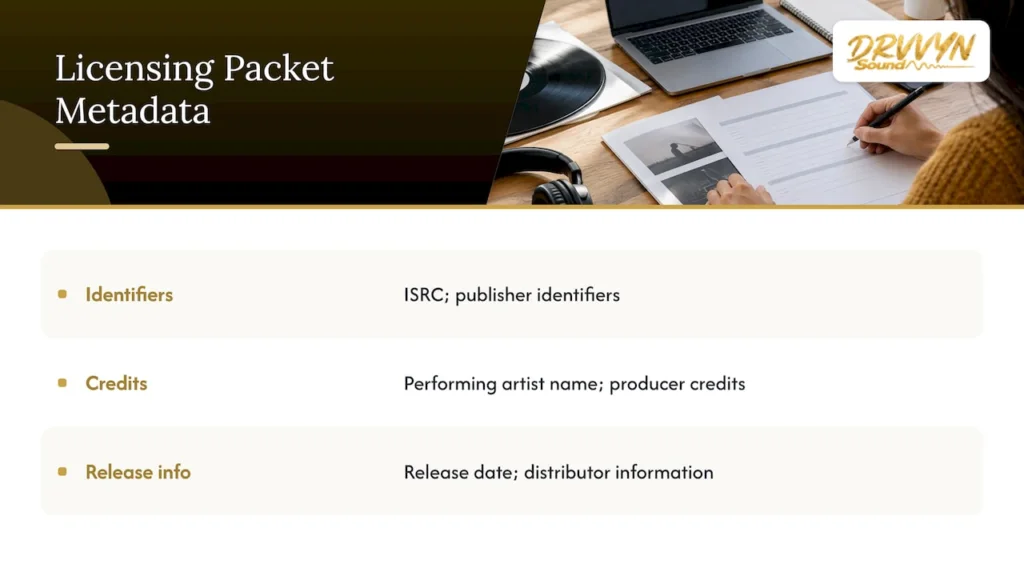
We build our own licensing packets around a short checklist: ISRC, performing artist name, producer credits, publisher identifiers, release date, and distributor information, all gathered before the first outreach email goes out. Our packet includes a brief cover note stating the intended use, a usage spec sheet, stem and mix options when relevant, and our preferred license template so the licensee isn’t starting from a blank page. Supervisors and clients appreciate not chasing us for basic facts.
Having stems and mix-minus versions ready, rather than scrambling to produce them after a deal is verbally agreed, consistently saves negotiation time and avoids last-minute delivery disputes. For readers also managing PRO registration alongside licensing, our guide to choosing between ASCAP and BMI walks through affiliation basics that pair naturally with this process, and for event organizers specifically, guidance on corporate music licensing from DJ Phoenix Entertainment covers how to avoid statutory damages when clearing music for live events.
Pro Tip:Lock your metadata before release, not after. Retrofitting ISRCs and credits onto a track already in distribution costs far more time than getting it right on day one, a pattern described in independent artist metadata guidance from Hot Mic Radio.
Why Owning Your Masters Changes the Whole Equation
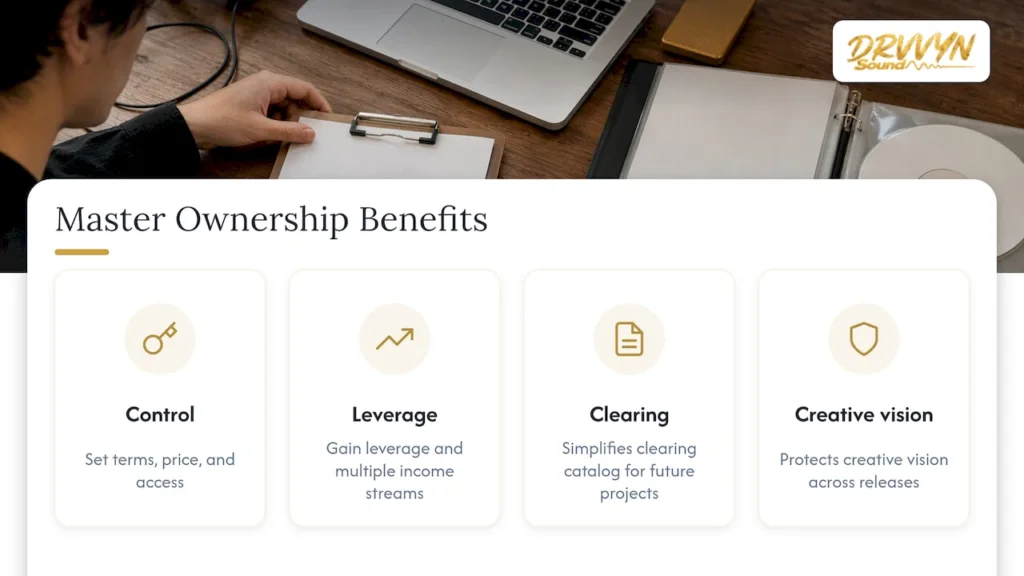
Licensing your own masters isn’t a side revenue stream, it’s leverage you build once and draw on repeatedly. When you hold the rights, you control the terms, the price, and who gets access, and every sync placement becomes a decision you make rather than a request you wait on.
Independent artists who retain their masters gain negotiating leverage and multiple income streams, and that ownership simplifies clearing their own catalog for future projects. For owners, that ownership also protects the creative vision behind each release, letting the storytelling stay intact wherever the music travels next.
— DRVVYN Sound
How We Support Master Licensing for Your Next Project
We handle licensing administration, from organizing metadata and delivery specs to drafting terms suited to sync and visual placements. When you reach out, we ask for your intended usage, timeline, and territory upfront to help move the process efficiently.
If you’re planning the broader rollout around a sync placement, our guide to music project management covers scheduling and coordination that pairs naturally with clearance work. To start a licensing conversation, visit our licensing page and tell us what you’re building.
FAQ
What does it mean for a musician to get their master’s?
Getting your masters means you own the actual sound recording rights, not just the underlying song, which lets you control licensing, pricing, and usage decisions directly. Independent artists who retain their masters gain leverage and additional revenue streams compared to artists who signed those rights away.
Can we use 30 seconds of a copyrighted song?
No, there’s no length-based exemption that makes a short clip automatically safe. Using any recognizable portion of a copyrighted recording without permission risks infringement, regardless of how brief the clip is.
Do I need a BMI and ASCAP license?
PRO affiliation through ASCAP or BMI covers performance royalties, which are separate from the upfront master and sync fees you negotiate directly with rightsholders. Performance royalties and sync or master fees are distinct income streams, and skipping proper PRO registration can forfeit backend income you’re otherwise owed.
Can you use a song after 20 years?
Copyright duration extends far beyond a typical term in nearly all cases, so age alone rarely puts a recording in the public domain. You still need a master use license from the recording owner and a sync license from the publisher unless you’ve confirmed the work has actually entered the public domain.
Sources
- Using Recorded Music on the Web – Copyright – LibGuides at Cornell University
- Copyright Registration for Sound Recordings (Circular 56) – U.S. Copyright Office
- Music Copyright Law, Publishing vs. Master Rights, and Royalties Explained | Musicians Institute
- Sync licensing vs. performance royalties explained – ThatPitch