

Listening & Culture
Ambient Music for Sleep: What It Is and Why It Works
Discover what ambient music for sleep is and how it calms your mind. Improve your sleep quality with soothing background sounds and science-backed benefits.
By DRVVYN · · 9 min read
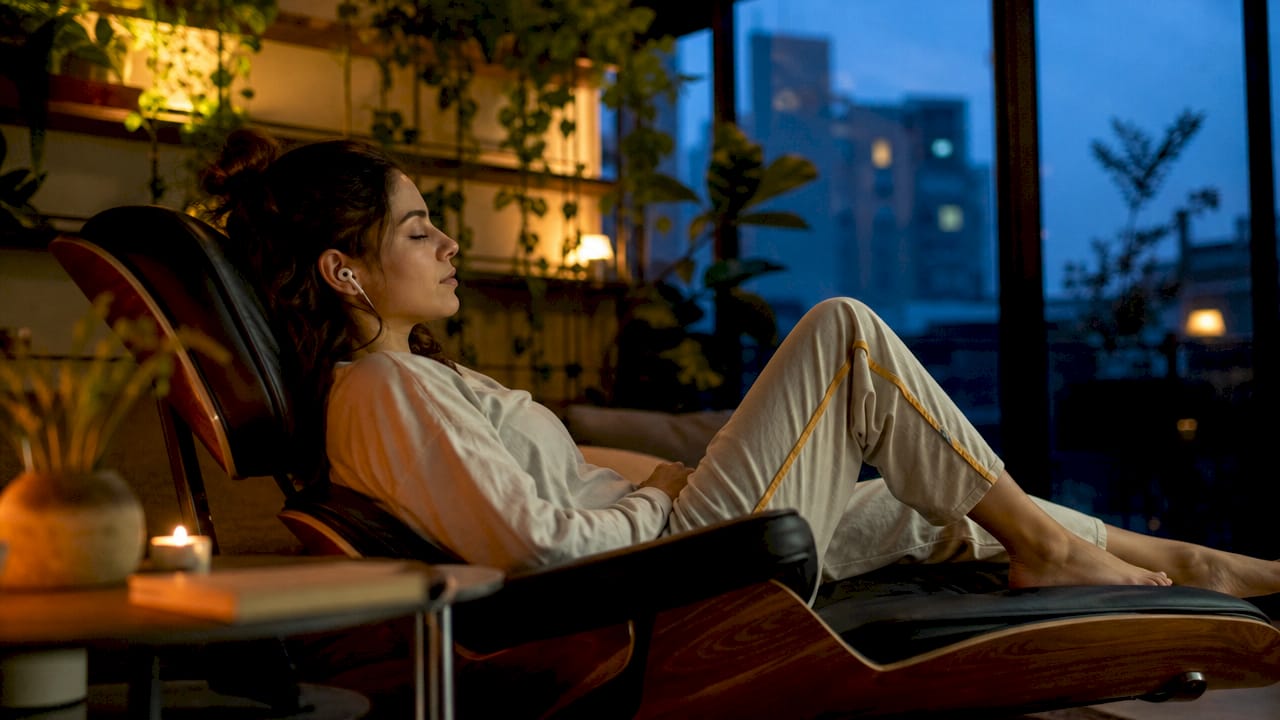
Ambient music for sleep is background sound designed to calm the nervous system and ease the mind into rest, without demanding your attention. The genre, formalized by Brian Eno in the late 1970s, is built on one defining principle: music that is as ignorable as it is interesting. That quality makes it uniquely suited for bedtime. Clinical reviews and meta-analyses confirm it reduces sleep onset latency and improves overall sleep quality. Professor James Kilner of UCL describes ambient music as giving people a period of calm that daily overstimulation strips away. If your nights feel too loud inside your own head, this is where the science starts.
What is ambient music for sleep, exactly?
Ambient music for sleep is a specific application of the broader ambient genre, one where the music functions like a sonic environment rather than a song. It does not tell a story. It does not build to a chorus. It simply holds a space, soft and steady, while your mind releases the tension of the day.
Brian Eno’s original concept, developed through albums like Ambient 1: Music for Airports, was that music could exist in the background without demanding focus. That idea maps directly onto sleep science. The brain needs to disengage from active processing to transition into sleep. Music that pulls your attention, with lyrics, dramatic swells, or unpredictable rhythms, works against that process. Music that fades into the room works with it.
The best ambient sleep music avoids attention-grabbing peaks entirely. Think slow, textureless drones, gentle piano figures that repeat without resolution, or soft synthesizer pads that blur at the edges. These are not songs you listen to. They are environments you rest inside.
What musical features make ambient music best for sleep?
Sleep-focused music benefits are tied to measurable musical parameters, not just a genre label. Researchers have identified a clear set of features that consistently improve sleep outcomes, including reduced time to fall asleep and better sleep quality scores.
Tempo, melody, and structure
Slow tempo is the most critical feature. Music in the 60–80 beats per minute range mirrors the resting heart rate, which signals the body to slow down. That physiological mirroring is not subtle. It actively pulls your cardiovascular system toward a calmer state.
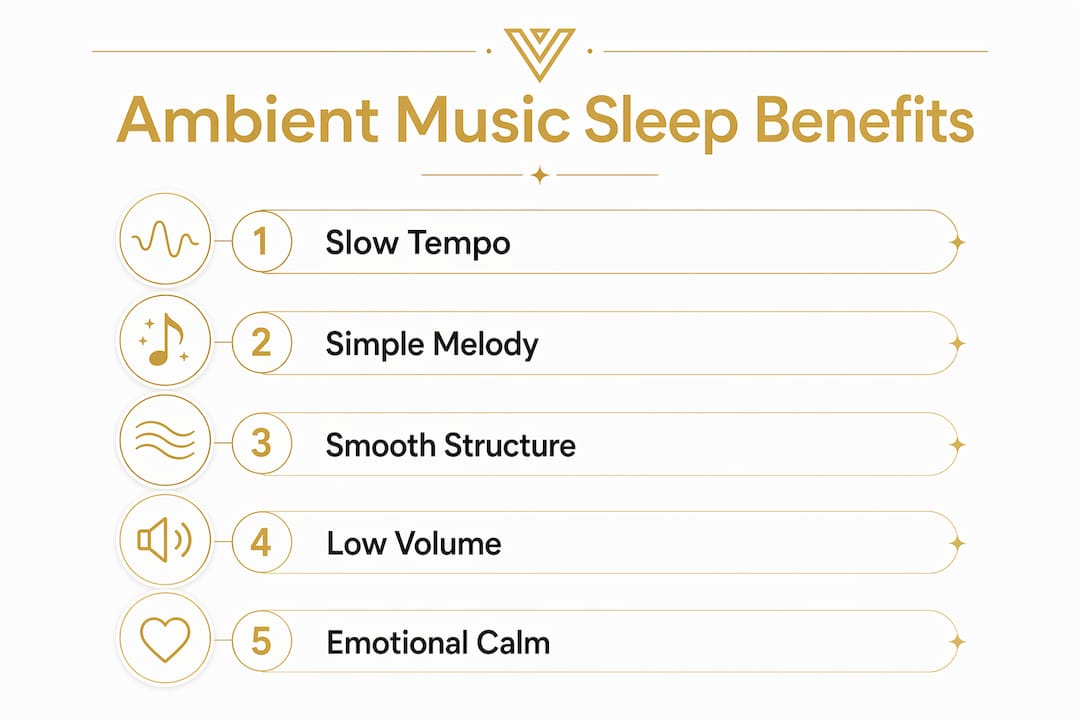
Soft, smooth melodies without sharp rhythmic accents reduce cognitive arousal. The brain stops tracking and starts drifting. Minor tonalities and simple, repetitive structures reinforce that effect by removing the element of surprise. When nothing unexpected happens in the music, your nervous system stops bracing for it.
The key musical features that support sleep onset include:
- Tempo: 60–80 bpm, mimicking resting heart rate
- Melody: Soft, smooth, and instrumental with no lyrics
- Structure: Simple and repetitive, avoiding dramatic shifts
- Dynamics: Low and consistent, with no sudden volume peaks
- Tonality: Minor or neutral keys that reduce emotional arousal
- Texture: Layered but not busy, more atmosphere than composition
Pro Tip:Keep your listening volume low enough that you could hold a conversation over it. Loud ambient music, even calm ambient music, keeps the auditory cortex more active than you want at bedtime.
What does science say about ambient music’s effects on sleep?
The clinical evidence for music as a sleep aid is stronger than most people realize. Randomized controlled trials and meta-analyses now provide specific, measurable outcomes rather than general impressions.
A 2026 randomized controlled trial combining music listening with bifrontal transcranial direct current stimulation showed a mean PSQI improvement of 2.57 points after four weeks and 20 sessions. The Pittsburgh Sleep Quality Index, or PSQI, is the standard clinical measure for sleep quality. A drop of that size is clinically meaningful.
A separate 2026 meta-analysis focused on older adults found even stronger results. Across 14 studies involving 1,730 participants, music-based interventions produced a PSQI mean difference of 3.37. Sessions ran 30–45 minutes, seven times per week, over four to eight weeks. That consistency matters. The benefit is not from one good night. It builds over time.
| Study type | Population | Duration | Key outcome |
|---|---|---|---|
| RCT with music and tDCS | Adults with sleep issues | 4 weeks, 20 sessions | PSQI improved by 2.57 points |
| Meta-analysis (14 studies) | Older adults, 1,730 participants | 4–8 weeks, daily | PSQI improved by 3.37 points |
| Narrative review | General adult populations | 30–45 min daily | Reduced sleep onset latency |
The mechanism behind these results is physiological and emotional. Slow, calm music lowers heart rate and cortisol levels. It also provides emotional regulation, giving the mind something gentle to rest on instead of cycling through the day’s unresolved thoughts. Music interventions are evolving toward structured, validated protocols in clinical insomnia research, which signals a shift from casual playlist use to something closer to therapy.
Pro Tip:Track your sleep quality before and after two weeks of consistent ambient music listening. Use a simple 1–10 scale each morning. Patterns become visible faster than you expect.
How does ambient music compare to other sleep sounds?
Not all calming sounds work the same way. Understanding the differences helps you choose what actually fits your needs.
White noise delivers a constant, undifferentiated sound that masks environmental disruptions. It works well for light sleepers in noisy environments, but it offers no emotional texture. It does not help the mind release tension. It simply covers other sounds.
Nature sounds, like rain or ocean waves, sit closer to ambient music in effect. They carry gentle rhythmic variation and a sense of space. Many people find them deeply calming. The difference is that nature sounds are recordings of real environments, while ambient music is intentionally composed to guide a specific emotional state.
Lyrical music is the least effective option for sleep. Lyrics activate the language centers of the brain, which keeps cognitive processing running when it should be winding down. Even familiar, beloved songs can delay sleep onset for this reason.
| Sound type | Attention demand | Emotional texture | Best use case |
|---|---|---|---|
| Ambient music | Very low | High, intentional | Emotional release, sleep onset |
| White noise | None | None | Masking environmental noise |
| Nature sounds | Low | Moderate, organic | Relaxation, light sleep support |
| Lyrical music | High | High, narrative | Mood, not sleep |
Ambient music occupies a unique position. It is ignorable by design but emotionally present. That combination is what makes it the most effective choice for people who need both quiet and comfort to fall asleep.
How can you build ambient music into your sleep routine?
Consistency is the variable that separates people who benefit from ambient music and people who try it once and forget it. The research is clear: 30–45 minutes of listening before bed, repeated daily over several weeks, produces reliable improvements. One night of good music does not rewire your sleep patterns. A month of it can.
Here is how to build a practice that actually holds:
- Set a fixed start time. Begin your ambient music 30–45 minutes before your target sleep time, not when you are already exhausted.
- Choose music without lyrics or dramatic structure. Avoid anything with a recognizable song form, verse, chorus, or bridge.
- Keep volume low and consistent. The music should feel like it is in the room, not in your ears.
- Use a sleep timer. Most streaming apps allow you to set a timer so the music stops after you fall asleep.
- Build a dedicated playlist. Switching tracks or searching mid-session pulls you back into active attention. Curate your ambient sleep playlist in advance.
- Pair it with other sleep hygiene habits. Dim lights, cool room temperature, and no screens amplify the effect of the music.
Ambient music works best as part of a ritual, not a rescue. When your brain learns that this sound means sleep is coming, the transition becomes faster and easier over time.
Pro Tip:If you find yourself actively listening to the music instead of drifting off, the track is too interesting. Swap to something with less melodic movement and more sustained texture.
Key takeaways
Ambient music for sleep works because its specific musical features, slow tempo, smooth melody, and simple structure, reduce physiological arousal and guide the mind toward rest.
| Point | Details |
|---|---|
| Definition matters | Ambient sleep music is ignorable by design, not just quiet background sound. |
| Musical features drive results | Tempo of 60–80 bpm, no lyrics, and simple structure are the core requirements. |
| Science supports consistent use | Daily listening over 4–8 weeks produces measurable PSQI improvements. |
| Ambient outperforms white noise | Ambient music adds emotional texture that white noise and nature sounds cannot match. |
| Routine amplifies the benefit | A fixed pre-sleep listening ritual trains the brain to associate the sound with rest. |
What I have learned about ambient music and sleep
Ambient music spent decades being misunderstood, filed away as background filler for airport lounges or elevator rides. The science has caught up to what listeners always felt intuitively: this genre does something specific to the nervous system that other music cannot replicate.
What strikes me most about the recent research is the shift toward structure. The studies that show the strongest results are not about putting on a playlist and hoping for the best. They treat music listening as a protocol, with defined duration, consistent timing, and measurable outcomes. That rigor changes the conversation. It moves ambient music from a personal preference into a legitimate sleep tool.
The deeper truth is that most people are not struggling to sleep because of silence. They are struggling because the silence is too sharp, too full of the day’s unfinished thoughts. Ambient music fills that space without demanding anything back. It gives the mind somewhere soft to land. That is not a small thing. For anyone who has spent hours staring at the ceiling, it might be exactly the thing.
The genre has evolved far beyond Brian Eno’s original experiments. Artists now compose specifically for sleep, for rest, for the space between waking and dreaming. That intentionality shows up in the music. You can feel the difference between a track made for listening and one made for letting go.
— DRVVYN
Drvvynsound and ambient music for your nights
Drvvynsound creates music built around emotional depth and intentional sound design. The DRVVYN Essentials collection brings that same care to ambient and relaxation listening, with tracks composed to support the kind of stillness that sleep actually needs.

If you are building a sleep routine backed by what the science recommends, the music you choose matters as much as the habit itself. Drvvynsound offers ambient music collections curated for rest, reflection, and the quiet moments before sleep. Each track is crafted to stay in the background, hold the space, and let your mind release what the day left behind. Start there, and let the sound do the work.
FAQ
What is ambient music for sleep?
Ambient music for sleep is background sound designed to be calming and ignorable, based on Brian Eno’s concept of music that is as ignorable as it is interesting. It uses slow tempos, soft melodies, and simple structures to reduce arousal and support sleep onset.
How long should I listen to ambient music before bed?
Research recommends 30–45 minutes of listening before bedtime, repeated daily over four to eight weeks for reliable sleep quality improvements.
Does ambient music actually improve sleep quality?
Yes. A 2026 meta-analysis of 14 studies involving 1,730 older adults found music-based interventions produced a mean PSQI improvement of 3.37 points, a clinically meaningful result.
Is ambient music better than white noise for sleep?
Ambient music offers emotional texture and intentional composition that white noise does not. White noise masks environmental sounds effectively, but ambient music actively supports the emotional release needed for sleep onset.
What should I avoid in a sleep music playlist?
Avoid tracks with lyrics, sudden volume changes, strong rhythmic peaks, or complex melodic structures. These features keep the brain in an active listening state, which delays sleep rather than supporting it.