

Music Business
Stop Split Streams: Fix ISRC vs ISWC Before Release for Indie Artists
Assign ISRCs before upload, register compositions with a PRO to get ISWCs, and follow a publisher tested release day workflow to stop royalties from leaking.
By DRVVYN · · 10 min read

ISRC identifies a specific recording, the master, while ISWC identifies the underlying musical composition, the song itself. Assign an ISRC to your track before release, and register the composition with a performing rights organization to receive an ISWC. Get this wrong, and your royalties scatter across systems that can’t find each other.
TL;DR:
- Using the same ISRC across all distributions maintains your streaming and sales history, preventing fragmentation of royalty tracking.
- You should register your composition with a PRO to obtain an ISWC, ensuring correct ownership data and royalty payouts.
- Both ISRC and ISWC are essential; ISRC tracks the master recording, while ISWC protects the song composition regardless of recordings.
- Obtain an ISRC from your distributor or directly through the online tool, and always reuse the original code if you already assigned it to a master.
- Register your composition with your PRO immediately after finishing it to prevent delays in royalty processing and ensure accurate metadata.
1. What is an ISRC and why does it matter?
An ISRC, or International Standard Recording Code, is a twelve-character string tied to one specific recording of a song. Think of it as a fingerprint for the audio file itself, not the song behind it. The format looks like CC-XXX-YY-NNNNN: a country code, a registrant code, a two-digit year, and a five-digit sequence.
Who hands these out? The ISRC International Agency oversees the system globally, while national agencies issue codes within their territories. In the United States, that’s USISRC, which explains that the code is meant to stay with a recording permanently, through every distributor change and every platform it lands on.
That permanence isn’t a technicality. It’s the backbone of your royalty history. If you swap distributors and the new one assigns a fresh ISRC to the same audio, your streaming counts and sales history fracture into two trails instead of one continuous record. How ISRC works through USISRC makes clear that reusing the original code when you migrate platforms keeps your certification eligibility and aggregated numbers intact.
Here’s where the ISRC earns its keep day to day:
- It travels in the metadata every time your track hits a distributor, a streaming platform, or a sales report.
- It’s what feeds chart calculations and certification bodies tracking consumption.
- It’s the identifier sync licensors and performance monitoring services use to trace a specific master back to its source.
Independent artists can also assign ISRCs directly through the ISRC online assignment tool, which runs on a credit system for lookups and new codes, giving you control instead of leaving it entirely to a distributor’s default process.
2. What is an ISWC and why does it matter for songwriters?
Where ISRC tracks the recording, ISWC tracks the song underneath it, the melody, lyrics, and structure that exist independent of any specific performance. The format is a T followed by nine digits and a check digit: T-123456789-C. One composition gets one ISWC, no matter how many artists cover it or how many recordings exist.
Issuance works differently here, and this trips up a lot of new songwriters. You don’t apply for an ISWC the way you request an ISRC. According to ASCAP’s ISWC FAQ, the code gets generated after you register your composition with a performing rights organization, which then feeds that registration into the global CISAC database through the ISWC International Agency network.
That registration has to carry accurate authorship data to mean anything. Writers need IPI numbers (Interested Parties Information, assigned by your PRO) attached to the work, along with correct ownership splits between every credited songwriter. Get the splits wrong at registration, and the ISWC still generates, but the royalty payouts attached to it won’t land where they should.
A few things worth locking in your head:
- ISWC applies to the composition only, never to a specific recorded performance of it.
- A song with five different artists covering it still carries just one ISWC across every version.
- Publishing royalties and PRO payouts depend on this code existing and matching your registration data correctly.
If you’re still figuring out which PRO fits your situation, our breakdown of ASCAP vs BMI walks through how registration and author data feed into this exact process.
3. ISRC vs ISWC at a glance
Both codes matter, but they solve different problems, and conflating them is where a lot of independent catalogs lose money quietly.
| Dimension | ISRC | ISWC |
|---|---|---|
| What it identifies | The specific recording (master) | The musical composition (song) |
| Format example | CC-XXX-YY-NNNNN | T-123456789-C |
| Who issues it | ISRC International Agency / national agencies like USISRC | Generated via PRO registration, processed through CISAC’s ISWC network |
| How you obtain it | Distributor assignment or direct request through the ISRC online tool | Register the work with a PRO (ASCAP, BMI, SESAC) |
| Typical use | Distribution metadata, charting, sync tracking | Publishing registration, PRO royalty payouts |
| Permanence | Fixed to the recording forever, reuse across distributors | Fixed to the composition regardless of how many recordings exist |
| Timing | Can be assigned before release | Often lags release by weeks while PROs batch-process registrations |
The short version: you need both, and they’re not interchangeable. ISRC protects your master’s royalty trail. ISWC protects your songwriting royalty trail. A remix or medley complicates things further, since a remix typically gets its own ISRC as a distinct recording, while a medley may reference multiple ISWCs if it blends different compositions.
4. How to get an ISRC and an ISWC, step by step
Getting these codes assigned isn’t complicated, but the order and timing matter more than most independent artists realize.
For your ISRC:
- Check whether your distributor automatically assigns one. Most do, but confirm it before upload.
- If you want direct control, especially across multiple release platforms, request codes through the ISRC online assignment tool instead of leaving it to each distributor.
- If you already released the same master elsewhere, reuse that original ISRC rather than letting a new platform generate a fresh one.
- Decide whether you need a block of codes under one registrant prefix (if you’re releasing frequently) or a single code (for a one-off release).
For your ISWC:
- Register the composition with your PRO as soon as it’s finished, title, writers, splits, and IPI numbers included.
- Wait for the PRO to process the registration and feed it into the CISAC database.
- Check your PRO’s online portal periodically, the ISWC usually appears there once assigned.
- Cross-reference the ISWC against your distributor and publisher records to confirm everything lines up.
Before you hit upload, verify these metadata fields are consistent everywhere: track title, writer names with IPI numbers, publisher name, the ISRC itself, and the ISWC if it’s already been assigned.
Pro Tip:Register your composition with your PRO the same week you finish it, not the week you release it. ISWC assignment can lag, and starting early means the code is often ready by the time royalties start flowing.
5. Metadata mistakes that quietly cost you royalties
Most lost royalty income isn’t dramatic. It’s a spreadsheet error or a skipped step that nobody notices until a royalty statement looks thin.
The biggest offender: issuing a new ISRC for a master that already has one. USISRC’s guidance is explicit that the code is meant to follow the recording permanently. Practitioner write-ups like the Songtrust blog on ISRC and ISWC back this up from the label-side perspective: a new code on the same audio splits your streaming history into two unconnected trails, which can also affect certification eligibility.
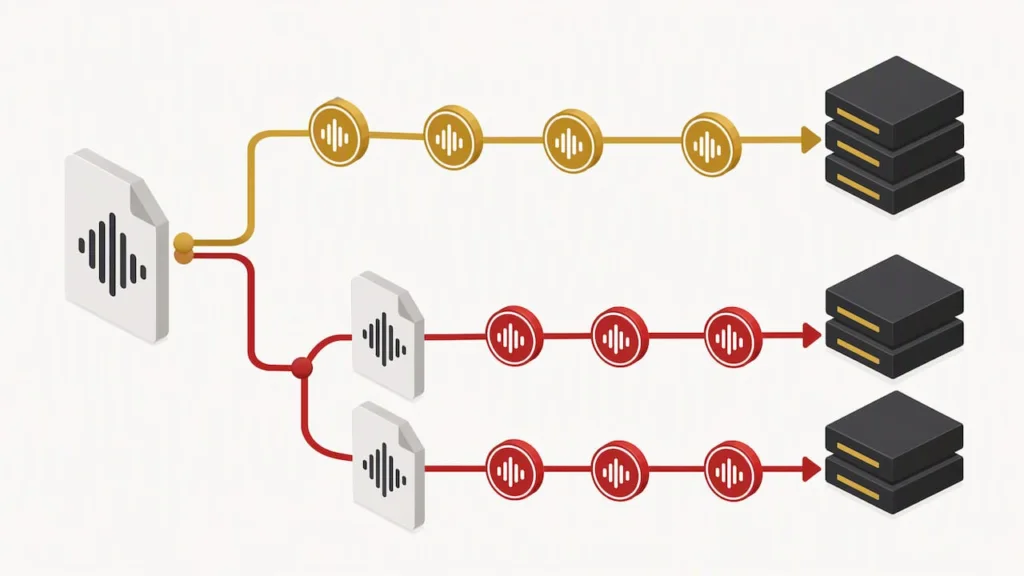
Second offender: delaying PRO registration. Since ASCAP notes that ISWC assignment depends on PRO processing and CISAC updates, waiting until after release to register means weeks of publishing royalties sitting unclaimed or misrouted.
A few habits worth building into every release:
- Keep one master spreadsheet with ISRC, title, writer names, IPI numbers, splits, and publisher info as your single source of truth.
- Cross-check that spreadsheet against your distributor upload, your PRO registration, and your publisher’s admin system before release day.
- Never let two platforms generate two different ISRCs for the identical audio file.
A composition retains the same ISWC regardless of how many separate recordings exist of it, per ASCAP’s ISWC guidance, which means getting it right once protects every future cover or re-release of that song.
It’s worth knowing that none of this replaces formal copyright registration. U.S. Copyright Office Circular 56A treats sound recordings and musical compositions as separate works entirely, filed through different forms (SR for recordings, PA for compositions). ISRC and ISWC are industry tracking tools; copyright registration is the legal step that protects ownership itself.
6. Our workflow for identifiers and metadata
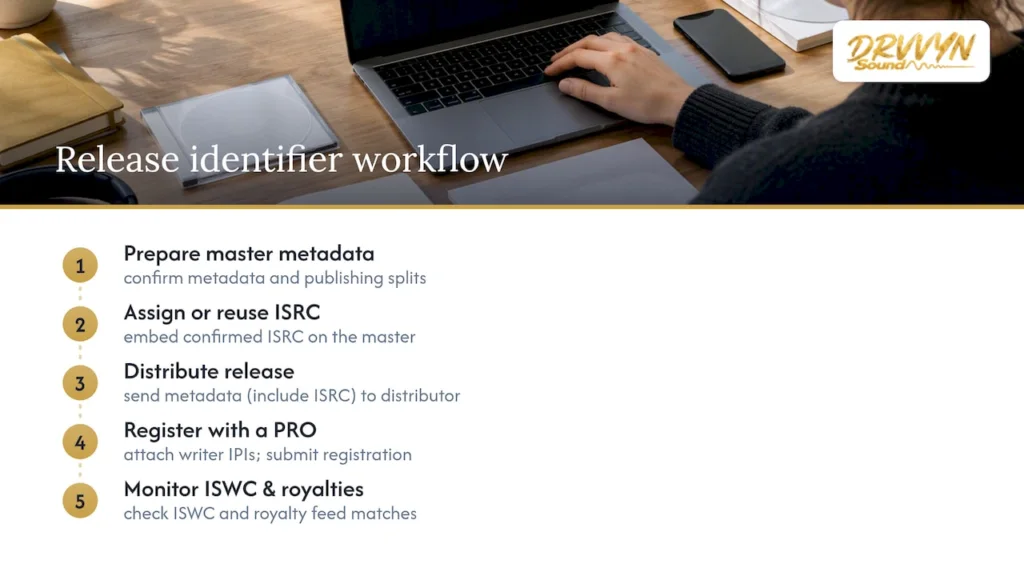
We built a straightforward sequence for every release that keeps identifiers from slipping through the cracks: prepare the master’s metadata first, assign or reuse the ISRC, distribute, register the composition with a PRO, then monitor for ISWC assignment and royalty feed confirmation.
At each stage we track a short checklist: confirmed ISRC on the master, writer IPI numbers attached correctly, publishing splits documented in writing before release, and PRO registration submitted within days of the track being finished rather than weeks later. We also cross-check distributor metadata against PRO records once the ISWC comes back, since a mismatch there is where royalties tend to disappear quietly.
For deeper reading on the pieces that connect to this, our guide on PRO selection and our notes on release timing and metadata both expand on steps touched here.
7. Why metadata discipline pays off for your whole catalog
Good identifier hygiene feels like small paperwork, but it compounds. A catalog with clean ISRC and ISWC data is a catalog that licenses smoothly, pays correctly, and survives distributor changes without losing history.
The artists who treat this as an afterthought are the ones chasing missing royalties years later. Metadata discipline isn’t glamorous work, but it’s the difference between a catalog that earns quietly in the background and one that needs constant cleanup.
— DRVVYN Sound
8. Prefer expert help with metadata and licensing?
Chasing down IPI numbers, confirming splits, and tracking ISWC assignment across multiple releases takes real time, time that often competes directly with writing and recording. We offer licensing support built around exactly this kind of metadata and registration work, so artists who’d rather hand off the administrative layer have a direct route to do it.
If you’re weighing whether a specific piece of music fits a commercial project, our explainer on needle drop licensing covers the rights side of that decision. And if you’ve been piecing together metadata basics on your own, the independent checklist from Hot Mic Radio is a solid companion resource before you reach out.
Check our licensing profile to see how assisted metadata and registration support could fit your next release.
FAQ
What does ISRC stand for?
ISRC stands for International Standard Recording Code, a twelve-character identifier assigned to a specific recording, not the underlying song. It travels with the audio through distribution, streaming, and sales reporting for the life of that master, as USISRC explains.
Where can I find my ISWC code in ASCAP?
ASCAP members can typically locate an assigned ISWC through their online member portal once the composition has been registered and processed. According to ASCAP’s ISWC FAQ, the code appears after PRO registration feeds into the CISAC database, which can take time rather than appearing instantly.
How do I obtain an ISRC number for a song?
Most distributors assign an ISRC automatically during upload, though independent artists can also request one directly through the ISRC online assignment tool. If you’ve already released the same master elsewhere, reuse the existing ISRC rather than accepting a newly generated one.
What happens if I don’t have an ISRC?
Without an ISRC, a recording lacks the standard identifier that distributors, streaming platforms, and chart or certification bodies use to track consumption. Per IFPI’s ISRC documentation, the code underpins how a specific master is recognized across platforms, so skipping it can leave your streaming and sales data harder to consolidate.
Sources
- ISWC number / Work codes FAQ | ASCAP
- Circular 56A: Copyright registration of musical compositions and sound recordings
- Assign ISRC online | ISRC (IFPI)