

Music Business
6 Steps to Claim Streaming Mechanical Royalties for Indie Songwriters
Indie songwriters: a six step checklist to join The MLC, fix ISWC/ISRC/IPI data, and claim unmatched streaming mechanical royalties.
By DRVVYN · · 13 min read

An interactive stream on a service like Spotify or Apple Music triggers a mechanical royalty, a reproduction payment that is separate from the performance royalty the same stream also generates. The Mechanical Licensing Collective administers this royalty for U.S. digital mechanicals, and registration is free. If you have not joined The MLC and registered your catalog with correct splits and identifiers, that is the one thing to fix today.
TL;DR:
- Register with The MLC and your PRO to ensure both mechanical and performance royalties are collected, as they operate through separate systems.
- Payment rates for streaming mechanical royalties vary month to month based on service revenue, subscriber numbers, and the formula set by the Copyright Royalty Board.
- Maintaining accurate and consistent metadata, including ISWC, ISRC, and registration details, is critical to matching royalties and avoiding unclaimed funds.
- International royalties depend on foreign collection societies and require additional registrations, with the same identifiers helping streamline cross-border matching.
- Regularly auditing your catalog and metadata, or working with professional catalog management, helps prevent delays and unclaimed royalties from unresolved mismatches.
What Are Mechanical Royalties in Streaming?
A mechanical royalty pays for the reproduction of a composition. Every time a service like Amazon Music or Tidal streams your song on demand, it creates a digital copy in order to deliver it to a listener, and that act of copying is what the copyright law treats as reproduction. That single click by a fan actually sets off two separate payments on the composition side.
- Mechanical royalty: paid for the reproduction created by the stream, owed to the songwriter and publisher.
- Performance royalty: paid for the public performance of the composition, also owed to the songwriter and publisher, but collected through a different organization.
- Master royalty: a third, unrelated payment for use of the actual sound recording, owed to whoever owns the master, often the artist or a label.
The distinction matters because mechanical and performance royalties are administered by entirely different organizations in the United States, so a songwriter who registers with only one is leaving money uncollected. If you wrote the song, you are owed both the mechanical and the performance share. If you only performed it, your mechanical claim depends on your publishing agreement, not your artist deal.
Who Pays and Who Collects: DSPs, The MLC, and PROs
Digital service providers like Spotify, Apple Music, and YouTube Music operate under a blanket mechanical license created by the Music Modernization Act. Under that license, they report usage monthly and pay mechanical royalties into a central pool rather than negotiating deals song by song.
- The MLC receives those reports, matches each stream to a registered composition, and distributes mechanical royalties to member songwriters and publishers.
- Performing Rights Organizations, ASCAP, BMI, and SESAC among them, collect performance royalties separately and pay out on their own schedules.
- A songwriter who registers only with a PRO collects performance royalties but leaves mechanical royalties unclaimed, since PRO membership does not enroll you in The MLC.
That is why most independent songwriters need two separate memberships, not one. A PRO covers the performance side; The MLC covers the digital mechanical side. Skipping either one means half your composition royalties from streaming go uncollected, sitting in an unmatched pool until someone claims them. For a deeper breakdown of what PROs actually pay for, ASCAP vs BMI: Which Fits Your Songwriting Career? walks through how those payments work.
How Are Mechanical Streaming Rates Set?
There is no flat penny-per-stream rate for interactive streaming. Instead, the Copyright Royalty Board sets rates through multi-step statutory formulas under Phonorecords IV, and those formulas are why your per-stream payout can shift from month to month even with the same play count.
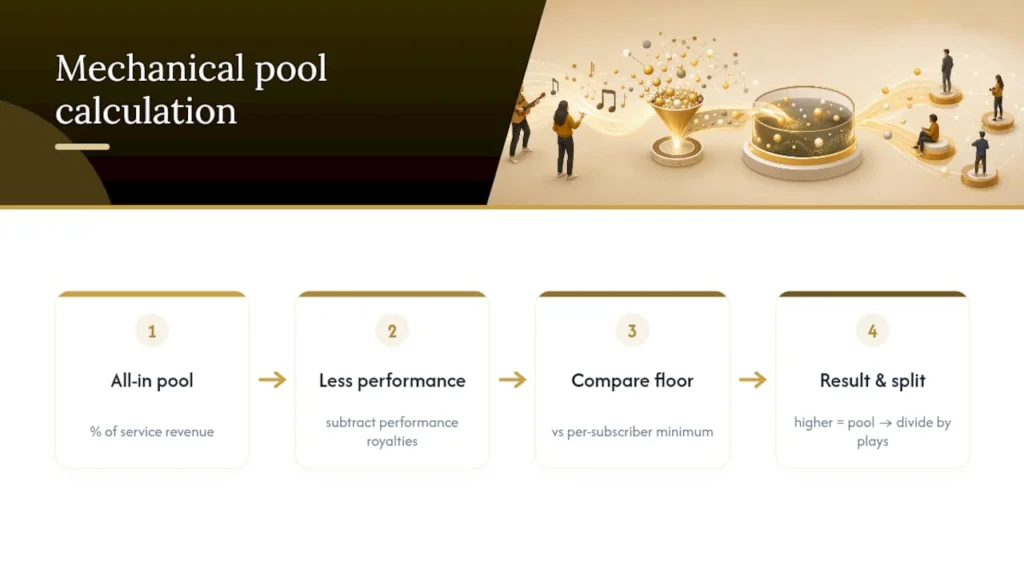
The logic runs roughly like this: a service calculates an “all-in” royalty pool as a percentage of its revenue, subtracts what it already pays out in performance royalties, then compares that result against a per-subscriber minimum floor. Whichever figure is higher becomes the mechanical pool, which then gets divided across total plays. Published rate tables show publisher-share percentages phasing between roughly 15.1% and 15.35% across the Phonorecords IV period, with the exact figure depending on the year and service tier.
Bundled subscriptions complicate this further. When a streaming plan is packaged with a phone contract or a fitness app, the service has to allocate a portion of that bundled revenue to music before running the formula, and different accounting choices about content costs and revenue recognition shift the resulting pool. That is why two songs with identical stream counts on the same platform can post different mechanical payouts, and why chasing an exact per-stream number is less useful than understanding the drivers behind it.
Step-by-Step: How to Collect Your Streaming Mechanicals
Getting paid consistently comes down to a short list of registrations and checks, done in the right order.
- Join The MLC as a member. Membership is free, and you register each song with full writer and publisher splits.
- Register with a PRO. ASCAP, BMI, or SESAC handles your performance royalties, and your PRO data should match what you filed with The MLC.
- Verify your identifiers. Check that the ISWC on your composition and the ISRC on each recording are correct, and confirm your IPI or CAE number matches across every registration.
- Fix mismatches with your distributor. If a code is wrong, your distributor, not The MLC, usually needs to correct it at the source.
- Use MLC’s Matching Tool and Songwriter Hub. Search your catalog for unmatched recordings, and if your distributor supports it, ask them to route through the Distributor Unmatched Recordings Portal.
- Keep a catalog log. Track every release, split percentage, and metadata version in one spreadsheet so you can reconcile it against monthly MLC statements.
Pro Tip:Set a recurring monthly calendar reminder to log into The MLC’s Songwriter Hub and search your own catalog by title. Catching a mismatch within a few weeks is far easier than untangling it a year later, once dozens of monthly reports have piled up unmatched.
Clean, accurate metadata across every one of these steps is what actually determines whether a royalty gets matched and paid instead of sitting in limbo.
When Do Streaming Mechanical Royalties Get Paid?
The MLC distributes mechanical royalties monthly, and the lag between a stream happening and that royalty landing in your account runs roughly 75 days in typical cases. That gap exists because DSPs need time to compile and report usage, and The MLC needs time to match those reports against registered works before it cuts a distribution.
Matching is not a one-time event. The MLC regularly reprocesses historical unmatched royalties as songwriters fix metadata or register works late, which means a payment for a stream from months ago can still show up after a correction goes through. The MLC’s 2025 Annual Report documents this reprocessing cycle as a routine part of how unmatched pools shrink over time. If you suspect royalties are sitting unclaimed, search the public unmatched database by title or writer name, and if you distribute independently, check whether your distributor supports DURP to surface unclaimed releases tied to your account.
Common Pitfalls That Cost Songwriters Their Royalties
Most unpaid mechanical royalties trace back to the same handful of mistakes, and nearly all of them are fixable in an afternoon.
- Missing or inconsistent metadata. A missing ISWC, a misspelled writer name, or a publisher listed under two slightly different names can each stall a match on their own.
- Assuming your PRO covers everything. ASCAP, BMI, or SESAC membership pays performance royalties only; digital mechanicals require separate MLC registration.
- Distributor gaps. Some aggregators do not pass full metadata through to DSPs, which breaks the identifier chain before it ever reaches The MLC.
- Ignoring match proposals. The MLC sometimes flags a probable match that needs your confirmation, and letting that notification sit unanswered delays payment.
Identifier mismatches are consistently cited as the primary reason usage lines go unmatched, ahead of any other single cause. Auditing your catalog against your distributor’s metadata once a quarter catches most of these before they compound.
Physical Sales, Downloads, and Streaming: Different Rules, Different Math
Mechanical royalties existed long before streaming, and the rules still differ depending on the format. Physical sales and permanent downloads, a CD or an iTunes purchase, generally pay a statutory mechanical rate per copy sold, a fixed amount that does not depend on service revenue or subscriber counts. Once the unit sells, the mechanical royalty on that copy is set.
Streaming works differently because a single interactive stream is not a permanent copy in the same sense as a download. Instead, the CRB’s formula-based approach ties the mechanical pool to a percentage of service revenue, then divides it across total plays. That means the per-play mechanical payout on a stream is smaller than the per-unit rate on a download, but it recurs every time the song plays, rather than paying once at the point of sale.
This distinction trips up songwriters who compare a download-era mental model to streaming income and conclude something is broken. Nothing is broken. A song that used to earn a flat rate per download now earns a fractional, formula-driven amount per play, and the total depends on volume and subscription mix rather than unit sales. Bundled and family-plan subscriptions add another layer, since a single subscription fee gets split across every stream a household generates, further diluting the per-play figure without reducing the total pool available to songwriters overall.
Understanding this shift matters most when explaining your royalty statements to co-writers or collaborators who grew up on the download economy. The math changed structurally, not just in scale.
Do Cover Songs and User-Generated Content Trigger Mechanical Royalties?
Cover versions and user-generated content both interact with mechanical royalties, but in different ways. A cover song, someone else recording your composition, still owes you a mechanical royalty whenever that cover streams, because the underlying composition copyright is what generates the payment, regardless of who performed it. Your MLC registration covers your composition no matter how many different artists record and release versions of it, as long as each release is properly credited back to your work through matching metadata.
User-generated content on platforms like YouTube, TikTok, and Instagram is messier. When a creator uses a clip of your song in a video, the platform typically operates under its own licensing arrangements with rights holders and PROs, and how that translates into a mechanical royalty depends on the specific platform and whether the use qualifies as an interactive stream of a full composition or a short synchronized clip under a different kind of license. Short-form video usage frequently falls under sync-style licensing rather than the standard blanket mechanical license that covers full-length interactive streams, which is part of why creators sometimes see performance-side income from viral UGC moments without a matching mechanical payment.
The practical takeaway: register every composition regardless of who might eventually cover it, and do not assume a viral UGC moment automatically means a mechanical royalty is coming. Check how the specific platform licenses that use, and confirm your metadata is clean enough that any qualifying use gets matched back to you.
How Are International Streaming Mechanical Royalties Collected?
The MLC’s blanket license and matching system apply specifically to U.S. digital mechanicals. Once your music streams outside the United States, mechanical royalty collection runs through a different structure entirely, typically a mechanical rights society or a combined mechanical and performance society in that country, depending on local law.
For songwriters, this means a global release strategy requires more than a single MLC registration. If you have a publisher, that publisher typically maintains sub-publishing or collection agreements with foreign societies on your behalf, so your international mechanical royalties flow back through that relationship. If you are fully self-published, you may need to register directly with relevant foreign collection societies, or work with an administrator who already has those relationships in place, since individual creators generally cannot access every territory’s collection system on their own.
The identifiers that make U.S. matching work, ISWC and ISRC codes referenced in DDEX metadata standards, are the same identifiers that make international matching work. A composition with a consistent ISWC across every territory is far easier for foreign societies to match to the correct writer and publisher, even when the collection infrastructure and rate-setting rules differ completely from country to country. Keeping that identifier consistent globally is one of the few things a self-published songwriter can control before ever signing with an international administrator.
Why Publishing Administration Never Really Stops
Treat your publishing paperwork like ongoing operations, not a task you finish once and forget. Run a monthly check on your MLC and PRO statements, update splits the moment a collaboration changes, and keep a running metadata ledger for every release.
Owning that process, or working with an admin who is transparent about it, is what keeps royalties from stalling in an unmatched queue. Reconciling a distribution against a clean, current ledger takes minutes. Reconciling it against scattered memory takes hours, and by then, months of streams may already be sitting unclaimed.
— DRVVYN Sound
A Managed Alternative for Catalog and Licensing Support
Chasing metadata errors across multiple registrations takes real time, time that could go toward writing the next song instead of untangling the last one. Licensing support is available for catalog administration and metadata cleanup for songwriters who would rather hand off the reconciliation work than do it themselves every month.
This route fits creators managing complex splits across co-writers, or anyone who simply does not have the bandwidth to audit ISWC and ISRC codes on a recurring basis while also releasing new music. Rather than replacing your MLC or PRO membership, licensing support through DRVVYN Sound works alongside them, helping keep the underlying metadata clean so those registrations actually pay out on schedule. If a growing catalog has started to feel harder to track than the songs themselves, check DRVVYN Sound’s licensing services and see what managed administration would look like for your catalog.
Sources
- The MLC — Digital music royalties landscape
- 37 CFR §385 — Copyright Royalty Board rate formulas
- MLC statutory royalty rate formula tables (January 2026)
- Understanding the difference between mechanical and performance royalties — The Anderson Firm
FAQ
How much does The MLC pay per stream?
There is no fixed per-stream rate. The MLC distributes from a mechanical pool calculated through Phonorecords IV formulas tied to service revenue, performance royalty deductions, and subscriber floors, so the amount varies by service, subscription tier, and reporting period.
How much does 1,000 streams pay in mechanical royalties?
The payout depends on which service streamed the song, its subscription revenue, and how the CRB formula applies that month, so there is no single reliable figure across platforms. Rate tables published by The MLC show the underlying percentages, but converting those into a per-stream dollar amount requires knowing the specific service’s revenue and subscriber data for that period.
Is The MLC free to join?
Yes, MLC membership is free for songwriters and publishers. You register your catalog at no cost, and The MLC collects a portion of the mechanical royalty pool from licensed services to fund its own operations, not from member fees.
Do independent artists actually get royalties from streaming?
Yes, but only if they are registered correctly. A songwriter earns both mechanical royalties through The MLC and performance royalties through a PRO like ASCAP, BMI, or SESAC, and missing either registration means that portion goes uncollected even though the streams are happening.
What is the difference between mechanical and performance royalties?
Mechanical royalties pay for the reproduction of a composition, the copy created when a song streams or downloads, while performance royalties pay for the public performance of that same composition. Both arise from a single interactive stream, but different organizations collect each one, which is why songwriters need separate registrations for each.