

Listening & Culture
The Role of Background Music Habits on Focus and Mood
Explore the role of background music habits on focus and mood. Discover how music can boost your motivation and enhance your productivity.
By DRVVYN · · 9 min read

Background music habits are defined as the regular patterns and preferences in how you listen to music during daily activities like studying, working, or relaxing. The role of background music habits goes far beyond filling silence. Research shows that 67% of students use music to improve focus, and 75% use it specifically to boost motivation. Those numbers reveal something deeper than casual listening. They point to a deliberate, if often unconscious, strategy for managing emotional and cognitive states. The effects, though, are not universal. They shift based on music type, task complexity, and who you are as a listener.
How background music habits shape mood and emotional regulation
Music functions as an emotional regulator before it functions as a cognitive tool. When you press play before a study session or a long work block, you are not just filling the room with sound. You are signaling to your nervous system how you want to feel. That distinction matters because it reframes how you should think about your listening choices.

Different musical elements produce different emotional responses. Slow tempos and minor keys tend to create a sense of calm or melancholy. Fast tempos and major keys lift energy and mood. Lyrics add another layer entirely. When a song’s words resonate with what you are already feeling, the emotional pull intensifies. That can be comforting during low-stakes tasks, but it can also pull your attention away from what you are trying to do.
Music also supports motivation and comfort during repetitive or tedious tasks. Music helps students feel more motivated, engaged, and comfortable when studying, though the degree of benefit varies with music type and task difficulty. Think of it like a pressure valve. The right song at the right moment can release tension and make a difficult task feel more bearable.
- Instrumental music tends to create emotional calm without competing for language processing resources.
- Lyrical music can boost mood and energy but risks pulling focus toward the words rather than the work.
- Familiar music feels emotionally safe and reduces anxiety, making it useful for warm-up tasks.
- Unfamiliar music keeps the brain slightly alert, which can help with tasks requiring mild stimulation.
Pro Tip:If you feel emotionally flat before a task, use an upbeat, familiar playlist for the first 10 minutes. Then switch to instrumental music once your mood lifts and focus kicks in.
Does background music actually improve focus and productivity?
The answer is yes, but with conditions attached. Self-selected background music increases energetic arousal and task engagement, which mediates improved performance on sustained attention tasks compared to silence. The key phrase is “self-selected.” Music you choose yourself carries more motivational weight than music chosen for you. That sense of agency matters to the brain.
The type of music you choose determines whether it helps or hurts. Instrumental and slow-tempo music generally supports concentration, while lyrical and fast-paced music tends to interfere with memory retention during cognitive tasks. This is not a minor distinction. If you are writing, analyzing, or memorizing, lyrics compete directly with the language centers of your brain.
Task complexity also changes the equation. Simple, repetitive tasks tolerate more musical stimulation. Complex tasks that require deep reasoning or creative problem-solving benefit from quieter, less intrusive sound. Fast and loud music or music with lyrics is often distracting and negatively impacts thinking, especially during complex tasks. That finding holds across educational psychology research and student interviews alike.
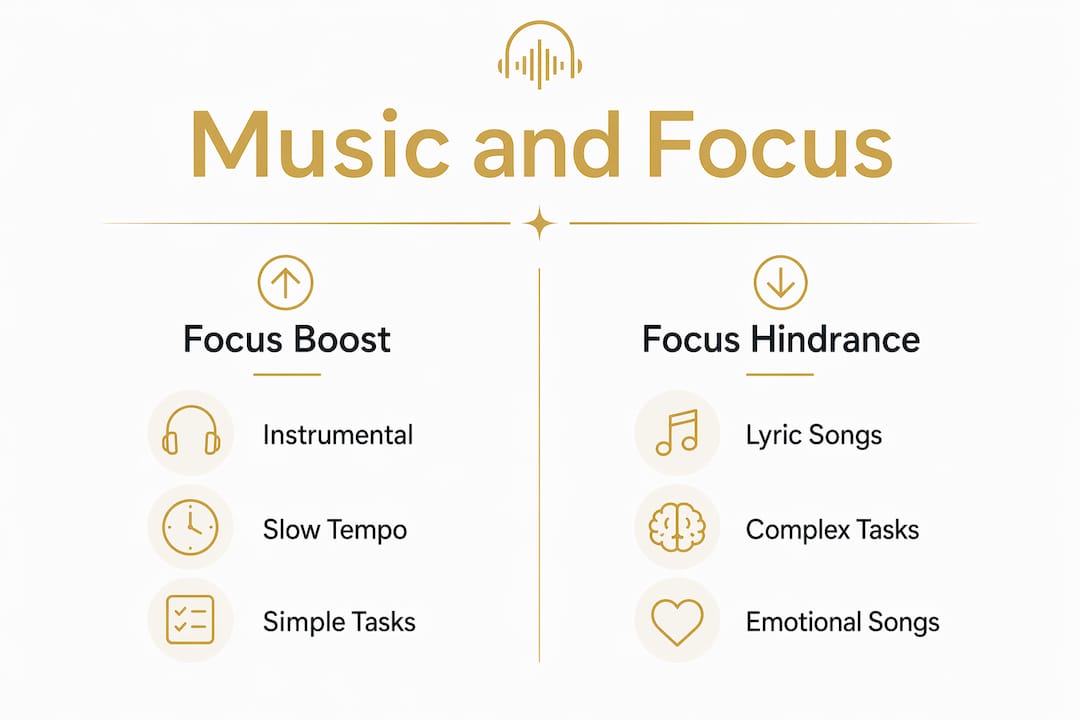
Individual differences add another layer. Music listening habits while reading differ, with roughly equal numbers of students listening with or without music during reading tasks. That split highlights a real truth: what works for one person can actively hurt another.
| Music type | Best task match | Likely effect on focus |
|---|---|---|
| Instrumental, slow tempo | Writing, deep reading, analysis | Supports sustained concentration |
| Lyrical, familiar | Repetitive or physical tasks | Boosts mood, mild distraction risk |
| Fast, loud, lyrical | Simple data entry, light admin | Energizing but cognitively disruptive |
| Ambient or nature sounds | Creative brainstorming | Mild stimulation, low interference |
Pro Tip:Match your music to your task before you press play. Ask yourself: does this task require language processing? If yes, go instrumental.
How do personality traits shape your music listening preferences?
Your personality is one of the strongest predictors of how and why you use background music. Background music use is significantly predicted by personality traits like extraversion and neuroticism, affecting whether music is used to self-regulate energy or mask discomfort. That finding comes from correlational analyses and decision tree modeling with 332 adults, and it carries real weight for understanding your own habits.
Extraverts tend to use music to amplify energy and social feeling. They are more likely to play upbeat, lyrical music during tasks because they find the stimulation motivating rather than distracting. Introverts, by contrast, often use music to create a controlled sonic environment. They may prefer instrumental or ambient tracks that block out unpredictable external noise without adding cognitive load.
Neuroticism, which refers to a tendency toward emotional instability or anxiety, also shapes music habits. People who score higher in neuroticism often use music to mask discomfort or anxiety during tasks. The music becomes a buffer between them and the silence that feels too sharp to sit with. That is not a weakness. It is a form of emotional self-management.
“Personality traits like extraversion largely explain differences in background music use, highlighting the importance of self-knowledge when optimizing listening habits. Understanding your own tendencies is the first step toward using music as a deliberate tool rather than a reflexive habit.”
Self-efficacy, or your confidence in your own ability to focus, also plays a role. Confidence in one’s attention span influences whether music is seen as helpful. More confident listeners use music strategically for motivation. Less confident listeners may default to music as background noise without evaluating whether it actually helps.
- High extraversion: Drawn to energetic, lyrical music; uses it to sustain drive during tasks.
- High introversion: Prefers low-stimulation, instrumental sound; uses it to create a predictable sonic space.
- High neuroticism: Uses music to soothe anxiety; benefits most from calm, familiar tracks.
- High self-efficacy: Treats music as a reward or motivational tool, not a crutch.
How to optimize your music habits for focus and well-being
The most effective approach to background music is treating it as a tool, not a default. Music’s impact is contingent on the listener’s confidence and the task at hand rather than universally beneficial or distracting. That means your listening strategy should shift depending on what you are doing and how you are feeling.
Here is a practical framework for building better music habits:
- Audit your current habits. Notice when you reach for music automatically. Is it because you need focus, or because silence feels uncomfortable? Honest self-observation is the starting point.
- Match tempo to task. Use slow, instrumental tracks for reading, writing, and analysis. Reserve fast, lyrical music for physical tasks, commutes, or warm-up routines.
- Curate playlists by lyric density. Curating playlists based on tempo and lyric density is the most reliable way to support concentration without interference. Build separate playlists for deep work and light tasks.
- Use music as a reward, not a constant. Play your favorite tracks as a motivational reward after completing a difficult block of work. This preserves the emotional lift without the cognitive cost.
- Know when to pause. If you notice your mind drifting to the lyrics or your productivity slipping, silence is the right call. Music should serve the work, not compete with it.
Common pitfalls include playing preferred or emotionally charged songs during intensive tasks. A song you love pulls more attention than a song you barely notice. That is not a flaw in the music. It is how emotional memory works.
Pro Tip:Build a “deep work” playlist of 20–30 instrumental tracks you find pleasant but not exciting. Familiarity without emotional charge is the sweet spot for sustained focus.
Key Takeaways
Background music habits shape cognitive performance and emotional regulation through the interaction of music type, task complexity, and individual personality traits.
| Point | Details |
|---|---|
| Music type determines outcome | Instrumental, slow-tempo music supports focus; lyrical, fast music risks disrupting memory retention. |
| Personality predicts usage | Extraversion and neuroticism significantly shape whether music energizes or soothes during tasks. |
| Self-selection amplifies benefit | Choosing your own music increases arousal and task engagement more than assigned or random playlists. |
| Task complexity sets the limit | Simple tasks tolerate more musical stimulation; complex tasks benefit from quieter, low-lyric sound. |
| Confidence shapes strategy | Listeners with higher self-efficacy use music as a deliberate motivational tool, not passive noise. |
What I’ve learned about music habits that most articles miss
I have spent years watching how music shapes the emotional texture of a day, both in creating it and in living inside it. The research confirms what I have felt intuitively: music is not a productivity hack. It is an emotional environment you build around yourself.
The part most people miss is the overreliance trap. When music becomes the only way you can tolerate silence, it stops being a tool and starts being a dependency. That shift is subtle. One day you realize you cannot read without a playlist running, not because it helps, but because the quiet feels wrong. That is the moment to pause and recalibrate.
Digital streaming has made music so frictionless that we rarely stop to ask whether we should be listening at all. The access is extraordinary. The mindfulness around that access is still catching up. I think the most interesting question is not “what music helps me focus?” but “what does my instinct to reach for music right now actually tell me about my emotional state?”
That question is worth sitting with. And sometimes, the most productive thing you can do is let the silence answer first.
— DRVVYN
Sound worth listening to, built for how you actually feel
Knowing how music affects your mind is one thing. Having the right music ready when you need it is another.

Drvvynsound creates original music and curated listening experiences designed around emotional depth and intentional sound. Whether you need something to carry you through a long work session or music that meets you in a quieter, more reflective moment, the DRVVYN catalog is built with that emotional range in mind. The music is crafted to feel like something, not just fill space. If you are ready to be more intentional about what you listen to and why, start there.
FAQ
What are background music habits?
Background music habits are the regular patterns in how and when you listen to music during daily activities like studying, working, or relaxing. These habits influence emotional regulation, motivation, and cognitive performance depending on music type and personal traits.
Does background music improve focus?
Background music can improve focus, but only under specific conditions. Instrumental and slow-tempo music supports concentration, while lyrical or fast-paced music tends to interfere with memory retention during complex tasks.
How does personality affect music listening preferences?
Personality traits like extraversion and neuroticism significantly predict background music use. Extraverts tend to use energetic music to sustain drive, while those higher in neuroticism often use calm music to manage anxiety during tasks.
Is the Mozart Effect real?
The Mozart Effect is largely a myth. Modern research emphasizes individualized music selection over genre-based claims, showing that personal relevance and self-selection matter far more than any specific musical style.
When should you avoid background music while studying?
Avoid background music during complex tasks that require deep reading, writing, or memorization. Fast, loud, or lyrical music is especially disruptive during high-cognitive-load work and can negatively impact thinking and retention.