

Listening & Culture
What Is Liquid Soul Music? A Guide for Supervisors and Creators
What Is Liquid Soul Music? A Guide for Supervisors and Creators
!
By DRVVYN · · 13 min read

What Is Liquid Soul Music? A Guide for Supervisors and Creators

Liquid soul is a smooth, cinematic variant of alternative R&B and soul, built on emotive vocals, warm production textures, and lyrics that lean inward rather than outward. It’s the sound of a quiet room at 1 a.m., where the tension in your chest finally has somewhere to go.
If you’re a music supervisor, this matters because metadata clarity is now a gatekeeper, as explored in the Blog – Twisby Records. Industry analysis projects that by 2026, music supervisors increasingly lean on AI-powered search tools to find tracks, which means a song tagged clearly as “liquid soul,” “cinematic R&B,” or “introspective alt-soul” surfaces faster than one buried under vague labels. DRVVYN Sound builds its catalog around this exact style, delivered with the standardized files (full mix, instrumental, stems) editors expect.
Here’s where to go next:
- Skip to the sonic checklist if you’re trying to identify the style by ear.
- Skip to the licensing steps if you’re ready to clear a track for a project.
Key Takeaways
Liquid soul works because it pairs intimate, emotionally direct vocals with cinematic, spacious production built to support a scene rather than dominate it.
| Point | Details |
|---|---|
| Core definition | Liquid soul is smooth, cinematic alternative R&B centered on emotive vocals and introspective songwriting. |
| Sonic markers | Slow to mid tempos, warm extended chords, Rhodes or piano, sparse guitar, and reverb-heavy ambient texture. |
| Licensing essentials | Request full mix, instrumental, TV mix, stems, and ISRC before negotiating term and territory. |
| Metadata matters | Clear mood and function tags help tracks surface faster as AI-driven search tools grow among supervisors. |
| DRVVYN Sound’s role | DRVVYN Sound offers a direct-to-artist liquid soul catalog with standardized deliverables and fast licensing turnaround. |
Table of Contents
- What Defines Liquid Soul: Sonic Characteristics and Production Hallmarks
- Where Liquid Soul Comes From: Neo-Soul, Alt-R&B, and Cinematic Roots
- How Brands and Supervisors Use Liquid Soul in Media
- How to Find and License a Liquid Soul Track
- Producing Liquid Soul: What Creators Should Get Right
- A One-Page Brief and Licensing Checklist to Send a Composer or Label
- What Liquid Soul Songs Are Actually About
- Where to Discover Liquid Soul Tracks
- What Liquid Soul Licensing Actually Costs
- Why We Make Liquid Soul, and How We Think About Licensing
- Ready to License or Commission a Liquid Soul Track?
- Frequently Asked Questions
- Sources
What Defines Liquid Soul: Sonic Characteristics and Production Hallmarks
Liquid soul announces itself through restraint. Nothing shouts. Every element earns its space, and the silence between notes carries as much weight as the notes themselves.
Listen for these markers when you’re trying to identify the style in a library search or a fresh cut:
- Vocal delivery: intimate, breathy, often close-miked, favoring emotional cracks over technical flourish
- Tempo: slow to mid-range, generally 60 to 95 BPM, built for lingering rather than driving
- Harmony: warm extended chords, seventh and ninth voicings, modal shifts that feel unresolved on purpose
- Instrumentation: Rhodes or warm upright piano, bowed strings, low brass, sparse or muted guitar
- Ambient texture: plate reverb, tape delay, faint field ambience that suggests a room rather than a booth
The production choices matter as much as the notes. Liquid soul tends to leave a gap in the midrange specifically so a voiceover or dialogue line can sit inside the mix without a fight. That’s not accidental. It’s the same reason cinematic soul writing leans on dynamic contrast, quiet verses that swell into a chorus, so the track behaves like a scene rather than a wall of sound.
Pro Tip:When you’re evaluating stems for a placement, listen for a clean pad space in the mids and a dry vocal reference track. If the low end stays clear even with the full mix playing, the track will sit under dialogue without a fight in post.
Where Liquid Soul Comes From: Neo-Soul, Alt-R&B, and Cinematic Roots
Liquid soul didn’t appear from nowhere. It grew out of three overlapping lineages, each contributing a different piece of the sound you hear today.
- 1960s to 1970s: Soul music forms around gospel-rooted vocal intensity, call-and-response phrasing, and direct emotional address, the foundation liquid soul still draws from, per Britannica’s history of the genre.
- Late 1990s to 2000s: Neo-soul artists reintroduce live instrumentation and jazz harmony into R&B, softening the genre’s edges.
- 2010s onward: Alternative R&B emerges as a loose label for artists blending R&B with indie, electronic, and rock textures, a genre-fluid tributary that NPR’s coverage of Tinashe and Ravyn Lenae frames as artists actively resisting a single box.
Frank Ocean, Jhené Aiko, SZA, Kehlani, and Steve Lacy each pushed R&B toward more atmospheric, confessional territory, while newer voices like Tinashe and Ravyn Lenae keep stretching the label further. AllMusic’s genre overview lists many of these names under “alternative R&B,” but liquid soul isn’t a rigid category any of them officially claim. It’s a description of a mood and a production approach, one that borrows freely and refuses to sit still.
How Brands and Supervisors Use Liquid Soul in Media
Liquid soul does specific work on screen. It carries emotional subtext without stepping on dialogue, which is why editors reach for it in scenes where the visuals need an undercurrent rather than a spotlight.
Common placements include:
- Emotional brand films built around a quiet, personal turning point
- Intimate dramatic scenes where a character processes grief, love, or realization
- Montage or memory sequences that need a felt sense of time passing
- Late-night product spots aiming for warmth over urgency
- Hero moments requiring a subtle emotional lift rather than a swell
Because soul music has long functioned as narrative glue in film and TV, editors often search using mood descriptors rather than genre names. Terms like “warm, intimate build to release,” “breathy vocal under dialogue,” or “minimal beats with cinematic strings” tend to surface the right tracks faster than “R&B” alone.
Pro Tip:When you pitch a liquid soul track, send the instrumental and a dry vocal reference alongside the full mix, and describe the mood in plain, editor-facing language rather than genre jargon. Supervisors move faster on tracks that already tell them where the emotional beat lands.
How to Find and License a Liquid Soul Track
Clearing the right track fast comes down to search precision and knowing what to ask for before you’re mid-negotiation.
- Search with mood and function tags, not just genre. Try combinations like “cinematic alt-soul,” “introspective R&B underscore,” or “intimate vocal build.”
- Request pre-clearance basics upfront: confirm the rights holder, publishing splits, and whether the master and publishing are controlled by the same party.
- Ask for a licensing quote tied to your actual use: term, territory, exclusivity, and media type all shift the fee.
- Confirm turnaround time. A straightforward sync request with a responsive rights holder can clear within days; anything requiring multiple approvals takes longer.
Before you commit, check that the catalog can deliver:
- Full mix and instrumental
- TV mix (no lead vocal, sometimes no backing vocals)
- Individual stems
- ISRC code and publishing information
Reliable delivery of these files, sometimes called standardized sync deliverables, is what separates a smooth clearance from a stalled one.
Producing Liquid Soul: What Creators Should Get Right
Building a track that reads as liquid soul starts with arrangement shape, not sound design. Structure it like a scene: a quiet intro, a slow build, an emotional climax, and a resolution that doesn’t overstay itself. That shape is what gives cinematic soul its “inner movie” quality, letting a track carry weight even at low volume.

Keep tempo in the 60 to 95 BPM range unless the brief calls for something more upbeat. Balance sample-based textures with at least one or two live elements, a real Rhodes take, a bowed string line, since sync buyers increasingly favor human performance artifacts like slight vocal cracks or imperfect timing over anything that sounds fully quantized.
On the technical side: leave headroom in your master rather than pushing for streaming loudness alone, since sync previews often get played at lower reference volumes. Always export a dry and a wet vocal pass, and deliver full stems even if no one asks yet. For engineering shortcuts, a warmth emulation plugin on the master bus, a subtle chorus on Rhodes or guitar, and a plate reverb recipe on vocals get you most of the way to the genre’s signature glow. Sing close to the mic, let your breath show, and resist the urge to fix every crack.
A One-Page Brief and Licensing Checklist to Send a Composer or Label
Copy this into an email or licensing form when you need a liquid soul track fast.
Brief essentials:
- Mood and reference tracks (name two or three)
- Tempo range and instrumentation preferences
- Vocal style (gender, tone, language)
- Timecode or cue length needed
- Intended use (broadcast, digital, social, trailer)
Licensing checklist:
- Confirm term (how long the license runs)
- Confirm territory (regional vs. worldwide)
- Confirm exclusivity (exclusive vs. non-exclusive use)
- Request a fee range tied to your specific use case
- Request technical deliverables: full mix, instrumental, TV mix, stems, and trackout notes
What Liquid Soul Songs Are Actually About
Lyrically, liquid soul rarely reaches for anthem or spectacle. The themes stay close to the body: heartbreak that hasn’t fully landed yet, the strange calm after a hard conversation, the ache of loving someone you know is leaving. Numbness gets as much room as grief, sometimes more, because the genre trusts that silence can say what a chorus can’t.
You’ll hear a lot of self-reflection framed as conversation, a verse that sounds like someone thinking out loud rather than performing for an audience. Healing shows up too, but rarely as a clean resolution. It tends to arrive halfway through a bridge and then get complicated again by the final verse, which mirrors how recovery actually moves. Themes of solitude, especially late-night solitude, recur often enough that they’ve become part of the genre’s emotional signature: driving alone, sitting with a phone that won’t light up, replaying a memory that won’t resolve.
The mood that ties it together is tension held gently. Not the sharp, immediate kind you feel in a thriller score, but something slower, the pressure of unspoken feeling finally allowed to breathe. That’s what makes the style so useful for brands and editors: it gives a scene emotional depth without forcing the moment. A track that trusts a listener to sit in ambiguity does more work in sixty seconds than a lyric that explains everything.
Where to Discover Liquid Soul Tracks
Finding the right liquid soul cut depends on searching in the right places with the right language. Major streaming platforms remain a starting point for ear training. Curated playlists built around mood rather than genre name, late-night, introspective, cinematic R&B, tend to surface tracks faster than a straight genre browse, since the style rarely gets its own dedicated category.
For licensing specifically, independent catalogs and boutique libraries that specialize in alternative and cinematic R&B often move faster than large stock libraries, partly because the rights holders are easier to reach directly. DRVVYN Sound’s own catalog, including multiple cuts of “Naked Soul”, demonstrates how a single track can exist in several mixes, a lofi variant, an intimate cut, a video treatment, giving supervisors flexibility to match a specific scene without commissioning something new.
Search-savvy supervisors also use metadata-forward tags when browsing any platform: “warm vocal, minimal beat,” “cinematic R&B underscore,” or “intimate late-night mood.” Since AI-driven search increasingly shapes what surfaces first, a catalog that tags its mood and function clearly will outperform one that relies on genre labels alone, regardless of how strong the actual track is.
What Liquid Soul Licensing Actually Costs
Licensing fees for liquid soul tracks follow the same variables that govern any sync deal: usage type, territory, term, and exclusivity. A short-term, non-exclusive license for a social media spot in a limited territory costs far less than an exclusive worldwide broadcast license tied to a national campaign. Independent artists and boutique catalogs, including DRVVYN Sound, generally offer more flexible fee structures than major-label catalogs, since there’s no committee approval slowing down a quote.
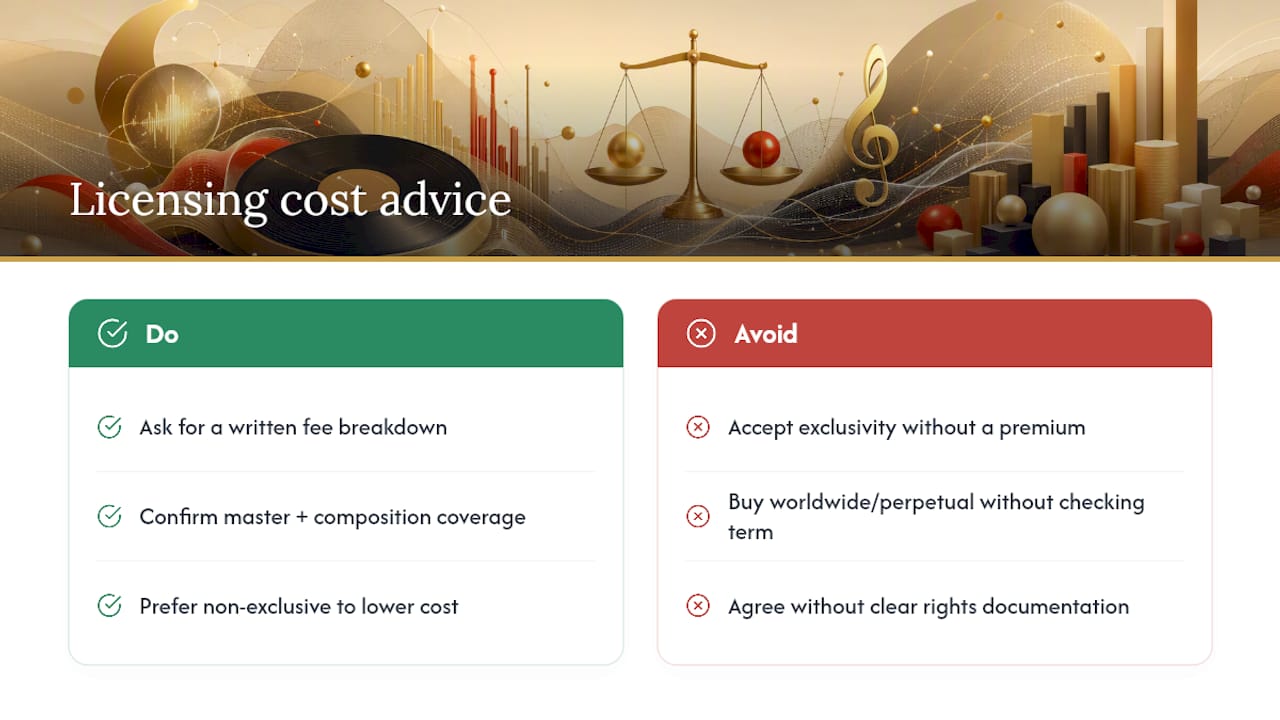
Exclusivity is the single biggest cost driver. An exclusive license, where the buyer locks out other potential licensees for a period, commands a premium because the rights holder gives up future opportunities on that track. Non-exclusive licenses, common for smaller digital campaigns, cost less precisely because the same track can be licensed elsewhere simultaneously.
Territory works the same way. A single-market license (say, just the United States) costs less than worldwide rights, and term length compounds the fee further: a one-year license runs cheaper than a perpetual buyout. Brands and supervisors should also confirm whether the fee covers both the master recording and the underlying composition, since some catalogs split these rights between different holders, which can double the negotiation.
Before agreeing to any number, ask for a written breakdown of what the fee actually covers: which media, which territory, how long, and whether any renewal or extension is priced upfront. A track that fits perfectly but comes without clear rights documentation isn’t worth the risk, no matter how good the mood match feels.
Why We Make Liquid Soul, and How We Think About Licensing
We built DRVVYN around the belief that R&B doesn’t need to shout to move someone. Cinematic alternative R&B suits branded media precisely because it trusts the visual to carry half the emotional weight, leaving the other half to a voice that sounds like it’s confiding in you.
Our catalog, including several “Naked Soul” cuts and companion visual pieces, reflects that approach in practice. We move quickly on licensing requests and deliver standardized files without back and forth.
Ready to License or Commission a Liquid Soul Track?
Most licensing routes ask you to dig through generic stock libraries or wait weeks for a boutique agency to get back to you. Drvvynsound skips both problems: you’re working directly with the artist behind the catalog, which means faster answers and a track built specifically for the mood you’re chasing, not pulled from a generic bin.

Every request starts the same way: send us your brief, mood references, tempo, timecode needs, and we respond with a preview mix, available stems, and straightforward license terms. No committee approval, no runaround. Our alternative R&B overview walks through the sound in more depth, and our production style guide is useful if you’re producing your own cut and want a second opinion on arrangement or mix. If you’re ready to move, reach out through Drvvynsound and describe your project. We’ll send a preview and a licensing quote within a few business days.
Frequently Asked Questions
What is liquid soul music, exactly?
Liquid soul music is a smooth, cinematic style of alternative R&B and soul defined by breathy, intimate vocals, warm harmonic textures, and lyrics that lean introspective rather than anthemic.
How do I identify liquid soul music when I hear it?
Listen for slow to mid tempos, Rhodes or piano voicings, sparse guitar, reverb-heavy space, and a vocal that sounds like a private conversation rather than a performance.
Who are some artists associated with the liquid soul sound?
Frank Ocean, Jhené Aiko, SZA, Kehlani, and Steve Lacy helped shape the atmosphere liquid soul draws from, while newer artists like Tinashe and Ravyn Lenae keep stretching the style’s boundaries.
What should I request when licensing a liquid soul track?
Ask for the full mix, instrumental, TV mix, individual stems, and ISRC code, then confirm term, territory, and exclusivity before agreeing on a fee.
Does liquid soul work for brand films and ads?
Yes. Its restrained production and emotionally direct vocals make it well suited for brand films, product spots, and dramatic scenes that need subtext rather than a musical spotlight.
Sources
- Tinashe and Ravyn Lenae lean into the paradox of ‘alt-R&B’ | NPR
- Alternative R&B music style overview | AllMusic
- Soul music | Britannica