

Listening & Culture
What Is Passive Music Listening? A Guide for Enthusiasts
Discover what passive music listening is and how it enhances your environment. Learn to harness music's mood-boosting power today!
By DRVVYN · · 9 min read

Passive music listening is defined as hearing music as ambient background while your attention focuses on something else entirely. You are not analyzing the melody, tracking the chord changes, or following the lyrics. The music simply fills the space around you, shaping your mood and environment without demanding your focus. This form of listening, sometimes called background listening in academic research, is the most common way people experience music daily. Understanding what it is and how it works gives you real control over how music affects your life.
What is passive music listening vs. active listening?
Passive music listening means music plays as backdrop while your attention stays on another task, like working at a computer, driving, cooking, or cleaning. You hear the music, but you are not listening to it the way a musician or critic would. Active listening is the opposite. It involves deliberate, focused attention on musical elements like melody, instrumentation, production technique, and arrangement.

The cognitive effort required separates these two modes sharply. Active listening is a skill. Musicians practice active listening to dissect sound layers, identify production choices, and understand how a track is built. Passive listening requires far less mental energy. It serves an ambient purpose rather than an analytical one.
Pro Tip:If you want to shift from passive to active listening, pick one element to track per song, like the bass line or the drum pattern. You will hear the same track in a completely new way.
The table below shows the core differences at a glance.
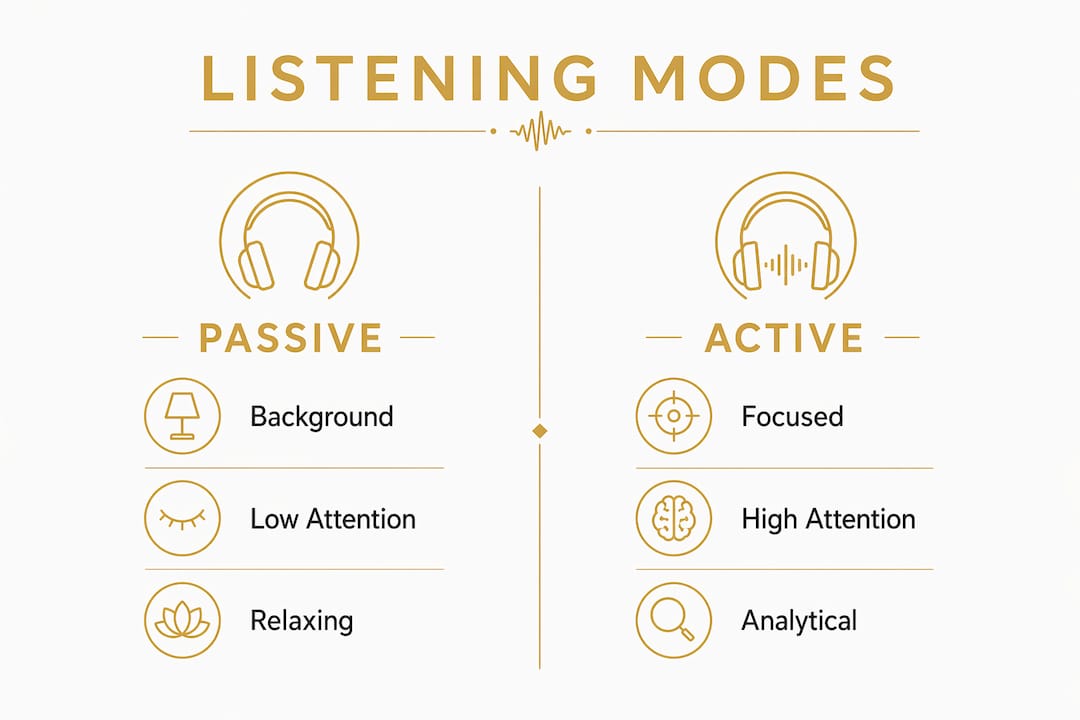
| Feature | Passive listening | Active listening |
|---|---|---|
| Attention level | Low, background focus | High, deliberate focus |
| Cognitive effort | Minimal | Significant |
| Primary purpose | Mood, atmosphere, ambiance | Analysis, appreciation, learning |
| Typical context | Working, driving, socializing | Concert, studio, critical review |
| Musical detail awareness | Low | High |
What are the benefits of passive music listening?
Passive listening shapes your emotional state without you making any conscious effort. That is its quiet power. Music heard in the background improves subjective well-being in adults, with a moderate effect size across listening interventions. The effect is real even when you are not paying close attention to what is playing.
The benefits extend well beyond mood. Research shows passive listening supports:
- Stress reduction. Soft, slow music lowers perceived tension and helps the body settle into a calmer state.
- Sleep improvement. Listening to slow tempo, soft melodic music for 30–45 minutes before sleep reduces how long it takes to fall asleep and improves overall sleep efficiency.
- Relaxation through familiarity.Familiar music reduces prediction errors in the brain, which lowers cognitive alertness and deepens the relaxation response.
- Auditory enrichment in medical settings. In neonatal care, passive listening serves as auditory enrichment during rest, supporting infant development without requiring active engagement.
One finding stands out above the rest. Familiar music relaxes you more effectively than new music. Your brain already knows what comes next, so it stops working to predict the sound. That release of tension is what lets the pressure leave your chest when the right song comes on.
Passive listening also engages auditory neural pathways without the multisensory involvement that active listening requires. This distinction explains why it works in contexts where active participation is impossible, like neonatal care or chronic pain management. That said, passive listening differs from music therapy. Therapy involves interaction and targeted intervention. Passive listening is exposure. Both have value, but they are not interchangeable.
How to get more from passive listening: techniques that work
Most people treat passive listening as an accident. Music plays, and they absorb it without thought. Treating it with even a little intention changes the experience completely.
-
Choose music that matches your goal. Slow tempos between 60 and 80 beats per minute work best for relaxation and sleep. Familiar, instrumentally simple tracks lower cognitive alertness. Upbeat, familiar music lifts mood during routine tasks like cleaning or cooking.
-
Time your sessions deliberately. For sleep, 30–45 minutes of slow, soft music before bed produces measurable improvements in sleep quality. For focus during work, longer sessions of consistent ambient or instrumental music reduce distraction without pulling your attention away from the task.
-
Set the right volume. Music that is too loud forces your brain to process it actively. Keep passive listening at a level where the music blends into the room rather than sitting on top of it.
-
Lean on familiarity. Structured music input, meaning slow tempo, simple melodies, and timed sessions, enhances passive listening effects far more than random playlist shuffling. Choose tracks you already know and trust.
-
Avoid lyrics when you need to concentrate. Vocal tracks pull your language processing centers into the music, even when you are trying to focus on reading or writing. Instrumental music or music in a language you do not speak keeps the auditory benefit without the cognitive interference.
Pro Tip:Build a dedicated passive listening playlist and keep it separate from your active listening queue. Knowing which playlist serves which purpose removes the friction of choosing in the moment.
How passive listening fits into everyday life and music appreciation
Passive listening is already woven into your day, whether you realize it or not. Music in coffee shops, background sound during a commute, a playlist running while you cook dinner. These are all examples of passive music listening in action. The question is not whether you do it. The question is whether you do it well.
Here are the most common and beneficial everyday contexts:
- Working or studying. Ambient, instrumental, or lo-fi music creates a sonic environment that masks distracting noise without competing for your attention.
- Driving. Familiar playlists reduce the mental sharpness of silence on long drives without pulling focus from the road.
- Socializing. Background music at a gathering sets emotional tone and fills conversational pauses without dominating the room.
- Winding down. Slow, soft music in the hour before bed signals to your nervous system that the day is ending.
Balancing passive and active listening makes you a richer music listener overall. When you spend time actively studying a track, you hear details that then register subconsciously during passive listening later. The two modes feed each other. Active listening builds the map. Passive listening lets you live inside it.
The music types best suited to each mode differ meaningfully.
| Listening mode | Best music types | Why it works |
|---|---|---|
| Passive | Ambient, lo-fi, slow R&B, classical | Low cognitive demand, mood shaping |
| Active | Jazz, progressive rock, orchestral | Rewards close attention to detail |
| Both | Soul, acoustic singer-songwriter | Accessible on surface, layered underneath |
Curating a passive listening playlist takes about ten minutes and pays back every day. Start with tracks you already love. Add music at a consistent tempo and energy level. Avoid jarring transitions between loud and soft tracks. Let the playlist breathe.
Key takeaways
Passive music listening is most effective when you treat it as a deliberate practice, not an accident, choosing familiar, slow music and timing your sessions to match your emotional or physical goal.
| Point | Details |
|---|---|
| Definition is specific | Passive listening means music plays as background without focused attention on musical detail. |
| Familiarity drives relaxation | Familiar music reduces brain prediction errors, lowering alertness and deepening calm. |
| Timing and tempo matter | Slow tempo music at 60–80 bpm for 30–45 minutes before sleep measurably improves sleep quality. |
| Passive and active listening complement each other | Active listening builds musical awareness that enriches what you absorb during passive sessions. |
| Context shapes the benefit | Matching music type to your activity, work, sleep, or socializing, maximizes the effect. |
Why passive listening deserves more of your respect
Most music enthusiasts I talk to treat passive listening as the lesser version of the real thing. They feel a little guilty about it, like they are not giving the music its due. I used to feel that way too. Then I started paying attention to what passive listening was actually doing to me.
The track I had playing in the background while I worked was not just filling silence. It was holding a particular emotional temperature in the room. When I switched to something more agitated, my writing got tighter and more anxious. When I put on something slow and familiar, the tension in my shoulders dropped. The music was doing real work, quietly, without asking anything from me.
What changed for me was understanding that passive listening is not lazy listening. It is a different kind of attention. You are not ignoring the music. You are letting it operate below the surface, where it shapes feeling rather than thought. That is a legitimate and powerful way to experience sound.
The mistake most people make is treating passive listening as whatever happens to be on. Choosing your background music with the same care you give your active listening sessions changes everything. You would not set the lighting in a room randomly. Sound deserves the same intention.
If you have never deliberately curated a passive listening environment, start tonight. Put on something familiar, something slow, something that has always made you feel a certain way. Then let it do its work without watching it too closely. You might be surprised by what you feel.
— DRVVYN
Sound built for the moments between moments
Drvvynsound creates music for exactly the kind of listening this article describes. The original R&B and ambient releases from DRVVYN are built around emotional texture, slow tempos, and the kind of familiarity that settles into a room rather than demanding attention from it.

Whether you are winding down after a long day, setting the tone for a late evening, or simply filling your space with something that feels true, the DRVVYN sound catalog gives you music designed to work on both levels. Stream it as background. Return to it actively. It holds up either way.
FAQ
What is passive music listening in simple terms?
Passive music listening is when music plays in the background while your attention focuses on something else. You hear the music but are not analyzing it.
How does passive music affect mood?
Background music shapes emotional state through auditory exposure alone. Familiar, slow music lowers cognitive alertness and promotes calm, while upbeat music can lift energy during routine tasks.
What is the difference between active and passive listening?
Active listening involves focused attention on musical elements like melody, instrumentation, and production. Passive listening uses music as ambient background without detailed focus or analysis.
What are good examples of passive music listening?
Common examples include music playing while you work at a computer, a playlist running during a commute, background sound at a social gathering, or soft music before sleep.
Is passive listening as beneficial as active listening?
Both serve different purposes. Passive listening improves mood, relaxation, and sleep quality. Active listening builds musical understanding and appreciation. Research shows active music therapy produces stronger clinical outcomes, but passive listening delivers real, consistent benefits in everyday life.