

Listening & Culture
Why Love Songs Resonate at Night: The Science Behind It
Discover why love songs resonate at night. Explore how brain chemistry shifts, letting music touch your emotions like never before.
By DRVVYN · · 9 min read

Love songs resonate at night because your brain chemistry shifts after dark in ways that strip away emotional defenses and open you to music’s full weight. Cortisol drops, melatonin rises, and the limbic system takes over from the prefrontal cortex. The result is a mind that feels more than it filters. That’s why a song you barely noticed at noon can press directly on something tender at midnight. Understanding why love songs feel deeper after dark isn’t just interesting. It changes how you listen.
Why love songs resonate at night: what your brain is doing
The neurological answer is direct. At night, reduced cortisol and rising melatonin shift brain activity away from the prefrontal cortex, the region responsible for rational filtering, and toward the limbic system, which governs raw emotion and memory. That shift means music bypasses your usual defenses. A lyric that would register as clever during the day lands like a confession at midnight.
The limbic system doesn’t just process emotion. It connects feeling to memory, to longing, to the specific ache of something unfinished. When a love song reaches you through that system, it doesn’t stay abstract. It attaches to a face, a moment, a version of yourself you thought you’d moved past. That’s the mechanism behind the experience so many listeners describe but rarely understand.
Research by neuroscientist Robert Zatorre confirms that music activates ancient reward circuits linked to survival and social bonding. Those circuits evolved long before language. At night, with rational thought quieted, music speaks directly to them.
- Cortisol reduction lowers emotional resistance, making lyrics feel more personal
- Melatonin increase slows cognitive processing, which deepens reflective listening
- Limbic dominance connects music to memory and identity rather than analysis
- Reduced prefrontal activity means you stop critiquing and start feeling
Pro Tip:If you want a song to land emotionally, listen with headphones after 10 PM. The neurological conditions for deep listening are already in place.
How silence at night reveals what you normally miss
Nighttime listening reveals details that daytime noise buries. Subtle production elements like reverb tail decay, the breath before a vocal phrase, and the warmth of a vinyl crackle become audible when ambient noise drops. Those details aren’t decoration. They carry emotional texture that producers spend hours crafting and most listeners never hear.
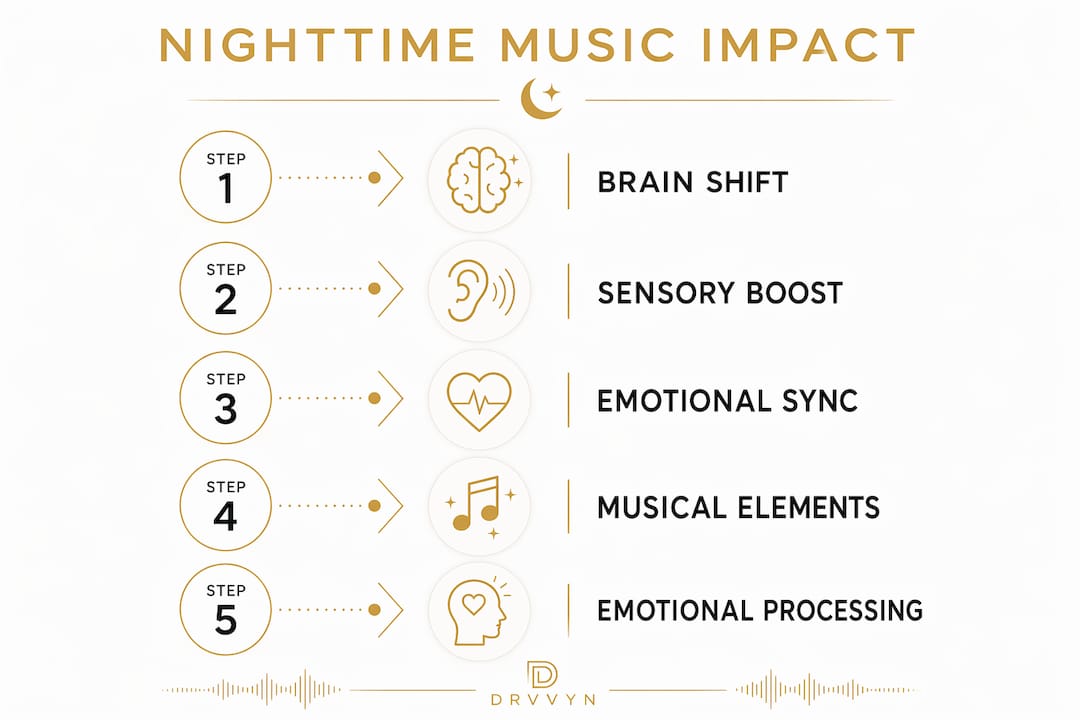
There’s also an evolutionary dimension here. Human auditory sensitivity heightens at night as a survival adaptation. Your ears were designed to catch what moves in the dark. That same sensitivity now catches the tremor in a singer’s voice, the space between notes, the way a chord resolves just slightly slower than expected. You’re not imagining that music sounds richer after midnight. Your hearing is genuinely sharper.
The sensory environment shapes the emotional experience in a concrete way. A love song heard in a quiet room with headphones is a different object than the same song played in a car at noon. The night version has more surface area. You feel more of it.
- Reduce ambient noise. Close windows, turn off background television, and let the room go quiet before you press play.
- Use headphones or quality speakers. The stereo image of a well-produced love song opens up completely when you’re not fighting room noise.
- Listen without a screen. Removing visual input redirects attention to sound and amplifies emotional response.
- Let the song finish. Outro sections and final chord resolutions carry emotional weight that skipping cuts off.
Pro Tip:The reverb tail at the end of a vocal phrase is where a producer hides the feeling. Train yourself to listen past the last word.
What musical elements make love songs hit harder after dark
Not every love song works equally well at night. The ones that cut deepest share specific characteristics. Streaming data confirms that nighttime music consumption trends globally toward quieter, slower, and lower-energy songs. That’s not coincidence. It’s a match between what the brain wants and what those songs deliver.

Tempo is the most direct factor. Songs in the 60–90 BPM range align with resting heart rate and slow breathing, which signals safety to the nervous system. That signal of safety is what allows emotional release. A fast song keeps you alert. A slow one lets you open.
| Characteristic | Daytime listening | Nighttime listening |
|---|---|---|
| Tempo | 100–130 BPM, energizing | 60–90 BPM, settling |
| Dynamics | Compressed, punchy | Wide, breathing |
| Lyric focus | Rhythm and hook | Meaning and narrative |
| Emotional register | Excitement, motivation | Longing, reflection |
| Stereo image | Centered, direct | Wide, immersive |
Beyond tempo, the best nighttime love songs share these qualities:
- Wide stereo image. Instruments placed across the full soundstage create a sense of being surrounded, which feels intimate in a quiet room.
- Minimal compression. Dynamic range lets the song breathe. Loud moments feel louder. Soft moments feel closer.
- Melancholic or nostalgic themes. Lyrics about distance, memory, and longing match the emotional state the brain naturally enters after dark.
- Sparse arrangement. Space in the production gives the listener room to project their own feelings into the music.
How night-time love songs become a tool for emotional processing
Listeners use nighttime music as a private, controlled space for emotional processing. The isolation of night removes social pressure. You don’t have to perform composure. You can let a song mean exactly what it means to you, without explaining it to anyone.
This is where love songs serve a function that goes beyond entertainment. When you project unresolved feelings onto a song’s narrative, you’re doing real emotional work. The song gives your feelings a container. It names what you haven’t been able to say. That process is a recognized form of emotional regulation, not just passive listening.
Nighttime listening also archives emotional states, linking specific songs to specific chapters of your life. A song you played on repeat during a breakup doesn’t just remind you of that time. It returns you to it, with the full sensory and emotional weight intact. That’s why certain songs feel like time travel. The night you first heard them is still inside them.
- Music gives unspoken feelings a narrative structure, making them easier to process
- Nighttime solitude removes the social filter that keeps emotions managed during the day
- Songs become emotional anchors, preserving the texture of specific life moments
- Repeated nighttime listening builds a personal emotional catalog tied to identity
Why do listeners deliberately choose sad love songs at night?
The paradox is real. You feel heavy, and you reach for the song that makes you feel heavier. The reason is biochemical. University of Montreal research shows that sad music triggers beneficial biochemical responses in empathetic listeners, producing comfort hormones even without real tragedy present. Sadness in music doesn’t feel the same as sadness in life. It feels safe.
Dopamine and prolactin both play a role. Dopamine creates the pleasure response tied to musical anticipation and resolution. Prolactin, typically associated with comfort and nurturing, rises in response to emotional music and produces a calming effect. The combination creates what researchers call “pleasurable sadness.” You feel the weight, and the weight feels good.
Nostalgic bittersweetness is the emotional state where loss and warmth exist together. Love songs at night create that state deliberately. The minor chord that aches, the lyric that names what you lost, the melody that still sounds beautiful despite the pain. That combination is not an accident. It’s the whole point.
The line between healthy emotional processing and rumination matters here. Healthy processing uses a song to feel, release, and move through an emotion. Rumination uses it to stay stuck. The difference is usually intention. If you’re listening to feel something and let it pass, that’s processing. If you’re listening to confirm that you’ll always feel this way, that’s a loop worth breaking.
Key Takeaways
Night-time love song listening is a neurologically distinct experience driven by limbic dominance, sensory sharpening, and the biochemical pleasure of safe emotional release.
| Point | Details |
|---|---|
| Brain chemistry shifts at night | Cortisol drops and melatonin rises, moving emotional processing from the prefrontal cortex to the limbic system. |
| Silence amplifies musical detail | Reduced ambient noise reveals production textures like reverb and dynamics that daytime listening buries. |
| Slow tempos match night-time physiology | Songs in the 60–90 BPM range align with resting heart rate and signal safety, enabling emotional release. |
| Music serves as emotional processing | Night-time solitude lets listeners project unresolved feelings onto songs without social pressure. |
| Sad songs produce comfort hormones | Biochemical research shows melancholic music triggers prolactin and dopamine, creating pleasurable emotional release. |
What I’ve learned from listening in the dark
Night-time listening changed how I write music. Not the theory of it. The actual experience of sitting with a song at 1 AM and feeling it reach somewhere that the same song couldn’t touch at 2 PM. That gap between the two experiences is where I started paying attention.
What I’ve found is that the night doesn’t just amplify emotion. It clarifies it. The feelings that stay vague during the day, the ones you push past because there’s always something else to do, those feelings get specific after dark. A song gives them a shape. And once you can feel the shape of something, you can actually work with it.
The listeners who get the most from nighttime music are the ones who treat it as a practice, not just a habit. They choose songs with intention. They let silence exist before pressing play. They don’t skip the parts that sting. That kind of listening is a form of self-honesty that most people only access when the world goes quiet.
My honest suggestion: don’t always reach for comfort. Sometimes the song that unsettles you is the one doing the most work.
— DRVVYN
Music built for the way you listen after dark
Drvvynsound creates music specifically for the emotional register that opens up at night. Every release from DRVVYN is produced with wide stereo imaging, dynamic range, and lyrical themes rooted in love, reflection, and healing. These aren’t background tracks. They’re built to be felt.

If you’ve ever needed a song to hold something you couldn’t say out loud, DRVVYN’s catalog is where to start. The music lives in the space between what happened and what you’re still carrying. Stream it, sit with it, and let it do what nighttime music does best.
FAQ
Why do love songs feel more emotional at night?
At night, cortisol drops and melatonin rises, shifting brain activity toward the limbic system. That shift makes music feel more personal and emotionally direct than it does during the day.
What tempo works best for nighttime love songs?
Songs in the 60–90 BPM range align with resting heart rate and slow breathing, which signals safety to the nervous system and allows emotional release.
Is it healthy to listen to sad love songs at night?
Listening to sad music at night is healthy when it helps you process and release emotion. University of Montreal research confirms that sad music triggers comfort hormones even without real sadness present. The key is feeling through the emotion rather than using music to stay stuck in it.
Why do I notice more detail in songs at night?
Ambient noise drops significantly after dark, revealing subtle production elements like reverb tails, vocal breath, and dynamic shifts. Your auditory sensitivity also heightens at night as a natural adaptation, making those details easier to perceive.
How does nighttime music listening affect memory?
Songs heard at night become strong emotional anchors, linking to specific life chapters and personal identity. That’s why a song from a significant night can return you to that moment with full emotional clarity years later.