

Listening & Culture
What Is Solitary Music Listening and Why It Matters
Discover what solitary music listening is and its benefits. Learn how it enriches your emotions and reduces loneliness through personal music experiences.
By DRVVYN · · 9 min read

Solitary music listening is defined as the act of engaging with music alone, and research confirms it does far more than fill silence. Unlike background noise, solo listening actively triggers social thoughts, vivid mental imagery, and emotional processing that group listening rarely reaches. The Individual and Social Music Listening Scale (ISMUS-LI) validates solitary listening as a psychologically distinct behavior, separate from social listening in both function and emotional impact. University at Buffalo research published in 2025 shows that favorite music reduces loneliness by acting as a social surrogate, filling what researchers call the “social fuel tank.” This is not passive entertainment. It is one of the most personal, psychologically rich experiences available to you.
What is solitary music listening and how does it work as a social surrogate?
Solitary music listening functions as a social surrogate by replacing absent human connection with a felt sense of belonging. Humans carry a biological need to belong. When real social contact is unavailable, the brain actively seeks substitutes to prevent psychological decline. Music steps into that gap in a way that silence cannot.
University at Buffalo researchers identified three specific pathways through which solo listening satisfies social needs:
- Connection to the artist. Listeners feel a personal bond with the musician, as if the song was written for them specifically.
- Immersion in the musical world. The listener enters the emotional and narrative space the music creates, which feels inhabited and alive.
- Reminders of other people. Songs trigger memories of specific relationships, pulling absent people into the present moment.
These three pathways explain why favorite music reduces loneliness more effectively than generic relaxation tracks or silence. Generic music does not carry personal significance, so it cannot activate the same emotional connections. The effect is measurable: self-selected music buffers social threats in ways that unfamiliar music simply does not.
Pro Tip:When you feel isolated, resist the urge to play whatever is trending. Choose a song that already carries meaning for you. That personal history is the mechanism, not the music itself.

Parasocial relationships with artists also play a role here. You may never meet the person whose voice is in your ears, yet the brain registers that connection as socially real. This is not delusion. It is the brain doing exactly what it evolved to do: seek warmth wherever it can find it.
What mental imagery and emotional effects occur during solo listening?
Music does not just accompany your thoughts. It shapes them. 57% of everyday personal music listening episodes involve mental imagery, and that imagery is far more social than what occurs during silence. A study of 600 participants found three times more social interaction themes in mental imagery during music listening compared to silence. That gap is significant. It means music is actively constructing an inner social world for you, even when no one else is in the room.
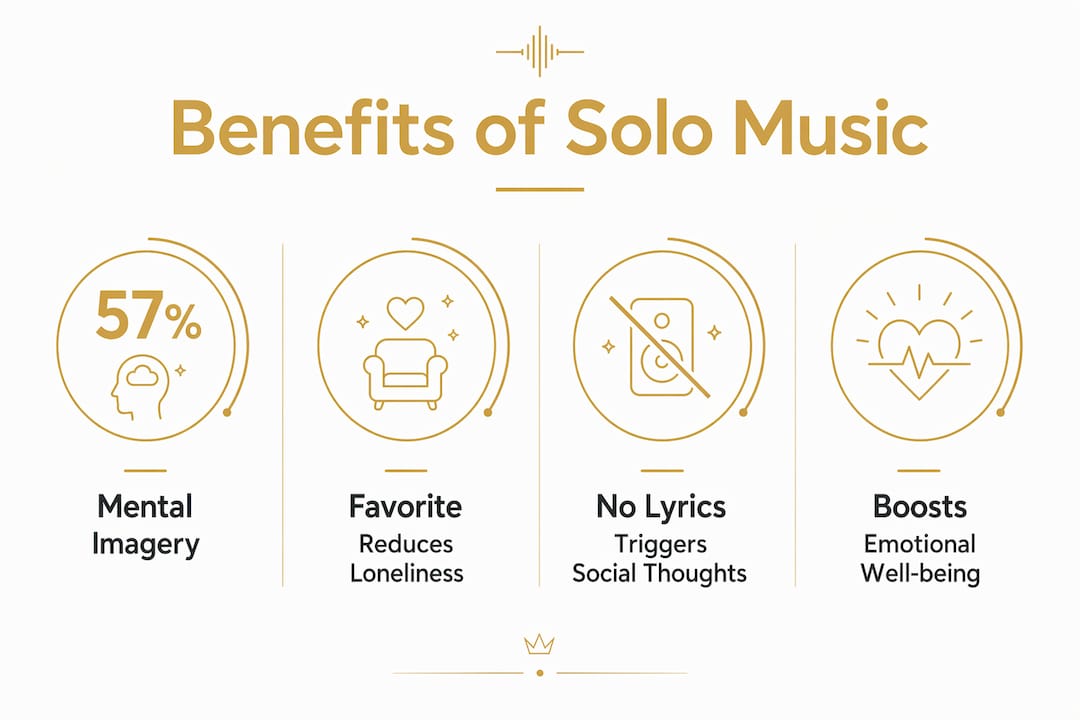
The imagery is often visual, narrative, and culturally shared. When you hear a song tied to a specific cultural moment or emotional archetype, your mind builds a scene. That scene frequently includes other people, relationships, and unresolved feelings. This is why music can make grief feel less sharp or make joy feel wider than it actually is.
Here is what the research shows about the emotional effects of solo listening:
- Happiness amplifies. Upbeat music heard alone produces stronger positive affect than the same music heard in a neutral context.
- Sadness deepens, but safely. Melancholic music allows emotional release without social judgment, which is why people reach for sad songs when they are hurting.
- Social thoughts increase. Music induces thoughts of others even without lyrics or vocals present.
- Emotional tension releases. The arc of a song, building and resolving, mirrors the emotional processing your nervous system needs.
| Effect | What the research shows |
|---|---|
| Mental imagery frequency | 57% of listening episodes involve imagery |
| Social imagery increase | 3x more social themes vs. silence |
| Vocal vs. instrumental | Both trigger similar social cognitive responses |
| Loneliness reduction | Favorite music outperforms generic music and silence |
One of the most striking findings is that songs without vocals still trigger social interaction imagery at similar levels to songs with lyrics. The social effect comes from the music itself, not the words. Your brain does not need language to feel less alone.
How do individual differences shape your solo listening habits?
Not everyone reaches for headphones when they need to process emotion. Some people prefer to talk it out, move through a crowd, or sit in silence. The ISMUS-LI scale confirms that individual listening preference is a distinct psychological trait, validated across studies with 197 and 179 participants respectively. Your preference for solitary versus social listening is not random. It reflects something real about your personality.
The research shows clear personality correlations:
- Extraversion correlates with social listening. Extroverts tend to use music as a shared experience, a soundtrack for connection.
- Neuroticism correlates with individual listening. People higher in neuroticism are more likely to use solitary listening as an emotional regulation tool.
- Openness to experience supports deeper engagement with music in both contexts, but especially in solo settings where reflection is possible.
Understanding your own listening profile matters. If you consistently prefer music alone, that is not social withdrawal. It is a recognized, healthy coping strategy with measurable psychological benefits. The ISMUS-LI brief nine-item version exists precisely to help people recognize and name this preference without pathologizing it.
Pro Tip:Pay attention to when you reach for music. If it is consistently during moments of emotional pressure or loneliness, you are already using solitary listening as a regulation tool. Naming that habit gives you more control over it.
Self-selected music also matters more than most people realize. The emotional and social impact of a song scales with how personally meaningful it is to you. Generic playlists curated by an algorithm carry less psychological weight than the song you chose yourself because it means something.
What practical benefits does solitary music listening offer for well-being?
The benefits of music solitude extend well beyond mood. Clinicians working in cognitive behavioral therapy have begun incorporating music-based imagery techniques, particularly imagery rescripting, into treatment for trauma and anxiety. The vivid, socially rich mental imagery that music produces makes it a natural fit for therapeutic contexts where patients need to reconstruct emotional narratives.
During the COVID-19 lockdowns, solitary music listening increased sharply as people sought company and emotional regulation in isolation. People reported using music specifically for company and relaxation, not just entertainment. That shift revealed something important: solo listening is a sophisticated psychological tool, not a passive habit.
Practical ways to use solitary listening intentionally:
- Set the context deliberately. Choose a quiet space where you will not be interrupted. The quality of attention you bring shapes the depth of the experience.
- Match the music to the emotion you need to process, not the one you want to escape. If you are grieving, a song that mirrors that grief often releases more tension than a forced upbeat track.
- Let the imagery come. Do not fight the mental pictures or memories the music surfaces. That imagery is the mechanism through which music does its emotional work.
- Use favorite music, not trending music. Personal significance is what activates the social surrogate effect and reduces loneliness.
- Reflect after listening. A few minutes of quiet after a meaningful listening session helps consolidate the emotional processing the music began.
Music also builds what researchers describe as a shared “theory of mind” with others who carry the same cultural background. When you listen to a song rooted in a specific cultural moment, you are not alone in that experience even if no one else is in the room. You are connected to everyone who has ever felt what that song captures. That is a quiet but real form of belonging.
Key Takeaways
Solitary music listening is a psychologically distinct, research-backed practice that reduces loneliness, amplifies emotional processing, and generates vivid social imagery, making it one of the most effective tools for personal well-being available to you.
| Point | Details |
|---|---|
| Social surrogate function | Favorite music fills the social fuel tank by connecting you to artists, memories, and imagined others. |
| Mental imagery effect | 57% of solo listening episodes involve mental imagery, with 3x more social themes than silence. |
| Personality and preference | Neuroticism correlates with individual listening; ISMUS-LI confirms it as a healthy, distinct trait. |
| Vocal vs. instrumental | Both trigger social cognitive responses equally, so lyrics are not required for the effect. |
| Intentional practice | Choosing personally meaningful music and setting deliberate context deepens the psychological benefit. |
Why solitary listening deserves more credit than it gets
People assume that listening to music alone is the lesser version of the experience. Put it on at a party, share it with someone you love, and suddenly it feels real. That assumption is wrong, and the research backs me up on that.
What I have found, both personally and through the music I create under DRVVYN, is that the most honest listening happens alone. There is no performance in it. You are not managing how you look while the song plays. You are just inside it. That is where the pressure leaves your chest. That is where the silence between the notes stops feeling sharp and starts feeling like space.
The social brain research confirms what I have always felt intuitively: music switches something on in you that ordinary quiet cannot. It does not replace people. It reminds you that connection is something you carry inside yourself, not something that only exists when someone else is in the room.
Solitary listening is not antisocial. It is one of the most social things you can do alone. Give it the respect it deserves.
— DRVVYN
Music built for the moments you need it most
If you have ever felt the weight lift during a song you chose just for yourself, you already understand what Drvvynsound is built around.

DRVVYN creates R&B music and immersive audio experiences designed for exactly the kind of listening this article describes: personal, emotional, and real. The themes running through every release, love, reflection, healing, and growth, are the same ones that surface when you sit alone with a song that actually means something. When you are ready for music that meets you where you are, explore Drvvynsound and find what fits your moment.
FAQ
What is solitary music listening?
Solitary music listening is the act of engaging with music alone, which research shows actively triggers social thoughts, mental imagery, and emotional processing distinct from group listening or silence.
Is listening to music alone better for emotional processing?
Solo listening allows deeper emotional engagement because there is no social performance involved. Research shows it amplifies both happiness and sadness more intensely than listening in a group context.
Why does favorite music reduce loneliness better than random music?
Self-selected music carries personal significance that activates the brain’s social surrogate response. Generic music lacks that personal history, so it cannot trigger the same sense of connection.
Does music need lyrics to trigger social thoughts?
No. Studies show that instrumental songs and foreign-language tracks trigger social imagery at similar levels to songs with familiar lyrics, meaning the music itself drives the effect.
What is the ISMUS-LI scale?
The ISMUS-LI is a validated psychological tool that measures individual versus social music listening preferences. It confirms that preferring to listen alone is a distinct, healthy personality trait, not a sign of social withdrawal.