

Listening & Culture
Explore Music for Night Commutes: Your 2026 Guide
Transform your drive home: explore music for night commutes that calms and rejuvenates, enhancing your evening journey with soothing soundscapes.
By DRVVYN · · 10 min read
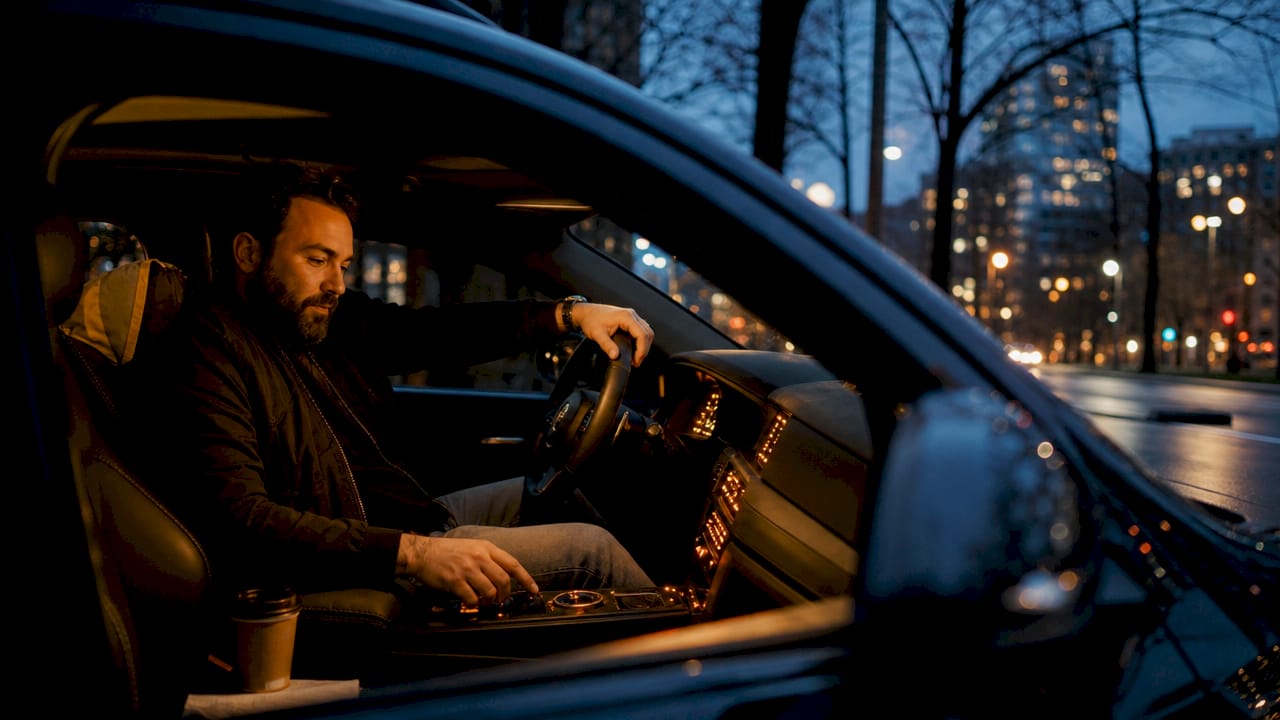
The right music for night commutes is defined as ambient, downtempo, and atmospheric sound that lowers tension, slows your nervous system, and turns the drive home into something you actually look forward to. Most commuters treat music as background noise. The ones who treat it as a tool arrive home calmer, clearer, and less worn down. Drvvynsound builds exactly this kind of music, rooted in emotional storytelling and cinematic atmosphere. Research from 2026 confirms that water-themed soundscapes and slow instrumental music effectively lower tension during nighttime journeys. The difference between a stressful drive and a restorative one often comes down to what is playing.
What music characteristics create an ideal night commute playlist?
The best songs for evening commutes share three qualities: controlled tempo, atmospheric production, and minimal lyrical density. These are not accidents of taste. They are the features that keep your mind engaged without pulling it into overdrive.
Tempo and genre
Matching music tempo in the 120–140 bpm range to your physical movement helps induce a flow state and reduce stress. That range feels like forward motion without urgency. Genres that consistently hit this sweet spot include synth-pop, chill R&B, dream pop, and downtempo electronic. These genres share luminous synths and smooth percussion, which are the sonic ingredients that make night driving feel cinematic rather than exhausting.

Production qualities that matter
Spacious mixes work better than dense ones after dark. When a track breathes, your mind breathes with it. Minimal lyrics reduce cognitive load because your brain does not have to process language while also watching the road. Low-end warmth, reverb-heavy pads, and slow-attack percussion all signal safety to your nervous system. Think of it as the musical equivalent of dimming the lights in a room.
The Water element soundscape
The concept of “Water element” soundscapes comes from art therapy frameworks and refers to music with fluid, unhurried movement and no sharp sonic edges. Water-themed ambient music is specifically recommended for commuters under pressure because it creates a calming atmosphere without forcing stillness. It does not demand your attention. It holds it gently.
- Synth-pop and dream pop: luminous textures, smooth transitions
- Chill R&B: emotional warmth, moderate tempo, minimal percussion clutter
- Downtempo electronic: slow builds, atmospheric pads, low lyrical density
- Ambient instrumental: no lyrics, pure texture, maximum mental space
Pro Tip:Build your night commute playlist around tracks with long intros. Songs that take 30 seconds to fully open give your mind time to settle before the melody arrives.
How do you build a night commute playlist that flows?
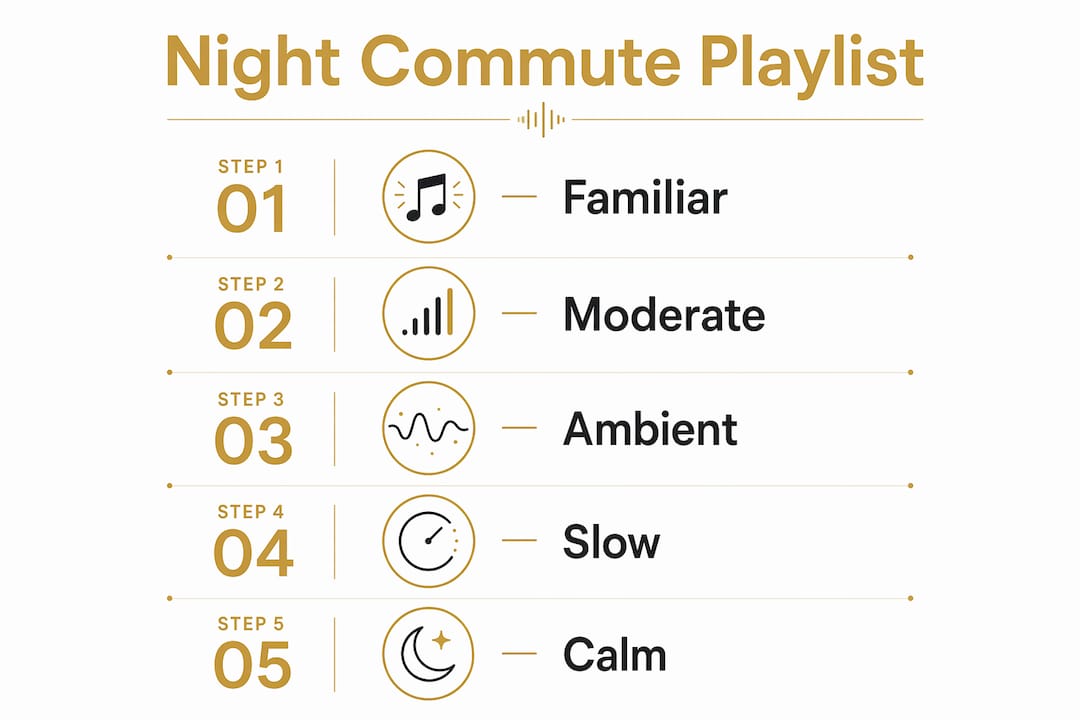
Sequencing is the most overlooked skill in playlist building. A random collection of good songs does not create a good listening experience. Intentional flow and atmosphere build a better mood than shuffled favorites.
The four-step sequencing method
- Open with familiarity. Choose a song you know well. Familiar music reduces cognitive load immediately and signals to your brain that it is safe to relax. Avoid starting with something new or sonically complex.
- Set the emotional temperature. Your second and third tracks establish the mood for the full commute. If you want calm, these songs should already be calm, not building toward it. Choose tracks with steady rhythm and no dramatic drops.
- Hold the middle with momentum. The middle of your playlist should feel like a slow river. Tracks here maintain energy without spiking it. Avoid jarring tempo changes or comedic tracks that break the atmosphere.
- Signal arrival with a quiet close. The final two songs should be your softest. This gradual wind-down tells your nervous system the commute is ending. You step out of the car already decompressed.
Pro Tip:Test every playlist on an actual drive before committing to it. The road acts as the ultimate editor. Songs that felt right at home sometimes feel intrusive in the dark.
Playlist structure at a glance
| Playlist position | Mood target | Song quality |
|---|---|---|
| Track 1 | Familiar, grounding | Known song, moderate tempo |
| Tracks 2–3 | Emotional temperature set | Calm, steady, no sharp drops |
| Tracks 4–8 | Steady flow | Atmospheric, minimal lyrics |
| Tracks 9–10 | Wind-down | Softest tracks, slow tempo |
Avoid songs with sudden volume spikes, aggressive drops, or comedy content. These break the cinematic thread you are building. Cohesive playlist flow creates a better mood than any single great song can on its own.
How do you match music to your mood during a night commute?
Personalized commute playlists are more effective when tailored to your current emotional state. A one-size-fits-all playlist is less effective than one built around how you actually feel when you get in the car.
Reading your emotional state before you press play
Some nights you leave work carrying tension that sits in your chest like a stone. Other nights you feel numb, suspended somewhere between tired and fine. The music that serves you in each state is different. Forcing slow, quiet music onto a mind that is still running hot does not calm you. It creates friction.
Loud or high-energy music used to mask stress can paradoxically increase anxiety during a commute. The research is clear on this. Starting with music that matches your current energy, then transitioning gradually toward calm, is the method that actually works.
The five-element framework for emotional alignment
Art therapy practitioners use a five-element framework, Water, Wood, Fire, Earth, and Metal, to match sound to emotional state. For night commutes, Water and Earth elements are most relevant.
- Water: Fluid, ambient, unhurried. Best for anxiety, overstimulation, or emotional numbness. Lets pressure leave your chest without demanding anything.
- Earth: Warm, grounded, rhythmic. Best for sadness or disconnection. Provides a sense of stability without being heavy.
- Wood: Upward, energetic, hopeful. Use sparingly at night, only if you feel flat and need a gentle lift.
- Fire: Intense, passionate, high-energy. Avoid during evening commutes unless you are genuinely celebrating something.
- Metal: Precise, structured, minimal. Useful for mental clarity but can feel cold if you are already emotionally depleted.
The goal is not to force yourself into calm. The goal is to meet yourself where you are, then let the music walk you somewhere better.
Practitioners recommend building separate playlists for morning energy and evening calming. Different emotional goals require specifically curated collections. One playlist cannot carry both directions.
What tools and habits make night commute listening effortless?
Decision fatigue is real, and it hits hardest at the end of a long day. The commuter who has to scroll through songs at a red light is already losing the benefit music could provide.
Build your playlist before you need it
Curating your playlist the night before and using a brief grounding breath before pressing play transforms a passive habit into a mindfulness ritual. Prepare two or three playlists in advance, one for high-stress nights, one for neutral evenings, and one for nights when you need a quiet, almost silent atmosphere. Label them clearly so you can choose in seconds.
Habits that protect the experience
Choose familiar songs over new discoveries for your commute playlist. New music demands active listening. Familiar music allows passive absorption, which is exactly what you want when you are driving in the dark. Save new releases for intentional listening sessions at home.
Use your phone’s playlist scheduling feature if available, or set a specific playlist as your default for evening hours. The fewer decisions you make in the car, the more the music can do its work.
Pro Tip:Before you start the car, take three slow breaths. Then press play. This small ritual separates the workday from the commute and lets the music land differently.
Common mistakes that undercut the experience
| Mistake | Why it backfires | Better approach |
|---|---|---|
| Playing high-energy music to push through fatigue | Increases cortisol and extends stress response | Match music to current mood, then ease down |
| Shuffling a random playlist | Breaks atmospheric flow with jarring transitions | Sequence tracks intentionally |
| Discovering new music while driving | Demands active attention, increases distraction | Save new music for home listening |
| Skipping tracks repeatedly | Signals restlessness, prevents settling | Pre-test playlists so you trust the sequence |
Key takeaways
The most effective evening drive soundtrack is built around tempo, emotional alignment, and intentional sequencing, not just genre preference.
| Point | Details |
|---|---|
| Tempo shapes your state | Tracks in the 120–140 bpm range induce flow and reduce commute stress. |
| Sequencing beats song selection | Intentional playlist order creates calm more reliably than any single great track. |
| Match music to your mood | Start where you are emotionally, then let the playlist walk you toward calm. |
| Prepare playlists in advance | Building your playlist before the commute removes decision fatigue when you need relief most. |
| Test on real drives | Songs that feel right at home may feel intrusive on the road at night. |
What I have learned from years of driving with intention
The first time I built a playlist specifically for a night drive, I did not think much of it. I just pulled together songs that felt quiet and let it run. What surprised me was how different the drive felt. The silence between songs stopped feeling empty. The city lights outside the window started to look like something worth watching instead of something to get past.
What I have come to understand is that the music you choose after dark is not really about entertainment. It is about permission. Permission to decompress. Permission to stop processing the day and just exist in the motion of the car. The right track at the right moment does not just fill the silence. It switches something off inside you, the part that is still at work, still running the list, still bracing for what comes next.
The mistake most people make is treating their commute playlist like a general favorites list. It is not. Your night commute needs its own collection, built for that specific hour, that specific quality of light, that specific weight you carry home. When you get that right, the commute stops being lost time. It becomes the best part of the transition between who you are at work and who you get to be at home.
Experiment with it. Try a Water element playlist for one week. Notice what changes. The road will tell you what works.
— DRVVYN
Drvvynsound: music built for the drive home
Drvvynsound creates original R&B and atmospheric music designed for exactly the moments this article describes. The music sits at the intersection of emotional storytelling and cinematic sound, which makes it a natural fit for late-night listening.
Every release from Drvvynsound is built around themes of reflection, healing, and personal growth. These are not incidental qualities. They are the reason the music works so well as a night commute soundtrack. The tempos are deliberate. The production breathes. The lyrics, when present, do not demand your full attention. They hold space instead. You can find curated playlists from Drvvynsound ready to play the next time you need the drive home to feel like something other than lost time.
FAQ
What tempo is best for a night commute playlist?
Tracks in the 120–140 bpm range are best for evening commutes. This tempo range matches physical movement and helps induce a flow state without increasing alertness.
Can calming music actually make anxiety worse?
Yes. Forcing slow music onto a stressed mind can increase anxiety rather than reduce it. Start with music that matches your current energy level, then gradually shift toward calmer tracks.
How many songs should a night commute playlist have?
A playlist for a 30-minute commute needs roughly 8–10 songs. Sequence them from familiar and moderate to soft and slow, ending with your quietest tracks as you near home.
What genres work best for chill music for late night driving?
Synth-pop, chill R&B, dream pop, and downtempo electronic are the most effective genres. They share smooth percussion, atmospheric production, and low lyrical density, all of which reduce cognitive load while driving.
Should I use the same playlist every night?
No. Build two or three playlists for different emotional states. A high-stress night and a neutral evening call for different music. Matching the playlist to your actual mood produces better results than using one fixed collection.