

Listening & Culture
Music Triggers Memories: The Science Behind the Feeling
Music Triggers Memories: The Science Behind the Feeling
! Person with vintage headphones listening thoughtfully
Music triggers memories because it simultaneously activates your auditory cortex, hippocampus, limbic system, and reward circuits, binding a song to the people, places, and feelings present when you first heard it.
By DRVVYN · · 15 min read

Music Triggers Memories: The Science Behind the Feeling

Music triggers memories because it simultaneously activates your auditory cortex, hippocampus, limbic system, and reward circuits, binding a song to the people, places, and feelings present when you first heard it. That binding is durable. A single familiar track can pull a complete emotional scene back into focus decades later, sharp and immediate, as if the distance between then and now simply collapses.
Research published in PMC by the NIH confirms that emotion enhances musical memory processes and that music activates the limbic and distributed networks involved in both encoding and retrieval. Familiarity accelerates that process further: a PLOS One study found that high-familiarity music evokes more memories and retrieves them faster than unfamiliar tracks.
The sections ahead unpack the brain mechanisms, the role of emotion, how specific musical features predict the kind of memory that surfaces, and how all of this translates into therapeutic and everyday use.
Key Takeaways
Music triggers memories because it binds sound, emotion, and context into a single durable retrieval cue, one that activates distributed brain networks and resurfaces complete emotional scenes with remarkable precision.
| Point | Details |
|---|---|
| Distributed brain activation | Music simultaneously engages the auditory cortex, hippocampus, amygdala, and dopamine pathways, creating multi-system memory traces. |
| Emotion as the encoding amplifier | Emotional responses to music are often automatic and strengthen memory consolidation even without deliberate focus. |
| Familiarity drives retrieval speed | High-familiarity songs evoke more memories and retrieve them faster; in roughly 79% of trials, the song was present at original encoding. |
| Musical features predict memory tone | Low-energetic, high-acoustic songs link to calm and intimate memories; high-energetic, low-acoustic songs link to excitement and social recall. |
| Drvvynsound applies this intentionally | DRVVYN’s production uses dynamic contrast, timbral focus, and lyrical specificity to create the emotional cues that make music memorable. |
Table of Contents
- Why music triggers memories: the brain systems involved
- How emotion turns a song into a memory you can’t forget
- How familiarity and musical features predict which memories surface
- How music reshapes the way you experience and remember time
- Where this research leads: dementia, therapy, and daily life
- How to use music to trigger or preserve memories
- Common myths about music and memory, addressed
- How music creators design emotional cues intentionally
- Does age or musical training change how music triggers memories?
- Why this matters to the work we do at Drvvynsound
- Drvvynsound and the music that stays with you
- Sources
Why music triggers memories: the brain systems involved
Music does not travel a single neural highway. It spreads. UCLA Health’s summary of neuroimaging evidence shows that music engages auditory, emotion, motor, and memory circuits simultaneously, which is why it can reach parts of the brain that speech often cannot.
Here is what that distributed activation looks like in practice:
- Auditory cortex processes pitch, timbre, and melody, the raw texture of sound.
- Hippocampus encodes and retrieves episodic memories, placing the song in time and context.
- Amygdala tags the emotional weight of the experience, making it feel significant.
- Prefrontal cortex links the sound to meaning, narrative, and personal identity.
- Dopamine pathways release reward signals during pleasurable musical moments, reinforcing the memory trace.
Motor regions also engage, especially with rhythmic music. That cross-modal activation, sound plus movement plus imagery, strengthens encoding at the moment of experience. When you danced to a song at a specific party, your motor system was part of the memory being formed.
“Music engages broader, more diverse neural networks simultaneously — auditory, emotion, motor, and memory circuits — explaining why music can reach parts of the brain that speech may not.”
— UCLA Health
One of the more striking findings from neuroimaging work is how music contrasts with speech processing. Speech tends to activate left-hemisphere language regions in a relatively focused pattern. Music, particularly melodic and rhythmic music, recruits bilateral networks and pulls in motor and limbic areas that speech largely bypasses. That broader footprint is part of why musical memory can remain accessible even when language-based recall has deteriorated, a fact with profound implications for dementia care.
How emotion turns a song into a memory you can’t forget
Emotion is not decoration on top of memory. It is part of the architecture. When something feels significant, the amygdala signals the hippocampus to consolidate that experience more deeply. Music is one of the most reliable triggers for that signal.
The NIH/PMC review on music, memory, and emotion found that even when participants were not deliberately focusing on their emotional state during encoding, emotions induced by music still influenced later recognition performance. The emotional response was automatic, not effortful, and it shaped what was remembered.
“Because emotions enhance memory processes and music evokes strong emotions, music can become involved in forming memories about events and strengthen autobiographical recall.”
— PMC / NIH Review
Music-evoked autobiographical memories, often called MEAMs in the research literature, tend to be disproportionately positive. Durham University’s research summary highlights music’s mood-repair effect: music evokes more positive recollections than most other emotional cues, even when the song itself carries a melancholy tone. That asymmetry matters for therapy and for everyday listening.
Mood congruence plays a role too. When you are in a particular emotional state, songs that match that state tend to surface memories encoded in a similar mood. But the relationship is not rigid. Music can pull you toward a memory that reframes how you feel right now, which is part of its quiet power.
Pro Tip:When you want to access a specific memory, try pairing the music you associate with that period with a low-demand activity like a slow walk or light chores. MEAMs surface most readily when your attention is relaxed, not forced.
How familiarity and musical features predict which memories surface
Not every song carries the same retrieval force. Familiarity is the single strongest predictor of whether a piece of music will evoke an autobiographical memory at all.
A PMC study on musical cue features found that in a large majority of memory trials involving high-familiarity songs, participants reported the song had actually been present at the original encoding of the event. The song was not just associated with the memory; it was there. That co-presence at encoding creates a retrieval cue with almost no friction.
Liking independently strengthens that effect. Songs you love tend to be songs you have heard repeatedly, in emotionally charged contexts, which deepens the cue-target association over time.
Beyond familiarity, the acoustic and energetic profile of a song shapes the emotional character of the memory it pulls forward. The PLOS One study mapped these relationships directly:
| Musical Feature Profile | Typical Memory Qualities |
|---|---|
| Low energeticness, high acousticness | Calmness, romance, sadness, intimacy |
| High energeticness, low acousticness | Amusement, excitement, social energy |
| High familiarity (any profile) | Faster retrieval, greater positivity, stronger arousal |
| Low familiarity | Fewer memories, slower or no retrieval |
A slow acoustic ballad does not just feel different from a high-tempo club track. It tends to pull different kinds of memories, from different emotional registers of your life. That is not a coincidence. It reflects how your brain filed those experiences in the first place.
- Songs heard during calm, intimate moments encode alongside low-arousal emotional states.
- Songs heard during high-energy social events encode with excitement and social context.
- Incidental exposure, hearing a song repeatedly in the background of a specific period, builds association strength even without deliberate attention.
How music reshapes the way you experience and remember time
One of the less obvious ways music and memory connect is through temporal structure. Music does not just accompany experiences; it organizes them. Emotional shifts within a piece of music act as event boundaries, the mental markers your brain uses to separate one episode from the next.
A UCLA and Columbia University study found that dynamic emotional changes in music create these boundaries and directly affect how experiences are sequenced and recalled later. When the emotional tone of a piece shifts, your brain treats what came before and after as distinct episodes.
“Composers can intentionally create emotional dynamics that act as ‘event boundaries’ — a potential tool in therapies focused on memory restructuring.”
— University of California News
The direction of that emotional shift matters. A shift toward a more positive emotional state tends to integrate adjacent experiences, making them feel like part of the same moment. A shift toward a more negative state tends to separate them, creating a sharper boundary. Think about a song that builds from quiet tension to a soaring release. The memories formed during that arc often feel unified, held together by the emotional shape of the music itself.
This is why a single song can feel like it contains an entire evening. The music was not just playing in the background. It was structuring how your brain chunked and stored the experience.
Where this research leads: dementia, therapy, and daily life
The most moving applications of the music and memory connection are clinical. The Music and Memory Foundation, whose work was documented in the film Alive Inside, has shown repeatedly that personalized playlists can reconnect people with dementia to autobiographical memories and improve mood and engagement in care settings. People who had been largely unresponsive would light up, sing along, and speak about specific memories when they heard songs from their own history.
UCLA Health’s clinical summary explains why: musical memory circuits are often spared in neurodegeneration even when other recall routes, speech, facial recognition, and semantic memory, have deteriorated. Music can access what other cues cannot reach.
“Music’s distributed brain activation explains why musical cues can access memories even when other recall routes fail — relevant in dementia and stroke recovery.”
— UCLA Health
Harvard Health’s review reports that music-based interventions can improve mood and cognitive test scores in older adults. Observational data also suggest that frequent music listening correlates with lower dementia risk, though Harvard is careful to note that observational studies cannot establish causation.
A few important considerations for clinical and caregiving contexts:
- Individualization matters. A song that comforts one person may distress another. Personalized selection, ideally informed by family history, is more effective than generic playlists.
- Monitor emotional responses. Some songs carry grief or trauma alongside joy. Watch for signs of distress and be prepared to shift the selection.
- Professional oversight adds safety. In formal therapeutic settings, a trained music therapist can calibrate the approach, manage difficult emotional responses, and integrate music into a broader care plan.
Music can also bypass damaged language circuits after stroke. Because singing and melodic memory rely more on right-hemisphere and distributed networks, music-based speech rehabilitation, such as melodic intonation therapy, has shown meaningful results in patients who struggle with conventional language therapy.
How to use music to trigger or preserve memories
Whether you are building a personal archive of emotional moments or supporting someone in a care setting, the process of creating an effective memory-trigger playlist follows a consistent logic.
- Start with high-familiarity tracks. Choose songs the person heard repeatedly during the period you want to evoke, not just songs they like in general. Co-presence at encoding is what creates the strongest retrieval cue.
- Match the emotional tone. Use the feature-to-memory mapping: low-energy acoustic tracks for calm or intimate memories, higher-energy tracks for social or celebratory ones. Mismatched energy can create friction rather than flow.
- Layer in contextual anchors. Pair the music with other sensory cues from the same period if possible: a photograph, a familiar scent, or even a specific time of day. Multi-sensory encoding deepens the retrieval pathway.
- Sequence with intention. Arrange tracks so emotional shifts are gradual rather than jarring. Abrupt tonal changes create event boundaries that can interrupt the memory flow rather than sustain it.
- Test and observe. Play one or two songs first and watch the response before committing to a full session. Adjust based on what surfaces.
Pro Tip:For caregivers, keep a short log of which songs produced positive engagement and which prompted distress. Over time, that record becomes a precise emotional map of the person’s musical history, far more useful than any generic “oldies” playlist.
Cultural and individual differences shape all of this. Musical associations are not universal. A song that carries deep meaning in one cultural context may be neutral or even dissonant in another. Avoid assumptions about what “should” evoke memories based on era or genre alone. Ask, listen, and adjust.
Common myths about music and memory, addressed
Myth: Music can trigger memories from past lives.
There is no scientific support for this claim. MEAMs are autobiographical, tied to experiences encoded within your own lifetime. When a piece of music feels inexplicably familiar or emotionally charged without a clear personal memory attached, the more likely explanation is prior exposure you do not consciously recall, a phenomenon called cryptomnesia, or a strong match between the music’s emotional profile and your current state.
Myth: Sad music always evokes sad memories.
The relationship between a song’s emotional valence and the memories it triggers is more complex. Durham University’s research highlights that MEAMs tend toward positivity even when the triggering song is melancholy. Mood-repair is a genuine effect: people often use sad music to access bittersweet memories that ultimately feel comforting rather than painful.
Myth: Music-triggered memories are accurate recordings of the past.
Memory is reconstructive, not reproductive. When music pulls a memory forward, the emotional intensity of the recall can feel like proof of accuracy. It is not. Strong emotional recall can actually increase the confidence of a memory without increasing its accuracy. The feeling of vividness is real; the fidelity of the details is not guaranteed.
How music creators design emotional cues intentionally
From a production standpoint, the science of why music triggers memories is not abstract. It is a set of tools.
At Drvvynsound, the approach to crafting emotionally resonant music draws directly on these mechanisms:
- Dynamic contrast creates the emotional shifts that the UCLA/Columbia research identified as event boundaries. A quiet verse that opens into a full arrangement does not just sound dramatic; it signals to the listener’s brain that something significant is happening, which deepens encoding.
- Timbral focus shapes the emotional register of a memory. Warm, close-miked vocals and sparse acoustic instrumentation activate the low-energy/high-acoustic profile associated with intimacy and calm. Layered production with rhythmic drive activates the high-energy profile linked to excitement and social memory.
- Lyrical hooks tied to specific scenes give the listener a narrative anchor. When a lyric names a feeling or a moment precisely, it gives the hippocampus something concrete to bind the sound to.
- Familiarity through repetition is built into arrangement structure. Recurring melodic motifs and consistent sonic signatures across a body of work create the familiarity that accelerates retrieval. Listeners who return to an artist’s catalog over time build deeper cue-target associations with each listen.
Testing emotional impact is part of the process too. Sharing early mixes with listeners and tracking which moments produce the strongest responses, the held breath, the involuntary memory, the comment “this reminds me of…”—that feedback loop is how you calibrate the emotional architecture of a song before it reaches the world.
Does age or musical training change how music triggers memories?
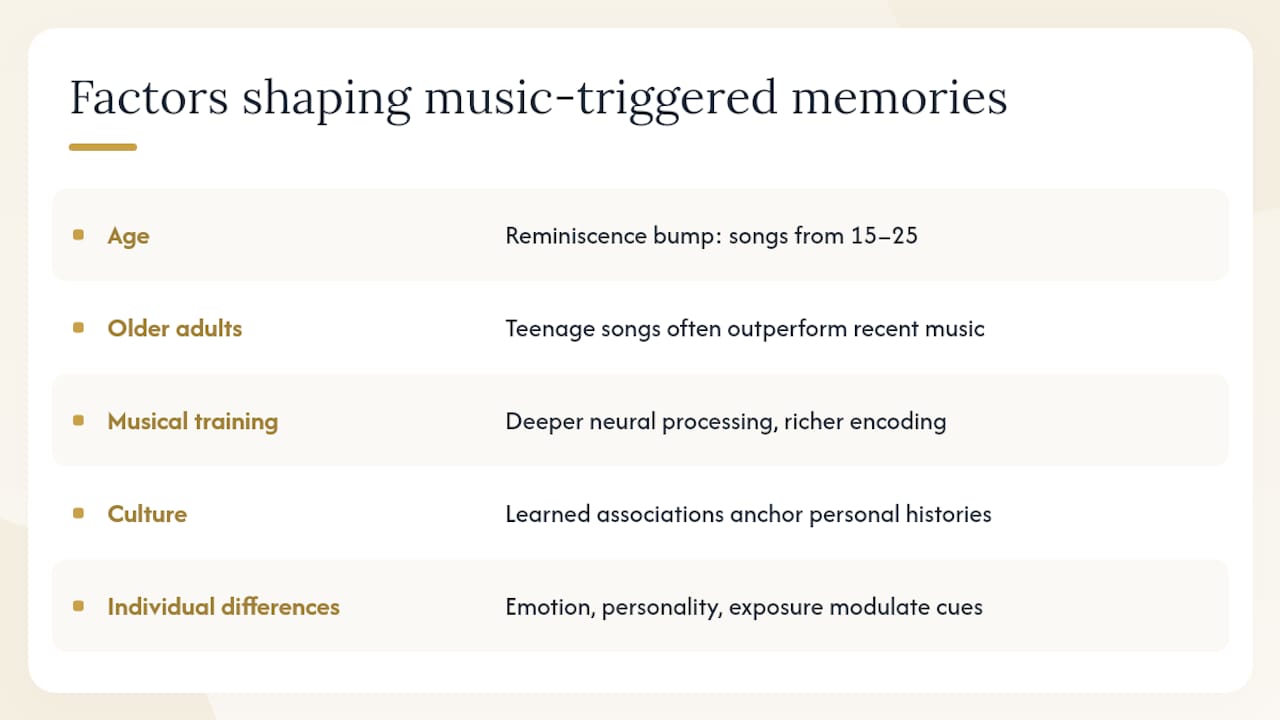
Age shapes the music and memory connection in a specific, well-documented way. The reminiscence bump, the tendency for memories from adolescence and early adulthood to be disproportionately vivid and accessible, means that songs from roughly ages 15 to 25 carry unusual retrieval force throughout life. Durham University’s research attributes this to the density of emotionally significant first experiences during that period: first relationships, first independence, first encounters with music as a personal identity marker.
For older adults, this means that music from their teenage years often outperforms more recent music as a memory cue, even if they have listened to newer music far more recently. The emotional charge of those early encodings is simply higher.
Musical training adds another layer. Trained musicians tend to process music with greater engagement across more neural regions, including stronger motor and structural analysis networks. That deeper processing can create richer encoding at the time of experience, which may produce more detailed and accessible memories later. It also means trained listeners are more sensitive to the structural features, the dynamic shifts, the timbral changes, that the research identifies as memory-shaping mechanisms.
Cultural background shapes which songs carry personal weight. Musical associations are learned within specific social and cultural contexts. The partner resource at PTT Music explores how cultural uses of music anchor personal histories across different communities, a reminder that no single playlist template works across all listeners. Individual differences in emotional sensitivity, personality, and prior exposure all modulate how strongly any given song pulls a memory forward.
Why this matters to the work we do at Drvvynsound
Every song Drvvynsound releases is built around the belief that music is not just something you hear. It is something you live inside, briefly, and then carry with you. The research on MEAMs, on emotional boundaries, on the way familiar sounds unlock scenes from years ago, that is not background reading. It is the reason the arrangements are shaped the way they are, the reason the lyrics reach for specificity over abstraction, the reason the sonic palette is chosen to match the emotional register of the memory we want to help you hold.
If you are curious about how that intention sounds in practice, the DRVVYN Essentials playlist is a good place to start.
Drvvynsound and the music that stays with you

The science is clear: the songs that stay with you are the ones that were present during moments that mattered, shaped with the emotional dynamics and acoustic textures that your brain uses to build durable memories. Drvvynsound creates music with exactly that in mind. Original alternative R&B built for emotional depth, cinematic production that gives each track a distinct sensory signature, and a catalog designed to grow more familiar, and more resonant, with every listen.
Whether you are looking for music that helps you process something tender, celebrate something real, or simply sit inside a feeling for a while, the DRVVYN Essentials collection is where that experience begins. Stream it, save it, and let it find its place in your story.
Sources
- Musical features predict memory quality: low-energetic, high-acoustic songs are more strongly linked to memories of calmness, romance, and sadness…
- Music, memory and emotion – PMC – PubMed Central – NIH
- The connection between music and memory | UCLA Health
- Why emotions stirred by music create such powerful memories
- Music can boost memory and mood | Harvard Health
- Music and Memory Foundation (Alive Inside movement)