

Listening & Culture
The Nostalgic Music Effect: How It Shapes Your Brain and Mood
The Nostalgic Music Effect: How It Shapes Your Brain and Mood
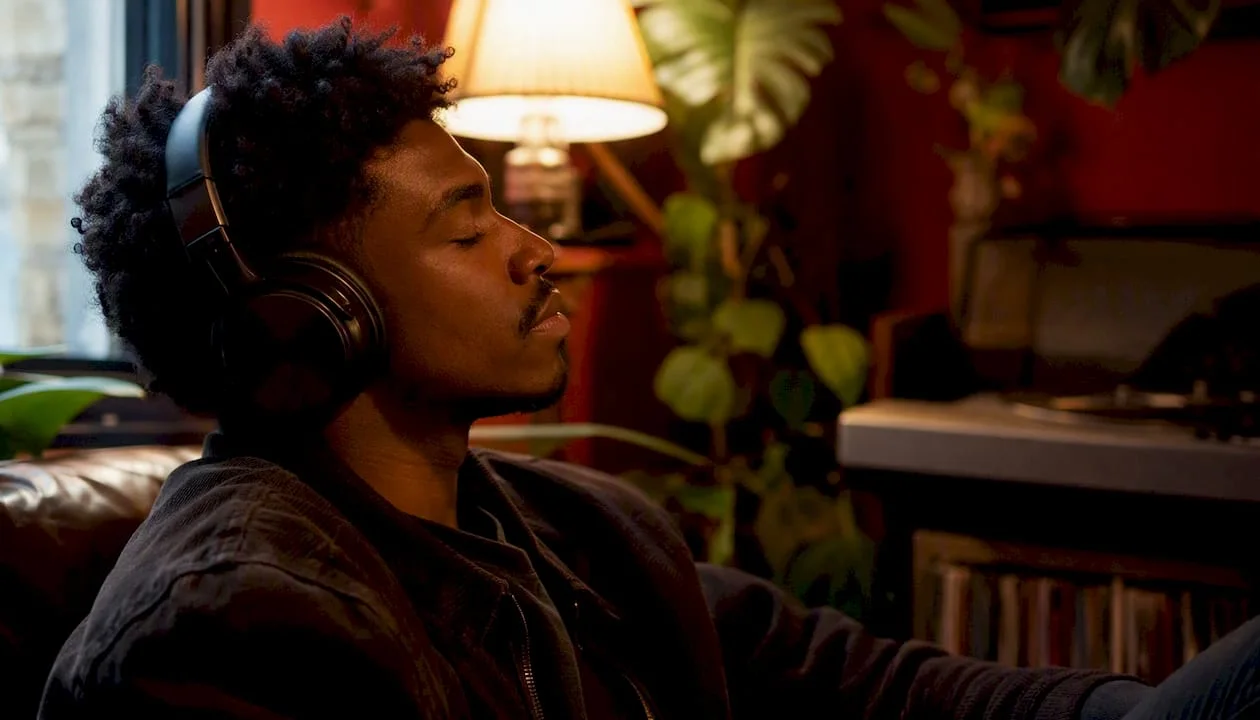
! Person listening to nostalgic music with headphones
The nostalgic music effect is the measurable shift in emotion, memory retrieval, and sense of self that happens when a familiar song pulls you back to a specific moment in your past.
By DRVVYN · · 16 min read
The Nostalgic Music Effect: How It Shapes Your Brain and Mood

The nostalgic music effect is the measurable shift in emotion, memory retrieval, and sense of self that happens when a familiar song pulls you back to a specific moment in your past. It is not simply “feeling old feelings.” Neurologically, it co-activates the brain’s default mode network, which handles self-referential thought, and its reward circuitry simultaneously, binding autobiographical memory to genuine pleasure. That combination is why a single chorus can make you feel both tender and alive at the same time. Research published in Music Psychology confirms that music-evoked nostalgia raises social connectedness, self-esteem, and meaning in life across experimental and correlational studies. Neuroscientist Daniel Levitin describes the experience as deeply personal and sometimes cathartic, noting that sad music can feel soothing because it allows safe processing of loss without real-world consequences.
The practical takeaway is direct: brief, intentional listening to self-selected nostalgic songs, for about 10–20 minutes, with a reflective rather than ruminative mindset, tends to lift mood, strengthen your sense of who you are, and reduce the pressure of feeling alone. The short-term benefits typically last for minutes to a few hours, so regular practice is more effective than occasional deep-dive sessions.
Key Takeaways
Music-evoked nostalgia co-activates the brain’s default mode and reward networks simultaneously, producing a measurable boost in mood, social connectedness, and self-continuity that approach-oriented listening reliably amplifies.
| Point | Details |
|---|---|
| Core neural mechanism | Nostalgic music uniquely co-activates the DMN and reward circuits, linking memory retrieval to genuine affective pleasure. |
| Primary psychological benefits | Research links nostalgic listening to raised positive affect, social connectedness, self-esteem, and meaning in life. |
| Reflection vs. rumination | Reflective listeners gain wellbeing benefits; ruminative listeners risk mood worsening after nostalgic listening. |
| When it may backfire | Acute grief, unresolved trauma, or avoidance-oriented listening can amplify distress rather than ease it. |
| Drvvynsound application | DRVVYN’s curated playlists are sequenced around emotional arcs, making them a natural fit for intentional reflective listening. |
Table of Contents
- What does “nostalgic music” actually mean?
- How does nostalgic music change your brain?
- What does nostalgic music do for your psychological wellbeing?
- What musical features make a song feel nostalgic?
- Who feels the nostalgic music effect most strongly?
- What does the research reliably show, and where are the gaps?
- How to use nostalgic music intentionally for mood and wellbeing
- Playlist templates and a listening exercise you can try today
- Why nostalgic music deserves more credit than it gets
- Drvvynsound’s curated playlists for reflective listening
- Sources
What does “nostalgic music” actually mean?
Nostalgic music is not a genre. It is any piece of music that carries a personal autobiographical link strong enough to produce sentimental longing, that bittersweet tension between warmth for a past moment and awareness that the moment is gone. The song does not need to be old. It needs to be yours, tied to a specific person, place, or chapter of your life.
A few listener-facing examples make this concrete. The R&B track that played on repeat the summer you fell in love. The song your mother hummed in the kitchen. The playlist you built during a cross-country move when everything felt suspended between who you were and who you were becoming. None of those songs are nostalgic in the abstract. They become nostalgic through the weight of your memory attached to them.
The scope of the effect includes:
- Emotional tone: Bittersweet, not purely sad or purely joyful. The mix is what gives the experience its particular texture.
- Triggers: A combination of musical cues (melody, timbre, production style) and learned associations (context, people, places).
- Typical contexts: Most often experienced when listening alone during quiet or reflective moments, though social nostalgia, sharing a song with someone who shares the memory, carries its own distinct warmth.
- Who it applies to: Anyone with autobiographical memory strong enough to anchor a song to a lived experience, which means the effect spans age groups, though its intensity shifts across the lifespan.
How does nostalgic music change your brain?
The short answer: nostalgic music does something that ordinary familiar music does not. It lights up multiple brain networks at once in a way that feels less like remembering and more like returning.
The default mode network and why it matters
The default mode network (DMN) is most active when you are thinking about yourself, your past, or your relationships. Nostalgic music pulls the DMN into high engagement because the song is not just a sound. It is a cue to reconstruct a version of yourself from another time. The posteromedial cortex, a core DMN hub, activates strongly during nostalgic listening, supporting the sense that the memory feels personal and continuous with who you are now.
Reward circuitry and the pleasure of remembering
At the same time, the ventral striatum, the brain’s primary reward hub, activates. This is the same region that responds to food, social connection, and music you simply enjoy. When nostalgic music fires both the DMN and the ventral striatum together, you get autobiographical memory retrieval wrapped in genuine affective reward. The result is that the memory does not just surface. It feels good to surface it.
Memory consolidation and the medial temporal lobe
The medial temporal lobe, including the hippocampus, handles the actual retrieval of autobiographical episodes. Nostalgic music appears to cue this region more specifically than familiar non-nostalgic music, suggesting the effect is not simply about recognizing a song you know. It is about unlocking a stored episode. A PubMed-indexed fMRI study comparing personalized nostalgic, familiar non-nostalgic, and unfamiliar music across 57 participants (29 aged 18–35; 28 aged 60+) found that nostalgic music produced greater activity across the DMN, salience network, reward network, and medial temporal lobe. Older adults showed stronger nostalgia-related BOLD signals, and connectivity in these networks correlated with trait nostalgia and emotional response.
The salience network and emotional intensity
The insula and anterior cingulate cortex, core nodes of the salience network, help explain why nostalgic music can feel physically felt, a tightening in the chest, a sudden sting behind the eyes. This network flags experiences as emotionally significant, essentially telling the rest of the brain: pay attention to this. Its co-activation with the DMN and reward circuits is part of what makes the nostalgic music effect feel more intense than simply enjoying a song.
Pro Tip:If you want to test whether a song genuinely activates your nostalgic response rather than just sounding pleasant, notice whether it pulls a specific memory or person to mind within the first 30 seconds. A song that evokes a vivid autobiographical scene is engaging your medial temporal lobe and DMN. One that just sounds good is mostly reward circuitry.
A methodological note worth holding: fMRI studies measure blood-oxygen-level-dependent (BOLD) signals as a proxy for neural activity, not neural activity directly. The 57-participant sample in the lifespan study is relatively small, and most fMRI nostalgia research uses lab conditions that differ from how people actually listen to music. The findings are consistent and compelling, but they are best understood as strong directional evidence rather than settled neuroscience.
What does nostalgic music do for your psychological wellbeing?
The psychological benefits of music-evoked nostalgia are well-documented across both experimental and correlational research. Nostalgia functions as an approach-oriented emotion, meaning it draws you toward connection, meaning, and self-continuity rather than pulling you into avoidance or withdrawal. That distinction matters for how you use it.
The most consistently supported outcomes include:
- Increased positive affect: Nostalgic listening tends to lift mood, even when the music itself is tinged with sadness. The bittersweet quality resolves toward warmth more often than toward grief.
- Stronger social connectedness: Nostalgia reliably increases feelings of belonging and closeness to others, even when you are listening alone. The mechanism appears to be the retrieval of social memories, which reactivates the felt sense of connection.
- Higher self-esteem and meaning in life: Revisiting a past self you recognize and value reinforces a coherent personal narrative, which supports both self-esteem and a sense that your life has direction.
- Self-continuity: The feeling that the person you were and the person you are now are part of the same story. This is particularly stabilizing during periods of transition or loss.
- Temporary autobiographical memory benefits in cognitive decline: Preliminary clinical evidence links music-evoked nostalgia to short-term improvements in autobiographical recall and emotional wellbeing in some older adults and individuals with dementia.
That last point deserves careful framing. The clinical evidence is preliminary and based largely on small-sample intervention studies. Music-based reminiscence therapy, which uses personally meaningful music to prompt memory and emotional engagement, has shown promise in dementia care settings, but the effects are typically temporary and vary considerably between individuals. It is a meaningful tool, not a treatment.
A Frontiers in Psychology study of 570 participants during the COVID-19 lockdown found that using nostalgic music with an approach emotion-regulation strategy, actively engaging with the memories rather than using music to escape them, was associated with higher wellbeing scores. Effect sizes were modest, and the benefits were context-dependent, but the directional finding is consistent with the broader literature.
What musical features make a song feel nostalgic?
Both the music itself and the associations you bring to it shape whether a song triggers nostalgia. Neither alone is sufficient. A technically beautiful piece of music with no personal history attached will not produce the same effect as a slightly rough recording that played during a moment that changed you.
That said, certain musical features consistently appear in songs people describe as nostalgic:
- Melodic simplicity and familiarity: Melodies that are easy to follow and have been heard many times create stronger autobiographical anchoring than complex, unfamiliar structures.
- Timbre and production artifacts: The warmth of analog recording, vinyl crackle, the specific reverb of a particular era, these sonic textures carry temporal cues that signal “this belongs to a specific time.” Your brain reads them as timestamps.
- Vocal style and delivery: A voice you associate with a specific period of your life, or a vocal quality that mirrors an emotional state you lived through, can trigger recall more directly than instrumentation alone.
- Lyrical references to time, people, and places: Songs that name specific emotional experiences, leaving home, falling in love, losing someone, create hooks for autobiographical memory to attach to.
- Cultural markers: Genre conventions, rhythmic patterns, and production styles that were dominant during your formative years carry collective temporal meaning alongside personal meaning.
Contextual cues matter just as much. Music reliably cues autobiographical memory, and the strongest nostalgic responses tend to involve songs that were playing during emotionally significant social moments, not just songs you happened to hear often. Songs from adolescence carry particular weight because of what researchers call the reminiscence bump: memories formed between roughly ages 12 and 25 are encoded with heightened emotional intensity, making music from that period especially potent as a nostalgia trigger later in life.
Pro Tip:To identify your most personally nostalgic tracks, try this: close your eyes, play a song from your teens or early twenties, and ask yourself, “Where am I? Who is with me?” If a specific scene surfaces within seconds, that song has strong autobiographical anchoring. Build your reflective playlist from those tracks, not from songs that are merely familiar.
Exploring how to rediscover your connection to music can also help you surface songs you may have forgotten but that still carry emotional weight.
Who feels the nostalgic music effect most strongly?
The size and direction of the nostalgic music effect vary considerably depending on who you are, what you are going through, and how you listen. It is not a uniform experience.
| Moderator | Expected typical effect |
|---|---|
| Older adults (60+) | Stronger nostalgia-related brain activation; richer autobiographical detail in recalled memories |
| Adolescents and young adults | Moderate effect; reminiscence bump songs not yet fully formed |
| High trait nostalgia (personality) | Larger wellbeing boost; more frequent and vivid nostalgic responses |
| Reflective listening style | Stronger positive mood and wellbeing gains; memories processed as meaningful |
| Ruminative listening style | Risk of mood worsening; memories processed as painful or unresolved |
| Loneliness (current state) | Higher frequency of nostalgic listening; stronger short-term social connectedness boost |
| Grief or acute loss | Risk of negative mood amplification; nostalgic music may intensify rather than soothe |
| Cultural familiarity with the music | Stronger collective nostalgia response; shared cultural markers amplify personal ones |
A study of autistic and non-autistic young adults found that music-evoked nostalgia boosted state wellbeing and authenticity across both groups, with reflection versus rumination as the key moderator of benefit. People who approached nostalgic memories with curiosity and warmth gained more. People who used the music to rehearse regret or loss gained less, or experienced a dip.
Context shifts outcomes sharply. Listening to nostalgic music during a quiet evening of journaling tends to produce the reflective, approach-oriented response associated with wellbeing gains. Listening to the same songs in the immediate aftermath of a breakup or bereavement, when the emotional wound is still raw, can tip the experience toward rumination. The music does not change. Your relationship to the memory does.
The emotional dynamics of fan communities show a parallel pattern: shared nostalgic listening in social contexts amplifies the social connectedness benefit, while isolated, grief-adjacent listening narrows it.
What does the research reliably show, and where are the gaps?
The strongest, most replicated findings in the nostalgic music literature are:
- Nostalgic music co-activates the DMN and reward networks more strongly than familiar non-nostalgic music.
- Music-evoked nostalgia consistently raises positive affect, social connectedness, and meaning in life under experimental conditions.
- Approach-oriented listening amplifies benefits; ruminative listening reduces or reverses them.
Key study snapshots:
- The lifespan fMRI study (N = 57) established that personalized nostalgic music produces distinct neural signatures across age groups, with older adults showing stronger activation.
- The Frontiers COVID-19 study (N = 570) linked approach-strategy nostalgic listening to wellbeing improvements during a period of enforced social isolation.
- The Springer Nature wellbeing study (N = 320 across autistic and non-autistic groups) confirmed that reflection moderates benefit across neurologically diverse populations.
Limitations the research itself flags:
- Sample sizes: Most fMRI studies involve fewer than 60 participants; generalizability is limited.
- Ecological validity: Lab listening conditions differ substantially from how people actually experience nostalgic music, alone, in the dark, at 2 AM.
- Self-report bias: Many wellbeing measures rely on self-report immediately after listening, which may not reflect sustained effects.
- Directionality: Most studies are correlational or short-term experimental; long-term effects of regular nostalgic listening are not well established.
- Population diversity: Most studies draw from Western, educated, young adult samples; cross-cultural and older-adult data are growing but still limited.
- Individual differences: The moderating role of personality, current emotional state, and listening context is real but not yet fully mapped.
How to use nostalgic music intentionally for mood and wellbeing
The research points toward a clear protocol. Passive, background nostalgic listening produces weaker effects than intentional, focused listening with a reflective orientation. Here is a sequence grounded in the evidence:
- Choose self-selected songs. Pick tracks you personally associate with a specific memory or period. Researcher-selected or algorithmically suggested “nostalgic” playlists produce weaker effects than music you chose yourself. Your autobiographical link is the active ingredient.
- Set a clear intention before you press play. Decide whether you are listening to reconnect with a positive memory, to process a feeling, or simply to lift your mood. Approach-oriented intention, curiosity and warmth toward the memory, predicts better outcomes than avoidance-oriented intention, using music to escape or numb.
- Listen for 10–20 minutes in a low-distraction environment. The wellbeing boost from nostalgic listening tends to be short-term, peaking during and shortly after the session. Longer sessions do not necessarily produce proportionally larger benefits and may increase the risk of rumination.
- Reflect or share after listening. Write two or three sentences about what the song brought up, or share the memory with someone who was part of it. This step extends the social connectedness benefit and helps consolidate the approach-oriented frame.
- Watch for red flags. If the music pulls you toward replaying regret, intensifying grief, or feeling worse than before you started, stop the session. Nostalgic music is not appropriate as a primary coping tool during acute loss, clinical depression, or unresolved trauma without professional support.
Duration note: the mood and connectedness benefits of a single nostalgic listening session are typically short-term, lasting minutes to a few hours. They are most useful as a regular, light-touch practice rather than an occasional deep-dive.
Playlist templates and a listening exercise you can try today
Three playlist approaches fit different goals and emotional states:
Reflective/solo playlist: 8–12 self-selected songs from a specific chapter of your life. Sequence them chronologically if possible. The goal is gentle autobiographical review, not emotional intensity. Best used during journaling, a quiet walk, or winding down before sleep.
Uplifting/social nostalgia playlist: Songs tied to shared experiences, road trips, celebrations, or friendships. These carry collective memory alongside personal memory, which amplifies the social connectedness effect. Share the playlist with the people who were there.
Memory-retrieval playlist for older adults: Personally meaningful songs from ages 12–25, chosen with input from the individual or their family. Used in reminiscence therapy contexts, this format has shown preliminary benefits for autobiographical recall and emotional engagement in older adults and some individuals with cognitive decline. Sessions work best when kept to 10–20 minutes with a facilitator present to guide reflection.
A 3-minute listening exercise
Choose one song with a strong autobiographical link. Press play. Close your eyes and let the first image that surfaces come fully into focus: where are you, what does the light look like, who is nearby? Stay with that scene for the full song without analyzing it. When it ends, write one sentence: “That song takes me back to ___.” That single sentence is enough to anchor the reflective frame and shift the session from passive listening to active memory engagement.
Drvvynsound’s DRVVYN project approaches playlist curation with exactly this kind of intentionality, sequencing tracks around emotional arcs rather than genre or tempo alone, so that the listening experience moves through tension and release rather than sitting flat.
Why nostalgic music deserves more credit than it gets
Most conversations about nostalgic music treat it as a guilty pleasure, something you indulge in when you are feeling sentimental and then set aside. The research suggests that framing undersells it considerably.
What strikes me most about the neuroscience is not that nostalgic music activates the reward system. Plenty of things do that. It is that it activates the reward system at the same time as the network responsible for your sense of self. That co-activation is unusual. It means that when a song pulls you back to a version of yourself you recognize and value, the brain is not just retrieving a memory. It is reinforcing the continuity of your identity. In a culture that moves fast and rarely pauses, that kind of reinforcement is not trivial.
The risk is real too. Nostalgic music used ruminatively, as a way to rehearse what went wrong or to stay anchored in a past that no longer exists, can deepen rather than ease distress. The difference between reflection and rumination is not always obvious in the moment. But the research is consistent: the question to ask yourself is whether the memory feels like something you are visiting or something you are trapped in. One opens. The other closes.
The most underused application of this effect is pairing nostalgic music with a brief creative act, writing, sketching, even just speaking a memory aloud. That combination moves the experience from passive emotional response to active meaning-making, which is where the deepest benefits tend to live.
Drvvynsound’s curated playlists for reflective listening
If you want a ready-made starting point rather than building a playlist from scratch, Drvvynsound’s DRVVYN project offers something built for exactly this kind of listening. The music is crafted around themes of love, reflection, healing, and personal growth, with production choices that favor warmth and emotional texture over surface-level energy. Each release is sequenced to move through emotional states rather than simply fill space, making it a natural fit for the intentional, approach-oriented listening the research supports.

Whether you are using music to reconnect with a memory, process something you have been carrying, or simply let some pressure leave your chest, the catalog at Drvvynsound gives you a place to start. Stream a playlist, find a track that lands, and let the reflection follow naturally.
Sources
- Music-Evoked Nostalgia Activates Default Mode and Reward Networks Across the Lifespan – PubMed
- The psychological benefits of music-evoked nostalgia
- Music-evoked nostalgia during the COVID-19 lockdown (Frontiers in Psychology)
- What’s going on in our brains when we experience nostalgia? : NPR
- Music-Evoked Nostalgia and Wellbeing in Autistic and Non-Autistic Young Adults | International Journal of Applied Positive Psychology | Springer Nature Link
- PLOS ONE article on music and autobiographical memory
This article is general information, not a substitute for advice from a qualified doctor. Consult a qualified healthcare professional about your own circumstances before acting on anything here.