
Artist Strategy
Best Independent Artist Streaming Services: 2026 Guide
Discover the best independent artist streaming services in 2026. Streamline your music distribution and reach your audience effectively today!
By DRVVYN · · 9 min read


For independent artists in the U.S., the single most effective approach is an integrated service package that combines distribution, metadata setup, creative asset production, playlist pitching, and targeted creator seeding — all coordinated under one provider or tightly managed workflow. That combination consistently outperforms any single tactic bought in isolation.
Start here, right now:
- Claim your Spotify for Artists profile and verify your artist page within 24 hours of reading this.
- Set up a smart link page (your central conversion hub) and point all social traffic there.
- Collect contact info for independent playlist curators in your genre before your next release.
- Identify nano and micro creators whose content already fits your track’s emotional tone, and begin outreach.
This fits you if you’re an independent or unsigned artist, or a small label managing one to three artists, with a release coming in the next 30–90 days. Realistic short-term outcomes include measurable playlist adds, early streaming saves, and the beginning of an email list you actually own. Budget ranges vary widely, but expect to invest modestly for a foundational bundle, and significantly more for a full multi-month growth campaign.
Table of Contents
- What do ‘independent artist streaming services’ actually mean?
- How do you pick the right service or package?
- A practical 90-day plan you can follow or brief a provider on
- How Drvvynsound executes integrated streaming growth
- Key Takeaways
- Why integrated services are the only honest path forward
- Drvvynsound’s services and how to get started
- Useful sources and further reading
What do ‘independent artist streaming services’ actually mean?
Most search results for this phrase return lists of DSPs — Spotify, Apple Music, Tidal. That is not what this article covers. Here, “streaming services for independent artists” means the providers and packages that help you grow your audience and increase streams: the agencies, studios, and specialists who handle the work that gets your music heard.
The service components that count:
- Distribution coordination: Getting your music onto DSPs with correct ISRCs, UPC codes, and accurate metadata — artist name consistency, PRO registration, and release date alignment.
- Smart link setup: A single landing page that routes listeners to their preferred platform and captures email addresses.
- Creative asset production: Cover art, visualizers, short-form video content, and press photos that hold attention on social feeds.
- Playlist pitching: Both editorial pitching (submitted at least seven days before release for Spotify’s editorial team) and independent curator outreach, which is often more reachable and faster to convert.
- Creator seeding: Placing your track with 20–40 aligned nano and micro creators on TikTok and Instagram Reels to trigger organic discovery and algorithmic reach.
- Paid ads: Meta ad tests and Spotify Marquee, layered in after organic validation — not before.
- Analytics and reporting: Tracking saves, playlist adds, smart link CTR, and email signups across the campaign.
- Publishing and sync outreach: Registering compositions with your PRO, maintaining searchable contact info, and pitching to music supervisors and sync libraries.
Why does an integrated package outperform one-off purchases? Because the foundation has to come first. Metadata, smart links, and visual branding are the infrastructure everything else runs on. Pitching a track with broken metadata or no cover art is like sending someone to a storefront with no sign and a locked door.
How do you pick the right service or package?
The checklist below is vendor-agnostic. Use it to evaluate any provider before you sign anything.
Must-have features in any package:
- Distribution to major DSPs with correct metadata and ISRC/UPC assignment
- Smart link page with email capture
- Creative assets (at minimum: cover art and one short-form video)
- A documented pitching workflow with curator vetting
- Analytics reporting at 30, 60, and 90 days
- Clear licensing and sync contact info on your artist profile
Questions to ask on a discovery call:
- What is your exact placement method for playlists — do you have direct curator relationships, or do you use a submission platform?
- How do you vet creators for seeding campaigns?
- What does your reporting look like, and how often do you send it?
- What are your cancellation and contract terms?
- How many other artists are you pitching to the same curator pipeline simultaneously?
Red flags that should stop you cold:
- Guaranteed stream counts (organic growth cannot be guaranteed; promises signal bot traffic)
- Opaque reporting with no playlist names or curator data
- No mention of metadata or smart links in the onboarding checklist
- Reusing the same playlist pipeline for every client regardless of genre
| Bundle Type | Delivery Timeline |
|---|---|
| Basic distribution plus pitching | A few weeks |
| Creative assets with pitching and seeding | Several weeks |
| Full multi-month growth campaign | Several months |
Vendors who recommend a minimum three-month engagement are not upselling you — they’re being honest. A single-release spike tells you almost nothing about momentum. Sustained growth requires repeated algorithmic evaluation windows, which is why consistent release schedules tend to outperform infrequent album drops for discovery.
Pro Tip:Paid promotion — Meta ads or Spotify Marquee — should only enter the picture after your organic seeding has validated the track. A small Meta test budget often outperforms Marquee for artists who haven’t yet crossed certain listener thresholds, because Meta’s targeting lets you reach cold audiences who match your listener profile.
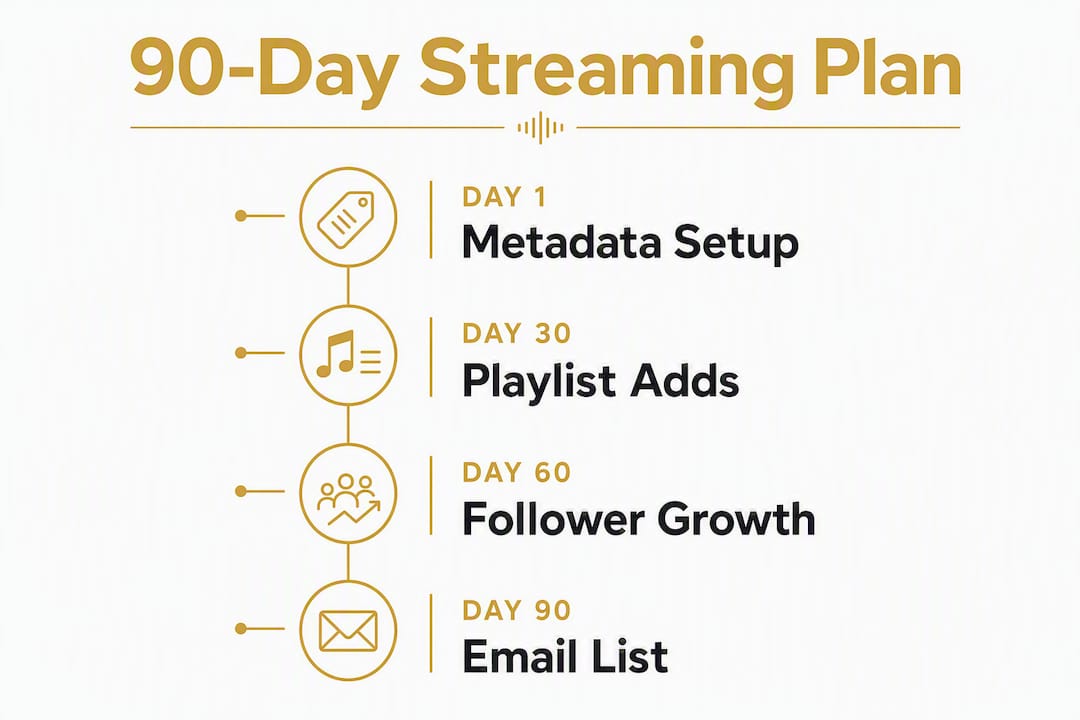
At 30 days, expect smart link traffic, early saves, and initial playlist adds. At 60 days, look for follower growth and email list movement. At 90 days, you should have enough data to decide whether to scale, pivot, or pause.
A practical 90-day plan you can follow or brief a provider on
This plan maps to a four-phase release structure: preparation, pre-release, launch week, and sustained post-launch promotion.
- Week 1: Claim Spotify for Artists. Audit and correct all metadata (artist name consistency, ISRC, PRO registration). Set up your smart link with email capture enabled. Finalize cover art and one short-form video asset.
- Week 2: Submit your editorial pitch to Spotify — at least seven days before your release date. Begin building your independent curator outreach list (target 15–25 curators in your genre). Identify 20–40 nano and micro creators whose content matches your track’s emotional tone.
- Week 3: Begin creator seeding outreach. Personalize each message — reference a specific video of theirs and explain why your track fits. Provide a clean audio file and any relevant visual assets. Do not mass-blast.
- Week 4 (Release Week): Push the smart link across all channels. Monitor saves and playlist adds daily. Engage every creator who posts your track within 24 hours.
- Weeks 5–6: Assess organic data. If saves and engagement are strong, run a small Meta ad test ($50–$100) targeting listeners who match your early audience profile. Track cost-per-save and cost-per-click.
- Weeks 7–8: Review playlist add data. Pitch a second wave of independent curators using early streaming numbers as social proof. Begin converting smart link visitors to your email list with a direct ask.
- Weeks 9–10: Evaluate email list growth and engagement rates. Consider a limited physical or merch release to deepen fan relationships and generate direct revenue alongside streaming income. Platforms like Payhip handle digital product sales and order fulfillment without requiring a separate storefront.
- Weeks 11–12: Compile your 90-day report. Measure smart link CTR, total saves, playlist adds, follower growth, and email signups. Use this data to brief your next release campaign and, if applicable, to pitch brand partnerships with an EPK that proves ROI.
KPIs to track at each phase: smart link CTR (aim for above 20%), save-to-stream ratio, playlist add count, email list size, and creator post engagement rate. An email list of 200 genuinely engaged subscribers often delivers more reliable reach than a large but passive social following — because you own that channel regardless of algorithm changes.
How Drvvynsound executes integrated streaming growth
Drvvynsound approaches every release as a full-system build, not a single tactic. The workflow moves from discovery through delivery and into measurement, with clear handoffs at each stage.
Services Drvvynsound coordinates:
- Distribution coordination and metadata cleanup
- Visual asset production (cover art, cinematic visualizers, short-form content)
- Playlist pitching to both editorial and independent curators
- Creator seeding campaigns (20–40 aligned creators per release)
- Paid ad management (Meta, with organic validation first)
- Analytics reporting at 30, 60, and 90-day intervals
- Publishing and licensing outreach, including sync contact visibility
The workflow:
- Discovery: Intake call to understand the artist’s sound, release timeline, and goals. Required materials include final audio files, existing visual assets, and any prior streaming data.
- Foundation: Metadata audit, smart link setup, and creative asset production before any pitching begins.
- Pitching and seeding: Editorial submission timed correctly, independent curator outreach, and creator seeding executed in parallel.
- Measurement: Reporting delivered at each milestone with specific metrics, not vanity numbers.
In a typical 90-day window, artists working within this model can expect early playlist placement, measurable save growth, and the beginning of an owned audience through email capture. Timelines depend on genre, release quality, and prior audience size. Onboarding requires roughly one week of asset gathering before active campaign work begins.
Key Takeaways
The most effective approach for independent artists is an integrated package covering distribution, metadata, creative assets, playlist pitching, and creator seeding — executed in sequence, not in isolation.
| Point | Details |
|---|---|
| Foundation before promotion | Metadata, smart links, and visual assets must be correct before any pitching or paid ads begin. |
| Creator seeding drives discovery | Seeding to 20–40 aligned nano/micro creators triggers organic reach and algorithmic momentum. |
| Email list over follower count | 200 engaged email subscribers often outperform large passive followings for sustained reach. |
| Budget realistically | Foundational bundles run $300–$1,500; full multi-month campaigns typically cost $1,500–$5,000+. |
| Drvvynsound as your partner | Drvvynsound offers the full integrated workflow: distribution, creative, pitching, seeding, and analytics. |
Why integrated services are the only honest path forward
There’s a version of this conversation that sounds like a sales pitch, and I want to sidestep it entirely. The reason integrated services matter isn’t because they cost more or because any single provider is irreplaceable. It’s because the music itself deserves a system that matches its quality.
Most artists pour everything into the recording and then treat the release like an afterthought — a single post, a playlist submission, maybe a boosted story. The silence that follows isn’t a verdict on the music. It’s a verdict on the infrastructure. When the metadata is wrong, when there’s no smart link, when the visual assets feel rushed, the music never gets a fair hearing. The pressure never leaves your chest because the release never actually landed.
What I’ve seen, working within this space, is that the artists who build slowly and deliberately — who own their email list, who seed to the right creators, who release consistently rather than waiting for the perfect moment — are the ones who still have momentum a year later. Chasing a single spike is exhausting and hollow. Building a system that compounds is the only thing worth your energy.
Drvvynsound’s services and how to get started
Independent R&B artists who want a clear path from release to real audience growth can work directly with Drvvynsound. The recommended starting package covers metadata cleanup, smart link setup, cover art and short-form video production, editorial and independent playlist pitching, and a creator seeding campaign sized to your release.
Onboarding is straightforward: a discovery call to align on your release timeline and goals, a deliverable checklist so you know exactly what to prepare, and a 90-day campaign window with milestone reporting. Pricing is discussed on the call based on your specific needs and release scope. There are no hidden retainers and no vague promises — just a documented workflow and honest metrics.
To get started or ask questions, visit drvvynsound.com.
Useful sources and further reading
Playlist pitching and curator outreach:
- Music Marketing for Indie Artists — The 2026 Guide | liminl. — covers editorial pitch timing, metadata essentials, and paid promotion sequencing.
Release planning and marketing strategy:
Brand partnerships and EPKs:
- Artist Profile Examples for Hip-Hop Artists: 2026 Guide | QuickRapReview — templates and examples for professional artist profiles.
Sync licensing:
Direct-to-fan sales:
- Sell Music — Payhip — digital product storefronts for music, merch, and exclusive content.
Drvvynsound internal resources:
- Why music transitions matter — pitching tactics and playlist curator outreach best practices.
- Why artists post after dark — social posting strategy and timing for content calendars.