

Music Business
Creators: 5 Step Check Before Using Royalty Free or Licensed Music
A creator focused five step checklist to choose royalty free or rights managed music. Check Content ID, PRO status, and indemnity first.
By DRVVYN · · 9 min read
Royalty-free describes a payment model: you pay once or subscribe, and there’s no recurring fee every time your video plays. Licensed, or rights-managed, music works differently. You negotiate specific terms per use, and in exchange you get tighter control and sometimes exclusivity. Most solo creators and small businesses need royalty-free. Anyone running a national ad, TV placement, or exclusive release needs rights-managed. Either way, read the license itself, and check the track’s Content ID and PRO status before you publish anything.
TL;DR:
- Most royalty-free tracks are non-exclusive, allowing multiple creators to use the same music in different videos without restrictions, while rights-managed licenses often include exclusivity clauses.
- License costs vary significantly, with royalty-free music usually priced per track or subscription, and rights-managed licensing potentially costing thousands for large, exclusive projects.
- Content ID claims can still occur with legally licensed music because digital platforms fingerprint audio at the catalog level and PRO registration can trigger claims regardless of license validity.
- For projects like national ads or TV placements, negotiating a rights-managed license is essential to secure specific rights, territory, and exclusivity, whereas royalty-free suits ongoing social media or podcast use.
- Always verify PRO registration status, read license terms carefully, and save all documentation to avoid disputes and ensure proper use of licensed music.
Royalty-Free vs. Licensed Music: The Definitions Nobody Explains Clearly
The confusion starts because “royalty-free” sounds like it means free, and it doesn’t. It means you pay a flat fee or subscription cost once, and you never owe another royalty payment for repeated plays, streams, or views. The creator who made the track still owns the copyright. You’re buying a license to use it, not the music itself.
Licensed, or rights-managed, music flips the structure. Instead of a fixed catalog price, you negotiate the rights you need: which territories, how long, which media, and whether you get exclusivity. Film studios and national advertisers use this model constantly because they need guarantees a stock library can’t offer.
Two more categories matter here. Public domain music has no copyright at all, usually because it’s old enough that protection expired. Creative Commons covers a spectrum of licenses, some of which allow commercial use and some of which don’t, often with attribution requirements attached. Both differ from royalty-free in one critical way: they’re not sold through a standard commercial transaction. Copyright law still governs all of it. As the U.S. Copyright Office makes clear, a license, not the absence of copyright, is what gives you permission to use someone’s work. “Free” almost never means permission isn’t required.
Rights, Cost, and Exclusivity: Where the Two Models Actually Diverge
The differences that matter aren’t philosophical. They’re the terms you’ll actually run into when you buy or negotiate a track.
Payment structure. Royalty-free tracks come per-track or via subscription, often through libraries with thousands of songs at a flat rate. Licensed music gets priced per negotiated use, which can range from a few hundred dollars for a small sync to five or six figures for a national campaign.
Exclusivity. Most royalty-free licenses are non-exclusive, meaning the same track could show up in a hundred other videos the same week. Rights-managed licenses can include exclusivity clauses, and some publishers offer custom buyouts where you own an outright use for a defined scope.
Permitted uses. This is where creators get burned. A royalty-free license might cover streaming and social video but exclude broadcast television or public performance. Rights-managed agreements spell out sync rights, broadcast rights, and performance rights individually, because each carries separate value.
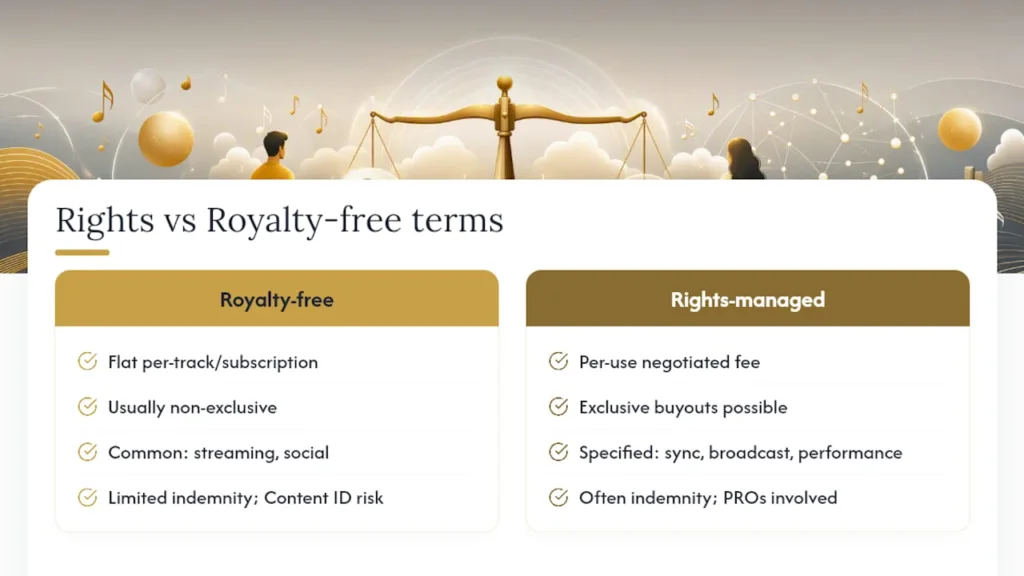
Risk management. Look for whether the seller offers indemnification if a claim arises, how the track behaves against Content ID, and whether a performing-rights organization has a stake in royalty collection regardless of your license. These three factors determine how much hassle you’ll deal with after publishing, not before.
How to Choose the Right Music License Before You Buy
Before you buy a track or start a subscription, run through this checklist. It takes ten minutes and it saves you from the claims and disputes that eat up hours later.
- Define your project’s scope. Is this a client video, a monetized YouTube channel, a podcast, or a paid ad campaign? Commercial intent changes which license tier you need.
- Read the license term. Confirm whether it’s perpetual or time-limited, and how many projects or videos it covers, since some libraries cap usage per purchase.
- Check broadcast and performance rights. If there’s any chance the project airs on TV or plays in a public venue, confirm the license explicitly includes those rights.
- Verify Content ID policy and PRO registration. Ask directly whether the track is registered with a performing-rights organization and whether the library whitelists licensed buyers against automated claims.
- Decide: royalty-free or negotiate. If your use case is background content for social media or a podcast, royalty-free usually covers it. If you need exclusivity or a guaranteed clearance for a specific market, rights-managed licensing is worth the extra negotiation.
Pro Tip:Save every license PDF and receipt in one folder, named by track and project. If a claim ever hits your video, you’ll want that document in under sixty seconds, not after a frantic search through old emails.
Why Content ID Claims Hit Tracks You Already Paid For
Here’s the part that frustrates creators the most: you can buy a legitimate license and still get a Content ID claim. It happens because platforms like YouTube fingerprint audio at the catalog level, and libraries register their tracks so unauthorized use gets flagged automatically. Your license doesn’t automatically tell the platform you’re authorized. It just proves you have permission if someone challenges the claim.
Performing-rights organizations add another layer. ASCAP, BMI, and SESAC collect royalties for public performance separately from your purchase, which means a track can trigger a claim tied to PRO registration even when your commercial license is fully valid. Learning how these organizations operate helps you understand where a claim is actually coming from.
- Ask the seller directly if the library is PRO-free or registered.
- Request whitelisting if the platform supports it.
- Get indemnification language in writing wherever the seller offers it.
Pro Tip:Keep a simple log, track name, purchase date, license type, and confirmation number. When a claim hits, you respond with facts instead of scrambling.
When You Need a Rights-Managed or Custom License
Rights-managed licensing earns its higher price when the stakes go up. National ad campaigns, television syndication, feature films, and any project requiring exclusivity all call for negotiated rights instead of catalog pricing. A needle drop license for film or TV placement, for instance, spells out exactly which rights you’re buying, which a generic subscription can’t replicate.
When negotiating, nail down territory, term length, media type, exclusivity, price, and indemnity before signing anything. Document every verbal agreement in writing, and confirm upfront how the publisher handles PRO registration and Content ID so there’s no ambiguity once the project airs.
Where to Find Music You Can Actually Trust
Not every source carries the same risk. Subscription libraries offer huge catalogs and predictable monthly costs, but cancellation can sometimes affect ongoing usage rights, so read the fine print on what happens to past projects after you cancel. Per-track purchases cost more upfront per song but often carry cleaner, permanent terms. Public domain and Creative Commons sources are free of licensing fees entirely, but they demand your own diligence since indemnity protection is essentially nonexistent. Comparing established music sourcing options before committing to one platform saves you from discovering limitations mid-project.
Whatever route you choose, verify these before you commit:
- Confirm you get a downloadable license PDF, not just a purchase confirmation email.
- Ask about PRO registration status in writing.
- Ask about Content ID handling and whitelisting support.
- Keep every document indefinitely, even after the project ships.
Independent artists distributing their own catalogs through platforms like Payhip also supply a meaningful share of what ends up in stock libraries, which is worth knowing if you’re curious where “royalty-free” tracks originate in the first place.
Publisher Notes on Licensing and Recordkeeping
When you evaluate a music supplier, ask about metadata, PRO registration, and whitelisting support upfront, not after a claim lands. DRVVYN Sound structures licensing agreements around clear metadata and documented Content ID handling, because ambiguity is what creates disputes months later. Store every license where you can find it fast, and template your attribution language once so you’re not rewriting it project by project.
The Bottom Line on Royalty-Free vs. Licensed Music
Recurring background content, like weekly YouTube uploads or podcast intros, almost always fits royalty-free licensing. National ads, exclusive releases, or broadcast placements call for rights-managed agreements. Whichever you choose, read the actual license, save your receipts, and confirm Content ID and PRO status before you publish. Platform-specific questions get answered below.
A Note From DRVVYN Sound on Fair Licensing
Transparent terms protect creators and artists in the same breath. When a license clearly states what’s covered, nobody’s caught off guard, and the artist who made the track gets compensated fairly for how it’s used. We handle clearance questions directly rather than burying answers in fine print, and custom licensing requests are something we welcome, not a hassle we avoid. If your project needs something outside a standard catalog license, reach out. We’d rather solve it upfront than leave you guessing.
— DRVVYN Sound
Licensing-Ready Music Without the Guesswork
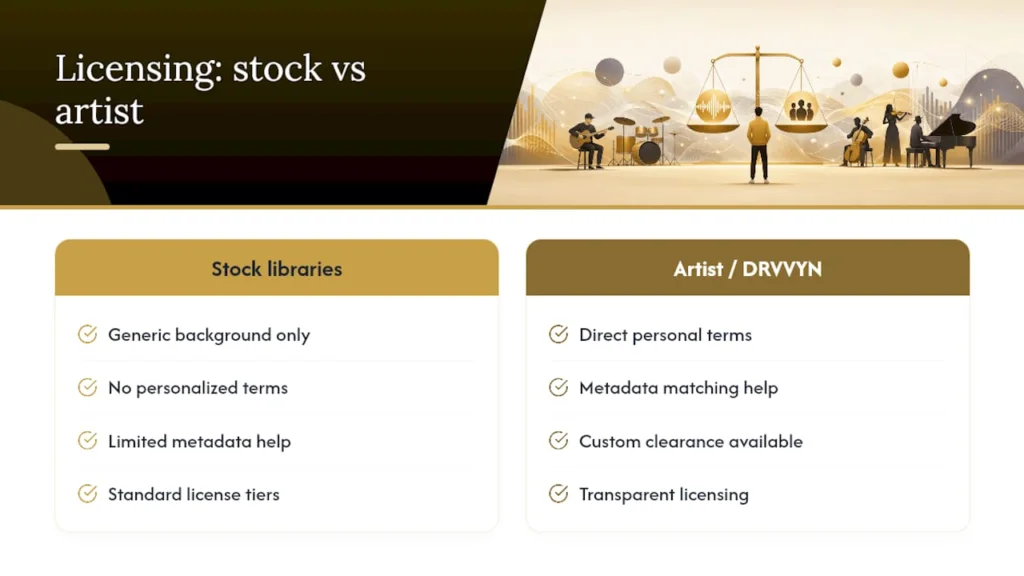
Stock libraries work fine for generic background noise, but they can’t offer what a direct relationship with an artist gives you: clear terms explained by an actual person, help matching metadata to your project, and a custom clearance if your use case doesn’t fit a standard license tier. DRVVYN Sound licenses tracks with that same transparency the industry too often skips, no vague fine print, no guessing whether a claim is coming six months later. If you’re scoring a project that needs music with real emotional weight and a paper trail you can trust, browse tracks built for quiet, reflective moments and see what fits before you commit to a generic catalog subscription.
Sources
For primary guidance straight from the source, the U.S. Copyright Office explains how copyright protection works regardless of a track’s price point. The Library of Congress covers how the Music Modernization Act reshaped digital royalty flows. For a plain-language breakdown of royalty-free terms, LegalClarity is worth bookmarking.
- What Is Copyright? | U.S. Copyright Office
- What Does Royalty-Free Mean for Music? – LegalClarity
- What Is Royalty-Free Music? Licensing Explained – MusicCreator
FAQ
Can I use licensed music in Facebook Reels?
Only if your license explicitly covers social media distribution and the platform Reels runs on; many royalty-free licenses do cover this, but rights-managed licenses may restrict it to specific platforms named in the agreement.
How much of a song can I use without copyright permission?
There’s no fixed number of seconds that’s automatically safe. Copyright protection applies to the whole work, and using even a short clip without permission or a valid license can trigger a claim.
Can I use copyrighted music if I don’t make money from the video?
Non-commercial use doesn’t exempt you from copyright law. Platforms like YouTube still apply Content ID matching regardless of whether your video generates revenue.
Is royalty-free music still copyrighted?
Yes. Royalty-free means you’re not paying recurring fees, but the composer or publisher still holds the copyright, and you’re using the track under a license, not owning it outright.
What’s the difference between royalty-free music and licensed beats?
Royalty-free tracks work well as background content and sync uses, while licensed beats are typically structured for artists recording original songs and distributing them, which usually requires separate lease or exclusive rights terms.