

Music Business
Independent Artists: Best Music Distributor, 3 Year Cost Examples
Compare distributors by artist profile and three year cost scenarios, including a $2,700 example. See when a managed service pays off versus DIY.
By DRVVYN · · 17 min read

For most independent artists releasing music more than once or twice a year, DistroKid’s subscription model with a flat annual fee is the default pick, since it charges one flat rate and keeps 100% of streaming royalties on its core plans. TuneCore is the better call for songwriters who need serious publishing administration. CD Baby suits artists who release rarely and prefer permanent hosting without ongoing fees. RouteNote or Amuse make sense if you have zero budget right now and just want your first single live on Spotify this week.
TL;DR:
- Artists releasing more than three projects annually benefit most from DistroKid’s flat annual fee, as it offers unlimited uploads and retains 100% of royalties.
- Songwriters seeking detailed publishing administration and collection should prioritize TuneCore, despite its higher yearly cost, because of its superior royalty reporting.
- Infrequent releasers who prioritize permanent hosting over ongoing fees should choose CD Baby, which charges a one-time fee per release but retains a 9% commission on streaming revenue.
- For artists with no budget, RouteNote or Amuse provide immediate Spotify listing, but RouteNote’s 15% commission and limited features make it suitable only for short-term tests.
- The total three-year cost for high-earning catalogs can reach thousands of dollars in commissions with platforms like CD Baby, whereas flat-fee services like DistroKid stay significantly cheaper for consistent releases.
What Is the Best Music Distributor Right Now?
There is no single “best” distributor, because the right choice depends entirely on how often you release and what you’re optimizing for. That said, the shortlist below covers the platforms that consistently show up across 2026 industry rankings for a reason: they cover the real trade-offs an artist actually faces.
Here’s the quick version, with the one line each artist needs to hear before digging deeper:
- DistroKid — best for prolific releasers; flat annual fee with unlimited uploads, but you lose access to your catalog if you stop paying.
- TuneCore — best for songwriters chasing publishing royalties; strong reporting, but pricier per year than DistroKid for a single artist.
- CD Baby — best for artists who release rarely; one-time fee per release means no recurring annual fees, but CD Baby keeps a 9% commission on streaming revenue on your streaming revenue permanently.
- Ditto Music — best for budget-conscious artists who still want a flat subscription; pricing sits below DistroKid in some tiers, though the feature set is thinner.
- Symphonic — best for small labels wanting a human account manager instead of a self-serve dashboard; application-based, so not every artist gets accepted.
- Amuse — best for artists who want a royalty advance against future earnings; free tier historically took a revenue cut, so read the current terms before assuming it’s free.
- RouteNote — best for artists testing distribution with zero cash; the free tier takes a 15% commission, and the trade-off only makes sense short term.
- UnitedMasters — best for hip-hop and R&B artists chasing brand deals or sync licensing on top of standard distribution.
The pattern across nearly every 2026 comparison piece is consistent: flat-fee unlimited distribution wins for active releasers, while one-time or revenue-share models win for artists releasing rarely or artists with no upfront budget. Everything after this list is about matching your specific release habits and income goals to the right column in that trade-off.
Comparing the Top Music Distribution Platforms Side by Side
A side-by-side view makes the trade-offs concrete, especially once you factor in what happens to your catalog if you ever stop paying or stop releasing.
| Distributor | Pricing model | Commission / royalty retention | Best for | Publishing admin | Delivery speed | Catalog permanence | AI content policy |
|---|---|---|---|---|---|---|---|
| DistroKid | Flat annual fee | 100% on core plans | Prolific releasers | Add-on available | Fast (often 2 to 3 days to Spotify) | Removed if subscription lapses, unless a legacy add-on is purchased | Requires disclosure of AI-assisted content |
| TuneCore | Flat annual fee, tiered | 100% while subscribed | Songwriters needing publishing collection | Yes, dedicated product | Fast | Removed on cancellation | Requires disclosure |
| CD Baby | One-time per-release fee (~$9.99 single) | 9% commission on streaming revenue | Infrequent releasers wanting permanence | Limited | Standard | Permanent, no annual renewal needed | Case-by-case review |
| Ditto Music | Low-cost flat subscription | Near 100% on paid tiers | Budget-conscious artists | Limited | Standard | Tied to active subscription | Standard DSP compliance |
| Symphonic | Application-based, varies | Varies by agreement | Small labels wanting account management | Available through label services | Standard to fast | Varies by contract | Standard DSP compliance |
| Amuse | Free/paid tiers, advances on paid | Revenue-share on free tier; 100% on paid | Artists wanting an advance | Limited | Standard | Varies by tier | Standard DSP compliance |
| RouteNote | Free (15% commission) or paid (100%) | Free tier, 100% paid | Zero-budget testing | Limited | Standard | Tied to plan chosen | Standard DSP compliance |
| UnitedMasters | Free and paid tiers | Varies by tier | Brand deals and sync-focused artists | Limited | Standard | Varies by tier | Standard DSP compliance |
DistroKid leads this table because its flat fee and delivery speed make it the strongest default for the largest group of readers: artists who release regularly and want predictable annual costs. The commission column is where the real long-term math lives. A ninth of your streaming revenue sounds small on a $50 payout. It stops sounding small once a track breaks out.
Pro Tip:Run your own numbers before assuming a flat fee always wins. That’s real money a flat-fee plan would never touch, no matter how many releases you upload.
The gap between a one-time fee model and a percentage-based model only widens as streaming income grows, since a 9% ongoing commission compounds linearly with revenue while a subscription fee stays fixed.
Mini-Profiles: What Each Distributor Actually Offers
DistroKid
DistroKid built its reputation on speed and simplicity. For roughly $24.99 a year, you get unlimited uploads and full royalty retention on main plans, with paid add-ons covering things like YouTube Content ID monetization and collaborator splits.
- Best for: Artists releasing three or more projects a year who want the lowest per-release cost.
- Standout feature: Fast delivery to Spotify, often within a few days, plus built-in tools for splitting royalties automatically between collaborators.
- The trade-off: Stop paying the annual fee and your catalog can come down from stores, unless you’ve purchased a permanence add-on. That’s a real risk for artists who release once, then go quiet for a few years.
TuneCore
TuneCore competes directly with DistroKid on flat-fee pricing but leans harder into publishing. Its publishing administration product helps songwriters register works and collect mechanical and performance royalties that often go unclaimed otherwise, a gap worth understanding alongside how ASCAP and BMI handle performance royalty collection separately from distribution.
- Best for: Songwriters and artists who write for others and need label-grade royalty reporting.
- Standout feature: Granular per-platform, per-country reporting that shows exactly where every dollar came from.
- The trade-off: Annual subscription tiers run higher than DistroKid’s entry price, and publishing admin has historically carried its own fee structure on top.
CD Baby
CD Baby flips the DistroKid model. Instead of an annual fee, you pay once per release, roughly a one-time fee for a single release, and CD Baby keeps a 9% commission on streaming revenue on the revenue that release generates going forward.
- Best for: Artists who release infrequently and don’t want to think about renewal dates.
- Standout feature: Permanent hosting with no recurring annual fees, plus active physical distribution and sync licensing support that most flat-fee competitors don’t offer.
- The trade-off: That a 9% commission on streaming revenue never goes away. It’s fine for a hobbyist earning a few dollars a month, but it becomes expensive fast for anyone whose catalog starts earning real streaming income.
Ditto Music
Ditto positions itself as the budget alternative to DistroKid, undercutting it on price in some markets while still offering unlimited releases on its paid tier.
- Best for: Artists who want a subscription model but are watching every dollar.
- Standout feature: Competitive low-tier pricing paired with genre-specific label tools for artists building out a small roster.
- The trade-off: The feature set is noticeably thinner than DistroKid or TuneCore once you get past core distribution.
Symphonic
Symphonic is the outlier on this list because it’s application-based rather than instant self-serve signup. It behaves more like a boutique label-services company than a pure distributor.
- Best for: Small labels and established independent artists who want a human account manager instead of a dashboard.
- Standout feature: Curated onboarding and label-style partnership options that self-serve platforms don’t offer.
- The trade-off: Not every artist gets accepted, and the process is slower than uploading through DistroKid on a Tuesday afternoon.
Amuse
Amuse built its early reputation on royalty advances, letting artists borrow against future streaming income. Its free tier has historically operated on a revenue-share basis rather than a flat fee.
- Best for: Artists who need cash now and are willing to trade a percentage of future royalties for it.
- Standout feature: Advance options and a mobile-first workflow built for artists who manage everything from a phone.
- The trade-off: Free-tier terms have shifted over time, so confirm the current commission structure before assuming it’s free in the way DistroKid’s flat fee is fixed.
RouteNote
RouteNote is the true zero-cost entry point into major DSPs. Upload for free, and RouteNote takes a commission on revenue on the revenue that release earns.
- Best for: Artists with no budget who want to test whether a song resonates before committing money.
- Standout feature: A genuine free tier with no subscription required, plus the option to upgrade a specific release later.
- The trade-off: That 15% adds up quickly if a free-tier release actually takes off, which is exactly the scenario where you’d wish you’d paid upfront.
UnitedMasters
UnitedMasters distinguishes itself through brand partnerships and sync placement access rather than pure distribution mechanics.
- Best for: Hip-hop and R&B artists specifically chasing brand deals or sync licensing alongside standard streaming distribution.
- Standout feature: A marketplace connecting artists with brands and sync opportunities on its higher tiers.
- The trade-off: The core distribution experience is competitive but not the primary reason to choose it; the brand and sync access is the real draw.
ONErpm
ONErpm operates as a hybrid between a pure distributor and a label-services company, offering marketing and monetization support without requiring artists to sign away rights.
- Best for: Artists who want label-like campaign support but need to stay independent.
- Standout feature: Integrated marketing services bundled with distribution rather than sold as a separate product.
- The trade-off: The added services come with more complexity than a simple upload-and-go platform.
EmuBands
EmuBands has built a quieter reputation as a reliable, support-forward distributor without the flash of bigger competitors.
- Best for: Independent artists who value responsive human support over flashy dashboard features.
- Standout feature: Straightforward, transparent pricing and a reputation for actually answering support tickets.
- The trade-off: Fewer bells and whistles like advances or sync marketplaces compared to bigger players.
Identity Music
Identity Music shows up in newer 2026 comparison roundups as a competitive entrant with standard distribution features and emerging promotional add-ons.
- Best for: Artists comparing niche platforms for competitive pricing plus promotional extras.
- Standout feature: A feature set that keeps pace with bigger names at a comparable price point.
- The trade-off: Less track record and brand recognition than the established players on this list.
How to Choose the Right Distributor for Your Situation
Work through these criteria in order. The first one that creates a clear answer usually settles the decision before you get to the rest.
- Release frequency. Releasing three or more times a year almost always favors a flat annual fee over a per-release or commission model.
- Expected earnings. If a release could realistically generate meaningful streaming revenue, a 9% ongoing commission gets expensive fast. Favor 100% retention plans.
- Publishing needs. If you write songs others perform, or you co-write frequently, publishing administration through TuneCore or a dedicated publishing service matters more than distribution speed.
- Sync or brand ambitions. If placements in film, TV, or ads are part of your goal, weigh CD Baby’s sync team or UnitedMasters’ brand marketplace against a plain distributor.
- Budget limits. If you genuinely have no money for distribution right now, RouteNote’s free tier or Amuse’s advance options get music live without upfront cost.
- Permanence requirement. If you release rarely and don’t want to track a renewal date, a one-time-fee model avoids the risk of your catalog disappearing.
- AI content sensitivity. If your workflow involves AI-assisted production or mastering tools, check each platform’s disclosure requirements before uploading.
Three quick examples:
- The hobbyist releasing one song every couple of years should lean toward CD Baby’s one-time fee. See the exact three-year math in the pricing section below.
- The prolific releaser putting out a project every month should default to DistroKid or TuneCore’s flat annual plan.
- The songwriter focused on royalty collection over release volume should prioritize TuneCore’s publishing administration, even at a higher annual cost.
Pro Tip:Before signing up anywhere, ask the distributor directly: what happens to my catalog if I stop paying? Do you take AI-assisted tracks? How fast is delivery to Spotify and Apple Music? A distributor that dodges any of these three questions is a red flag.
What Do Three Years of Distribution Actually Cost?
Numbers make this decision concrete in a way “best for” labels never fully do.
| Scenario | DistroKid (3 years) | TuneCore (3 years) | CD Baby (3 years) |
|---|---|---|---|
| Hobbyist, 1 release/year | ~approximately $75 in flat fees | $75 plus (flat fee) | ~about $30 one-time fees without renewal |
| Prolific, 12 releases/year | ~$75 total (unlimited uploads) | $75 plus total (unlimited uploads) | $120 plus (per-release fees stack) |
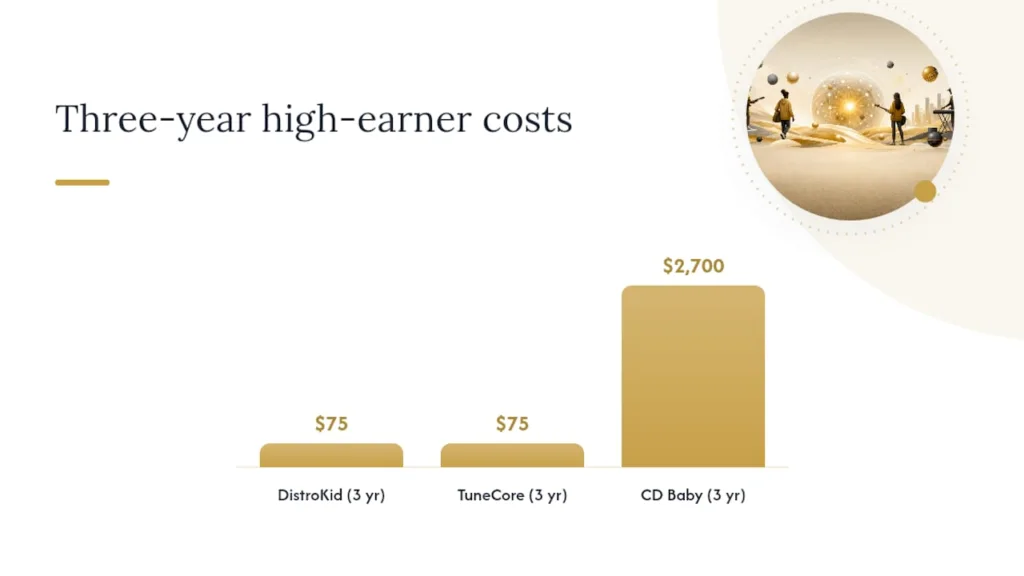
| High earner, $10,000/year streaming revenue | ~$75 total, 100% retained | $75 plus total, 100% retained | ~$30 one-time, but a 9% commission on streaming revenue = $2,700 over 3 years |
Scenario A: the hobbyist. Releasing once a year, CD Baby’s roughly $9.99 to $30 one-time fee beats three years of DistroKid or TuneCore subscriptions outright, since a one-time fee with permanent hosting avoids renewal costs entirely for low-volume catalogs.
Scenario B: the prolific releaser. At 12 releases a year, DistroKid’s flat annual fee stays fixed no matter how many uploads you add, while CD Baby’s per-release charges stack with every new song. The subscription model wins decisively here.
Scenario C: the high earner. This is where the math gets uncomfortable. A catalog generating $10,000 a year in streaming revenue costs $75 total over three years on DistroKid, versus roughly $2,700 in commission on CD Baby over the same period. That gap only grows as streams do.
When DIY Distribution Isn’t Enough
Choosing the right distributor solves half the problem. The other half, getting a release actually heard, requires marketing, visual content, and often a publishing strategy that no self-serve distributor provides out of the box.
A release uploaded correctly but promoted poorly still fails commercially. Distribution gets your music into stores. It does not get anyone to press play.
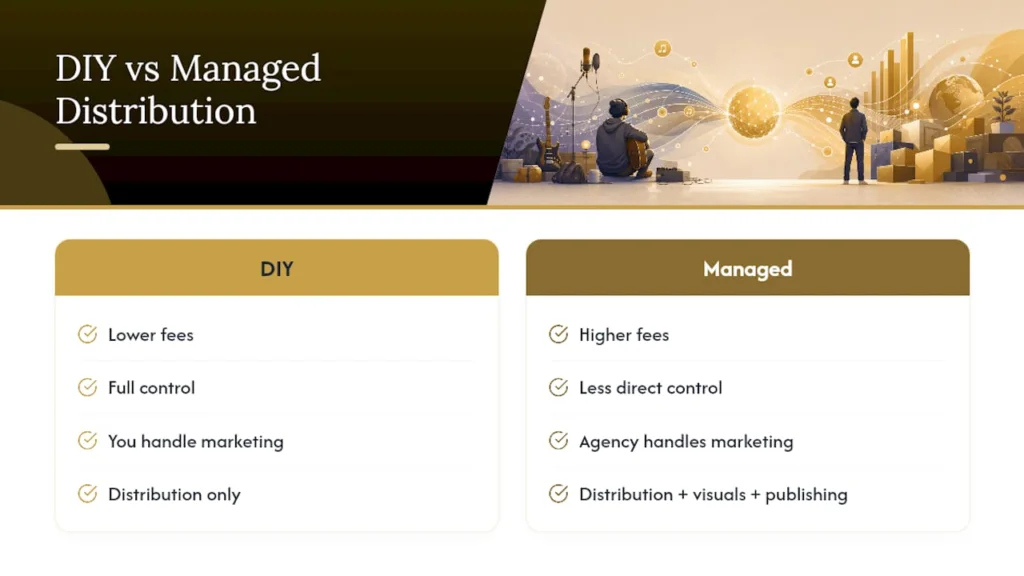
That’s the gap agency-managed services exist to close. Some managed music services approach releases as full projects rather than single uploads, coordinating production, visual content like music videos and visualizers, publishing setup, and campaign timing around a release date rather than treating distribution as the finish line.
The trade-off is straightforward: DIY distribution costs less and gives you full control, but it demands your own time for sync pitching, visual production, and campaign planning. A managed approach costs more upfront but replaces that workload with coordinated execution. For an artist with a strong song but no bandwidth to also become a marketer, video editor, and publishing administrator in the same week, that trade often pays for itself; for advice on legal music access and downloads, see Iranian music for download: best legal sources and how-to – DJ Phoenix Entertainment.
How We Evaluated These Music Distribution Services
The comparisons above weigh five factors consistently across every platform: pricing structure (flat fee, per-release, or revenue-share), royalty retention percentage, publishing administration availability, delivery speed to major DSPs, and what happens to a catalog if a subscription lapses or an artist stops releasing.
Pricing figures come from publicly stated rates verified against multiple 2026 industry roundups rather than promotional claims alone, since distributor pricing pages change frequently and roundups sometimes lag those updates. Where a platform’s terms shift between free and paid tiers, like Amuse’s historical revenue-share structure, that variability is flagged rather than presented as fixed.
The three-year cost scenarios use straightforward math: fixed annual or one-time fees compared against a percentage commission applied to a stated revenue figure, compounded across identical release volumes. No scenario assumes viral growth or worst-case underperformance. They model a steady, realistic catalog so the comparison stays fair across pricing models rather than favoring whichever platform benefits from an extreme assumption.
How and When Do Music Distributors Pay You?
Most distributors pay monthly, following the roughly 45 to 90 day lag it takes streaming platforms to report and remit royalty data back to the distributor. DistroKid and TuneCore typically process payouts monthly once funds clear from DSPs, while CD Baby has historically followed a similar monthly cycle tied to when Spotify, Apple Music, and other platforms report revenue.
Minimum payout thresholds vary by platform and by payout method. Some distributors let you withdraw small balances instantly through PayPal, while bank transfers or checks may carry a higher minimum before a payout triggers. PayPal tends to be the fastest option; direct bank deposit is often slower to set up but avoids PayPal’s transaction fees on larger balances.
The practical takeaway: if cash flow matters to you, check a distributor’s minimum payout threshold and payout method options before signing up, not after your first royalty check gets stuck below the minimum. An artist earning $15 a month on a platform with a $50 threshold waits far longer to see money than one on a platform with a $10 threshold and instant PayPal transfers.
What Contract Terms Should You Expect From a Distributor?
Reputable distributors, DistroKid, TuneCore, CD Baby, and the others on this list included, do not claim ownership of your master recordings or publishing rights. You retain full ownership; the distributor’s role is limited to getting your music into stores and collecting royalties on your behalf.
Contract length differs by pricing model. Subscription platforms like DistroKid and TuneCore operate on rolling annual terms. Cancel, and your catalog typically comes down from stores unless you’ve purchased a permanence add-on. CD Baby’s one-time fee model has no renewal term at all. Pay once, and the release stays live indefinitely without further contractual obligation.
Exclusivity is rarely required at the distribution level. You generally are not locked into using one distributor’s publishing administration or sync services just because they handle your streaming distribution. That said, some services, like Symphonic’s label partnerships, do involve more binding label-style agreements. Read those terms closely, since they operate differently from a simple self-serve upload agreement.
Are These Distributors Actually Trusted by Artists?
Reputation across the independent music community tends to track two things: reliability of payouts and responsiveness of support when something goes wrong, not flashy features.
DistroKid and TuneCore have built the largest user bases among independent artists, which comes with the tradeoff of slower, more templated support during high-volume periods like end-of-year tax reporting. CD Baby’s longer track record in the industry gives it credibility with artists who value stability over cutting-edge features. Smaller platforms like EmuBands have built loyal followings specifically around responsive, human support, a factor that matters enormously the first time a release gets stuck in review or a metadata error blocks a delivery deadline.
The honest pattern across artist communities is that no distributor has a spotless reputation. Every platform generates complaints about slow support during peak periods or confusing royalty statements. What separates the trusted names from the rest is consistency: artists return to DistroKid and TuneCore release after release not because either is flawless, but because the delivery and payout process behaves predictably once you understand it.
What Actually Matters When You Pick a Distributor
The conventional advice treats distributor choice like a one-time decision: pick one, upload, move on. That framing misses the real pattern in the data. The right distributor for your first release is often not the right one for your fiftieth.
What gets overlooked most is the compounding cost of commission-based models. It stops feeling irrelevant the moment a song breaks out, and by then switching distributors mid-catalog is a genuine hassle. Model your three-year numbers before you upload anything, not after a track takes off.
— DRVVYN Sound
DRVVYN Sound’s Music Project Management Service
DistroKid gets your track into Spotify. It does not build the visualizer, pitch the sync placement, or time your release around a coordinated campaign. That’s the gap DRVVYN Sound’s Music Project Management service is built to close for artists who’d rather hand off the coordination than learn it themselves.
Instead of choosing a distributor and handling production, visuals, publishing, and marketing separately, a music project management service can manage the release as one connected project, timing music video or visualizer production around the same calendar as your distribution date. This isn’t a replacement for a distributor. It’s what fills the space around one.
If you’re weighing whether to DIY your next release or hand off the moving pieces, start with a look at DRVVYN Sound’s Music Project Management guide and reach out to talk through what a managed release timeline could look like for your next drop.
Sources
- Best Music Distribution Services in 2026, Ranked by Royalty Payout | MelodicMind
- Musicproductionwiki
- Best Music Distribution Services 2026 Ranked | Dynamoi
FAQ
Is there a better distribution service than DistroKid?
It depends on your release habits: TuneCore edges ahead for songwriters needing publishing administration, and CD Baby wins for infrequent releasers who want permanent hosting without an annual fee.
What is the best distro for music in 2026?
For most active independent artists, DistroKid’s subscription model with a flat annual fee remains the strongest default, with TuneCore and CD Baby as the top alternatives depending on release frequency and publishing needs.
Should I use a distributor or hire a managed service like DRVVYN Sound?
A distributor alone works well if you’re comfortable handling your own marketing, visuals, and release timing; a managed service like DRVVYN Sound’s project management offering fits artists who want that coordination handled alongside distribution.