

Listening & Culture
Bass Frequencies at Night: What You’re Really Feeling
Discover the role of bass frequencies at night and how they transform sound into a profound, physical experience. Explore their impact on sleep and listening.
By DRVVYN · · 10 min read

Bass frequencies at night are defined as low-frequency sound waves, ranging from 20 Hz to 200 Hz, that become disproportionately prominent after dark due to acoustic, neurological, and physiological shifts in how your body receives them. The role of bass frequencies at night goes far beyond music preference. When the world quiets down, your body opens up. Bass stops being something you hear and starts being something you feel in your chest, your bones, your breath. Understanding why this happens changes how you listen, how you sleep, and how you relate to sound after sunset.
How do bass frequencies interact with the nighttime acoustic environment?
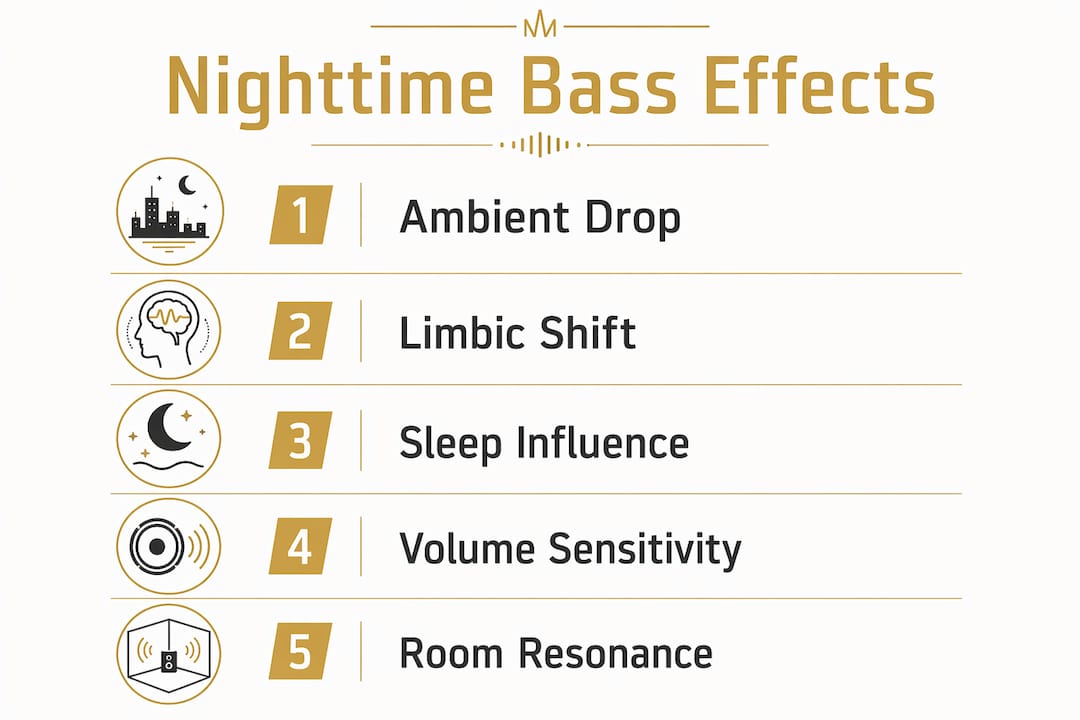
The night strips away the noise that normally buries bass. Ambient sound drops by up to 20 dB after dark, pulling back the acoustic curtain that masks low-frequency content during the day. That 20 dB reduction is not subtle. It is the difference between a quiet library and a busy street. When that masking disappears, bass tones that were always present suddenly surface with full weight.
Building physics make this worse, or better, depending on your perspective. Frequencies below 200 Hz penetrate residential walls with ease because their wavelengths are simply too long for standard wall construction to block. Human speech, which sits between 300 Hz and 3,000 Hz, gets absorbed. Bass does not. It passes through drywall, concrete, and insulation as if they are not there.
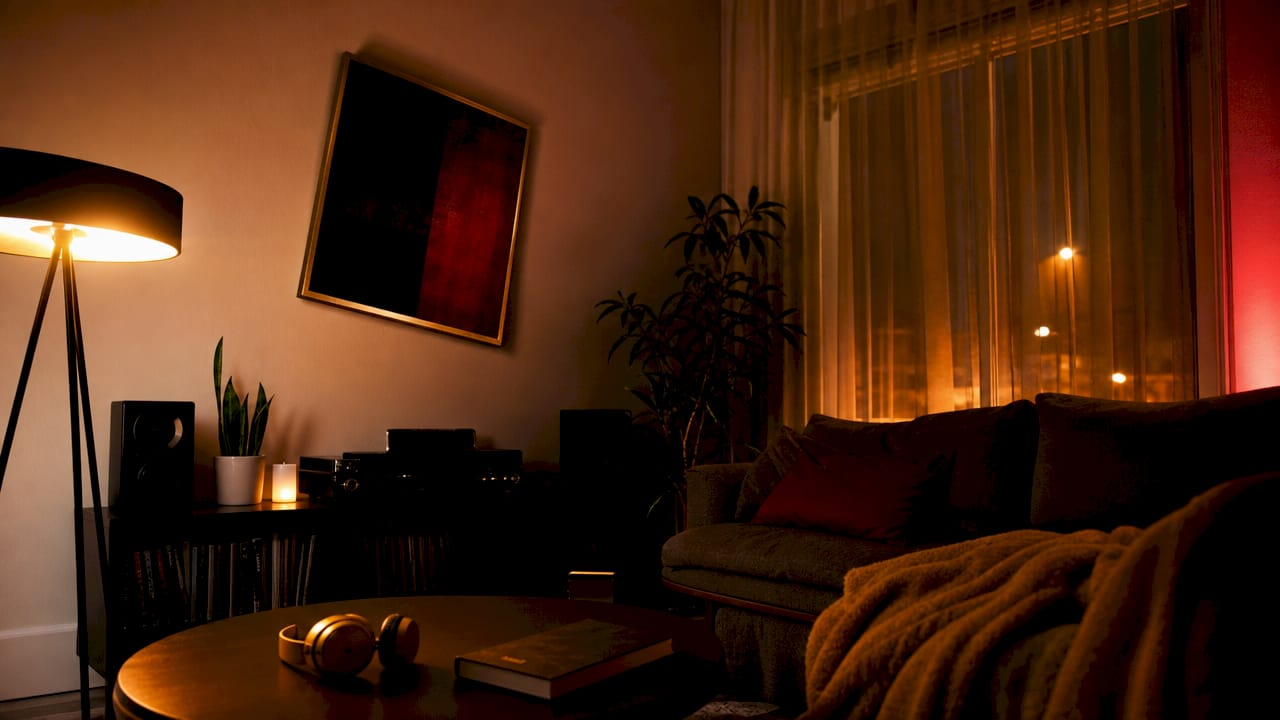
Walls and building materials vibrate with bass energy, acting like membranes that re-radiate sound into adjacent rooms. This is called structure-borne transmission, and it explains why you can feel a neighbor’s subwoofer in your mattress without hearing a single lyric. Your bedroom walls are not blocking bass. They are conducting it.
The table below shows how frequency range, wall penetration, and masking behavior differ across the audible spectrum.
| Frequency range | Typical source | Wall penetration | Daytime masking |
|---|---|---|---|
| 20–200 Hz (bass) | Subwoofers, kick drums, HVAC | High | Strong |
| 200–500 Hz (low-mid) | Bass guitar, male voice | Moderate | Moderate |
| 500–3,000 Hz (mid) | Speech, snare, piano | Low | Weak |
| 3,000 Hz+ (high) | Cymbals, sibilance | Very low | Minimal |
One more factor compounds all of this: room resonance. Every bedroom has a natural resonant frequency determined by its dimensions. When bass content hits that frequency, the room amplifies it. At night, with no ambient noise to compete, that resonance becomes the dominant sound in the space.
Why does your brain process bass differently at night?
Your brain at night is not the same organ it was at noon. Brain activity shifts from the prefrontal cortex to the limbic system after dark. The prefrontal cortex handles analysis, logic, and critical filtering. The limbic system governs emotion, memory, and physical sensation. When the limbic system takes over, bass stops being a sound you evaluate and becomes a feeling you absorb.
This shift is not metaphorical. Bass frequencies connect directly to the limbic system, bypassing rational analysis and triggering physical responses. That is why a bass drop at 2:00 AM hits differently than the same drop at 2:00 PM. Your brain’s emotional center is running the show, and bass is its native language.
Fatigue adds another layer. Auditory filtering weakens with tiredness, which means your brain treats bass rhythms as high-relevance signals rather than background texture. The filtering system that normally says “that’s just music, ignore it” stops working. Bass rhythms feel urgent, present, and physically real.
Bass also stimulates the vestibular and tactile systems through physical resonance and bone conduction. You are not just hearing low frequencies. Your inner ear, your skin, and your skeletal structure are all receiving the signal. This is why bass at night feels like it lives inside you rather than around you.
Pro Tip:If you want to use this shift intentionally, try listening to bass-heavy R&B or soul music through quality headphones between 10:00 PM and midnight. Your limbic system is primed for emotional depth at that hour, and the physical resonance of bass will feel more connected and personal than at any other time of day.
How do bass frequencies influence sleep and physical health at night?
Bass and sleep share a complicated relationship. Certain low-frequency ranges actively support sleep architecture. Low-frequency soundscapes in the 1–4 Hz range increase deep sleep stages by 19%, while 4–8 Hz content enhances REM sleep by 12%, and 8–12 Hz reduces sleep onset time by 15%. These ranges overlap directly with delta and theta brainwave activity, the states your brain enters during its most restorative phases.
That means intentional, gentle bass content can function as a sleep tool. Ambient music with slow, deep low-frequency pulses can guide your brain toward delta wave states more efficiently than silence alone. The key word is intentional. The bass must be steady, soft, and non-rhythmically aggressive.
The opposite is also true. Continuous thumping bass causes sleep disturbance, tinnitus, and mental health anxiety. Intrusive bass from a neighbor’s sound system or a nearby venue does not just wake you up. Over time, it degrades sleep quality, elevates cortisol, and creates a low-grade state of physical stress that persists even when the sound stops.
Here is what separates bass that helps sleep from bass that harms it:
Bass characteristics that support sleep:
- Frequencies in the 1–12 Hz range, aligned with delta and theta brainwaves
- Steady, non-percussive low-frequency tones without sharp transients
- Low volume, felt more than heard
- Consistent drone or ambient texture without rhythmic variation
Bass characteristics that disrupt sleep:
- Repetitive kick drum patterns above 60 Hz with sharp attack
- Intermittent or unpredictable bass bursts that trigger the startle response
- Bass transmitted through walls and floors as structure-borne vibration
- Any bass source loud enough to prevent sleep onset
The distinction is not about bass itself being good or bad. It is about pattern, frequency, and volume working together or against your body’s natural sleep cycle.
What are the best strategies for nighttime bass listening?
Managing bass at night means working with acoustics rather than against them. The first and most practical tool is brown noise for bass masking. Brown noise sits in the low-frequency range and mirrors the spectral shape of intrusive bass drones, effectively neutralizing them without requiring high volume. It is a more targeted solution than white noise, which spreads energy across all frequencies and can feel harsh at night.
Room treatment is the longer-term answer. Standard acoustic foam and earplugs are ineffective against low frequencies because bass wavelengths exceed the thickness of most treatment materials. Effective bass control requires bass traps with significant depth, typically corner-mounted panels at least 4 inches thick, and structural decoupling of walls and floors. This is not a weekend project, but it is the only physical solution that actually works.
Volume management is the most overlooked strategy. At night, your auditory system is more sensitive, so you do not need high volume to feel bass deeply. Reducing playback volume by 20–30% from your daytime level often produces a more immersive experience, not a quieter one, because your brain is already primed to amplify low-frequency signals.
One more thing worth knowing: not all nighttime bass comes from music. Internal building sources like HVAC systems operate in the same frequency range as musical bass. If you hear a low drone at night and cannot identify the source, check your heating and cooling system before assuming it is a neighbor’s subwoofer. Misidentifying the source leads to the wrong solution.
| Strategy | Best for | Limitation |
|---|---|---|
| Brown noise masking | Intrusive neighbor bass | Does not eliminate the source |
| Bass traps and room treatment | Controlling room resonance | Requires installation and cost |
| Volume reduction | Personal listening comfort | Requires discipline at night |
| Structural decoupling | Blocking transmitted bass | Major renovation required |
Key Takeaways
Bass frequencies become physically and emotionally dominant at night because your acoustic environment, brain chemistry, and auditory system all shift in ways that amplify low-frequency perception.
| Point | Details |
|---|---|
| Nighttime ambient drop | Sound floor falls by up to 20 dB at night, making bass content far more prominent. |
| Brain shifts to limbic system | Emotional bass perception intensifies after dark as the prefrontal cortex yields to limbic dominance. |
| Bass penetrates walls | Frequencies below 200 Hz pass through walls easily, making structure-borne bass unavoidable. |
| Sleep frequency overlap | Low-frequency content in the 1–12 Hz range aligns with delta and theta brainwaves and can deepen sleep. |
| Brown noise as a tool | Brown noise effectively masks intrusive bass drones without requiring high volume or structural changes. |
What I’ve learned from listening after midnight
There is a moment, usually around 11:00 PM, when music stops being background and starts being presence. I have felt it in my own listening sessions, and I have heard listeners describe it the same way: the bass drops, and something in your chest responds before your mind catches up. That is not imagination. That is your limbic system doing exactly what it was built to do.
What surprises most people is how little volume you actually need at night. The acoustic environment does the work for you. The ambient noise is gone, your auditory filters are down, and your body is already tuned to receive low-frequency information. Cranking the volume is not just unnecessary. It works against you, pushing bass from immersive to intrusive.
The part that most listeners miss is the neighbor question. Your bass does not stay in your room. It travels through your floor, your walls, and your ceiling, and it arrives in someone else’s space at full intensity while the higher frequencies disappear. Being aware of that is not about limiting your enjoyment. It is about understanding the physics so you can make choices that feel good for everyone in the building.
The best nighttime listening sessions I have experienced share one thing: intentionality. Knowing why bass hits harder after dark lets you choose music that uses that effect well, set volume that works with your body rather than against it, and create a listening environment that feels like a room built for exactly this moment.
— DRVVYN
Drvvynsound and the sound that finds you at night
If you have ever felt a bass line settle into your chest at 1:00 AM and wondered why it felt so much heavier than it did that afternoon, you already understand what Drvvynsound is built for. DRVVYN creates music that meets you in that exact space: emotionally open, physically receptive, and ready for sound that means something.

Drvvynsound’s catalog is designed with late-night listening in mind. The R&B production carries low-frequency weight that rewards the nighttime acoustic environment rather than fighting it. Whether you are winding down, processing a feeling, or just letting the bass do what bass does after dark, explore the full catalog and find the sound that fits the hour.
FAQ
What is the role of bass frequencies at night?
Bass frequencies at night become more physically prominent because ambient noise drops by up to 20 dB, removing the masking that suppresses low-frequency content during the day. Your brain also shifts toward limbic dominance after dark, making bass feel more emotional and physical than intellectual.
Why can you hear your neighbor’s bass but not their voice at night?
Frequencies below 200 Hz pass through walls easily due to their long wavelengths, while speech frequencies between 300 Hz and 3,000 Hz are absorbed by standard building materials. At night, the drop in ambient noise removes the last layer of masking, making transmitted bass even more audible.
Can bass frequencies help you sleep?
Low-frequency content in the 1–4 Hz range increases deep sleep stages by 19%, and 4–8 Hz content enhances REM sleep by 12%. The bass must be gentle, steady, and non-percussive to support sleep rather than disrupt it.
Does brown noise actually block bass from neighbors?
Brown noise does not block bass. It masks it by filling the low-frequency range with a steady, non-rhythmic signal that your brain stops treating as a threat. It is most effective against continuous bass drones rather than intermittent thumping.
Why does bass feel stronger at night even at the same volume?
Auditory filtering weakens with fatigue, so your brain flags bass rhythms as high-relevance signals rather than filtering them out. Combined with the nighttime drop in ambient noise and the limbic system’s dominance over emotional processing, bass at the same volume genuinely registers as more intense after dark.