

Listening & Culture
Build a Late-Night Listening Playlist That Hits Different
Learn how to build a late-night listening playlist that perfectly captures the mood of the night. Create emotional and atmospheric coherence.
By DRVVYN · · 9 min read

A late-night listening playlist is a curated sequence of tracks designed to match the heightened emotional sensitivity and quieter acoustic environment of nighttime hours. When you build a late-night listening playlist with intention, you create something closer to a mood chamber than a random shuffle. The goal is emotional and atmospheric coherence: every song should feel like it belongs in the same room as the one before it. Research shows that optimal playlist length sits between 60 and 120 minutes. That window is long enough to complete a full emotional arc without tipping into repetition or fatigue.
What makes the late-night listening mood different from daytime?
The late-night listening mood is not simply “quieter music.” It is a physiologically distinct state that changes how you receive and process sound. Understanding that distinction is the foundation of good playlist curation.
Your body’s circadian rhythm triggers a melatonin surge after dark. That shift reduces activity in the prefrontal cortex, the part of your brain responsible for rational filtering and social performance. The result is that emotional sensitivity deepens at night, making music feel more personal and more penetrating than it does at noon.
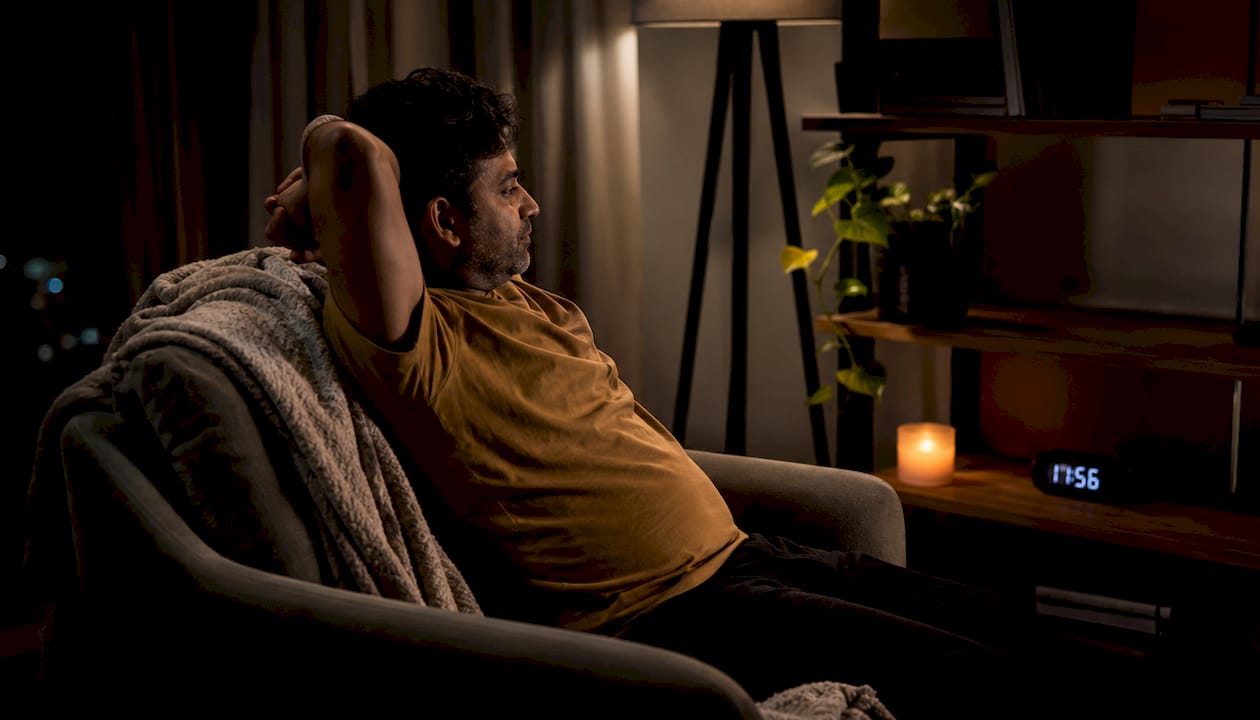
The acoustic environment changes too. Nighttime ambient noise drops by 15–30 decibels compared to daytime levels. That reduction removes the auditory masking that buries subtle details during the day. Stereo width, reverb tails, and soft vocal textures all emerge more clearly when the world goes quiet around you.
Nighttime listening also serves a specific emotional function. Music at night activates emotional regulation by removing the social performance pressures that follow you through the day. You are no longer performing for anyone. That openness makes honest, vulnerable tracks land with a weight they simply cannot carry at 2:00 PM.
“At night, the silence is sharp enough that music fills it completely. Your guard is down, your filters are off, and a single chord can carry the weight of something you have been carrying all day.”
The contrast with daytime listening is stark. Daytime playlists compete with noise, distraction, and the need to stay functional. A midnight mood playlist does not compete with anything. It occupies the whole room.
- Emotional receptivity increases as melatonin rises and rational filtering decreases.
- Acoustic clarity improves because ambient noise drops, revealing subtle mix details.
- Introspective depth grows because social pressure lifts after dark.
- Vulnerability opens the door for honest, emotionally raw tracks to resonate fully.
How do you structure the emotional arc of a late-night playlist?
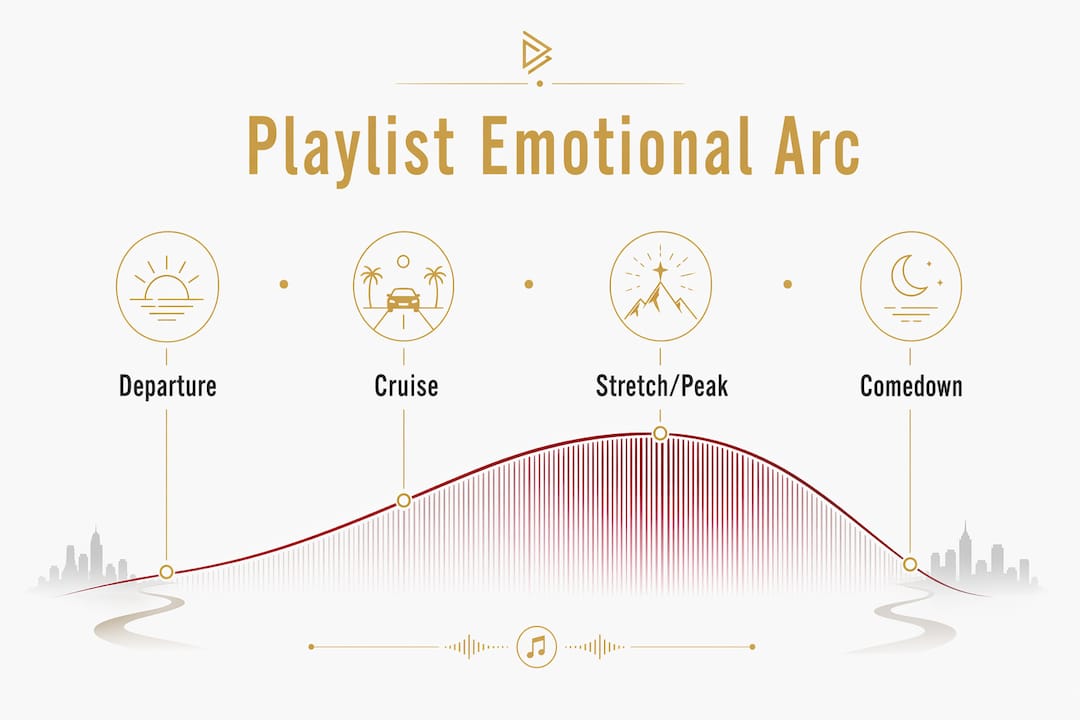
Effective late-night playlist sequencing follows a four-part emotional arc: Departure, Cruise, Stretch/Peak, and Comedown. Random song order destroys the sense of a journey. Intentional sequencing creates one.
Departure: the warm-up
The Departure phase opens the playlist with tracks that feel familiar and grounding. These songs should have moderate energy, not too loud and not too sparse. Think of them as the door you walk through. They signal to your nervous system that the night has officially begun. Warm acoustic guitar, soft piano, or a gentle R&B groove all work well here.
Cruise: the steady middle
The Cruise phase is where the playlist settles into its core identity. Energy stays consistent. The mood deepens without spiking. This is the longest phase, typically covering 40–50% of your total runtime. Songs here should share a similar tempo, key, or emotional texture. Listeners should feel suspended in the mood rather than pushed through it.
Stretch/Peak: the emotional center
The Stretch or Peak phase holds the most emotionally charged tracks. This is not necessarily the loudest moment. It is the most honest one. A single, spare vocal over a minimal beat can carry more weight here than a full production. Sparse textures and undefended vocals outperform dark, moody clichés that feel manipulative after repeated listens.
Comedown: the release
The Comedown phase brings the listener back to earth. Tracks here should feel like exhaling. Slower tempos, softer dynamics, and more space between notes all signal that the emotional peak has passed. This phase prevents the playlist from ending abruptly and leaves you feeling settled rather than cut off.
Pro Tip:Listen through the entire sequence in one sitting before you publish or share it. Flow problems that seem invisible when you build track by track become obvious when you hear the full arc without stopping.
What sound elements work best for nighttime playlists?
The technical qualities of a track matter as much as its emotional content when you curate a midnight mood playlist. A song can feel right thematically but still break the spell if its production is too aggressive.
Tempo and energy
For chill and downtempo genres, a BPM range of 60–90 keeps the energy grounded without feeling stagnant. For soft electronic or late-night house, 118–124 BPM can work if the mix is spacious and the dynamics stay controlled. The key is consistency. Abrupt tempo jumps and loud drops pull listeners out of the mood immediately.
Mixing and production qualities
| Feature | What to favor | What to avoid |
|---|---|---|
| Dynamic range | Quiet passages, soft peaks | Compressed, wall-of-sound mixes |
| Bassline | Warm, rounded low end | Punchy, aggressive sub hits |
| Vocals | Breathy, intimate, or sparse | Loud, belted, or heavily processed |
| Reverb and space | Wide stereo, long tails | Dry, close, or cluttered mixes |
| Overall volume | Comfortable at low levels | Tracks that only work loud |
Genres that consistently deliver these qualities include ambient, downtempo, lo-fi hip-hop, acoustic soul, soft R&B, and minimal electronic. These are not the only options, but they share a common trait: they reward quiet listening.
Pro Tip:Test every track at low volume before adding it to your playlist. Songs that only work loud will disrupt the introspective flow the moment your volume drops.
A common mistake is equating late-night with sleepy. Experienced curators keep a restrained rhythmic pulse running through the playlist to prevent it from going flat. The goal is suspended, not sedated.
How do you build and maintain your personalized night playlist?
Building a mood-based night playlist works best when you treat it as a living document rather than a finished product. Start focused, then refine over time.
The initial build
- Choose a core mood. Pick one emotional anchor: reflective, tender, restless, or peaceful. Every track you add should serve that anchor.
- Select 12–15 songs. That range covers 60–120 minutes at average track length, which is the ideal session window for a complete emotional experience.
- Sequence into the four arc stages. Assign roughly 2–3 songs to Departure, 5–6 to Cruise, 2–3 to Stretch/Peak, and 2–3 to Comedown.
- Run a full listening test. Play the playlist under actual night conditions: lights low, headphones on, no multitasking. Note any track that breaks the spell.
- Cut what does not belong. Remove songs that feel too bright, too aggressive, or emotionally mismatched. One wrong track can fracture the whole arc.
Ongoing maintenance
Monthly playlist review is the single most effective way to preserve cohesion over time. Removing weak links matters more than adding new ones.
- Remove tracks that feel overplayed or that no longer match the mood.
- Add no more than 2–3 new songs per review cycle to avoid genre drift.
- Check that the four-arc structure still holds after any changes.
- Retest the full sequence after every significant edit.
Genre drift is the quiet killer of a great playlist. It happens gradually: you add one slightly brighter track, then another, and six months later the playlist sounds nothing like it did when you built it. Monthly pruning catches that drift before it takes over.
Key Takeaways
A well-built late-night playlist follows a four-part emotional arc, uses tracks that hold up at low volume, and gets reviewed monthly to stay cohesive.
| Point | Details |
|---|---|
| Nighttime changes how you hear | Melatonin and reduced ambient noise make music feel more emotional and detailed after dark. |
| Use the four-part arc | Structure tracks into Departure, Cruise, Stretch/Peak, and Comedown for intentional flow. |
| Test tracks at low volume | Songs that only work loud will break the introspective mood of a nighttime session. |
| Start with 12–15 songs | That range covers 60–120 minutes, the ideal length for a complete emotional arc. |
| Review monthly | Prune overplayed or mismatched tracks before genre drift quietly reshapes your playlist. |
What I have learned from building playlists at 2:00 AM
The science confirmed what I already felt in my chest: night listening is different. Once I understood that melatonin lowers your rational guard and that the quiet amplifies every detail, I stopped treating my late-night playlists like daytime ones with the volume turned down. I started building them the way you would set a room before a conversation you actually care about.
My favorite tracks for this hour share one quality: they do not try too hard. A breathy vocal over a warm bassline, a piano note that hangs in the reverb longer than it should, a lyric that sounds like someone finally said the thing they had been holding. Those are the songs that stay. The ones that perform emotion rather than carry it get cut fast.
The hardest part of maintaining a playlist is resisting the urge to add too much. I have broken my own playlists by chasing variety. The best late-night sequence I ever built had 13 songs and I did not touch it for four months. That restraint was the point.
If you are building your first personalized night playlist, start with the mood you actually feel at midnight, not the mood you think you should feel. The playlist will tell you what it needs. Your job is to listen honestly and edit without mercy.
— DRVVYN
Drvvynsound and the sound of your late nights
The tracks that work best after midnight share something with everything Drvvynsound creates: emotional honesty, warm production, and the kind of depth that rewards quiet listening. DRVVYN’s music is built for exactly the hours this article is about.

If you are ready to add something real to your late-night rotation, DRVVYN Essentials brings together original R&B and cinematic sound designed for introspective, after-dark listening. These are not background tracks. They are the kind of songs that make you stop what you are doing and just feel. Head to Drvvynsound to find music that belongs in your midnight playlist.
FAQ
What is the ideal length for a late-night playlist?
The ideal length is 60–120 minutes. That window delivers a complete emotional arc without repetition or listener fatigue.
How do I build a late-night listening playlist for the first time?
Start with a single core mood, choose 12–15 songs, and sequence them into four stages: Departure, Cruise, Stretch/Peak, and Comedown. Test the full sequence under actual night conditions before finalizing.
Why does music sound better at night?
Melatonin rises after dark and reduces prefrontal cortex activity, which deepens emotional sensitivity. Ambient noise also drops by 15–30 decibels, revealing subtle mix details that daytime noise masks.
What genres work best for a late-night mood playlist?
Ambient, downtempo, lo-fi hip-hop, acoustic soul, soft R&B, and minimal electronic consistently suit nighttime listening. They share warm production, controlled dynamics, and tracks that hold up at low volume.
How often should I update my late-night playlist?
A monthly review keeps the playlist cohesive. Remove overplayed or mismatched tracks first, then add no more than 2–3 new songs per cycle to prevent genre drift from reshaping the mood over time.