
Music Marketing
Seed Five to Ten Micro Creators to Move Your Music Streams
Seed five to ten micro creators with a 15 to 30 second stem, track saves and playlist adds, and run a low risk test that lifts your music streams.
By DRVVYN · · 12 min read
Yes, influencer marketing is worth your time as an independent artist, and the fastest place to start is a micro creator UGC seeding campaign on short form video. Give five to ten small creators a 15 to 30 second stem and a tracking link, then watch what happens to saves and streams over the next two weeks. Saves and playlist adds are the number to watch first, not follower counts or likes.
TL;DR:
- Micro creators with smaller followings tend to offer better value for the cost and should be prioritized for testing influencer campaigns.
- TikTok, Instagram Reels, YouTube Shorts, and Twitch each serve different discovery and engagement purposes, requiring tailored call-to-action strategies.
- Effective creator vetting relies on engagement quality and audience fit rather than follower count alone, with short and specific outreach increasing response rates.
- Campaign success relies on tracking consistent KPIs like saves, playlist adds, and click-throughs, using UTMs and distinct links for attribution.
- Disclosures must be clear and timely, with artists sharing liability for unproper disclosures, especially when content is paid or gifted.
Your quick start checklist for a first campaign
You do not need a big budget to test whether influencer marketing works for your song. You need a clear format, a few honest creators, and a way to measure what happens after they post.
Start by choosing one campaign type that matches where your song already feels strongest emotionally:
- UGC seeding: send a 15 to 30 second stem to five to ten micro creators and ask for an organic reaction or use.
- Dance or movement challenge: works best when your hook has a rhythmic, repeatable moment in the first eight seconds.
- Storytelling clip: pairs a creator’s personal narrative with your lyrics, ideal for ballads and emotionally heavy tracks.
- Duet or stitch format: invites a second voice into your song, useful for building community around a chorus.
- Livestream listening session: works on Twitch or Instagram Live when you want direct, real time reaction.
Before you reach out to anyone, prepare these:
- A clean 15 to 30 second stem or clip cut at the song’s emotional peak.
- Your streaming links (Spotify, Apple Music) and one trackable link for click attribution.
- A one-paragraph creative brief describing the mood, the ask, and the disclosure requirement.
- A short list of five to ten creators whose tone matches your song’s feeling, not just its genre.
Give the test two weeks. If saves and adds move, you have a format worth repeating.
Which platforms to prioritize and how each one behaves
Short form video is where most new music gets found now. Deloitte’s 2024 survey found that a large majority of Gen Z and millennials discover new music on social media or UGC sites, while a much smaller share rely on streaming service recommendations. That gap is the whole argument for creator partnerships.
TikTok remains the strongest discovery engine, especially when a creator uses your song inside a moment that already fits their content style rather than a scripted ad. UGC video use on the platform has been linked to chart and playlist attention when a track gets picked up widely by creators.
Instagram Reels works well for visual branding and paid amplification. Stories give you swipe-up or link stickers for direct traffic, and Reels benefit from a small paid boost once an organic post shows early traction.
YouTube splits into two jobs: Shorts for discovery, long-form for depth. A creator’s full-length reaction or “first listen” video builds trust in a way a six-second clip cannot, and it often gets added to a creator’s own playlists.
Twitch and livestreams serve a smaller, more devoted audience. Conversion happens in real time through chat links, donation prompts, or a host reading your streaming link aloud.
- TikTok: fastest discovery, best for short emotional hooks.
- Instagram Reels: strongest for visual identity and paid boosting.
- YouTube: best for storytelling depth and long-term playlisting.
- Twitch: smallest reach, highest intimacy and direct conversion.
Each platform has its own CTA mechanics, so brief creators to use the link sticker on Instagram, the pinned comment on YouTube, and the bio link on TikTok rather than a generic “check the link” line.
How to find and vet creators who will actually move your streams
Finding creators is easy. Finding the right ones takes a little more patience.
Start with hashtag search on TikTok and Instagram using your genre and mood tags together, not just the genre alone. Genre-specific Discord and Reddit communities often surface creators who already talk about music like yours. Creator marketplaces can speed up discovery, but manual curation, scrolling a creator’s last twenty posts, still catches things a filter misses.
When you vet a creator, look past follower count:
- Engagement rate relative to their audience size, not the raw like count.
- Comment quality: do people respond emotionally, or just drop emojis.
- Audience fit: does their typical viewer match your listener, by mood and age, not just genre.
- History with music placements: have they used songs from other independent artists before.
Pro Tip:Watch how a creator talks about music they were not paid to promote. That tone is the tone your song will get too.
Outreach should be short and specific. Introduce the song in one line, explain what feels authentic about the fit, name the format you are proposing, and state the compensation or product offer clearly. Avoid vague asks like “would love to work together,” since specific briefs get faster replies.
Red flags include sudden follower spikes, comment sections full of unrelated language, and creators who ask for payment before any conversation about format or fit. Verify by checking a few months of post history for consistency before you commit a budget.
Creative formats that perform and how to brief them
The songs that travel on social media almost always give creators something specific to react to, not just a song to play in the background.
Formats that consistently perform include: stem drops that let creators build their own audio moment, movement or dance challenges tied to a repeatable hook, duet and stitch formats that invite a second creator’s voice, storytelling clips where a creator narrates a personal moment against your lyrics, and short visualizer loops that give editors a ready-made visual layer.
A brief does not need to be long. One paragraph should cover:
- The objective: awareness, saves, or a specific release-day push.
- The required asset: which stem, clip, or visualizer to use.
- The disclosure requirement, stated plainly and in the creator’s own words.
- Usage rights: whether you can repost their content and for how long.
- The timeline: post date, any embargo, and when payment or product ships.
Leave room for the creator’s own voice. A brief that scripts every second usually produces flat content, while one that states the emotional goal and lets the creator shape the delivery tends to feel more native to their audience.
Before you approve anything, confirm you have final assets, disclosure language, usage rights, and a posting window in writing.
What to budget and how to structure a low-risk test
Micro creators, generally those with 1,000 to 50,000 followers, tend to deliver a stronger return relative to cost than larger accounts, which is why Deloitte’s research points toward testing a batch of smaller creators before committing to one large partnership.
Common payment models include:
- Gifting: free merchandise, early access, or a feature in exchange for content, common with very small creators.
- Fixed fee: a flat payment per post, the most predictable model for budgeting.
- Performance pay: compensation tied to views, saves, or clicks, which shifts risk toward the creator.
- Affiliate or commission: a cut of streaming or merchandise revenue generated through a tracked link.
For a first test, spread a small budget across five to ten micro creators rather than one mid-tier name. Set a simple checkpoint, such as a minimum view count or engagement rate, before you agree to a second post. Once you see which creators and formats produce real streaming lift, scale spend toward those specific creators and calculate your cost per stream or cost per playlist add before expanding further.
How to measure whether a campaign actually worked
The only way to know if a campaign is working is to track it the same way every time.
Primary KPIs to watch: streams and playlist saves, follower growth on your own profiles, engagement on the creator’s post itself, and click-throughs on any tracked link. Saves matter more than raw stream count in the first week, since a save signals a listener plans to return.
Attribution gets easier with a few habits: use UTM-tagged links for every creator post, give each creator a distinct promo code or link variant, and compare streaming numbers in the days immediately before and after a post goes live to estimate lift. A privacy-first measurement framework can help you track this without relying on platform-side data alone.
| Metric | What it tells you | How to track it |
|---|---|---|
| Streams | Overall listening volume | Streaming platform analytics |
| Saves or playlist adds | Intent to return to the song | Spotify for Artists, Apple Music for Artists |
| Click-throughs | Direct response to a creator’s post | UTM-tagged links |
| Engagement rate | How the creator’s audience responded | Platform native insights |
Calculate cost per stream by dividing total spend by the streams generated during the campaign window, and do the same for cost per playlist add. Review results weekly during a test and monthly once a format is proven, and treat a cost per add that is climbing rather than falling as your signal to pause and rework the creative.
FTC disclosure rules and what to put in every brief
Every creator you work with, paid or gifted, has to disclose the relationship, and that rule is not optional. The FTC’s plain-language guide requires disclosures to be clear, conspicuous, and hard to miss, with video content needing both on-screen text and a spoken mention when possible.
Disclosures must be placed where they are hard to miss, not buried in a hashtag string or a video description.
The FTC’s own guidance also makes clear that responsibility does not stop with the creator. As the artist or brand directing the campaign, you share liability if a post fails to disclose properly, which means monitoring posts after they go live matters as much as writing the brief beforehand.
Every brief should include:
- Plain disclosure language such as “#ad” or “Paid partnership” placed in the first line of a caption.
- A spoken disclosure cue for any video content, not just on-screen text.
- A reminder that gifted product still requires disclosure, even without a cash payment.
What a full campaign flow looks like in practice
A workable flow usually moves through three stages: seed a stem with a small group of creators two to three weeks before release, push harder on release day with a coordinated round of posts and a livestream listening session, then follow up in the two weeks after with creator-shared visualizer content to keep the song circulating.
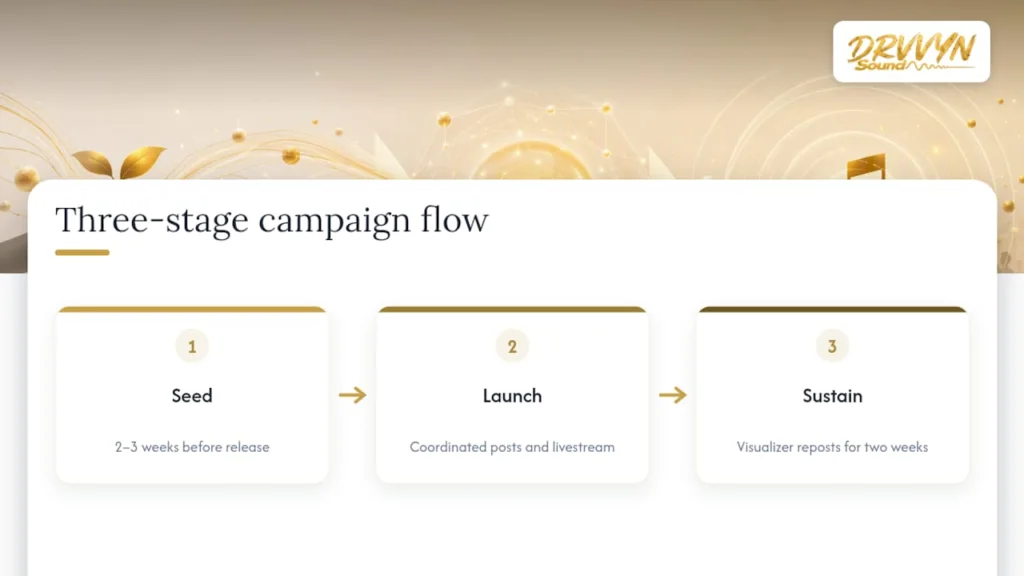
For a project like DRVVYN’s own catalog of cinematic R&B, that means preparing a short list of assets ahead of time: a 15 to 30 second stem cut at the song’s emotional turn, a finished visualizer loop creators can repost, a one-sentence story hook that explains what the song is about emotionally, and a single tracked link that routes to streaming platforms.
The same asset kit supports licensing conversations too. A visualizer or cinematic clip built for a creator campaign can double as a pitch asset for licensing opportunities down the line, which is part of how DRVVYN Sound approaches artist branding: build once, use across both fan-facing and business-facing channels.
What to actually expect from influencer marketing right now
Chasing a single viral moment is the wrong goal. A song that spikes for a week and disappears did not build you an audience, it borrowed one temporarily. The artists who benefit most from creator partnerships treat each campaign as a discovery tool that feeds a fan community they are building on their own terms, not as the end goal itself.
Paid creator campaigns make sense when you have a specific release moment to support and a clear asset ready to seed. Owned community work, email lists, a Discord, a consistent posting rhythm, matters more over a year than any single campaign. The goal of a good influencer push is not just streams. It is converting a stranger’s attention into someone who saves your next song too.
— DRVVYN Sound
If you would rather have the creative and campaign built for you
Running a self-managed influencer campaign takes time most independent artists do not have between writing, recording, and everything else. DRVVYN Sound offers an alternative path for artists who want the cinematic assets, an artist to build a story around it, without building the campaign alone: visual production, artist branding, and licensing support built around the same emotionally driven storytelling that a good creator campaign needs.
- Cinematic visualizers and music video assets ready for creator seeding.
- Artist branding and campaign creative built around a song’s emotional core.
- Licensing support for artists who want their music placed with brands or media partners.
If managed creative and licensing sound like a better fit than running outreach yourself, that page is the place to start the conversation.
Sources
- Digital media trends: Consumer attitudes and behaviors (Deloitte) – 2024
- Disclosures 101 for Social Media Influencers (FTC staff guide)
- FTC’s endorsement guides: What people are asking (FTC consumer guidance)
FAQ
How do I find influencers to promote my music?
Search genre and mood hashtags on TikTok and Instagram together, check genre-specific Discord and Reddit communities, and manually review a creator’s last twenty posts for tone and engagement quality before reaching out. Creator marketplaces can speed this up, but manual review still catches fit that filters miss.
Can I pay someone to promote my music?
Yes, paid promotion is common and works through fixed fees, performance pay, or affiliate commissions tied to a tracked link. Any paid arrangement, including free product, requires the creator to disclose the relationship clearly under FTC rules.
What does a music influencer do?
A music influencer creates content, like a dance clip, a reaction video, or a storytelling post, that features an artist’s song to their own audience, often driving new listeners to streaming platforms. Their value comes from authentic use of a track rather than a scripted advertisement.
Does Spotify do influencer marketing?
Spotify itself does not run paid influencer campaigns on behalf of individual artists, but songs that gain traction through creator content on platforms like TikTok often see downstream lift in Spotify streams and playlist adds. Deloitte’s research points to UGC video as a major driver of that kind of discovery.