
Music Business
Indie Musicians: Micro Sync Licensing Checklist, Metadata First
Publisher backed micro sync licensing playbook for indie musicians. Concise registration checklist, metadata first tactics, Content ID setup, and steps to…
By DRVVYN · · 9 min read
Micro sync licensing is the high-volume, digital-first version of sync licensing. Small fees, sometimes just a few dollars, get paid out across TikTok, YouTube, and other short-form platforms every time your song rides underneath someone else’s video, and those fees compound when your catalog gets used widely. The real payoff isn’t one big check. It’s registering your rights correctly so hundreds of tiny uses turn into a real, recurring stream of income.
TL;DR:
- Micro sync royalties can generate recurring income through tiny payments from platforms like TikTok and YouTube, which compound as your catalog is used widely.
- Accurate registration with PROs, SoundExchange, and matching metadata across platforms are essential to ensure you receive all owed micro sync royalties automatically.
- Platforms such as TikTok and Reels typically pay through blanket licensing deals, while YouTube may route royalties via Content ID detection and monetization.
- Independence from traditional sync deals makes micro sync suitable for artists with a high-volume catalog and music that appeals to digital creators.
- Proper catalog management and fast outreach during viral moments can maximize income from short-form video placements and social media trends.
What Is Micro Sync Licensing, and How Is It Different From Traditional Sync?
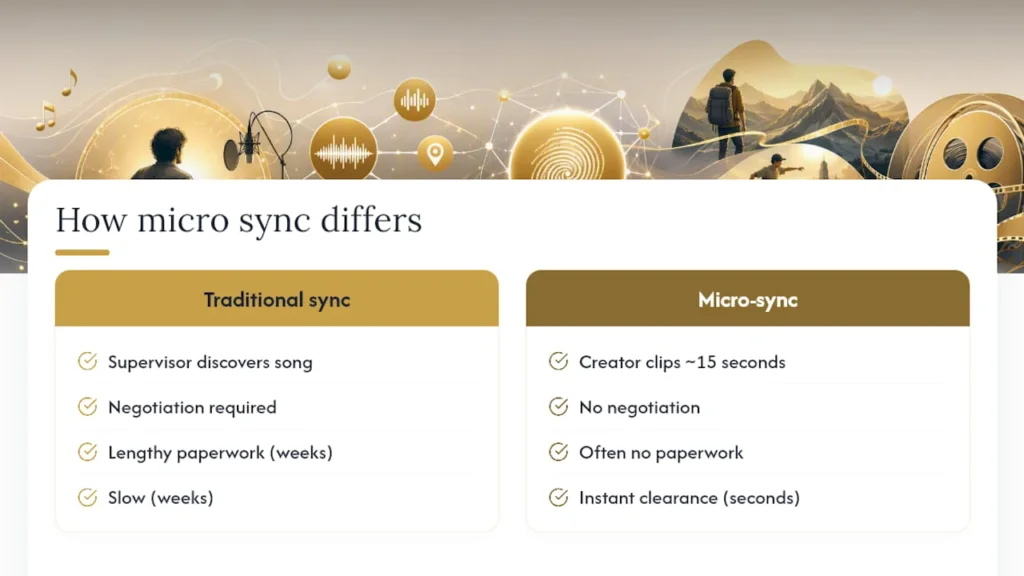
You already know traditional sync. A supervisor hears your song, negotiates a fee with your publisher, signs paperwork that takes weeks, and your track lands in a TV drama or a car commercial for a check that might run into the thousands. That world still exists, and it still matters. But it’s not where most independent musicians are getting paid anymore.
Micro sync licensing lives somewhere quieter. It’s the version that happens when a stranger clips fifteen seconds of your song under a TikTok transition, a YouTube Shorts edit, an Instagram Reel, a Twitch highlight reel, or the background of a podcast ad read. No supervisor. No negotiation. Often, no direct contact between you and the person using your music at all. The micro-sync model is scale-driven by design, built on thousands of small, pre-cleared or platform-covered uses rather than one carefully brokered deal.
The creator economy runs on speed, and micro-sync was built to match that pace. A YouTuber editing a video at midnight isn’t waiting three weeks for licensing approval. They need a track cleared in seconds, which is exactly why pre-cleared libraries and blanket platform deals exist. Your job as an artist isn’t to negotiate each use. It’s to make sure your rights are set up so the system pays you automatically when it happens.
How Micro Sync Royalties Actually Work
Every time your song shows up in someone’s video, it can trigger more than one kind of royalty, and understanding which one applies to you changes how you plan your income.
There are three royalty types that matter here, and they don’t all flow to the same person or through the same door:
- Performance royalties get paid when your composition is performed publicly, including streamed video. These flow through your PRO.
- Mechanical royalties cover the reproduction of your composition and typically route through your publisher or a mechanical rights organization.
- Master-use royalties compensate the sound recording owner (often the artist themselves, if independent) whenever the actual recorded track is used.
If you wrote the song and recorded it yourself, you’re entitled to both the composition side and the master side. That’s a meaningful advantage independent musicians have over signed artists who’ve given up master ownership.
Platform deals complicate this picture in a useful way. Many platforms negotiate blanket licensing agreements with rights holders and collecting bodies, which means a single Reels clip might trigger a payment governed by a broader agreement rather than a one-off license. PROs and collecting societies handle the performance side, while SoundExchange manages digital performance royalties for sound recordings under U.S. statutory rules, covering webcasters and certain streaming uses that fall outside standard platform deals. If you’re not registered with both, you’re leaving money on the table that’s already been collected on your behalf and is sitting unclaimed.
Registering and Collecting: A Practical Checklist
Getting paid for micro-sync isn’t automatic just because someone used your song. It’s automatic only if you’ve done the paperwork first. Here’s the order that actually works:
- Register your composition with a PRO (ASCAP, BMI, or another performance rights organization) and register your master recording with SoundExchange. This is the foundation. Skip it, and none of the downstream systems know you exist.
- Bring in a publishing administrator or distributor to handle registration with platform partners and mechanical rights organizations. Companies like Songtrust often maintain direct agreements with platforms to collect on your behalf, which matters because you can’t personally negotiate with TikTok.
- Set up Content ID or the platform’s rights manager tool, and make absolutely sure your metadata (ISRC, ISWC, writer names, publisher names) matches across every registry. Mismatched metadata is the single biggest reason legitimate uses go unpaid.
- Monitor your statements monthly and reconcile them against known uses. Catch split errors early, before six months of misdirected royalties pile up.
Pro Tip:Name variants kill more royalties than piracy does. If your PRO has you registered as “J. Smith” but your distributor lists “John Smith,” automated matching systems can fail to connect the two, and your royalties stall in limbo. Use one exact name, everywhere, permanently.
Follow that sequence, and you’ve built the infrastructure that catches money automatically instead of chasing it manually later.
Where Micro Sync Deals Happen and What They Pay
Not every platform pays the same way, and knowing the difference shapes how you think about which uses actually matter for your income.
- TikTok runs primarily on blanket licensing deals with rights holders, meaning individual creators rarely pay you directly. Your royalty comes through the platform-level agreement instead.
- YouTube uses Content ID to detect uses and can route ad-revenue share back to you when a video monetizes, which makes accurate Content ID registration essential.
- Instagram and Reels operate similarly to TikTok, largely through Meta’s own music licensing agreements rather than per-video negotiation.
- Twitch and podcasts behave more unpredictably, often requiring pre-cleared library agreements or direct sync deals since blanket coverage is thinner there.
Pricing shapes vary too, from tiny per-use micropayments, to fixed splits from pre-cleared libraries, to aggregate payouts from platform blanket deals. What moves the number up or down is monetization status, territory, how long the clip runs, and how much reach the creator using your song actually has.
Turning Attention Into Actual Income
Fixing your metadata is the highest-leverage move available to you, and it costs nothing but time. Consistent ISRC and ISWC codes across your distributor and PRO records are what let automated systems recognize your song in the first place. Document your ownership splits clearly and keep that documentation current.
- Publish accurate splits in writing before disputes happen, not after.
- Work with a publishing administrator for global collection you can’t chase yourself.
- Consider direct platform deals or a storefront like Payhip’s music-for-video marketplace to license tracks directly to video creators.
- When a clip goes viral, move fast: reach out to the creator, pitch a playlist placement, and convert that spike in attention into follower growth before it fades.
Pro Tip:A viral moment has a shelf life of days, not weeks. Have a templated outreach message ready before you need it, so you’re not writing one from scratch while the clock runs out.
What DRVVYN Sound Does With Its Own Catalog
Releases should have composition registered, master documented, metadata locked down, splits written and signed before going anywhere near a short-form platform. That’s not a luxury step. It’s the difference between a song that earns quietly for years and one that gets used a thousand times and pays out zero.
If you’re preparing your own catalog, start with the same order. And if a placement gets complicated (unclear splits, a platform dispute, an unfamiliar licensing request) that’s the moment to bring in a publishing administrator or licensing partner rather than guessing.
— DRVVYN Sound
Is Micro Sync Right for Your Career?
Micro-sync fits artists with a broad catalog, a volume mindset, and music that already resonates with creators. Traditional sync still wins when you want targeted exposure and a single meaningful payday. Most independent musicians benefit from both: build volume through micro-sync while staying open to bigger placements when they come.
How DRVVYN Sound Can Help You Get Paid
There are other paths here: DIY registration across every PRO and platform yourself, or hiring a full-service publisher to manage everything hands-off. Both work, but both ask a lot of independent musicians already stretched thin on time. Some services handle music publishing, licensing preparation, and visual content built specifically to turn a short-form placement into a lasting audience, not just a one-time royalty.
If you’re trying to decide which PRO fits your situation before you register, our ASCAP vs BMI breakdown walks through the practical differences. And once you’ve got a track catching traction on a platform, our music visualizer ideas guide gives you copyable recipes for turning that moment into shareable content instead of letting it disappear. Start there, then reach out if you want help preparing your catalog for licensing.
Where to Verify the Details
- Register for performance royalties through ASCAP, BMI, or another PRO.
- Register your masters with SoundExchange for statutory digital performance royalties.
- Read the legal basics on synchronization rights before signing any licensing agreement.
- Check Merlin Network if you’re distributed independently and want better platform terms.
Sources
- Micro-Sync: The New Frontier in YouTuber Music Licensing (2025 Guide)
- What Are Micro-Sync Royalties? | Songtrust Blog
- Synchronization rights — Wikipedia
FAQ
How Much Does a Sync License Cost?
Traditional sync fees can vary widely depending on usage and reach, while micro-sync fees are much smaller per use but accumulate across many short-form placements.
What Are the Top Sync Licensing Companies?
Rather than chasing a fixed list, focus on the categories that matter: publishing administrators like Songtrust, PROs like ASCAP and BMI, statutory bodies like SoundExchange, and distributors that maintain direct platform agreements for micro-sync collection.
Do I Need Both ASCAP and BMI Licenses?
No. You register your composition with only one PRO at a time, either ASCAP or BMI, not both simultaneously. Choosing between them depends on your catalog and career goals, which our ASCAP vs BMI guide breaks down in detail.
How Do I Obtain a Sync License?
For traditional sync, you or your publisher negotiate directly with a music supervisor. For micro-sync, you register your composition and master with the right PROs, SoundExchange, and a publishing administrator, then let platform-level Content ID and blanket deals handle the licensing automatically.