

Music Business
Neighboring Rights for US Indies: 5 Steps to Claim With SoundExchange
US independent musicians: claim neighboring rights by registering in SoundExchange Direct, submitting correct ISRCs, signing the international mandate,…
By DRVVYN · · 8 min read

US neighboring rights are narrower than you might expect: the law covers certain digital audio transmissions under Section 114, not every public play of your music. If you want what you are owed, the immediate step is to register your recordings with SoundExchange, claim them in SoundExchange Direct, and add the international mandate so foreign royalties find their way back to you. Clean metadata and clear ownership documentation decide whether that money arrives on time.
TL;DR:
- US neighboring rights cover eligible digital audio transmissions, satellite radio, and internet radio, but not terrestrial AM/FM broadcasts or every public performance.
- SoundExchange registration is free, but domestic enrollment alone does not collect foreign royalties; artists need the separate international mandate or direct foreign CMO registration.
- Conflicting ownership claims freeze disputed royalties, and SoundExchange will not decide who owns the master; signed split agreements and contributor records help resolve holds.
- Match each release’s ISRC, title, artist credit, release date, and ownership details across distributor records and SoundExchange to prevent plays from going unclaimed.
- Register and claim recordings before release day; later claims can leave weeks or months of covered plays harder to trace.
What neighboring rights mean in the United States
Neighboring rights sit next to copyright, protecting the people who perform and record a song rather than the people who write it. In the US, that protection grew in pieces: the Digital Performance Right in Sound Recordings Act of 1995 first gave recordings a performance right, and the Digital Millennium Copyright Act of 1998 widened it to cover more digital services. Together they created Section 114, the digital performance right, alongside Section 112(e), which authorizes the ephemeral copies broadcasters and webcasters make to deliver a stream.
Here is the part that surprises most independent artists: terrestrial AM/FM radio does not pay a sound-recording performance royalty under this scheme, and many public performances outside the digital space fall outside it too. What is covered is digital audio transmission, satellite radio, internet radio, and similar services that stream recordings to listeners.
The practical upshot is this: you may receive domestic statutory payments when your recordings play on eligible digital services, and you may receive foreign neighboring-rights payments when your music is used abroad, but only through the right international arrangements. Nothing about this is automatic.
Step-by-step: register, claim, and verify with SoundExchange
Collecting what you have earned starts with getting into the system correctly. The registration itself is free, whether you register as a featured performer, a sound-recording copyright owner, or both.
- Create a SoundExchange account and register as a featured artist and/or rights owner.
- Search SoundExchange Direct for your recordings and submit a claim for each one.
- Enter accurate details: ISRC, release date, featured-artist credit, copyright owner, and ownership shares.
- Complete the international mandate so SoundExchange is authorized to collect foreign royalties on your behalf.
- Monitor your statements and resolve any holds as they appear.
A few distinctions matter here:
- Membership enables domestic statutory collection; it does not by itself trigger foreign payments.
- The international mandate is a separate authorization that lets SoundExchange collect abroad through its partner network.
- A distributor upload is not the same as SoundExchange registration: uploading to a streaming platform does not automatically register you with SoundExchange.
Claims typically go through a verification period, and a hold can appear when details conflict with another claimant’s submission or when identifying information is incomplete. Payout timelines vary, but accurate claims with no competing ownership questions tend to move fastest.
How international collections reach US artists
The international mandate is what makes foreign neighboring-rights money possible for US artists. Once you sign it, SoundExchange is authorized to collect on your behalf through reciprocal agreements with collective management organizations in other countries. Those partner CMOs track plays of your recordings in their territories, collect the royalties generated there, and route them back through SoundExchange to your account.
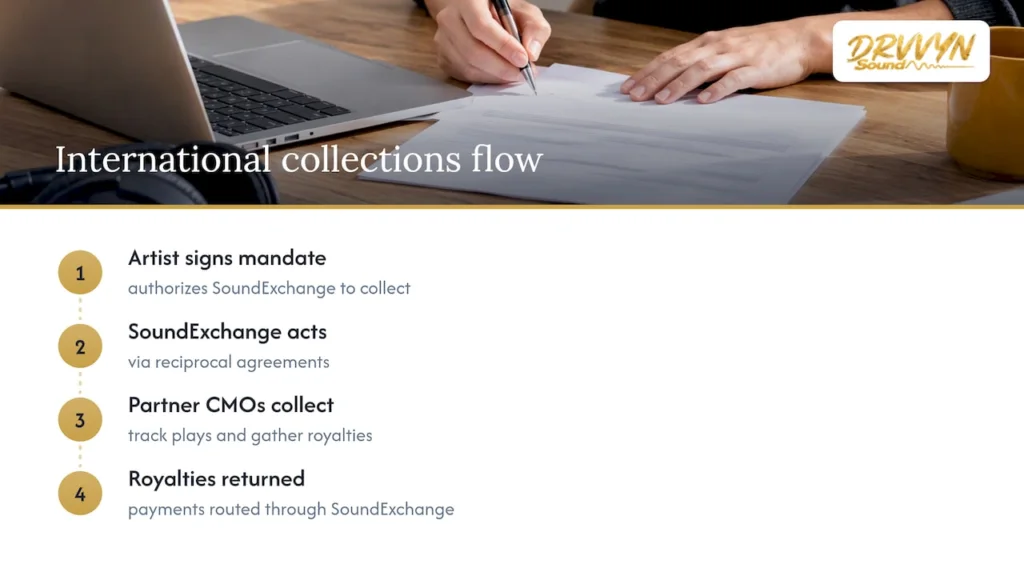
Coverage varies by territory and by how each partner CMO reports data, so distributions from abroad often lag behind domestic statutory payments. For most independent artists, the mandate is the simpler route: one signature instead of dozens of separate foreign registrations. Direct registration with a specific foreign CMO can make sense if you have concentrated airplay or licensing activity in one country and want more granular reporting than the mandate provides, but for most catalogs, the mandate alone does the job.
Who gets paid: ownership, splits, and disputes
SoundExchange pays two parties: the featured artist and the sound-recording copyright owner. Managers, agents, and other third parties are generally not paid directly unless proper documentation authorizes it.
A Letter of Direction, or LOD, lets a featured artist route part of their own royalty share to a producer, background vocalist, or other creative participant who contributed to the recording. An LOD is appropriate for that specific purpose. It is not a substitute for a proper split agreement among the people who hold featured-artist status, and it cannot resolve a dispute over who owns the master itself.
When two parties claim the same recording, SoundExchange places the disputed royalties on hold and notifies both claimants. The organization does not adjudicate who is right: the parties have to sort that out between themselves, often with a signed agreement or other proof of ownership.
- Keep signed split sheets for every recording, agreed on before or immediately after release.
- Maintain a release log with ISRCs, credits, and ownership percentages.
- Store contributor agreements somewhere you can retrieve them quickly if a hold appears.
Pro Tip:File your split sheet the same day you finish the session, while every contributor still agrees on the percentages.
Metadata checklist to stop delayed or missing royalties
Most missed neighboring-rights payments trace back to mismatched metadata rather than any legal gap. A digital service reports plays using the identifying information it has, and if that information does not match what you filed with SoundExchange, the system cannot connect the play to your claim.
Audit these fields every time you release something; for instance, following the six steps to claim your Apple Music artist page can help ensure metadata consistency.
- Recording title, spelled and punctuated exactly the same everywhere.
- Featured artist credit, consistent across your distributor and your SoundExchange claim.
- ISRC, the single most important identifier for matching plays to a recording.
- Release date and copyright owner information.
- Contributor roles and agreed ownership shares.
When these fields disagree between your distributor and SoundExchange Direct, reconcile them as soon as you notice, not after a quarter of missing payments. Keep a simple release packet for every song: title, ISRC, credits, splits, and the date you filed the claim.
Pro Tip:Save your ISRC log and contributor agreements in one folder per release so you are never searching for proof when a dispute or audit comes up.
When to prioritize neighboring-rights registration in your release plan
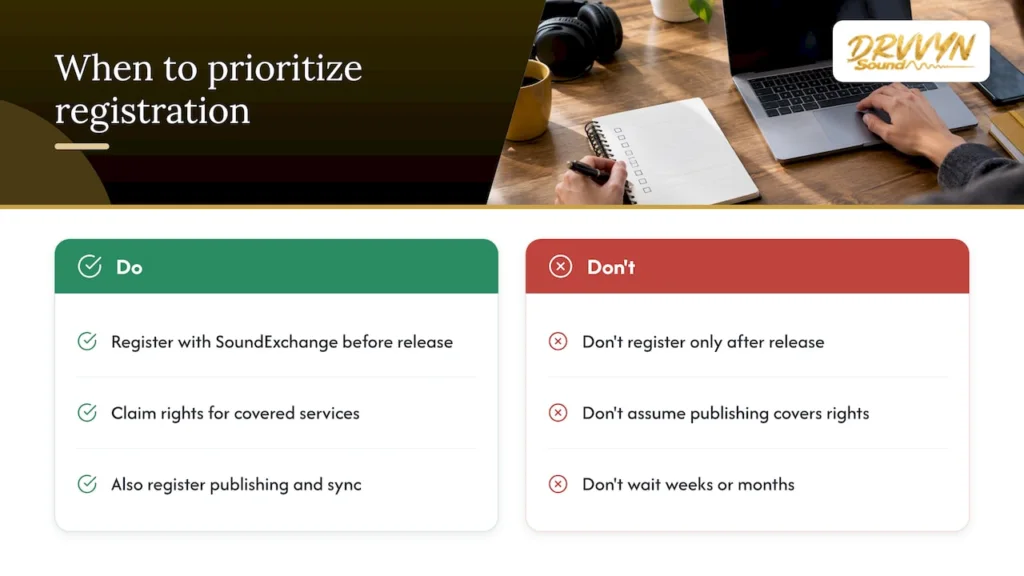
We treat SoundExchange registration as one of the highest-return tasks an independent artist can do, because the cost is zero and the upside compounds with every stream on a covered service. It sits alongside, not instead of, your publishing registration and any sync licensing you pursue, since each covers a different slice of income.
Our rule of thumb: register and claim before release day, not after. Waiting means weeks or months of plays that are harder to trace back to you once the window has passed.
How we support artists who want a managed approach
Registering every recording, reconciling metadata across platforms, and chasing disputes takes real time, and not every artist wants to own that process alongside writing and releasing music. We offer licensing and release support to help organize release packets, keep credits and identifiers consistent, and assist catalogs in staying audit-ready.
- A managed approach fits artists juggling a full release calendar or a catalog too large to track by hand.
- It also fits artists actively pursuing sync and licensing opportunities who need clean metadata on hand.
- Our team can assist with packaging to help reduce your administrative workload.
If that sounds like where you are right now, the licensing page is the place to start a conversation about what managed support could look like for your catalog.
— DRVVYN Sound
FAQ
Can you buy the rights to use a song?
You can license the rights to use a song, most commonly through a sync license for the composition and a master use license for the specific recording. A needle drop license is one common form of this for film, video, and advertising use, and it requires permission from both the publisher and the master owner.
What are neighboring rights royalties?
Neighboring rights royalties compensate performers and sound-recording copyright owners when a recording is used, separate from the songwriting royalties a composer earns. In the United States, this is limited mainly to certain digital audio transmissions under Section 114, not a universal payment for every public play.
What is the 35-year rule in music?
The 35-year rule refers to termination rights under Section 203 of US copyright law, which let an author or their heirs terminate certain grants or transfers after roughly 35 years. It is a termination mechanism with specific notice and timing requirements, not an automatic expiration of a deal.
Can you use a song after 20 years?
Using a song, whether it was released 2 years ago or 20, still requires permission from whoever currently holds the rights, since copyright protection in the US lasts far longer than 20 years. Termination rights under Section 203 can shift who holds those rights after 35 years, but they do not open the song to free use.
Is SoundExchange or the MLC the right place to register?
SoundExchange collects neighboring-rights royalties for sound recordings, while the Mechanical Licensing Collective administers mechanical royalties for musical compositions. Most artists need to register with both, since they cover different rights and different income streams entirely.
Sources
- U.S. Copyright Office: Federal Register notices on the digital performance right (Section 114/112)
- SoundExchange: International partners and how international collections work