

Listening & Culture
How Streaming Algorithms Shape Your Night Listening
How Streaming Algorithms Shape Your Night Listening
! Hand adjusting vinyl turntable at night
At night, recommendation systems shift their priorities.
By DRVVYN · · 8 min read

How Streaming Algorithms Shape Your Night Listening
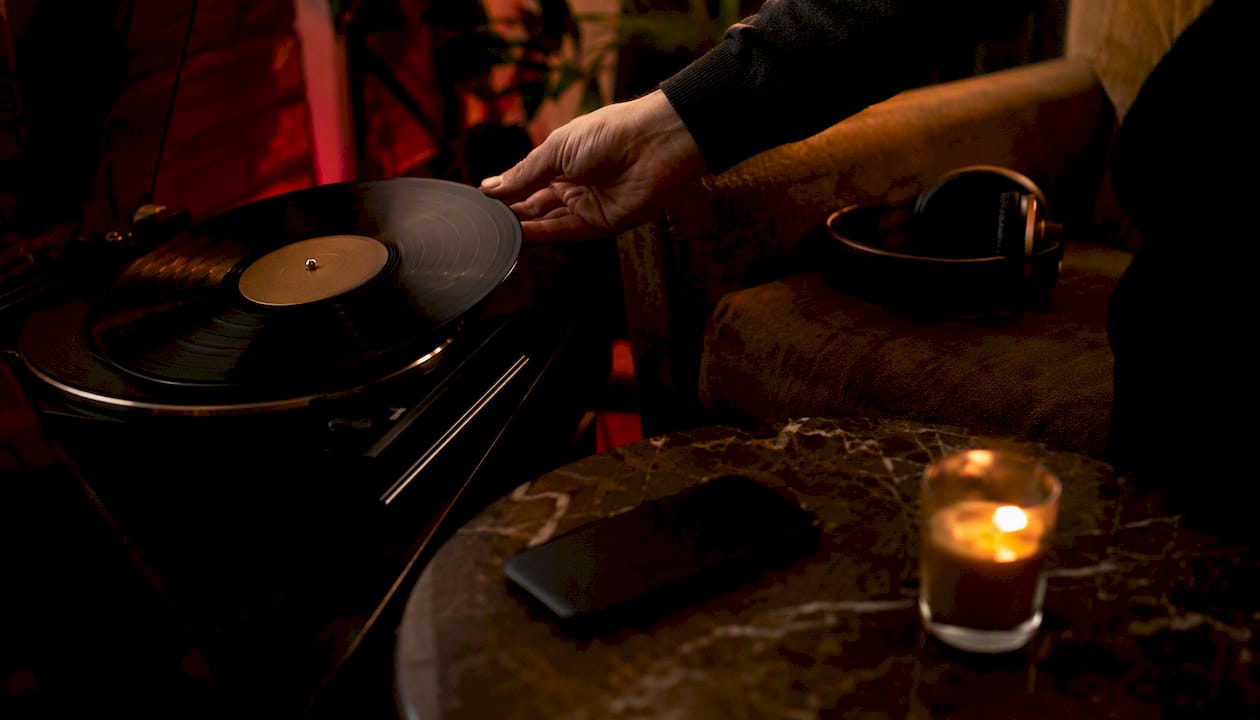
At night, recommendation systems shift their priorities. They optimize for session continuation, lower-attention consumption, and energy modulation — and that shift changes what you hear and watch in ways most people never notice. The role of streaming algorithms at night is quieter than their daytime counterpart, but the pull is just as strong, and understanding it gives you real control over your experience.
Here is what you can do right now:
- Listeners: Start a private session on Spotify before your late-night wind-down so the algorithm does not log those choices into your main taste profile.
- Listeners: Disable autoplay on Netflix and YouTube to prevent attention-grabbing content from interrupting a calm session.
- Listeners: Build a dedicated late-night playlist and use it consistently. Repeated, deliberate choices train the recommender toward your actual nighttime preferences.
- Creators: Tag your music with clear mood and energy descriptors in your distributor metadata, and pitch to editorial playlists that specifically serve late-night or sleep-adjacent moods.
Research published in a peer-reviewed PMC study confirms that recommender systems produce measurable behavioral influence on aesthetic choice — meaning the platform is not just reflecting your taste, it is quietly shaping it.
Table of Contents
- How do recommendation algorithms actually work?
- How do platforms use time-of-day signals at night?
- What creators can do to reach late-night listeners
- “Streaming algorithms” vs. recommendation systems: what people get wrong
- Key Takeaways
- A practitioner’s perspective on designing late-night experiences
- Useful sources and further reading
How do recommendation algorithms actually work?
The phrase “streaming algorithm” carries two very different meanings, and mixing them up leads to real confusion. In academic computer science, streaming algorithms are single-pass, low-memory techniques designed to process massive data streams without storing everything. Think Count-Min sketches or HyperLogLog — tools built for approximation under tight memory constraints. That is a mathematically precise field with almost nothing to do with why Spotify just served you a slow R&B track at midnight.
Platform recommendation systems are something else entirely. They are machine-learning models trained on large datasets of user behavior, and they use several distinct approaches:
- Collaborative filtering — finds patterns across millions of users. If people who listen like you tend to follow a certain path, the system nudges you down it.
The signals feeding these systems go well beyond your play history. According to CodeWeek’s technical overview, platforms factor in skip rates, session length, device type, local time of day, and even prior-night listening patterns. Engagement optimization sits at the center of all of it — platforms want you to keep watching or listening, because that is how they measure success.
How do platforms use time-of-day signals at night?
Time of day is one of the most underappreciated contextual signals in streaming. Platforms do not treat 11 PM the same as 11 AM, and the differences show up in concrete, recognizable ways.
The most common temporal and contextual signals platforms use include:
- Local clock time (used to infer likely mood and attention level)
- Session position (early, mid, or late in a listening session)
- Device type (phone in bed versus laptop at a desk)
- Content energy level of recent plays
- Prior late-night listening history
Industry analysis from the Arts Management and Technology Lab describes how platforms adapt recommendations based on when users are most engaged, using engagement metrics to reduce churn and maximize session length. At night, that means the system leans toward content that keeps you present without demanding too much of you.
How each major platform behaves after dark
Spotify shifts its session-aware ranker toward lower-energy, higher-familiarity tracks as a session extends into late hours. Its “Radio” and “Autoplay” features draw on mood tags and audio features to maintain a consistent emotional temperature. The platform’s algorithmic playlists — “Chill Hits,” “Late Night Vibes” — are partly editorial and partly personalized, blending human curation with real-time session data.
Netflix uses autoplay and home-screen ordering that responds to time-of-day signals. Late at night, the platform tends to surface comfort content — familiar genres, shorter episodes, previously watched shows — because its engagement models have learned that users in low-attention states are more likely to continue watching something they already know.
YouTube relies heavily on its autoplay queue, which at night can drift toward longer, lower-stimulation content: ambient video essays, lo-fi streams, sleep-adjacent material. The recommendation engine reads session momentum and adjusts accordingly, though the transition can be abrupt when the model misjudges your energy state.
Hulu incorporates similar temporal signals, though its recommendation surface is more constrained by its content library. Its autoplay behavior defaults to next-episode continuation, which at night can mean hours of passive consumption that the user never consciously chose.
Broadcast radio solved a version of this problem decades ago through what engineers call “hot-clock” design: hour-aligned, energy-balanced rotations that account for fade timing and transition coherence. Streaming platforms are only beginning to approximate that level of intentional overnight programming.
| Recommendation approach | Energy modulation | Coherence | Serendipity |
|---|---|---|---|
| Human-curated overnight rotation | High | High | Moderate |
| Personalized session playlist | Moderate | Moderate | Low |
| Autoplay / radio continuation | Low | Low | Variable |
| Editorial mood playlist (hybrid) | Moderate | High | Moderate |
What creators can do to reach late-night listeners
Late-night listeners are not a passive audience. They are present, emotionally open, and often in exactly the reflective state that alternative R&B was made for. Reaching them is a matter of speaking the algorithm’s language while staying true to your sound.
A practical checklist for late-night optimization:
- Tempo and dynamics: Tracks with a BPM in the 60–90 range and gradual dynamic arcs tend to perform better in late-night session playlists. Understanding musical dynamic contrast in your arrangements signals coherence to both listeners and the algorithm.
- Release timing: Dropping music on Thursday or Friday evening (Eastern Time) positions it for weekend late-night listening when streaming volume peaks. Drvvynsound’s own approach to posting after dark explores how timing intersects with algorithmic visibility.
Broadcast radio’s overnight engineering offers a useful model here. Hot-clock design builds coherence through hour-aligned energy arcs and deliberate transition planning — something independent artists can borrow when sequencing an EP or curating a playlist. The goal is a session that flows, not just a collection of good tracks.
Pro Tip:Pay close attention to how your tracks end and begin. Jarring transitions between songs — a sudden tempo jump, a key clash, an abrupt dynamic shift — are one of the fastest ways to trigger a skip. Understanding why music transitions matter at the arrangement level can mean the difference between a listener staying through your full project or the algorithm pulling them elsewhere after track two.
“Streaming algorithms” vs. recommendation systems: what people get wrong
The confusion is understandable. “The algorithm” has become shorthand for everything a platform does to decide what you see or hear. But that shorthand flattens a genuinely complex system.
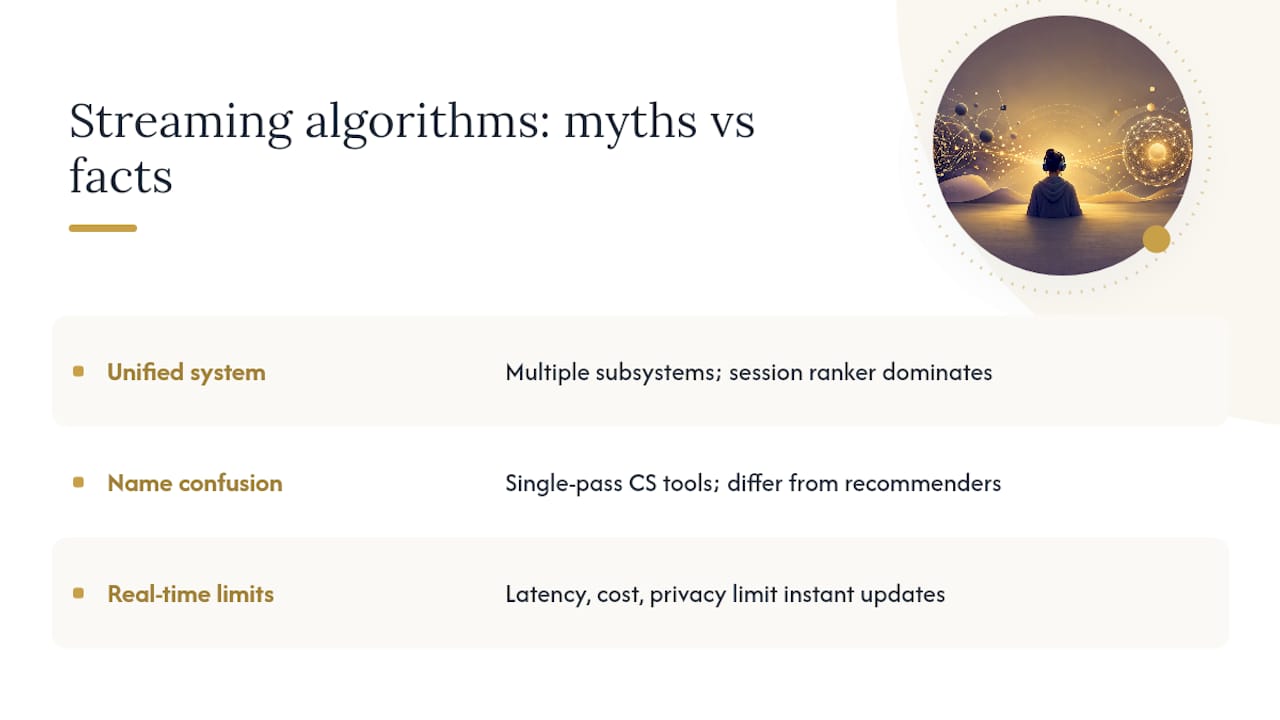
Myth: Streaming algorithms are a single, unified system that decides everything.
Fact: Most platforms run multiple cooperating subsystems: a short-term session ranker, a long-term preference model, and UI heuristics (like autoplay defaults and home-screen ordering). At night, the short-term session ranker and autoplay defaults exert the most influence — not your long-term taste profile.
Myth: “Streaming algorithms” in the tech sense are the same as platform recommenders.
Fact: In academic computer science, streaming algorithms are single-pass, space-limited computation techniques — tools like sketches and approximation methods designed for data streams too large to store. They share a name with platform “streaming” but solve a completely different problem. Production recommenders use large-scale ML training, not single-pass approximation.
Myth: Platforms can do anything with your data in real time.
Fact: Engineering constraints — latency requirements, compute costs, and privacy regulations — limit what platforms can process in the moment. Many updates to your taste profile happen in batch, not instantly. That is why a late-night private session can protect your daytime recommendations: the system has not yet processed those signals into your long-term model.
Key Takeaways
At night, streaming recommendation systems shift toward session continuation and familiarity, narrowing discovery and shaping your mood in ways you can counter with deliberate, consistent listening choices.
| Point | Details |
|---|---|
| Algorithms shift at night | Platforms prioritize session continuation and low-attention content after dark, not discovery. |
| Private sessions protect your profile | Starting a private session on Spotify prevents late-night choices from skewing your main recommendations. |
| Consistent playlists train the system | A dedicated late-night playlist gives the algorithm cleaner, more intentional data to work with over time. |
| Creators need mood-specific metadata | Clear energy tags, accurate genre classification, and deliberate transition design improve late-night placement. |
| Autoplay is the biggest lever | Disabling autoplay on Netflix and YouTube restores your control over every session transition. |
A practitioner’s perspective on designing late-night experiences
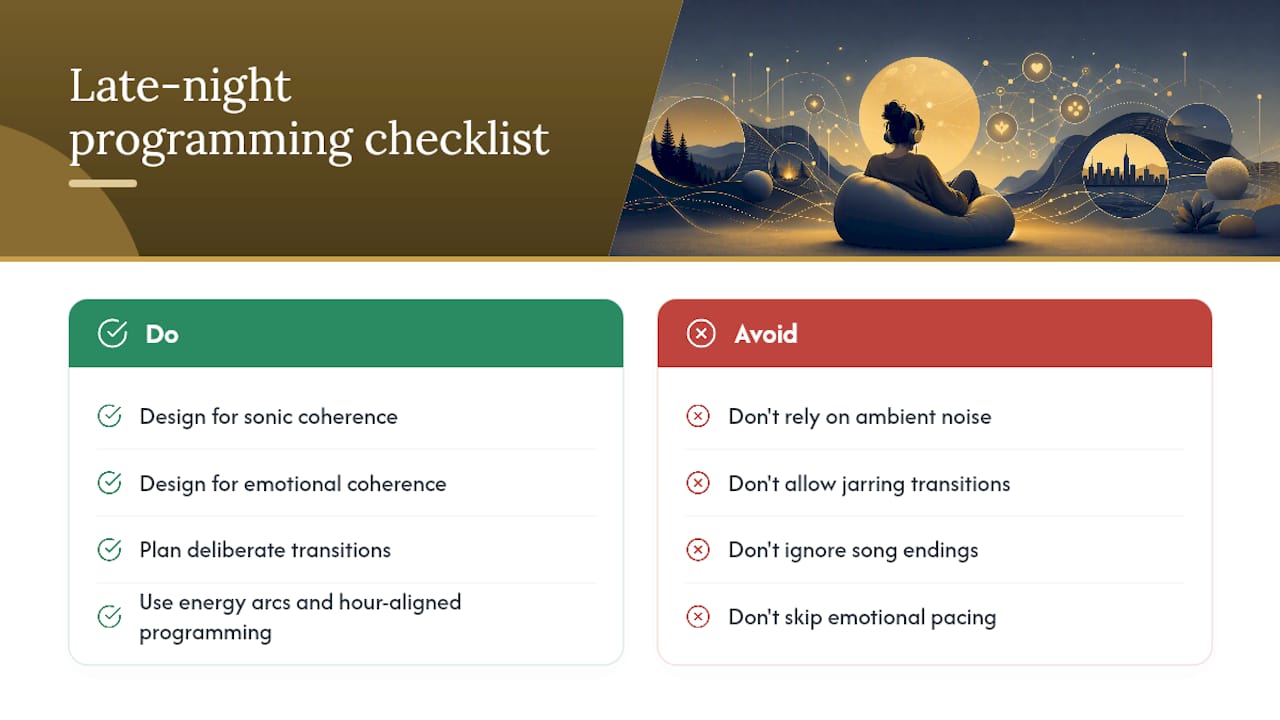
Late night is where the music either holds or it doesn’t. There is no ambient noise to fill the gaps, no distraction to smooth over a jarring transition. The listener is present in a way they rarely are at noon, and the algorithm knows it — even if it does not always respond with the care that moment deserves.
At Drvvynsound, the approach to late-night programming starts with coherence. Not just sonic coherence, but emotional coherence: the sense that every track in a session belongs to the same internal world. That is harder to achieve than matching BPMs. It requires thinking about how a song ends, what emotional temperature it leaves behind, and whether the next track honors that or breaks it. The editorial instinct that broadcast engineers built into overnight rotations — energy arcs, deliberate transitions, hour-aligned programming — is something independent artists can bring to their own releases and playlists. The algorithm will reward it, but more importantly, the listener will feel it.
For deeper reading on how Drvvynsound approaches these creative and strategic decisions, the blog at drvvynsound.com covers release timing, arrangement choices, and the craft behind late-night music that actually connects.
Useful sources and further reading
- Because You Watched: How Do Streaming Services’ Recommender Systems Influence Aesthetic Choice? — PMC
- How Streaming Services Use Algorithms — Arts Management and Technology Lab
- Designing a broadcast overnight music rotation that doesn’t sound like a playlist — DEV Community
- How streaming algorithms work — CodeWeek blog
- Course notes — streaming algorithms (MIT CSAIL)
- Lecture notes — Streaming algorithms (Columbia University)
- How do streaming algorithms change the way we listen to music? — Music Ally