

Listening & Culture
What Is Binaural Audio Experience? A Full Guide
Discover what is binaural audio experience and how it creates immersive soundscapes. Learn how this technology transforms your listening experience.
By DRVVYN · · 10 min read
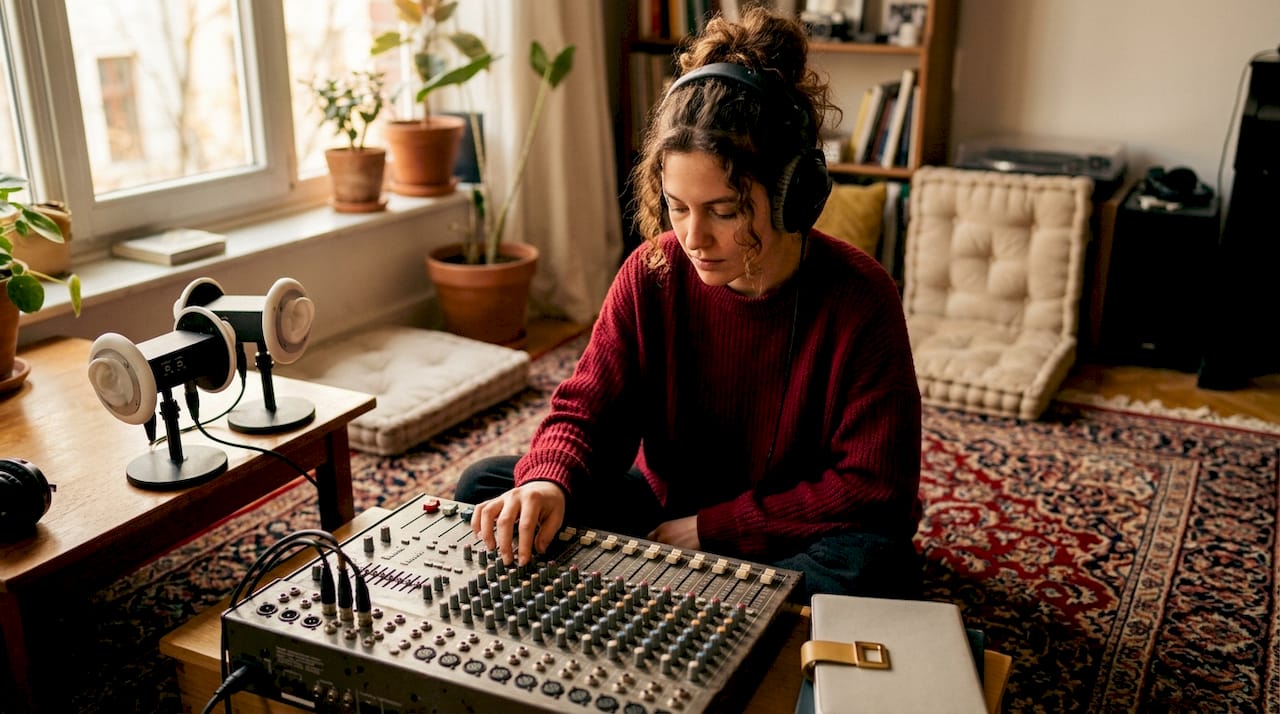
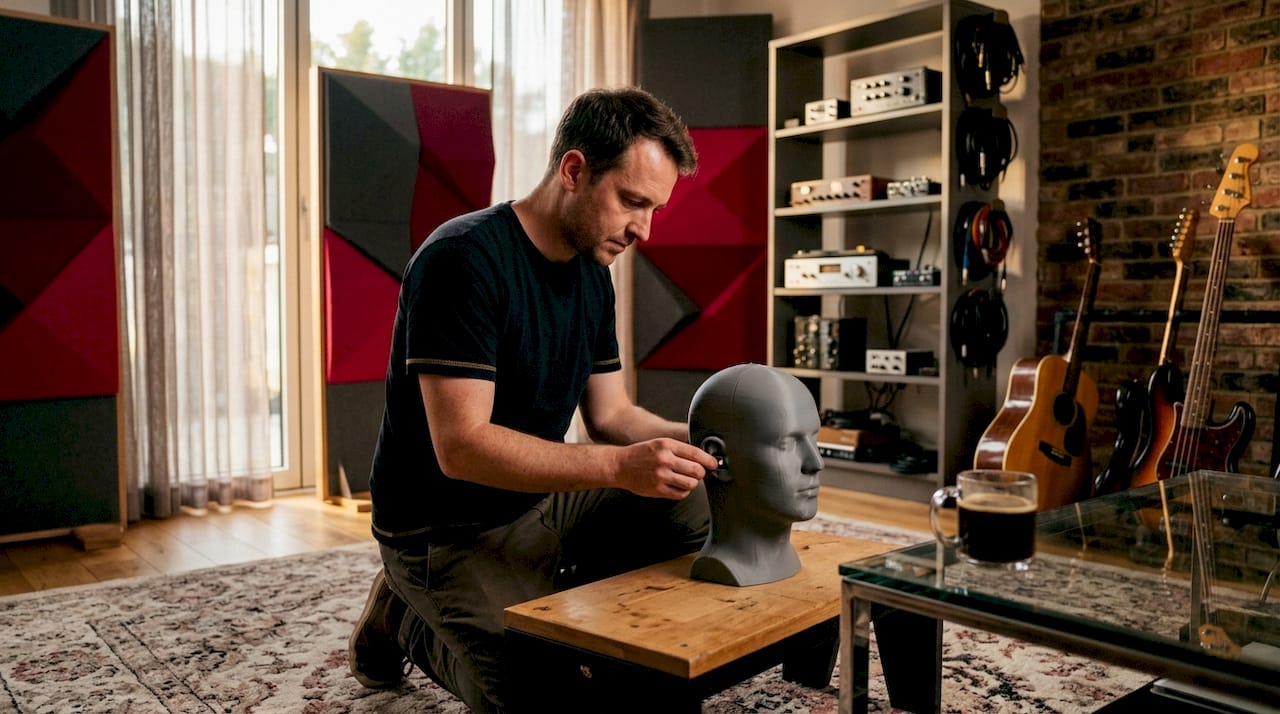
A binaural audio experience is defined as a sound recording and playback technique that replicates how humans naturally perceive audio in three-dimensional space, using two microphones positioned like human ears. Unlike standard stereo, binaural sound captures the precise timing and volume differences your ears detect in real life. These differences, known as interaural time differences (ITD) and interaural level differences (ILD), are what let your brain place a sound to your left, above you, or behind you. When played back through headphones, the result feels less like listening to music and more like standing inside it. Techniques like Head-Related Transfer Function (HRTF) modeling and dummy head microphone rigs are the industry standards that make this possible.
How does binaural audio work compared to stereo sound?
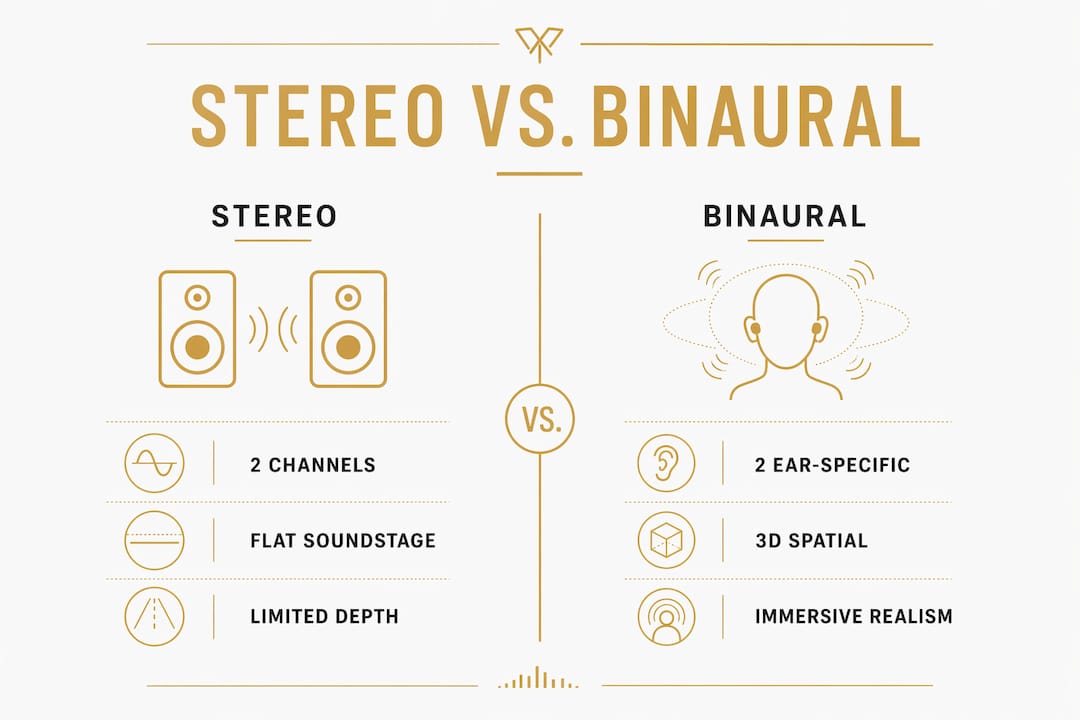
Stereo sound delivers two channels, left and right, to create a flat horizontal soundstage. You hear width, but not height, depth, or the sensation that a sound is behind you. Binaural audio captures all three dimensions by mimicking the physical reality of how sound reaches your ears.
The key mechanism is HRTF. Your outer ear, skull, and torso shape every sound wave before it reaches your eardrum. HRTF filters encode those exact physical transformations into the recording. When you play that recording through headphones, your brain processes the encoded cues as if the sound source were physically present in the room.
Stereo speakers cannot replicate this. When sound from a left speaker reaches your right ear, it creates crosstalk that collapses the spatial illusion. Binaural playback requires headphones because only headphones deliver isolated left and right signals directly to each ear, preserving the ITD and ILD cues intact.
Stereo vs. binaural at a glance
| Feature | Stereo | Binaural |
|---|---|---|
| Channels | 2 (left, right) | 2 (ear-specific) |
| Spatial dimensions | Horizontal only | Full 360-degree, including height |
| Playback device | Speakers or headphones | Headphones only |
| Depth perception | Limited | Strong |
| HRTF encoding | No | Yes |
Pro Tip:If you want to test the difference, find a binaural recording of rain or a live concert and switch between speakers and headphones. The spatial collapse on speakers is immediate and striking.
What are the benefits and applications of binaural audio?
The core value of binaural audio is immersive realism. It does not simply improve audio quality. It changes where sound feels like it exists in physical space. That shift in perception opens up applications far beyond music listening.
Music and emotional presence
Binaural recordings place instruments and vocals around you rather than in front of you. For R&B and soul music, where emotional intimacy is everything, that spatial presence deepens the connection between the listener and the performance. You feel the breath in a vocal, the room around a piano, the space between a bass line and a snare hit.
Virtual reality, gaming, and sound design
Binaural audio excels in VR and gaming because it gives listeners accurate directional cues in 360-degree space. A sound that appears to come from behind you in a game is not a trick. It is your brain reading encoded spatial data the same way it reads real-world sound. That accuracy raises psychological immersion to a level stereo cannot reach.
ASMR and narrative audio
ASMR creators were early adopters of binaural techniques. The format rewards close-mic, spatially rich recordings where whispers, tapping, and ambient textures feel physically close. Podcast producers and audio dramatists use the same approach to place characters in space, making listeners feel present in a scene rather than observing it.
Cognitive and therapeutic applications
Research on binaural audio’s therapeutic potential is growing. A 2023 review of 14 studies showed conflicting evidence on brainwave effects, though some findings suggest binaural audio may help reduce anxiety in certain groups. The evidence is real but not conclusive, which means binaural audio works best as a supportive tool rather than a standalone treatment.
- Immersive music listening with full spatial presence
- Directional sound cues for VR, gaming, and film
- Heightened engagement in ASMR and audio storytelling
- Potential anxiety reduction in sound therapy contexts
- Enhanced focus and relaxation during meditation sessions
What technical challenges does binaural recording face?
Binaural recording sounds simple in concept. Two microphones, placed like ears, capture the world. In practice, the margin for error is narrow and the problems are specific.
Microphone placement and spacing
Precise microphone spacing of approximately 18–21 cm replicates average human head width. That distance is what generates accurate ITD cues. Even a few centimeters of drift changes the perceived spatial image. Engineers use laser alignment tools to hold that spacing and ensure the microphones point in parallel directions.
Body noise and environmental interference
Body noise is one of the most underestimated problems in binaural recording. Breathing, clothing rustle, and footsteps all transmit through the body into the microphone rig. Professionals address this by using dummy heads and windjammers that are mechanically separated from the recordist. The dummy head sits in the acoustic environment while the engineer monitors from a distance.
The generic HRTF problem
Every listener’s ear and head shape is different. A generic HRTF filter, built from average measurements, works reasonably well for most people but fails for some. The generic HRTF problem means that a recording engineered to sound like a sound is above you might feel flat or even wrong to a listener whose ear geometry differs significantly from the model. Engineers test HRTF filters across diverse listener groups to find the most stable spatial images.
Post-production binauralization
Not every binaural production starts with a dummy head recording. Binauralization software applies HRTF filters in post-production to place and move sounds spatially after recording. This gives creators flexibility without requiring a full binaural rig on set. The tradeoff is that software-generated spatial cues can feel slightly artificial compared to a true physical recording, though the gap narrows with each generation of processing tools.
- Set microphone spacing to 18–21 cm and verify with a laser alignment tool.
- Use a dummy head or in-ear microphone rig to capture natural HRTF cues.
- Add windjammers to reduce breath and environmental noise.
- Monitor through headphones during recording, not speakers.
- Apply HRTF filters in post-production to refine spatial positioning.
Pro Tip:Always monitor your binaural recording through closed-back headphones during the session. Open-back headphones bleed room sound into your perception and mask spatial errors you will only catch in the final mix.
What are binaural beats and how do they differ from binaural audio?
Binaural beats and binaural audio recording are two separate things. Confusing them is one of the most common mistakes in audio discussions, and the difference matters.
Binaural beats create a perceived third frequency when two slightly different tones play separately into each ear. If your left ear hears 200 Hz and your right ear hears 207 Hz, your brain perceives a pulsing tone at 7 Hz. That perceived beat is entirely internal. It does not exist in the audio file.
Binaural audio recording, by contrast, is about spatial sound reproduction. It has nothing to do with frequency manipulation. The two techniques share the word “binaural” because both require headphones and separate left and right ear signals, but their goals and mechanisms are completely different.
40 Hz binaural beats significantly enhance reading comprehension and attentional accuracy in a controlled study of 72 participants. That finding is real and worth noting. But 7 Hz frequencies in the same study showed no significant effects, which illustrates how variable the results are across frequencies.
- Binaural beats are a psychoacoustic phenomenon, not a recording technique.
- They require headphones to work because the two tones must reach separate ears.
- Scientific evidence on cognitive benefits is mixed and frequency-dependent.
- Claims about chakra clearing or energy balancing have no scientific support.
- Binaural beats are best treated as a relaxation aid, not a medical treatment.
The wellness industry markets binaural beats aggressively. The science supports cautious optimism, not the sweeping claims you often see. Use them as a tool for focus or relaxation, and hold the extraordinary promises loosely.
Key Takeaways
Binaural audio creates genuine three-dimensional sound by encoding ITD, ILD, and HRTF cues that stereo cannot replicate, and headphones are the only playback device that preserves those cues intact.
| Point | Details |
|---|---|
| Binaural vs. stereo | Binaural captures full 360-degree space; stereo delivers only horizontal width. |
| Headphones are required | Only headphones isolate left and right signals to preserve spatial cues. |
| HRTF drives realism | Head-Related Transfer Function encodes how your body shapes sound before it reaches your ear. |
| Recording precision matters | Microphone spacing of 18–21 cm is critical for accurate interaural time differences. |
| Binaural beats are separate | Binaural beats are a frequency phenomenon, not a spatial recording technique. |
Why binaural audio feels like the future of emotional listening
I have spent years working with sound as a creative medium, and the moment that changed how I think about audio was not a technical breakthrough. It was the first time I heard a binaural recording of a live performance and felt the room around me shift. The audience was behind me. The stage was in front. My body responded before my mind caught up.
That physical response is what separates binaural audio from every other format. Stereo is a picture. Binaural is a place.
What excites me most right now is personalized HRTF technology. Generic filters have always been the weak point in binaural production. As AI-assisted measurement tools make it possible to build listener-specific HRTF profiles from a phone camera scan, the generic HRTF problem starts to dissolve. That means the spatial experience becomes accurate for every listener, not just the statistical average.
The honest challenge is adoption. Most listeners still consume music through phone speakers or earbuds not optimized for spatial audio. Creators who invest in binaural production are often ahead of where their audience’s hardware sits. But that gap is closing. As spatial audio becomes a standard feature on streaming platforms and consumer headphones, the audience for true binaural content will grow fast.
My advice: start listening binaurally now. Put on a good pair of headphones, find a well-recorded binaural track, and let the room open up around you. The format rewards attention, and attention is exactly what music built for emotional connection deserves.
— DRVVYN
Drvvynsound and the art of immersive listening
Binaural audio is not just a technical format. It is a way of letting music reach you fully, without the distance that speakers and flat stereo create. At Drvvynsound, every track is built with that closeness in mind. The music is designed to sit with you, not in front of you.

DRVVYN’s catalog of R&B and cinematic audio is crafted for headphone listening, where emotional detail lives in the space between sounds. If you are ready to hear what music feels like when it surrounds you, explore DRVVYN Essentials and put on your headphones. The difference is not subtle.
FAQ
What is a binaural audio experience?
A binaural audio experience is a recording and playback method that uses two microphones placed like human ears to capture three-dimensional sound. Played through headphones, it recreates the spatial cues your brain uses to locate sounds in real life.
Do you need headphones for binaural audio?
Yes. Binaural audio requires headphones because only headphones deliver isolated left and right signals to each ear, preserving the interaural time and level differences that create spatial perception.
How is binaural audio different from stereo?
Stereo creates a flat horizontal soundstage with two channels. Binaural audio encodes full 360-degree spatial information, including height and depth, using HRTF filters that mimic how your body shapes sound naturally.
What are binaural beats and are they the same as binaural audio?
Binaural beats are a separate psychoacoustic phenomenon where two slightly different tones played into each ear create a perceived third frequency inside the brain. They are not a spatial recording technique and should not be confused with binaural audio production.
Do binaural beats actually work?
The evidence is mixed. A controlled study of 72 participants found that 40 Hz binaural beats improved reading comprehension and attention, but results vary by frequency and individual. Treat them as a relaxation or focus aid, not a medical treatment.