
Artist Strategy
How to Write an Artist Bio That Actually Gets Read
How to Write an Artist Bio That Actually Gets Read
! Artist writing bio draft on tablet
An effective artist bio is a short third-person snapshot that frontloads who you are, what you make, and why it matters.
By DRVVYN · · 9 min read

How to Write an Artist Bio That Actually Gets Read

An effective artist bio is a short third-person snapshot that frontloads who you are, what you make, and why it matters. It is not a résumé and it is not your life story. Draft a primary version around 100 to 120 words, then save two shorter cuts labeled for different uses.
Start here, tonight, before you overthink it:
- Write your name, your medium, and one sentence about what drives the work
- Add one accomplishment or affiliation that proves the claim
- Name your current project or focus
- Save the file, then trim it into a 50 to 80 word version for captions or program notes
TL;DR:
- Keep your primary artist bio around 120 words to balance clarity and impact, using a clear structure focused on your name, medium, and current project.
- Include only one or two concrete accomplishments or affiliations to support your main claim, avoiding lengthy lists or vague praise.
- Always frontload your bio with who you are, what you make, and why it matters now, rather than biographical details like birthplace or influences.
- Regularly update your bio before each new release or project to ensure it accurately reflects your current focus and achievements.
- Save and prepare three versions—short, primary, and long—to suit various uses, and avoid relying on AI-generated drafts without thorough editing.
How to Write an Artist Bio vs. a Statement or CV
A bio is a narrative snapshot written in the third person. A statement is a first-person reflection on your intent and process, often required for grant panels. A CV is a bare list of exhibitions, releases, and credits with no voice at all.
- Bio — read by curators, press, playlist editors, and fans scanning quickly; short, warm, third person
- Statement — read by jurors and panels evaluating intent; longer, reflective, first person
- CV — read by presenters checking history; no prose, just dates and venues
Readers of visual and written material tend to skim rather than study, which is exactly why brevity works harder than detail. The Mid-America Arts Alliance recommends the third-person convention specifically because it reads as professional framing rather than self-description, and it is what press and EPK templates expect.
What Length Should an Artist Bio Be?
Three versions cover almost every situation you will face as an emerging artist.
- Short (50 to 80 words): program notes, social captions, quick press mentions
- Primary (100 to 150 words): your website, your EPK, most press requests
- Long (250 words or more): for catalogs, grant panels, or full biographies when a presenter specifically asks
Pro Tip:Name your files clearly, like “yourname_bio_short.docx” and “yourname_bio_120.docx,” so you never send the wrong version under deadline pressure.
Artsy’s team writes roughly 7,000 artist bios and lands on 80 to 140 words as the working range, with 120 as the sweet spot. That number isn’t arbitrary. It’s short enough to survive a phone screen and long enough to hold one real idea.

What to Include in an Artist Bio
Every version, no matter the length, needs the same skeleton before it needs polish.
- Name and role first. “Maya Torres is an alternative R&B artist” beats any warm-up sentence about childhood or influences.
- What you make. Medium, genre, or signature technique, stated plainly rather than described in adjectives.
- The theme underneath it. What your work keeps returning to, whether that’s heartbreak, memory, or place.
- One or two proof points. A release, a placement, a collaborator, a stage, a publication. Pick the strongest, not all of them.
- Current focus. What you’re releasing or working on right now, and ideally who it’s for.
- Optional details. A short quote, pronouns, or location, only if they add real context.
Pro Tip:If you’re a musician, name the actual project instead of a vague genre tag. “Her latest single explores the ache of long-distance love through slow-burning alt-R&B production” tells a reader more than “she makes emotional music.”
Common Mistakes in Artist Bios (and the Fix)
- Artspeak and generic praise. Replace “boundary-pushing, genre-defying artist” with the one specific thing that’s actually true, like the instrument you built the track around.
- The CV laundry list. Save the full exhibition or release history for your CV; the bio gets one or two proof points, not ten.
- Inflated or unverifiable claims. “Viral sensation” without a number behind it reads as a red flag to editors and curators alike, according to ArtConnect.
- Sloppy mechanics. Inconsistent tense, missing italics on song or album titles, and typos undercut an otherwise strong bio faster than weak content does.
- Burying the lede. Don’t open with where you were born. Open with what you make and why it matters now.
How to Write and Edit Your Bio Step by Step
Step 1: Draft. Write your name, your primary medium, and one sentence explaining why the work exists. Don’t polish yet, just get the bones down.
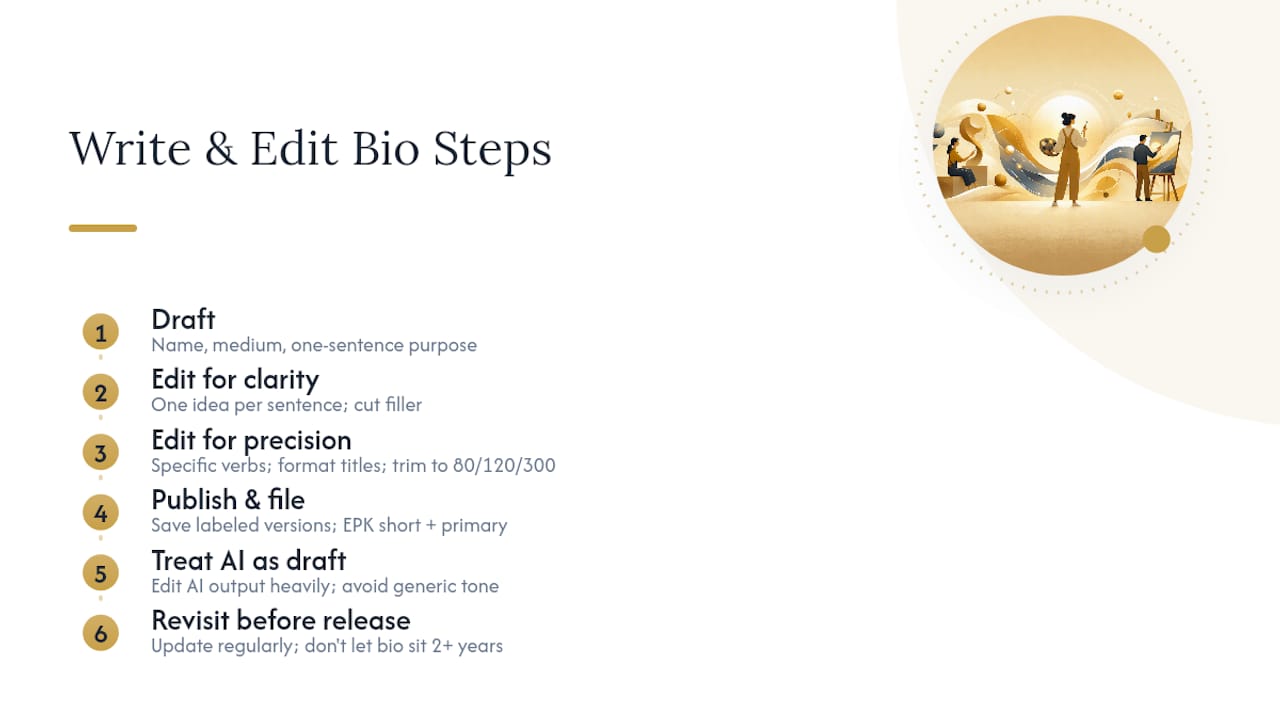
Step 2: Edit for clarity. Cut every sentence that tries to do two jobs at once. One idea per sentence. Remove filler words like “very” or “truly.” Choose your one or two strongest accomplishments and cut the rest.
Step 3: Edit for precision. Swap weak verbs for specific ones. Check that song and album titles are italicized or quoted consistently. Count your words and trim toward your target, whether that’s 80, 120, or 300.
Step 4: Publish and file. Save each labeled version, drop the short and primary cuts into your EPK, and send the long version only when a presenter requests it.
Pro Tip:If you use AI to get past a blank page, treat the output as a rough draft only. ArtConnect and other industry sources warn that unedited AI drafts tend to sound generic, and editors can usually tell.
Revisit the file before every release, show, or submission. A bio that hasn’t changed in two years is a bio that’s stopped doing its job.
Artist Bio Examples and Templates You Can Copy
Short (program note, ~65 words):
Maya Torres is an alternative R&B singer and producer based in Atlanta. Her music blends slow, cinematic production with raw, confessional lyrics about love and self-reckoning. Her 2025 EP Quiet Static earned placement on three editorial R&B playlists. She is currently writing her debut full-length album.
Primary (website/EPK, ~125 words):
Maya Torres is an alternative R&B artist and producer whose music sits somewhere between a whispered confession and a slow-building storm. Working out of Atlanta, she builds tracks around sparse piano, warped vocal layers, and lyrics that don’t flinch from grief or desire. Her 2025 EP Quiet Static was featured across editorial streaming playlists and led to her first sync licensing placement. Torres is currently finishing her debut full-length album, due in late 2026, and continues to release accompanying visualizers that extend each song’s mood into a cinematic frame. Her work speaks to listeners drawn to music that processes real feeling rather than performs it.
Long-form outline (250+ words): open with the same frontloaded line, then expand into two paragraphs, one on artistic development and influences, one on recent projects and what’s next, closing with where to hear the work.
Fill-in templates:
- One-sentence: “[Name] is a [medium/genre] artist known for [signature technique or theme], most recently [accomplishment].”
- Paragraph: “[Name] is a [medium] artist based in [location]. Their work explores [theme] through [technique or approach]. [Accomplishment or affiliation]. They are currently [current project], created for [audience/purpose].”
Notes for Music and Multimedia Artists
DRVVYN Sound works across original R&B releases, visualizers, and music videos, and the same rule holds across every format: name things specifically or don’t name them at all.
- Say “alternative R&B” or “cinematic R&B,” not just “music,” and name real collaborators instead of vague credits
- Describe a visualizer or music video by what it does for the song, not by adjectives like “stunning” or “innovative”
- Link directly to the release or video you’re referencing rather than describing it from memory, the way DRVVYN Sound’s own visual releases tie song and image together
- Keep a standing EPK folder with your short bio, a current headshot, and links to your latest release and its visualizer, so you’re never assembling one from scratch under deadline
Framing your project this way also supports how listeners actually find new music, through playlist and streaming discovery rather than a single big break.
Why Clear Bios Matter More Than You Think
We’ve watched enough artist submissions come through to notice a pattern: the clearest bios almost always belong to the artists who get picked up by playlists, licensed for sync, or written about by press first. Clarity isn’t the opposite of personality. It’s what lets your personality land.
If you’re building out your own catalog, look at how a project page frames itself, the way DRVVYN Sound’s Piece of Peace release describes its own mood and intent, and borrow that same directness for your bio. Adapt the templates above, then attach the finished version to your EPK. For a deeper structural walkthrough of what belongs in that kit, Twisby Records’ EPK guide is worth a look.
— DRVVYN Sound
Key Takeaways
A clear, third-person artist bio built around one frontloaded claim and a current project outperforms a long biographical list in every context that matters, from EPKs to press outreach.
| Point | Details |
|---|---|
| Target 120 words for the primary bio | Artsy’s guidance of 80 to 140 words, 120 ideal, fits most websites and EPKs. |
| Keep three labeled versions | Save short (50 to 80 words), primary (100 to 150), and long (250 to 350) files. |
| Frontload name, medium, and why | Open with the single line that explains your practice before any biographical detail. |
| Cut jargon and laundry lists | Replace vague praise and long credit lists with one or two verifiable accomplishments. |
| Update before every release or show | Treat the bio as a living document tied to your current project, not a one-time write-up. |
Sources
- How to Write an Artist Bio with Tips and Examples – Mid-America Arts Alliance
- What We Learned from Writing 7,000 Artist Bios – Artsy Partners
- How to Write an Artist Bio That Works – ArtConnect Magazine
FAQ
What is a good example of an artist’s bio?
A strong example names the artist, medium, and central theme in the first sentence, includes one verifiable accomplishment, and closes on a current project, all within roughly 100 to 150 words.
What is a good bio length?
Most guides, including Artsy’s, recommend 80 to 140 words with 120 as the ideal target for websites and press materials, alongside a shorter 50 to 80 word version for captions and program notes.
How can I generate an artist bio?
Draft it yourself by frontloading name, medium, and purpose, then use AI tools only to help brainstorm phrasing, since unedited AI drafts tend to sound generic and should always be revised into your own voice.
What are common mistakes in artist bios?
The most frequent mistakes are academic jargon, exaggerated claims, exhaustive credential lists, and opening with biographical trivia instead of leading with the work itself.