

Music Business
U.S. Composers: Negotiate Work for Hire Music to Keep Your Writer’s Share
A U.S.-focused, practitioner guide for composers, producers, and session musicians explaining what work for hire really transfers, why there’s no 35-year…
By DRVVYN · · 11 min read

A valid work made for hire under U.S. law makes the hiring party the legal author and initial copyright owner of the music, not the person who wrote or performed it. That’s the whole deal in one sentence. Commissioned work only counts if it fits one of nine narrow legal categories and comes with a signed written agreement naming it as such. The real cost shows up years later: no termination right to reclaim your work, and no ongoing royalty stream from something you built.
TL;DR:
- Work made for hire agreements transfer authorship and copyright ownership to the hiring party from the moment of creation, often permanently excluding future reclamation rights.
- Valid work for hire must meet four criteria: fall into one of nine statutory categories, have a signed written agreement, both parties must sign, and the agreement explicitly states “made for hire.”
- Signing a work-for-hire contract typically means losing control over publishing income, sync licensing, some performance royalties, and the ability to reclaim rights after decades.
- Most standard contracts are defaulted out of habit, and negotiation for clauses like reversion rights or PRO carve-outs can often be done at no extra cost.
- Proper registration with PROs and the Copyright Office, consistent paperwork, and clear contract terms are crucial for protecting residual rights and income streams.
What Counts as Work for Hire Music Under U.S. Law?
The statute that governs all of this, 17 U.S.C. §101, splits work made for hire into two separate paths, and confusing them is where most creators get burned.
The first path covers work an employee creates within the scope of employment, think a staff composer on a game studio’s payroll. No separate contract needed; the employment relationship itself does the legal work. The second path, specially commissioned work, is the one that actually affects independent composers, session players, and producers. For a commissioned song, score, or beat to qualify, it needs to satisfy four things at once:
- The work must fall into one of nine statutory categories (contributions to a collective work, part of a motion picture or audiovisual work, translation, supplementary work, compilation, instructional text, test, answer material for a test, or atlas)
- There must be a written agreement
- Both parties must sign it
- The agreement must explicitly state the work is “made for hire”
Miss any one of those four elements and the work-for-hire claim usually fails, no matter what a producer’s email or verbal handshake implied. The Copyright Office’s Circular 30 is blunt about this: registrants must determine status based on the facts that existed at the time of creation, not what someone decides to claim afterward. Legal commentary backs this up further. Cornell’s Legal Information Institute notes that without a signed, written instrument expressly designating the music as made for hire, work created by an independent contractor typically remains the contractor’s own copyright, regardless of who paid for it or whose name is on the invoice.
When Work for Hire Comes Up in Real Music Careers
The statute is abstract until it lands on your desk in the form of a contract you’re being asked to sign this week. Here’s where it actually surfaces:
- Session musicians. Under AFM union agreements, session terms are often standardized, with clear compensation for the performance itself. Non-union sessions are riskier: a verbal “just play on this track” arrangement can turn into a signed WFH clause buried in a rate confirmation you sign without reading closely.
- Composers scoring film, TV, or games. Studios routinely commission scores as work for hire, since the underlying audiovisual work already qualifies under the statute’s nine categories. Composers frequently retain no ownership stake, though credit and backend points are negotiable.
- Jingle and ad composition. Brands want unrestricted, permanent use of a track without licensing renewals, so WFH is the default ask in advertising work, not the exception.
- Beat sales and producer agreements. Many “exclusive” beat deals are marketed as exclusive licenses but drafted with WFH language that transfers full authorship. Read the actual clause, not the marketplace label.
- Co-authorship edge cases. When a session player adds a melodic hook or a producer contributes original composition beyond simple performance, courts have sometimes found joint authorship claims even where a WFH clause existed, especially when the written agreement was vague about scope.
What You Actually Give Up When You Sign
Signing a work-for-hire agreement isn’t a paperwork formality. It’s a transfer of legal authorship, and legal authorship is where the money lives.
Once the agreement is valid, the hiring party is treated as the legal author and initial copyright owner from the moment of creation, according to practitioner analysis of work-for-hire consequences. You typically get a one-time fee. They get everything else:
- Publishing income. If you don’t own the composition, you don’t collect mechanical royalties or publisher’s share.
- Sync control. The rights holder decides where the music gets licensed next, and keeps that revenue.
- Some performance royalties. Depending on how the deal is structured, your writer’s share with a PRO can evaporate entirely.
- Termination rights. This is the one most creators don’t see coming.
Statistic Callout: Ordinary copyright transfers in the U.S. carry a termination right that lets the original creator reclaim their work after a set period of decades. Work-for-hire agreements are explicitly excluded from this right under the Copyright Act, according to Cornell’s overview of work-for-hire law. There’s no future reclaim window, ever.
Think about what that means in practice. A jingle you wrote at 24 for a flat $800 fee could still be generating licensing income for a beverage brand at age 59. Under a normal transfer, you’d have a shot at renegotiating or reclaiming rights after 35 years. Under work for hire, that door never opens. The upfront fee is the entire deal, permanently.
The Pre-Signing Checklist Every Composer Needs
Before you sign anything labeled “work made for hire,” run the contract through this checklist. Most of these points are negotiable even when a hiring party insists otherwise.
Decide whether WFH language is even necessary. Many hiring parties default to work-for-hire because it’s the industry habit, not because they need full authorship. An exclusive license, as licensing guides for film and TV explain, often gives them everything they actually need (unrestricted use for their specific purpose) while letting you keep the composition copyright.
Negotiate the payment structure, not just the number. A flat fee is the weakest position you can take. Push for an advance against backend points, producer points on the master, or sync participation if the piece gets placed elsewhere later.
Ask for specific carve-outs, even inside a WFH deal:
- Retain your composition share with your PRO where possible
- Keep SoundExchange registration rights for neighboring performance royalties
- Require explicit written credit
- Add a reversion clause that returns rights to you after a set term if the work goes unused
- Cap the territory and duration of the grant instead of accepting a worldwide, perpetual claim
Watch for red flags: ambiguous language that never quite says “work made for hire” but functions like it, missing signatures from one party, or a “future works” clause that quietly assigns everything you create for that client going forward, not just the current project.
Pro Tip:Session fees often get treated as fixed and non-negotiable, but credit, SoundExchange carve-outs, and reversion language rarely cost the hiring party anything extra to grant. Ask for them even when you accept the fee as-is.
Registering Authorship and Coordinating With PROs
Once the contract is signed, the paperwork side of protecting whatever rights you kept still matters.
- Confirm who registers the work. If it’s a valid WFH agreement, the hiring party lists themselves as author on the Copyright Office registration. If you negotiated a license instead, you register as author and grant usage rights separately.
- Keep your PRO registration current regardless of the deal structure. Even under WFH, your writer’s share with ASCAP, BMI, or SESAC can sometimes survive if the contract carves it out explicitly. If it’s silent, assume you’ve lost it.
- Register with SoundExchange separately if you performed on the recording. Neighboring rights for digital performance royalties operate independently of composition ownership, per Morris Music Law’s practitioner guidance. Performers can sometimes collect here even after signing away the master.
- Match your registration paperwork to the actual signed contract, not what someone told you verbally. The Copyright Office bases status determinations on the facts at the time of creation, so inconsistent paperwork creates real legal exposure later.
For deeper detail on how writer’s shares and publisher splits actually get divided, comparing ASCAP and BMI is worth reading before your next negotiation.
When Signing Work for Hire Actually Makes Sense
Work for hire isn’t automatically a bad deal. For a one-off session with low lifetime earning potential, a fair flat fee can be the smarter, faster choice than fighting over rights nobody will monetize twice.
The calculation changes when the work has real upside: a placement-ready score, a distinctive beat, a hook likely to get synced repeatedly. In those cases, push for an exclusive license, an assignment with a reversion clause, or ownership limited to a defined term instead of a permanent transfer. Price the tradeoff honestly. Ask yourself what the composition might earn over ten years, not just what the check says this month, then negotiate accordingly.
What DRVVYN Sound Has Learned Negotiating These Deals
DRVVYN Sound operates across original release production, publishing management, and licensing negotiation, which means these clauses cross our desk regularly, not as abstractions but as terms attached to real sessions and real placements.
The clauses we push hardest for aren’t complicated: explicit writer credit, a PRO carve-out that survives the master transfer, and a reversion window if the commissioning party never uses the work. None of these typically cost the other side money. They cost them nothing but a signature, and they change what a creator owns five years later.
Streaming statistics and production credits behind DRVVYN’s own catalog reflect the same principle applied to our own releases: retain what you can, license what you must, and never assume the standard contract is the only contract on offer.
Why the Standard Advice on This Topic Undersells the Negotiation
Most guides to work-for-hire music stop at the warning: you’ll lose ownership, read carefully, get a lawyer. That’s true, but it treats the contract as fixed when it usually isn’t. The research here supports a different starting point. Hiring parties default to WFH language out of habit and legal caution, not because every use case genuinely requires it. That gap between the standard boilerplate and the actual need is where negotiation lives.
The mistake creators make isn’t signing WFH agreements. It’s signing them without asking what a reversion clause or a PRO carve-out would cost the other side to grant. Usually, nothing. Prioritize the ask over the fear. A composer who understands the statutory categories in Section 101 walks into a negotiation with leverage a composer who just wants to “get the check” never has.
— DRVVYN Sound
Let DRVVYN Sound Help You Structure the Deal Instead of Just Sign It
Reading a work-for-hire clause correctly is one thing. Rewriting it before you sign is another, and that’s where most independent creators lose ground without realizing it. DRVVYN Sound works directly with composers and producers on contract review, publishing management, and licensing structure, the exact points where a flat fee quietly turns into a permanent rights transfer.
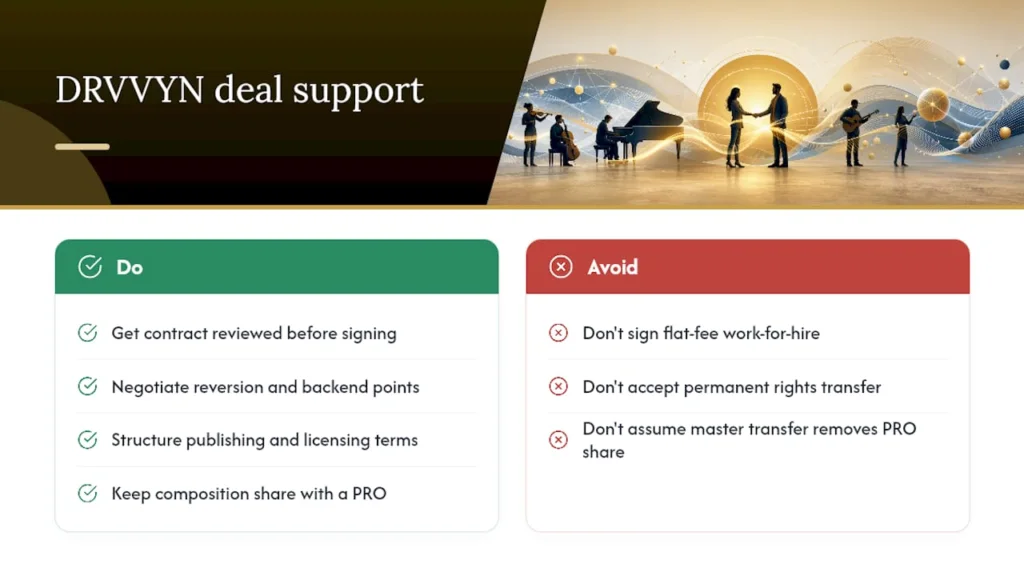
Rather than signing whatever a hiring party sends over, creators working with DRVVYN Sound get help identifying which clauses are negotiable, how to structure backend points or reversion language, and how to keep a composition share intact with a PRO even when the master changes hands. If you want a working example of how rights-managed publishing actually looks in practice, explore DRVVYN Sound’s music project management guide and see what a properly structured release process protects for the creator.
Sources
- 17 U.S.C. §101 — Definitions (work made for hire)
- Circular 30: Works made for hire (U.S. Copyright Office)
- Work For Hire | Morris Music Law
- Music licensing agreements and alternatives (practical guide)
FAQ
What is a work for hire music contract?
It’s an agreement where the hiring party, not the creator, becomes the legal author and copyright owner of the music from the moment it’s made, provided the work fits one of nine statutory categories and both parties sign a written agreement expressly saying so.
What is the 35 year rule in music?
Ordinary copyright transfers include a termination right letting creators reclaim their work after 35 years, but this right doesn’t apply to valid work-for-hire agreements, which permanently exclude that future reclaim option.
How much does it cost to hire a musician for an hour?
Rates vary widely by market, experience, and whether the session is union or non-union, and no single flat hourly rate applies industry-wide; what matters more than the rate is whether the session agreement includes work-for-hire language that affects ownership beyond just the performance fee.
Is there a job that pays you to listen to music?
Roles like music supervisor, sync licensing coordinator, and A&R involve critical listening as part of the job, but they’re evaluative positions tied to selecting or licensing music, not passive listening for its own sake.