

Music Business
8 Step Music Clearance Checklist for Indie Creators
8 step checklist music clearance for indie creators. DIY workflow aligned with U.S. Copyright Office guidance and publisher recordkeeping.
By DRVVYN · · 14 min read
If you used an existing recording or wrote melody that echoes someone else’s song, the music clearance process requires you to get written permission from every rights holder tied to that material before you release anything. The first move is simple: figure out exactly what you used. If you sampled actual audio, you need two separate permissions. If you re-recorded a melody or lyric yourself, known as interpolation, you may only need the publishing side cleared.
TL;DR:
- Clearing a sample or interpolation requires permission from both the owner of the sound recording and the publisher of the musical composition, with specific licenses needed depending on the use.
- Identifying all rights holders is crucial, as ownership is often split among multiple parties, and missing one can delay or block licensing agreements.
- The clearance process involves detailed steps, including precise identification of used material, building a request packet, tracking responses, and securing signed agreements before release.
- Costs vary based on the length, prominence, territory, and duration of the use, with popular or widely streamed tracks generally incurring higher fees.
- Maintaining organized documentation and considering licensing support can reduce risks, speed up negotiations, and prevent issues with unauthorized use or expired licenses.
1. What music clearance actually protects
Music clearance is the process of getting documented permission to use a piece of existing music in your project, whether that’s a sample, a cover, or a sync placement in a video. It exists because a song is never just one thing legally. The moment you drop in someone else’s audio without permission, you’re exposed to takedowns, lawsuits, and lost revenue the instant a platform’s detection system or a rights holder’s team notices.
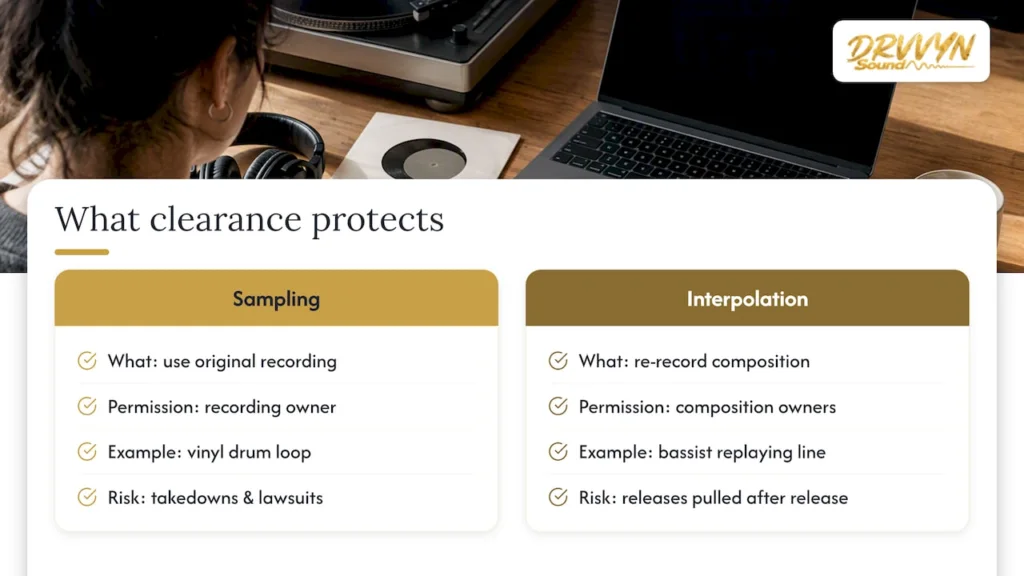
The difference between sampling and interpolating matters here, and it changes what you owe. If you lift the actual recorded audio of a drum break or vocal run, you’ve sampled it, and you need permission from whoever owns that recording. If you instead re-record a melody, chord progression, or lyric line in your own studio, with your own musicians, you’ve interpolated it, and you’re dealing only with the people who own the underlying composition.
A short example makes this concrete. Looping two bars of a vinyl drum break under your verse is sampling. Having your bassist replay a famous bassline note for note, with nobody touching the original recording, is interpolation. Mixing them up is the single most common mistake creators make, and it’s the one that gets releases pulled after the fact.
2. Master recording vs. musical composition: the two rights you must clear
Every recorded song carries two distinct copyrights, and you have to treat them as two separate negotiations. The musical composition covers the melody, lyrics, and chord structure. It’s owned by the songwriter and typically administered by a music publisher, and this is the right you clear through what’s called a sync or mechanical license depending on use. The sound recording, or master, is the actual captured audio: the specific performance, mix, and production. It’s usually owned by a record label or the artist directly, and you clear it through a master use license.
The U.S. Copyright Office is direct about this split: the law treats the composition and the sound recording as two legally distinct assets, and clearing a sample generally means getting permission for both, as laid out in its guidance on sound recording registration. Skipping one because you secured the other doesn’t protect you.
Which rights apply depends on what you did:
- Sampling audio needs both a master use license from the recording owner and a sync or mechanical license from the publisher.
- Interpolating a melody or lyric usually needs only the publishing side cleared, since you didn’t touch the original recording.
- Recording a cover typically falls under a statutory mechanical license for audio-only releases, though sync to video still needs separate permission.
Before you reach out to anyone, know who you’re contacting and what to send them. For the publishing side, you want the credited writers or their publisher, and you’ll need a project description, intended use, and distribution plan. For the master side, you want the label or rights administrator, and you’ll need the same details plus your release timeline. Our sampling explainer walks through how to spot which category your use falls into before you start making calls.
3. Step-by-step music clearance process (practical workflow creators can follow)
Once you know which rights you’re chasing, the actual clearance process follows a fairly predictable order. Skipping steps here is how creators end up with a track that sounds finished but can’t legally go anywhere.
- Pin down exactly what you used. Note the timecodes, isolate the stems if you can, measure the length of the clip, and be honest about how prominently it sits in your mix. A buried two-second texture and a hook that drives your whole chorus are treated very differently by licensors.
- Identify every rights holder tied to that material. This usually means the songwriter or writers, their publisher, and separately the label or artist that owns the master. Ownership is often split across several people, and missing one person’s share can stall the entire request.
- Build a clearance request packet. Include a short synopsis of your project, exactly how the music will be used, your release or distribution plan, your budget range, and any context that helps the licensor picture the final product. Rights holders decide based on intended use, project scale, and exposure, so give them something concrete to evaluate, a point the Film Independent guide to music licensing makes clearly when walking creators through the request process.
- Send the requests and track responses. Keep a simple log of who you contacted, when, and what they said. Follow up politely after a week or two of silence; publishers and labels field a lot of these and a quiet inbox is common, not necessarily a rejection.
- Negotiate the terms. Fees, territory, duration of the license, and exclusivity all move depending on your budget and how big your release is. Ask about limited-term or limited-territory options if a full all-media license is out of reach.
- Insist on a written agreement. A verbal yes from someone’s assistant is not a license. Get the terms in a signed document that spells out scope, duration, fee, and credit requirements before you move forward with mixing or release.
- Secure every signature before you distribute. If even one rights holder hasn’t signed off, you’re not cleared, and releasing anyway puts your whole project at risk.
- Keep every piece of documentation. Save the original request emails, quotes, drafts, and the final signed licenses somewhere organized. You’ll need this paper trail if a dispute ever comes up, or simply to track when a limited-term license expires.
Pro Tip:Start the clearance process the moment you finish a rough mix, not after mastering. Licensors move slowly, and a tight release deadline gives you no leverage to negotiate fees down.
Fragmented ownership is the detail that trips up most first-timers. A single sample can have four or five credited writers, each represented by a different publisher, plus a separate master owner. If even one of them says no, you may be blocked from using that sample at all, something the Film Independent guide notes is a routine hazard rather than an edge case. Build in time for that complexity rather than assuming one email will close the loop.
4. How to find rights holders and verify ownership
Finding the right person to ask is often harder than the negotiation itself. Start with the performing rights organizations: ASCAP, BMI, and SESAC maintain searchable databases of registered songwriters and publishers, and most credited writers show up there along with their publishing representation. Cross-check what you find against the U.S. Copyright Office’s own registration records, which serve as a public source of truth for who filed ownership claims and when.
A practical checklist for this stage:
- Search ASCAP, BMI, and SESAC repertoire databases for every credited songwriter and their publisher of record.
- Pull the sound recording’s label and distributor information from streaming metadata or the original release credits.
- Check Copyright Office registration filings when PRO listings are incomplete or outdated.
- Reach out through official publisher and label contact pages rather than social media, since those requests route to the right legal or licensing desk.
Our piece on ASCAP versus BMI breaks down how these organizations differ, which helps when you’re trying to figure out where a particular writer’s catalog actually lives. Clean metadata also makes this search faster; the field guide on music metadata for pitching from Playlist Pilot is a useful reference if you’re untangling credits on an older or obscure track.
When ownership is split into small fractional shares, or when a publisher simply goes quiet, escalate carefully. Try a second contact at the same organization, reach out to a co-writer’s publisher instead, or consider hiring a clearance researcher once you’ve spent real effort without a response. A researcher’s fee is usually worth it once a single uncleared sample is holding up your entire release schedule.
5. Negotiating fees and timeline: realistic costs and what affects price
There’s no fixed price sheet for music clearance, because licensors price based on how you plan to use the work, not a flat rate. The core levers are length of the clip, territory of release, duration of the license, and how prominently the music sits in your project. A song playing faintly in the background of a short clip costs far less to clear than the same song used as your opening theme across a wide release.
Festival-only or limited-term licenses tend to be the cheapest entry point for creators working with tight budgets, and quotes from licensors are frequently valid only for a short window, a detail the Documentary flags for filmmakers navigating this exact trade-off. All-media sync rights, which cover broad distribution across formats and territories indefinitely, sit at the other end and cost considerably more.
A well-known or heavily streamed track almost always commands a higher clearance fee than a lesser-known one, since labels and publishers price partly on the recognition value their catalog brings to your project, a pattern confirmed across the licensing examples in the Film Independent guide.
A few ways to bring the cost down without walking away from a track you want:
- Ask about festival-only or limited-territory rights instead of a full all-media license.
- Request a shorter license term with an option to renew if your project gains traction.
- Offer a songwriter or producer credit in exchange for a reduced upfront fee.
- Propose a backend royalty split instead of a large flat payment, which can appeal to smaller independent catalogs.
None of these guarantee a lower number, but they give you something to negotiate with beyond a flat cash offer, and licensors are often more flexible than their first quote suggests.
6. Alternatives to traditional clearance and their trade-offs
Full clearance isn’t always necessary, and knowing the alternatives can save you both time and money if you understand what each one actually covers.
- Interpolation lets you re-record a melody or lyric yourself, which generally means only the publishing side needs clearing since no original master audio is used, a distinction the Copyright Office’s guide for musicians lays out clearly.
- Statutory mechanical licenses cover certain cover recordings for audio-only release, but they don’t extend to syncing that cover to video or any other visual medium.
- Beat-store licenses and royalty-free libraries can be fast and affordable, but the fine print matters. Terms labeled “premium” or “unlimited” can still carry real restrictions on commercial use, and some beats contain uncleared embedded samples the seller never disclosed.
Read every license agreement before you build a track around it, and treat a cheap beat-store purchase with the same scrutiny you’d give a traditional clearance request. Our rundown of why producers sample old records covers the creative reasoning behind sampling, but creative intent never substitutes for a signed license.
7. Registering your own work and documentation basics with the Copyright Office
Once your project clears everything it needs to, register your own compositions and recordings so your side of the work is protected too. Register a musical composition when you finish writing it, and register the sound recording separately once a final master exists. They are two distinct filings because they’re two distinct assets, the same split that governs clearance in the first place.
The Copyright Office offers group registration options that let you file multiple works together, which cuts down on paperwork for artists releasing several tracks close together, detailed in its circular on registering musical compositions and sound recordings.
- Submit the correct deposit material, typically a complete audio file or lyric sheet depending on what you’re registering.
- Use group registration when filing multiple songs or recordings from the same release cycle.
- Keep your registration certificates on file as primary evidence if you ever need to prove ownership in a dispute.
Registration isn’t just paperwork. It’s the evidence that holds up if someone else samples your work without asking, giving you the same standing you’re expected to respect when clearing someone else’s catalog.
8. DRVVYN Sound’s practical checklist and recordkeeping workflow
A clean clearance file saves you more stress than any single negotiation tactic. Before distribution, confirm you’ve identified every sample and interpolation in the track, secured signed licenses for both composition and master where needed, and logged every rights holder’s contact details.
- Keep every quote, draft agreement, and final signed license in one labeled folder per project.
- Save email threads showing the full negotiation, not just the final agreement.
- Note each license’s term length and territory so you know exactly when it expires.
- Watch for beat-store contracts with vague “unlimited use” language that still restricts commercial release or monetization.
Pro Tip:If a beat-store or producer agreement won’t clearly state whether it includes an exclusive master use license, treat that silence as a red flag and get it clarified in writing before you build a release around it.
When a contract’s terms feel deliberately vague, that’s the moment to bring in a music attorney rather than guessing.
What the clearance process actually rewards
Most advice on this topic treats clearance like a legal hurdle to survive, something you grit your teeth through once and never think about again. That framing undersells what’s actually at stake. The creators who treat clearance as part of their creative process, not a tax on it, end up with cleaner catalogs, faster negotiations, and fewer surprises down the line.
The conventional wisdom oversells fair use as a safety net. It isn’t one. A rights holder can say no regardless of how transformative you think your use is, and a court may still find against you even after you’ve argued it. Treat fair use as a legal defense of last resort, never a clearance strategy.
If there’s one thing to prioritize first, it’s documentation. Not the negotiation, not the fee, the paper trail. A disorganized clearance file is where disputes and expired licenses quietly sink projects months after release, long after anyone remembers what was agreed to on a phone call.
— DRVVYN Sound
When it makes sense to bring in licensing help
DIY clearance works well when you’re chasing one or two samples with clear ownership. It gets harder fast once you’re juggling fractional splits, unresponsive publishers, or a release timeline that can’t wait on slow negotiations. Licensing support, including rights negotiation and publishing administration, is available for creators who’d rather hand off that workload. Visit our licensing page to discuss your project and get a quote.
Sources
Before sending a single clearance request, read the Copyright Office’s circular on sound recording registration and its introduction to sampling and interpolation for musicians. For a practical, production-side view of the workflow, the Posthive blog’s overview of music clearance offers useful grounding in how working productions handle the process day to day.
- Circular 56: Copyright Registration for Sound Recordings (U.S. Copyright Office)
- The Filmmaker’s Guide to Music Licensing (Film Independent)
FAQ
How much does music clearance cost?
There’s no standard price since licensors set fees based on how the music will be used, including its length, territory, license term, and how prominently it appears in your project. A famous, heavily streamed track typically costs more to clear than a lesser-known one, as licensing guidance from Film Independent explains.
Why do artists have to get songs cleared?
Clearance exists because the law treats the musical composition and the sound recording as two separate, protected assets, each with its own owner. Releasing music that samples or interpolates existing work without permission from those owners, as outlined in Copyright Office guidance, risks takedowns, lawsuits, and lost revenue.
What is the 80/20 rule in songwriting?
Definitions of this vary across the industry, and it isn’t a standard legal or Copyright Office term. It’s commonly used informally to describe splitting songwriting credit when one contributor’s input is considered more significant, but it carries no official clearance or copyright weight.
What is music clearance?
Music clearance is the process of getting written permission from every rights holder tied to a piece of existing music before using it in a project. That generally means securing permission for the musical composition, the sound recording, or both, depending on whether you sampled audio or re-recorded a melody yourself.