
Music Business
Instagram Music Licensing: What You Need to Post Legally
How music licensing works on Instagram in the U.S.: personal vs. business accounts, sync and master rights, what to ask for in writing, and how to stay safe.
By DRVVYN · · 10 min read
Instagram music licensing comes down to one question: who is posting, and why? If you are a private person adding a song to a Story, Instagram’s built-in library is designed for you. If you are a brand, a creator working with sponsors, or anyone delivering a video to a client, the song you love in the search bar may not be yours to use. In that case you need permission from the people who own the song and the people who own the recording.
This guide walks through that difference slowly, the way you would want it explained before a Reel gets muted or a campaign gets pulled. It is written for creators, marketers, and independent artists alike.
TL;DR
- Instagram’s in-app music library is meant for personal, noncommercial posting. GEMA, the German collecting society, states that non-private, commercial use is not allowed, even from a private account.
- In the U.S., a Reel with a commercial song usually needs two permissions: a sync license for the composition and a master-use license for the recording. The Copyright Office confirms there is no compulsory license for either.
- Business accounts typically see a smaller catalog, often described as about 14,000 tracks. Availability changes by account type, territory, and rights-holder deal, so check your own app.
- Get rights in writing, and name every destination up front: organic posts, paid boosts, client use, reposts, website embeds.
Why a song in Instagram search is not always a song you can use
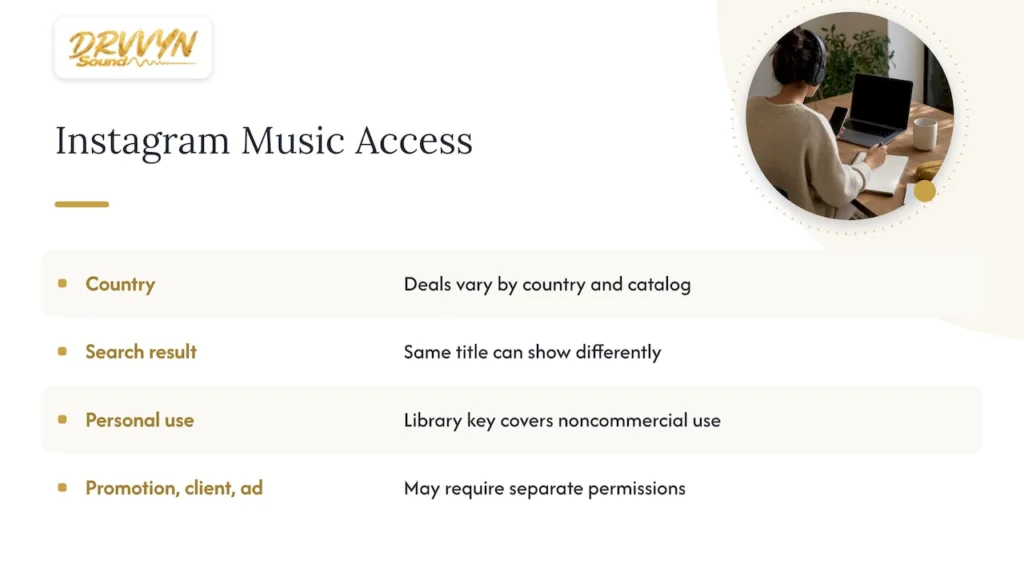
A song surfacing in Instagram’s audio browser feels like a green light. It is not a promise. Instagram’s deals with labels and publishers cover specific uses by specific kinds of accounts, and those deals vary by country and by catalog.
Soundstripe’s recent explainer on the Instagram music library makes the territorial point well: music licensing is negotiated territory by territory, so a label can license a recording to Meta for one country and not another. That is why two people can search the same title and see different results.
Think of it like a key that opens one door. The library key opens the door marked “personal, noncommercial.” The moment your post is promoting a product, delivering a client’s content, or running as an ad, you are standing at a different door.
Personal, creator, and business accounts
Instagram’s catalog is not identical for every account. According to Universal Music for Creators’ May 2025 overview, access differs among personal, creator, and business accounts, and business accounts were described as having the smaller Meta Sound Collection of roughly 14,000 songs and sounds rather than the full licensed library. A 2026 guide from Foxi Music describes the same split: the large catalog for personal and creator accounts, a cleared commercial set for business accounts.
Treat those numbers as a snapshot. They move. What does not move is the logic behind them.
| Situation | What the in-app library covers | What to do |
|---|---|---|
| Private person, personal Story or Reel | Designed for this | Use the library, follow Instagram’s rules |
| Creator account, unsponsored content | Usually available, but commercial use is still a separate question | Avoid anything that looks like advertising |
| Business account, organic post | Smaller commercial collection | Stay inside that collection or license directly |
| Paid boost, ad, or branded content | Do not assume coverage | Get written rights for paid use |
| Client deliverable or agency work | Do not assume coverage | License the music for the client’s use |
Switching account type will not unlock a song either. Availability also depends on territory and the rights-holder’s agreement, so changing your settings cannot guarantee access to every track.
Two copyrights inside one song
This is the part most people discover too late. A finished track contains two separate pieces of ownership:
- The composition: the melody, chords, and lyrics. Songwriters and their publishers own it.
- The master recording: the specific recorded performance. Usually the artist, a label, or the producer owns it.
When you pair a song with moving images, you need permission for both. The Copyright Office’s educational material explains that synchronization covers pairing the composition with visuals, while a master-use license covers the recording. It also notes that neither right has a compulsory license, so commercial users have to negotiate with the owners or their representatives. The mechanical compulsory license you may have heard about applies to phonorecords, not to online video.
That means a few common habits do not protect you:
- Buying or downloading the track
- Crediting the artist in the caption
- Using only a short clip
- Saying “no copyright intended”
Foxi Music’s guide makes the same point about clip length: there is no 10-second or 30-second rule that makes unlicensed music safe.
If you want a deeper look at the kind of one-off permission a video might need, our guide to the needle drop license explains what rights are involved and how they are usually scoped.
What happens when you get it wrong
For most people the first consequence is small and quiet: the audio is muted, a Reel is removed, or reach drops. For brands the stakes rise. Nixon Peabody’s copyright team points out that overlaying sound onto promotional videos, or reposting content already embedded with sound, requires certain licenses and permissions even when the sound came from Instagram’s song library.
That is the point worth sitting with. The library did not fail you. The use simply moved outside what the library was built for.
If a Reel of yours is muted or taken down, the calm response is to stop reposting it, check the account type and the use, and decide whether to replace the audio or license the track properly. If real money or a contract is involved, talk to an entertainment attorney who handles music clearance. This article is general information, not legal advice.
How to license music for a commercial Reel
Here is a process that holds up whether you are a solo creator or an agency.
- Define the use before you pick the song. Write down where the video will live: Reels, Stories, feed video, a paid boost, the client’s own channels, your website. Videos that start as Instagram posts often end up on a site, on TikTok, or in paid media. Nixon Peabody flags this expansion as a common trap, so plan the destinations now.
- Identify both owners. Find the publisher or songwriters for the composition and the label or artist for the master. For independent artists this is often the same person, which makes things simpler.
- Ask for the scope in writing. Request rights for the platforms, organic and paid use, client or brand use, territory, term, edits, and reposting.
- Check for extra layers. Lyrics, voiceovers, samples, interpolations, and name or image elements can each need their own permission.
- Do not publish until both sides are confirmed. A yes on the master with silence on the composition is not a yes.
- Keep the paperwork. Save the signed license, the exact approved recording, and the date. If a platform flags the post later, you can answer in minutes instead of days.
What your agreement should spell out
A short checklist you can paste into an email:
- Licensed track title, version, and length
- Platforms and formats (Reels, Stories, feed, ads)
- Organic only, or paid and boosted use as well
- Who may use it: you, your client, or both
- Territory (U.S. only or worldwide)
- Term (months, years, perpetual)
- Whether you may edit, loop, or cut the track
- Fee and credit requirements
The more vague a license is, the more it tends to disappoint you when a post performs well.
Royalty-free music, explained honestly
“Royalty-free” does not mean free of charge. It usually means you pay once, or subscribe, and then use the track without ongoing per-use royalties. Providers such as Artyfile describe their model as a one-time payment for permanent use, not a free download.
The terms still matter. Read whether the license covers commercial use, paid ads, client work, and every platform you plan to publish on. A cheap track that only allows personal use will not protect a brand campaign.
Original audio is the other safe route: your own voice, your own beat, a track you wrote and recorded, or music from an artist who grants you a license directly.
A note for independent artists posting their own music
If you are the artist, the licensing question flips. You are not the person asking permission; you are the person others will ask. A Reel built on your song can bring streams, but only if people can find it and you can answer a licensing request quickly.
We suggest keeping a simple rights packet for every release:
- Songwriter names and splits
- Publisher and PRO details (our comparison of ASCAP vs BMI can help you choose)
- Master ownership
- Producer and sample clearances
- The exact approved version of the recording
When you have that, saying yes to a brand takes an afternoon, not a month. Trying to reconstruct ownership after a Reel takes off is far harder.
And if you are trying to turn attention into listeners, remember that a Reel is one door among many. Our pieces on the role of social media in music careers and email lists versus social media look at what to build so a viral moment does not vanish with the algorithm. If you are planning rights for reposts and cross-platform campaigns, this guide to growing a music following on social media is a useful companion.
Our perspective
We make alternative R&B, cinematic visuals, and playlists, so we sit on both sides of this conversation. We are the people who write the songs and cut the visuals, and we are also people who want to put music under a moving image.
What we have learned is that the most emotional use of a song is also the most fragile one. A slow, late-night track under a quiet Reel can change how a stranger feels about a brand or a story. That is exactly why it deserves a real agreement, not a hopeful guess. The song carries weight; the paperwork lets it carry that weight without cracking.
We think music licensing works best when it is treated as part of the creative process, not a gate at the end. Choose the mood, choose the track, and ask early. Independent artists are usually easy to reach and glad to be asked. A clear message that names the platform, the length of use, and the audience gets a faster, warmer answer than a vague request.
— DRVVYN Sound
Licensing music with DRVVYN Sound
If you are looking for cinematic, emotionally driven R&B for a video, a brand piece, or a visual project, you can start with our licensing page. We do not publish a price there, so reach out with your use, platforms, and timeline and we will take it from there. For artists who want help organizing releases and rights, our music project management guide is a good place to begin.
Frequently asked questions
Can I use any song from Instagram’s library on my business account?
Not necessarily. Business accounts have typically been given a smaller collection cleared for commercial use, and availability varies by territory and rights-holder deals. If a song is missing, that is usually a licensing boundary, not a glitch. Check what your own account shows, and license the song directly if you need it.
Do I need a license for a short clip of a song?
Yes, in most commercial cases. Licensing applies to snippets and samples as well as whole songs, as Universal Music for Creators notes. There is no safe length that removes the need for permission.
What is the difference between a sync license and a master-use license?
A sync license covers the composition, meaning the song itself, when paired with video. A master-use license covers the particular recording. For a commercial Reel you normally need both, and each comes from its own owner.
If I boost a Reel, does the music still count as personal use?
Treat it as commercial. Paid promotion, branded content, and client deliverables are separate clearance questions, so confirm that your license names paid use before you boost.
Is royalty-free music safe for Instagram?
It can be, if the license covers your actual use. Read the terms for commercial use, ads, client work, and every platform you plan to post on. Keep the receipt or license file with the project.
Sources
- GEMA: using Instagram’s music library for a Story or Reel
- U.S. Copyright Office: How Songwriters, Composers, and Performers Get Paid
- Universal Music for Creators: Cross-Platform Music Licensing in 2025
- Nixon Peabody: Embedding videos with music? You may need a sync license
- Foxi Music: Can You Use Copyrighted Music on Instagram?
- Artyfile: Royalty-Free Music for Instagram and Reels