

Artist Strategy
8 Slide Artist Pitch Deck Gatekeepers Actually Open
Copy a ready 8 slide artist pitch deck and one sheet gatekeepers actually open. Slide by slide template, checklist, and an annotated example.
By DRVVYN · · 11 min read

An artist pitch deck, often called an EPK, is a scannable, playable sales document whose first job is to make the gatekeeper’s decision easy. The rule that matters most: lead with playable media and contact information, because every other detail is secondary to that first listen. The Big 4 anyone reviewing your work needs fast are a hero photo, a short bio, playable audio or video, and a clear way to reach you.
TL;DR:
- Embedding live performance clips and contact info at the top of your pitch deck increases chances of quick engagement from gatekeepers.
- Use hosted, playable links over large attachments, and regularly update streaming metrics, press quotes, and videos to reflect your current momentum.
- Tailor your core assets and their order depending on whether you’re targeting venues, labels, managers, or festival programmers.
- Keep filenames and metadata consistent and current to ensure your assets are organized, easily findable, and ready for swift sharing.
- A curated selection of assets that answer the gatekeeper’s key questions beats a comprehensive portfolio and makes it easier to get quick approvals.
The core elements every pitch deck needs
A gatekeeper rarely reads an EPK from top to bottom. They scan it, and industry guidance notes decision-makers evaluate materials in about a minute and a half, which means every element has to earn its place.
Your hero photo sets the tone before a single word gets read, so pair it with one line that names your genre and your angle. Your bio should run two sentences: who you are and what you have done recently that matters, written with the same care we talk about in how to write an artist bio that actually gets read. Audio and video need to be embedded, not linked off to a third page, and a short live performance clip tells a booker more about your stage presence than any photo could.
- Hero photo and positioning: one strong image, one line naming your genre and lane.
- Short bio: two sentences covering identity and your most relevant recent highlight.
- Playable audio and video: embedded, not just linked, with a live clip if you’re pitching venues.
- Contact and booking info: a direct line, visible without scrolling.
- Supporting proof: press quotes, recent shows, streaming numbers, and a technical rider for anyone booking a stage.
Each of these answers a specific question a gatekeeper is silently asking, and skipping one just means they have to go hunting for the answer somewhere else.
A slide-by-slide template you can copy and adapt
Think of your EPK as a sequence of quick answers, not a narrative. This order works whether you’re building a hosted page or a simple deck.
- Hero slide: your name, your genre, one striking photo, one tagline.
- Metrics snapshot: streaming numbers, audience size, recent growth, kept brief.
- Press and quotes: one or two pull-quotes, sourced and dated.
- Video: a live performance clip, ideally under five minutes.
- Audio: one full-length streamable track embedded directly.
- Bio: your two-sentence summary, no longer.
- Technical rider: stage, sound, and setup needs for anyone booking you live.
- Contact: booking email, management contact, and social links.
Keep each screen lean: a two-sentence bio, a 300-second live clip, and metrics that fit in a single glance rather than a paragraph.
Pro Tip:Build mobile-first. Most gatekeepers open your link on a phone, so put play buttons within thumb’s reach near the top, not buried under scrolling text.
Choosing the right format and sharing it well
The container matters almost as much as the content. A hosted web page with embedded players tends to outperform static documents because it loads fast and plays instantly, without forcing anyone to download anything first. Industry guidance recommends hosted, playable links over large attachments, and that preference shapes how you should package everything you send.
- Hosted EPK page: the default choice, since embedded players remove friction entirely.
- One-sheet PDF: appropriate for quick email attachments, and a one-sheet is considered the most versatile single asset when you need something fast and portable.
- Shared folder: only when specifically requested, organized with clear, consistent file names.
- Preview testing: open your own link on a phone before sending it, because a broken embed undoes everything else.
Keep attachments light. Unsolicited files that strain someone’s inbox get deleted before they get opened.
Rights, metadata, and business-readiness checklist
Professional partners move faster when the paperwork is already visible, not something they have to request. A clean rights section signals you have done this before, even if it is your first real pitch.
- Ownership clarity: state whether you control the master, the publishing, or both.
- Identifiers: include your ISRC, UPC, writer splits, and PRO affiliation where relevant.
- Licensing terms: state plainly whether a track is available for needle-drop use, non-exclusive licensing, or exclusive placement.
- Supporting documents: link to or store contracts and splits somewhere a partner can request access easily.
If you’re still deciding how licensing terms should read, our breakdown of what a needle drop license actually covers and our comparison of ASCAP versus BMI for songwriters both clarify language worth having ready before anyone asks.
Pitching workflow: email copy, link placement, and follow-up timing
The email around your EPK does real work. A subject line that names the opportunity, followed by a one-line hook and your EPK link in the first sentence, gets more opens than a long introduction that buries the ask.
- Subject line: specific and short, naming the opportunity or event.
- First line: one hook sentence, immediately followed by your EPK link.
- Link over attachment: send the hosted link first, and only attach a one-sheet if someone asks for it directly.
- Follow-up: wait roughly a week, then send one short nudge referencing the same link.
- Track response: if your hosting platform shows plays or opens, use that data to judge whether to follow up again or move on.
A reply rate improves less from clever copy and more from removing every reason to hesitate before clicking play.
A practical example and checklist you can use today
A useful way to see this assembled is through an annotated one-sheet. Fields might read: Artist name and genre tag (“DRVVYN, alternative R&B”), one-line hook (“cinematic, emotionally driven R&B for listeners seeking depth”), recent highlight (a release, a feature, a milestone), and contact (a direct booking or licensing email). A track page like Lost in Her Rhythm (Intimate Cut) shows how embedded audio and a clear presentation work together without extra clutter.
- Filenames: keep them consistent, such as
01_HeroPhoto_Name_2026.jpgor02_OneSheet_Name.pdf, so nothing gets lost in a folder. - Metadata: match filenames to what’s inside, since a mislabeled file costs you a reply.
- Update cadence: refresh metrics and press quotes every few months, and swap in new video the moment you have stronger footage.
Pro Tip:Treat your filenames like your handshake. A booker’s first impression of your organization often comes before they’ve even opened the file.
Tailoring your deck for venues, labels, and managers
The same core assets serve different audiences, but the emphasis shifts depending on who’s reading. A venue booker cares most about your live performance clip, your technical rider, and proof you can draw a crowd, so put the video and rider near the top when pitching a stage. A label or A&R contact weighs streaming trajectory and songwriting more heavily, so your metrics snapshot and a strong studio track deserve the lead position instead.
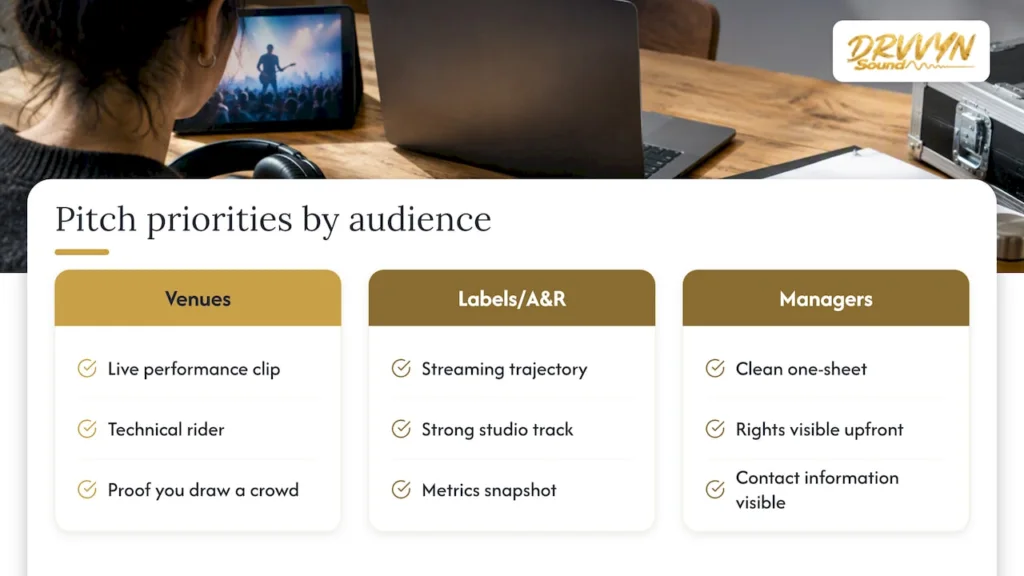
Managers evaluate differently again. They’re assessing whether you’re organized enough to be worth their time, so a clean one-sheet with your rights and contact information visible upfront often matters more than any single creative asset. If you’re approaching a brand partnership or sync opportunity, licensing terms belong near the top rather than buried at the end, since that’s the first question a licensing contact will ask.
The content stays largely the same across all four; the order changes. Keep one master version with everything included, then reorder or trim sections for each specific pitch rather than rebuilding from scratch every time. This is part of why a shared asset library helps, something our guide to music project management workflows covers in more detail for artists juggling multiple pitch variants at once.
One more distinction worth noting: festival programmers often want to see crowd engagement and past festival experience specifically, not just general streaming numbers. Festival booking rhythms tend to follow predictable announcement cycles, so timing your outreach around those windows, with a deck tailored to show festival-specific proof, tends to land better than a generic pitch sent at the wrong moment.
Showing social proof without overloading the page
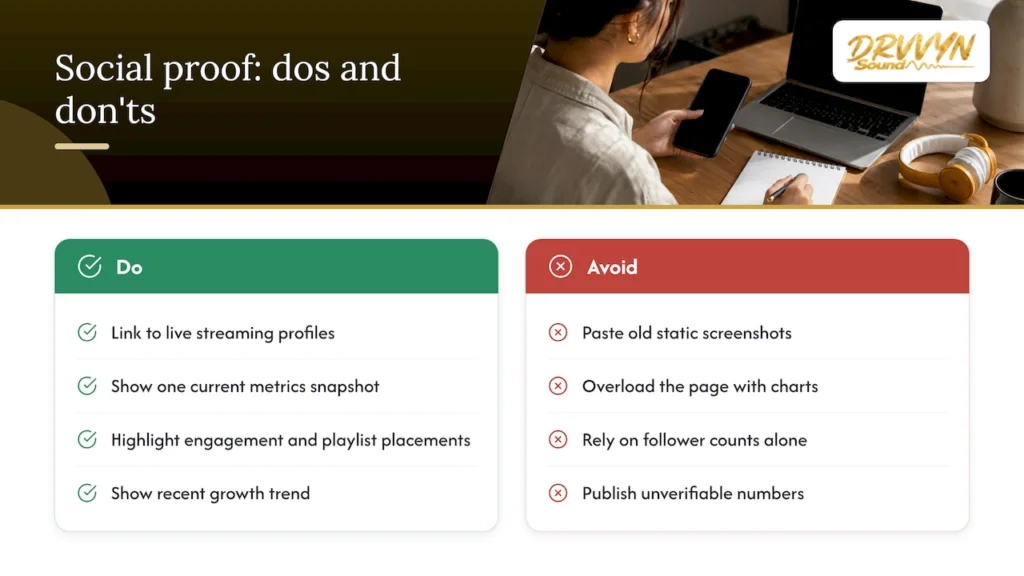
Social and streaming numbers earn their place in an EPK only when they’re current and easy to verify. A static screenshot from eight months ago reads as neglect, not proof, so link directly to your streaming profiles and social accounts rather than pasting in numbers that go stale the moment you publish them.
Our piece on turning social media attention into a real music career walks through which metrics actually signal momentum to someone evaluating you, which matters because not every number is equally persuasive. Follower counts alone say little; engagement rate, playlist placements, and recent growth trajectory say more.
Keep this section compact. A single metrics snapshot near the top of your deck, with a link to live, auto-updating stats where your hosting platform supports it, does more work than a page full of charts. Gatekeepers want confirmation you’re active and growing, not a full analytics report.
Common mistakes that cost artists the opportunity
The most frequent misstep is treating an EPK as a portfolio instead of a sales document, packing in every track and photo you’ve ever made rather than the handful that answer the question at hand. One veteran framing puts it plainly: curate so the recipient can say “yes” quickly, rather than making them dig for it.
Other recurring mistakes: attaching large files instead of linking, leaving contact information buried at the bottom, letting stats go stale for months, and skipping the technical rider entirely until a venue asks for it at the last minute. A broken embed is its own category of mistake, one easily avoided by testing your own link on a phone before you send anything.
The fix for nearly all of these is the same: cut what doesn’t directly help someone decide, and make sure what remains actually works when clicked.
Keeping your pitch deck current
An EPK that was accurate six months ago can quietly become a liability if nobody updates it. Streaming numbers shift, press quotes age, and a stale metrics snapshot undercuts the exact impression you’re trying to create.
Set a simple cadence: refresh numbers and swap in new press whenever something notable happens, and do a full review every few months even if nothing major has changed. Replace video the moment you have stronger live footage, since an outdated clip undersells where you actually are now. Treating the EPK as a living sales tool rather than a one-time project is the guidance that holds up best across the industry, and it’s the habit that separates artists who get booked repeatedly from those who send one pitch and wonder why it stalled.
Why curation beats a complete portfolio every time
The strongest pitch decks aren’t the fullest ones. Choosing the handful of assets that answer the gatekeeper’s real question beats showing everything you’ve ever made. Operate with a simple mindset: make the yes easy. Spend real effort on design, but match it with equal effort on keeping your rights information and contact details ready to go.
— DRVVYN Sound
Looking for production or licensing support
If you’ve built your deck and need the assets inside it to carry more weight, some teams work on original music production, visual media, and licensing for artists who want their catalog pitch-ready. We handle the creative side so your next EPK has stronger material behind it, not just a better layout. Explore licensing and production support when you’re ready to strengthen what you’re pitching.
FAQ
What is an artist pitch deck or EPK?
An artist pitch deck, or electronic press kit, is a concise business document built to help bookers, labels, or brands decide quickly whether to work with you. It typically includes a hero photo, a short bio, embedded playable audio or video, and contact information, all organized for fast scanning.
How long should an artist EPK be?
There’s no fixed page count, but the goal is brevity: a one-sheet summary plus a hosted page with embedded media covers most needs. Industry guidance treats the one-sheet as the most versatile single document precisely because it forces you to prioritize.
Should I send a link or an attachment?
Send a hosted link whenever possible, since decision-makers tend to prefer playable links over large unsolicited attachments. Reserve a one-sheet PDF attachment for cases where someone specifically requests it.
What rights information should I include in my pitch deck?
Include whether you control the master and publishing, your ISRC and UPC identifiers, writer splits, and your PRO affiliation, along with a clear statement of licensing availability. This lets a licensing or sync contact move forward without needing to ask follow-up questions.
How often should I update my EPK?
Refresh your numbers, press quotes, and video clips every few months, or sooner whenever something notable happens, such as a new release or a strong live performance. An EPK that reflects outdated momentum can undercut an otherwise strong pitch.
Sources
- How to Make an EPK (2026 Complete Guide) – Artist Results
- How to Create an Electronic Press Kit in 2026 (EPK Guide) | Tools 4 Music
- The EPK Playbook – by Joel Gouveia – The Artist Economy